
Dropshipping fulfillment is the work of checking an order, obtaining the right stock, picking and packing the items, handing parcels to a carrier, updating tracking and resolving delivery or return problems. A supplier or fulfillment partner handles the physical goods. The retailer manages the offer and the customer’s experience of that work.
The process starts before a warehouse prints a label and continues after a parcel leaves it. A paid order needs both a delivery plan and someone responsible for exceptions. Without those, a store can accept sales faster than its suppliers can turn them into correct shipments.
This article follows the physical order through that process. The broader dropshipping business overview explains how fulfillment connects with sourcing, pricing and customer acquisition.
01
What the fulfillment partner does and what you still own
A dropshipping supplier may hold products, receive your order, select the items, pack them and ship directly to the buyer. A separate fulfillment company may perform that work using stock bought from another supplier. Shopify’s fulfillment overview describes the customer-to-retailer-to-supplier order flow; the actual division of work depends on your arrangement.
Before accepting orders, agree who performs each task and what completion looks like:
| Task | What you need to know |
|---|---|
| Stock acceptance | Who confirms that the exact variant and quantity can be supplied? |
| Picking and packing | Who checks the items and follows the agreed packaging instructions? |
| Shipping | Who buys the service, arranges collection and supplies tracking? |
| Customer problems | Who investigates, who can approve a replacement and who contacts the buyer? |
| Returns | Where goods go, who inspects them and when any supplier credit becomes due |
The supplier’s agreement does not answer every customer-service question. If a supplier is slow to reply, the customer still needs information from the store where they purchased. Give your team a deadline for escalating unanswered requests and a person authorized to decide the next step.
Be precise about provider names, too. A manufacturer that sells cartons wholesale may not be equipped to pick one unit for one consumer. An agent may coordinate suppliers without storing goods. A warehouse may pack perfectly but have no role in product sourcing. The agent, supplier and 3PL comparison explains those different responsibilities.
02
Choose how the products will reach the packing bench
Three common arrangements put different constraints on the same order. Choose the one that fits your demand, cash and product requirements rather than treating them as identical services.
Supplier-direct fulfillment
The supplier holds the products and fulfills individual orders as you send them. This can limit the inventory you purchase in advance, but you need to understand whether its stock is shared across sellers and how quickly it confirms orders.
Ask whether the supplier accepts your SKU quantities, destination countries, parcel instructions and expected order pattern. A catalog listing alone cannot confirm any of those conditions. Begin with the relevant dropshipping supplier options and qualify the actual arrangement behind the listing.
Stock allocated to a fulfillment warehouse
You buy or arrange a defined allocation, and a warehouse receives, stores and ships it. That can make availability and packing more controllable, but receiving discrepancies, storage fees and unsold units become part of the decision. A purchase order is not proof that the warehouse has received usable stock.
Reconcile the receipt by SKU and condition before making the units sellable. The inventory management guide explains why physical stock, reserved quantities and available units must be distinguished. For a business considering stored inventory, warehousing and 3PL services are a separate service discussion from supplier-direct ordering.
Products made after purchase
Print-on-demand or customized products add production ahead of picking and shipping. The order may need artwork, personalization or an approved specification before work begins. Ask when changes stop being possible and which production defects qualify for a remake.
Keep production time in the customer’s delivery estimate. A carrier service that is fast after collection does not remove the time required to make the product. Shopify’s supply-chain explanation is useful for identifying the parties involved; your supplier agreement should establish the specific handoffs.
03
Check the order before someone picks it
Begin with an order that is ready for fulfillment. Confirm its payment and review status under your store’s process, the exact variant, quantity and delivery address. Resolve a missing apartment number or a shipping service that cannot serve the destination before the package is prepared.
The supplier needs an unambiguous instruction. Send the supplier SKU rather than relying on a product title that might describe several models. Preserve the order reference so you can match later updates to the original request.
A useful pre-pick check covers:
- The correct supplier SKU, including size, color or model.
- The quantity accepted at the location that will ship it.
- The customer’s usable delivery address and contact details where required.
- The shipping service and any restrictions on the goods.
- The approved packaging version and included accessories.
If the requested item is unavailable, hold the affected work and determine the customer’s options. Do not silently replace an unavailable variant with another product. A substitute can have different compatibility, value or safety characteristics even when it looks similar.
Order transmission and supplier acceptance should be distinguishable. If a request has no clear outcome, investigate before sending another purchase. The integration and retry mechanics belong in automated dropshipping fulfillment; the physical process still needs a correct, accepted instruction to work from.
04
Pick the exact item, then pack for the actual journey
Picking means retrieving the ordered items from stock. Packing means checking and preparing those items for shipment. Shopify’s pick-and-pack explanation separates those activities; combining them into one status in a supplier portal does not remove either task.
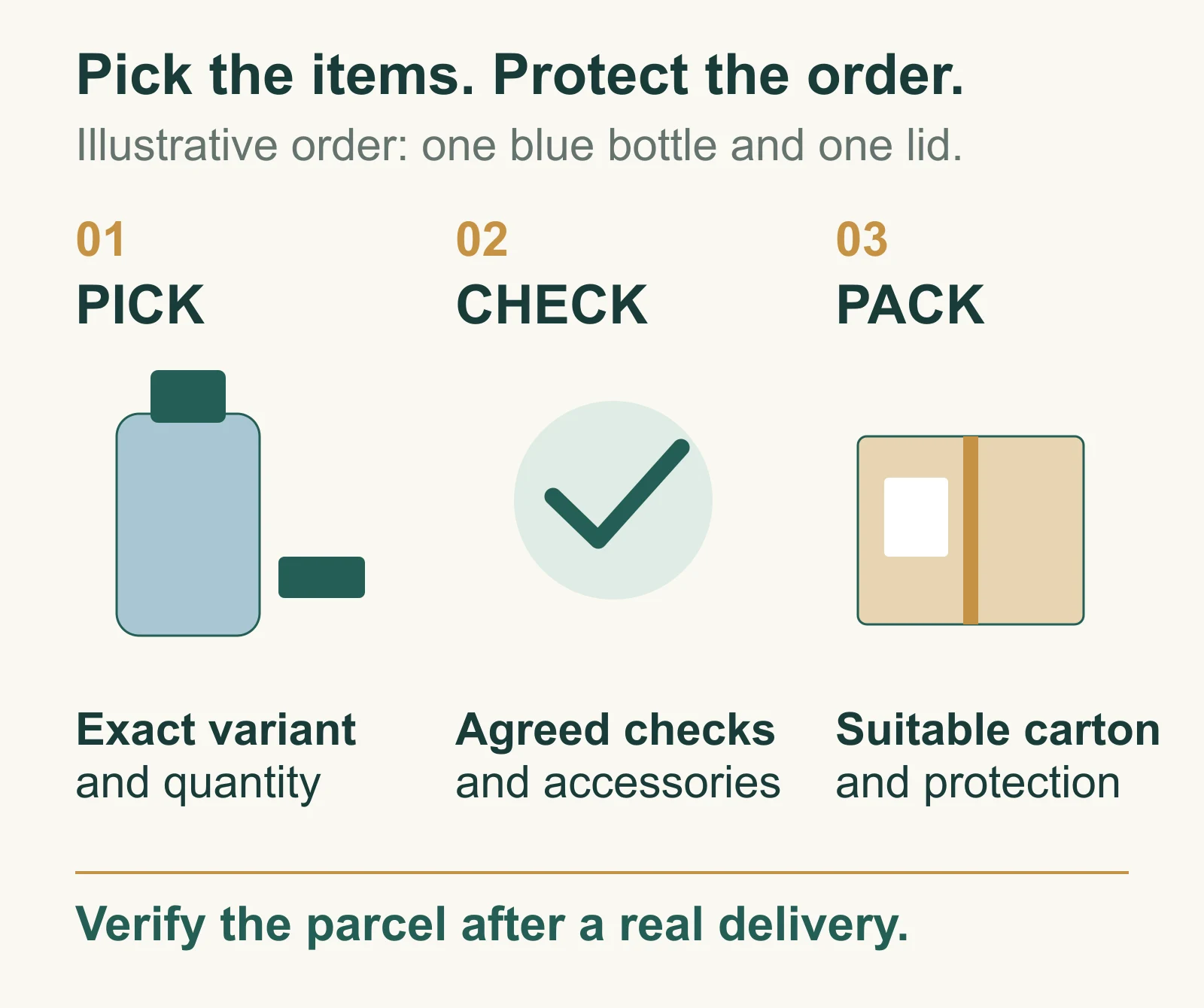
Consider an illustrative order for one blue bottle and one replacement lid. The picker must identify the correct bottle variant and a lid that fits it, then verify both quantities. A similar-looking lid in the next bin could turn a complete-looking parcel into an unusable order.
Agree on the inspection that matters
Specify the checks the partner should perform rather than requesting “good quality.” For this bottle order, the agreed checks might cover visible damage, the right color, correct lid model and the presence of any listed accessory. Those are illustrative checks, not a product-safety certification or a guarantee against hidden defects.
Define how failures are recorded and what happens to the item. A damaged bottle should not rejoin sellable stock simply because the order was canceled. Use the quality-control article to define a fuller inspection brief where the product warrants it.
Protect the product and the purchase experience
The packer needs a suitable carton or mailer, protection for vulnerable parts and a way to prevent loose items from damaging each other. Check the packed dimensions and weight because packaging changes can affect the shipping service and charge.
Confirm which inserts, invoices and promotional materials are allowed. Supplier branding is not automatically removed just because an order is dropshipped. If you require a particular packing slip or insert, provide an approved version and check it in a real sample parcel.
Review the packaging after an actual delivery. An attractive box that arrives crushed, leaks or leaves a small part hidden in discarded filler has failed its job. The packaging guide covers the choices more closely; here the objective is a complete order that survives the route and is easy to identify when opened.
05
Hand over the parcel and match tracking to its contents
Once the parcel is packed, the shipping label and carrier handoff must correspond to the order. Check the address, chosen service, parcel count and required shipment information before collection. Cross-border shipments also need appropriate customs information for the actual goods and route; agree who supplies it and who resolves requests for clarification.
A shipping label is not evidence of carrier possession. UPS distinguishes “Label Created,” when shipment information has been received, from later movement after it has the shipment. Use the relevant carrier’s evidence and terminology rather than translating every supplier update into “on the way.” UPS tracking-status definitions explain that distinction for UPS shipments.
For the illustrative bottle-and-lid order, suppose the bottle ships in Parcel A and the lid in Parcel B. Parcel A is delivered while Parcel B is still moving. The store must keep the lid visible as outstanding, even though one tracking number now shows delivery.
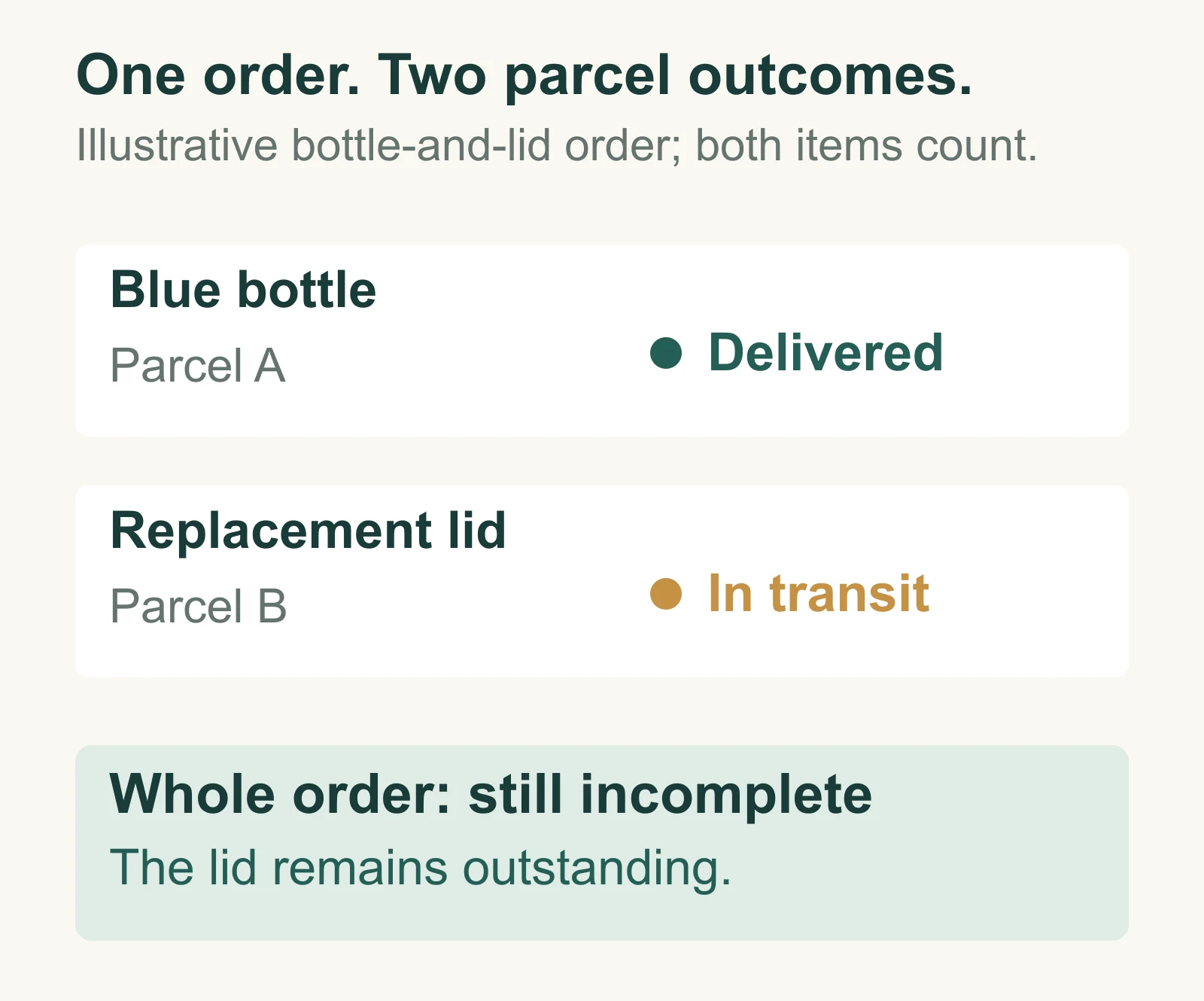
| Ordered item | Assigned parcel | Observed event | Order consequence |
|---|---|---|---|
| One blue bottle | A | Delivered | Bottle parcel reached its destination; confirm contents if a problem is reported |
| One replacement lid | B | In transit | Lid remains outstanding |
| Whole order | A and B | Different parcel states | Do not describe the entire order as delivered |
Send tracking messages that make those contents clear. If the customer knows which items belong to which parcel, a normal split shipment is less likely to look like a missing item. A delivered scan still does not establish that the parcel contained every expected product.
Check for parcels with no meaningful movement and for updates that never reached the store. The tracking guide covers event interpretation and no-scan investigation; keep the item-to-parcel relationship intact while investigating.
06
Resolve short shipments, damage and delivery failures
Start by identifying the problem the customer actually has. “Part of my order is missing” could mean a second parcel has not arrived, the packer omitted an item or the wrong item was sent. Each requires different evidence and a different remedy.
Ask for information that helps resolve the specific issue. A photograph of the received items and packing slip may clarify a short shipment. A damaged carton and product can be relevant to a damage claim. Avoid asking customers for repetitive evidence that adds no useful information.
Keep the customer resolution and any supplier or carrier recovery as separate tasks:
- Tell the customer what you have established and when you will update them.
- Check the order, packing and parcel records against their report.
- Decide whether a replacement, refund, further investigation or another agreed solution fits the situation and applicable obligations.
- Open the supplier or carrier case using its own evidence requirements and deadlines.
- Record the final customer outcome, including any replacement parcel or completed refund.
For covered US orders, the FTC’s Mail, Internet, or Telephone Order Merchandise Rule requires a reasonable basis for the stated shipping time. If you cannot ship within the applicable time, its delay-consent and refund requirements matter. Review the FTC business guidance for the circumstances; this is not a worldwide delivery deadline or a promise that every carrier arrives within a set number of days.
Returns need a usable route, too. Confirm the authorized address, reference, inspection and disposition before asking the customer to send goods back. Some products may be unsuitable for resale after opening or damage. The returns guide explains how to connect customer instructions with supplier recovery without making one depend indefinitely on the other.
07
Compare fulfillment quotes using the same basket
A low “fulfillment fee” can describe only part of the work. One provider may quote per order, another per item and another per parcel. Compare the same basket and destination before concluding that one is cheaper.
Give providers a small set of representative orders: one unit, multiple units of the same SKU, different SKUs in one parcel and a basket likely to split into two parcels. Include packed dimensions, destination and the expected packaging. Ask which charges are included and which arise only under particular conditions.
Here is an illustrative two-item order costing $23 before marketing, payment fees and other store expenses. These figures are invented for calculation, not a quote from AIDrop or another provider.
| Cost for the example order | Amount | Unit being charged |
|---|---|---|
| Products | $14.00 | Both items together |
| Base pick charge | $1.20 | Order, including the first item |
| Additional item pick | $0.40 | Second item |
| Packaging | $0.80 | One parcel |
| Shipping | $6.60 | One parcel on the assumed route |
| Product plus fulfillment cost | $23.00 | Entire example order |
The arithmetic is $14 + $1.20 + $0.40 + $0.80 + $6.60 = $23. If the items ship separately, the one-parcel assumption no longer holds. Obtain the extra packing and shipping charges rather than simply adding another pick fee.
Also ask about receiving, storage, minimum charges, special handling, address corrections, failed-delivery returns and return inspection. These may be irrelevant to one arrangement and material to another. Keep them visible in the comparison instead of averaging every fee into a single untraceable number.
08
Test the service and measure the promises you publish
Run a small pilot before relying on the arrangement for a promotion. Include an order with multiple variants or accessories, the packaging you intend to use and a destination representative of the market. Inspect the delivered goods and reconcile the supplier’s invoice with what was agreed.
Record the important timestamps: order approved for fulfillment, supplier accepted, carrier received and delivery recorded. A test identifies whether the process works; a single successful delivery cannot establish a dependable service average for all products and routes.
Choose a few measures with clear denominators:
- Dispatch performance: among orders released and due to dispatch in the period, how many received carrier handoff evidence by the agreed deadline?
- Order accuracy: among orders checked, how many contained the correct items and quantities?
- Unresolved delivery problems: how many orders remain open, how old are they and who owns the next action?
- Fulfillment cost: what was invoiced per completed order, with unusual fees identified separately?
Report held orders alongside dispatch performance. Excluding them from a released-order measure may be appropriate, but hiding the queue would conceal the customer delay. Similarly, calculate delivery performance for a defined order cohort and keep undelivered orders visible; reporting only parcels that arrived can make a troubled route look healthier than it is.
Use the results to adjust the service, packaging or customer promise. Route-specific shipping-time estimates are more useful than copying a provider’s broad headline into every product page.
09
When to add warehouse stock or more automation
Consider allocated stock when recurring product demand is stable enough to justify buying units and the current sourcing delay is a material problem. Check the cash exposure, receiving lead time and unsold-stock risk before moving products into a warehouse. Faster dispatch is useful only if the stock and total costs suit the business.
Add automation when the manual process already has clear inputs, accepted outcomes and exception owners. Automating a wrong SKU mapping or an unclear supplier response can reproduce the error more quickly. Keep physical quality and delivery checks in place after the software is connected.
For a service discussion, describe your order mix, products, dispatch origins, destinations and the problem you need to solve. That gives a provider something concrete to assess through order fulfillment services. The operations section of the Dropshipping Hub connects the detailed inventory, shipping and exception topics as the process grows.