
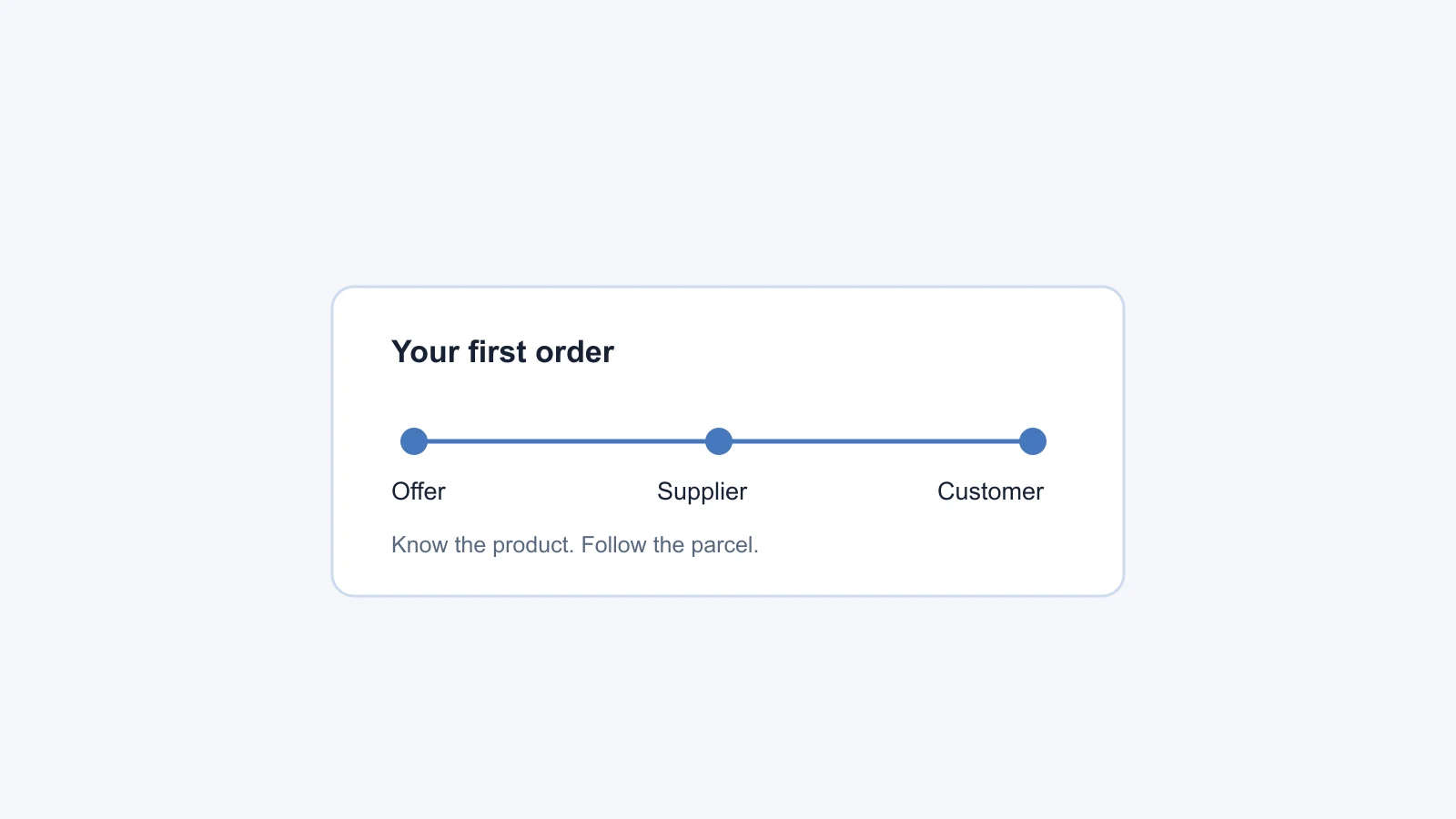
Dropshipping is a way to sell products through your store while a supplier stores and ships them to your customers. You choose the offer, collect payment and handle the customer relationship. The supplier handles the physical order according to the arrangement you agree.
For a beginner, the sensible starting point is a small offer you can understand and support: a defined customer, a checked product and supplier, enough cash to pay upcoming bills, and a first order you have rehearsed from checkout to arrival. Opening a store is one part of that preparation.
This guide explains the jobs, tools and decisions involved. When you are ready to work through business setup in detail, use our step-by-step guide to starting a dropshipping business.
01
Understand what you are responsible for
Suppose someone buys a desk organizer from your store. You send the correct item, variant and delivery details to your supplier, usually through a connected system or an agreed order file. You pay the supplier, who prepares and ships the parcel. The customer comes back to your store with questions about delivery or a damaged item.
The practical advantage is that you can test an offer without first buying a large quantity of stock. You also give up some direct control over availability, packing and dispatch. Those trade-offs deserve attention before you choose the model; our dropshipping overview covers them in more depth.
| Participant | Main job | What to check before selling |
|---|---|---|
| Your store | Present the offer, take payment and serve the customer | Accurate product information, delivery terms and a way to resolve problems |
| Supplier | Provide the agreed product and arrange the agreed physical fulfillment | Stock, variant, preparation time, shipping method and exception terms |
| Order app or connector | Transfer information between systems | Correct mapping, acceptance and a visible failure alert |
| Payment provider | Process payment and make payouts under its terms | Eligibility, fees and access to funds |
An installed app does not take over your customer obligations. It may transmit an order successfully even when the supplier cannot fulfill the requested variant. Keep a way to confirm what happened after the order left your store.
02
Keep your first offer small enough to learn from
Begin with one audience, a narrow product range, one destination market and one customer acquisition channel. This is an editorial recommendation for reducing the number of unknowns in your first attempt, not a rule that every successful store follows.
A desk organizer for people working in small apartments is more specific than “home products for everyone.” It gives you useful questions: what space does it fit, what can it hold, how is it assembled, and what makes it worth its delivered price? These questions also help you judge a sample and write the page.
Look for a need you can explain with the product itself. Avoid choosing an item solely because a video has many views or a supplier calls it a bestseller. For a closer look at demand evidence, use the product research guide; for comparisons among item types, see choosing dropshipping products.
Before adding a product to your first offer, answer four questions:
- Can you describe the item accurately, including its dimensions, materials and included parts?
- Can you ship it to the intended market at a cost and speed the offer can support?
- Can you explain what happens if it arrives damaged, does not fit or needs to be returned?
- Can you verify any safety, labeling or selling requirements relevant to that product and destination?
When a requirement is unclear, resolve it before accepting orders. Adding more products multiplies the questions you have to answer.
03
Choose a supplier you can actually work with
A supplier search should produce a usable agreement, not just a low unit price. Ask for the exact variant, current availability, order preparation time, shipping options, packaging, total quoted cost and the procedure for shortages or damage. Confirm where returns would go and who pays for each kind of exception.
Then order a sample. Inspect what arrived against the listing and your intended offer: dimensions, finish, function, packaging and included instructions. Save the order details, photos and delivery events. A sample shows you one observed result; it does not prove every future shipment will match it.
Before your first customer order: agree how the supplier will acknowledge an order, flag an unavailable item and contact you before substituting a product or shipping method.
Do not rely on a chat promise that leaves the product or route unspecified. A clear written description makes it easier to investigate a mismatch later. Our supplier comparison guide explains how to compare available options, while finding dropshipping suppliers covers the search and verification process.
04
Budget for profit and for money you need before payout
You need a budget for samples, store operation, supplier orders, shipping and customer acquisition. Allow room for refunds, replacements and mistakes as well. The required amount depends on the product, destination, payment terms and launch approach; there is no single responsible “start with this much” figure for every store.
The following is a hypothetical example, using assumed costs to show how the arithmetic works. It is not an AIDrop Agent price quote or a forecast of typical results.
| One order | Assumed amount |
|---|---|
| Selling price paid by the customer | $45 |
| Product cost | −$14 |
| Shipping paid to the supplier | −$6 |
| Payment processing cost | −$2 |
| Customer acquisition cost | −$10 |
| Contribution before fixed expenses, refunds and taxes | $13 |
The calculation is $45 − $14 − $6 − $2 − $10 = $13. Calling that $13 “net profit” would leave out costs the store still has to cover. Use the profit margin guide when building a more complete model.
Now assume ten customers place that same order, and you must pay the supplier and the advertising bill before the customer payments are paid out to your bank. The ten orders produce $450 in sales, but you need $200 for product and shipping plus $100 for advertising: $300 of cash before that payout arrives.
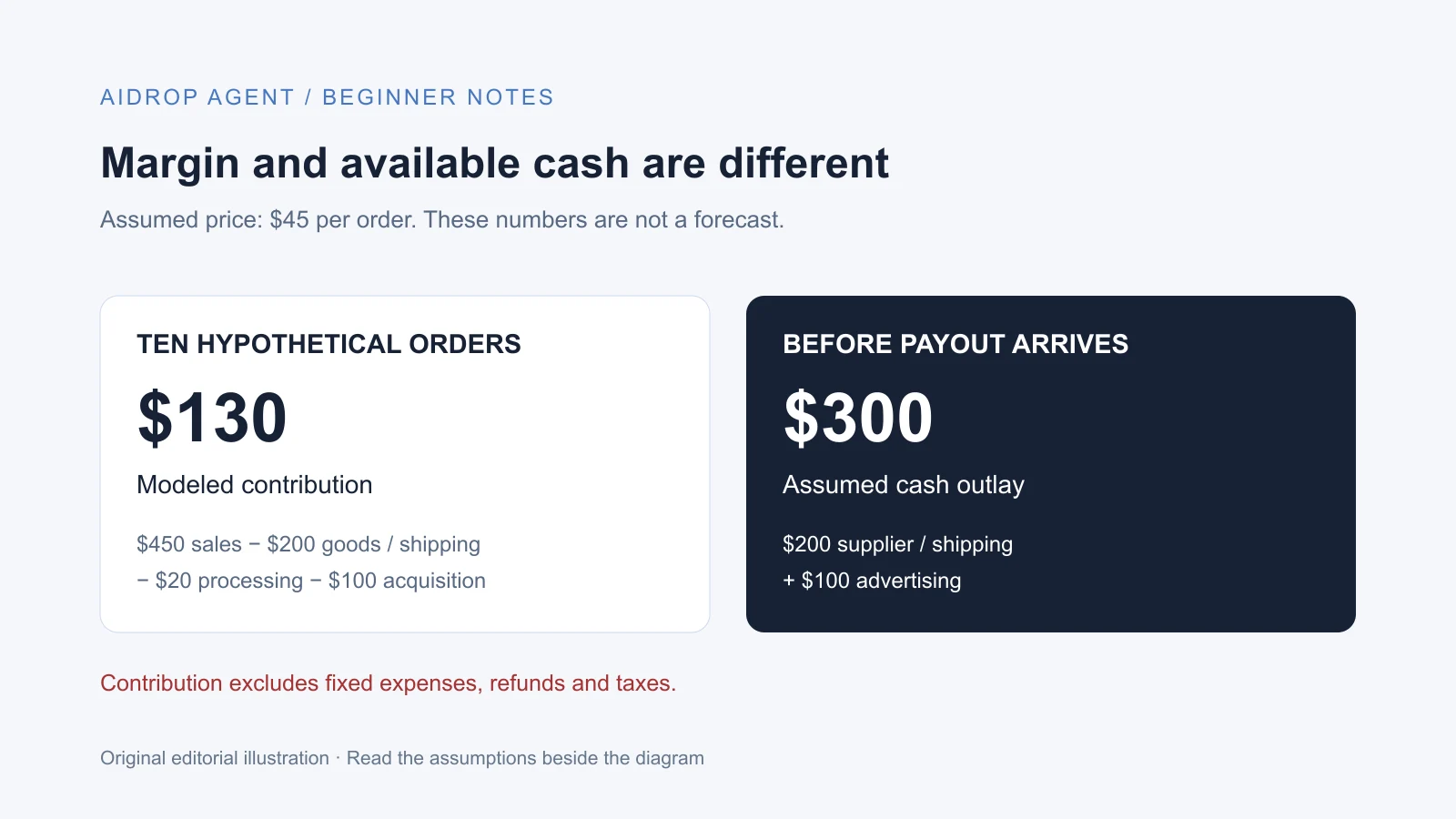
Under these assumptions, deducting the $20 in processing fees leaves an eventual $430 payout before any other deductions or adjustments. After the $300 outlay, the modeled contribution is $130. Store expenses, refunds, taxes and financing can reduce what remains.
A positive margin does not guarantee that cash is available when the supplier needs payment. Shopify’s account-hold guidance explains that a hold can prevent payouts; in some cases checkout is affected too. Check the terms and notices for the provider you actually use.
Decide how many orders you can fund without relying on an unreceived payout. If you set money aside for a possible refund, treat that as reserved cash in your planning; it becomes a refund cost only when the relevant event occurs. A launch that generates more orders than you can fulfill creates a customer problem quickly.
05
Prepare the essentials in your store
You need a storefront, a supported way to accept payment, an order handoff method and a customer contact route. You also need a simple record of costs and order status. Begin with tools that cover those jobs; add an app when there is a specific problem for it to solve.
| Essential | What “ready” looks like |
|---|---|
| Product page | Correct variant details, included items, useful images and a price the buyer can understand |
| Delivery information | Processing and transit expectations tied to the intended route, plus applicable shipping charges |
| Returns and contact pages | A usable contact method and clear instructions consistent with your obligations |
| Checkout and payment | Available for the intended buyer and tested with the correct currency and shipping settings |
| Order record | Supplier reference, variant, amount paid, parcel details and any unresolved issue |
Write delivery information from the route you can support, rather than copying a competitor’s claim. Processing time and carrier transit time are different parts of the wait; the shipping-time guide explains how to present them.
If Shopify is your chosen platform, the Shopify dropshipping guide covers its store and supplier handoffs. You do not need to settle every future automation decision before testing a small, manageable offer.
Check business registration, tax, product and consumer obligations for the places involved. Shopify’s dropshipping compliance guidance makes clear that using this fulfillment model does not remove the merchant’s responsibilities. A platform account is not a substitute for those checks.
06
Rehearse the first order before promotion
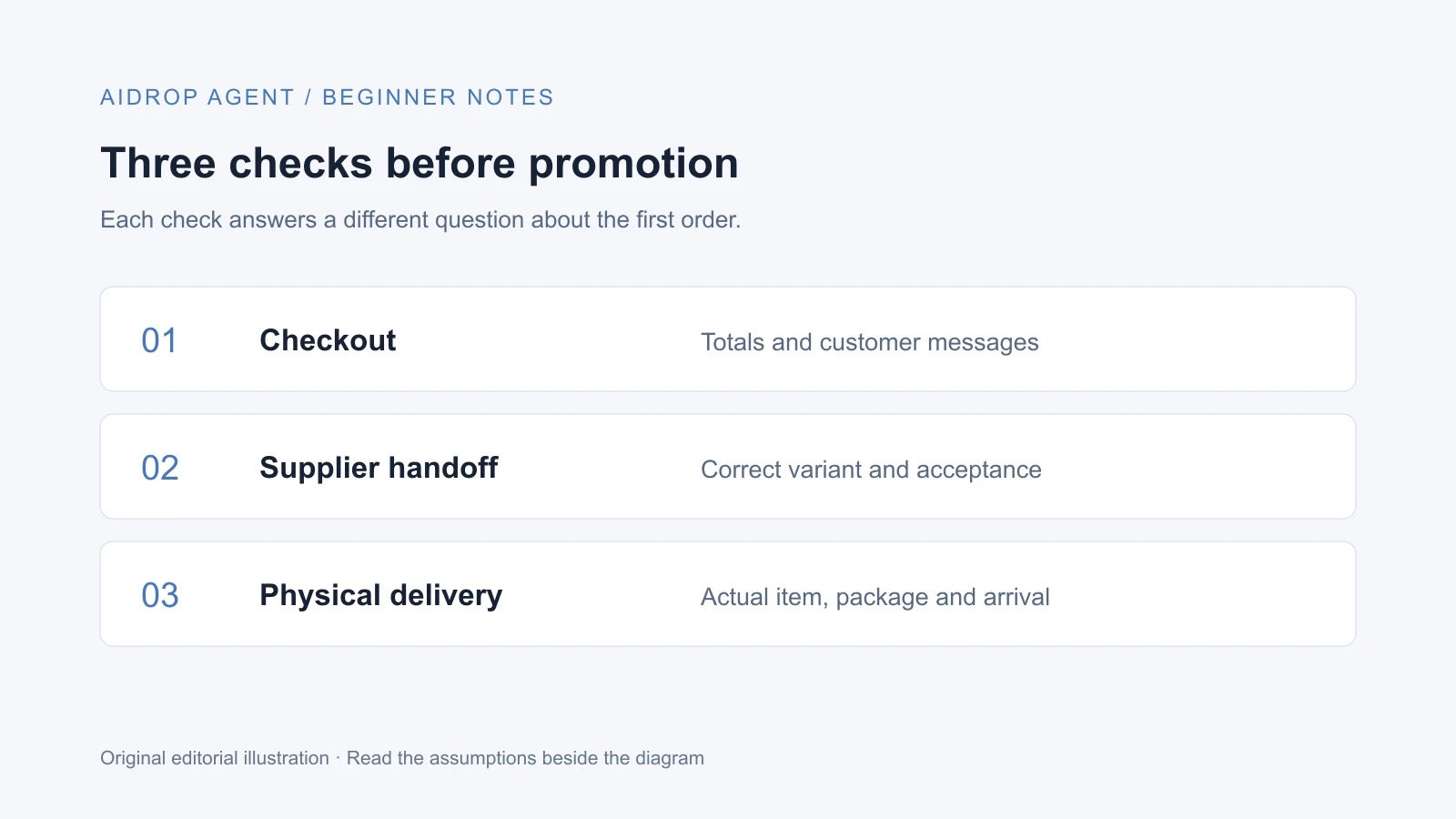
A test checkout, a supplier acknowledgment and a delivered parcel answer different questions. Plan to observe all three before treating the order process as ready.
| Check | Evidence to look for | What it cannot prove alone |
|---|---|---|
| Simulated checkout | Correct product, address fields, shipping charge and customer messages | Supplier acceptance or real delivery |
| Order handoff | Matching variant and quantity, supplier reference and accepted instructions | Packing quality or carrier performance |
| Real sample delivery | The actual item, packaging, parcel events and arrival condition | Consistency across every future order |
For Shopify, test-order documentation explains how simulated transactions help check store settings. They do not appear in payouts, and customers cannot place live orders while payment providers are in test mode. Restore the appropriate live payment configuration before opening to customers.
Use a real sample order to check the physical side. If your simulator does not send orders to the supplier, test that handoff separately through the agreed process. Confirm that you are authorizing a real shipment and any associated charges; do not repeatedly resend an uncertain order without checking whether the supplier already accepted it.
Keep a short rehearsal record:
- What the customer ordered, including the selected variant.
- What the supplier received and accepted.
- What you paid and which shipping method was agreed.
- Which parcel events appeared and what the customer was told.
- What arrived, whether it matched, and which issues remain open.
Fix a wrong variant mapping or an unrealistic delivery message before sending people to that offer. The goal is to understand a real order well enough to recognize when the next one needs attention.
07
Find your first customers and learn from the whole order
Choose a channel where you can reach the intended customer and demonstrate the product honestly. Depending on your audience and resources, that could mean useful short videos, search-focused content, participation in a relevant community where promotion is permitted, or a limited paid campaign. Organic channels still take work and time; paid traffic does not guarantee sales.
For the hypothetical desk organizer, show its dimensions and how it fits a small working area. A clear demonstration helps the buyer decide whether it solves their problem. Avoid claims about materials, durability or benefits that your evidence cannot support.
Set a spending limit you can afford to lose and record what happened. Views tell you that something was seen. Checkout activity tells you that some people moved further. Paid orders, delivered orders, complaints and refunds show different parts of the outcome. Do not increase spending solely because revenue looks encouraging.
After each early order, check whether the supplier accepted it, whether the promised dispatch occurred and whether any customer question needs an answer. If a delay develops, communicate from the available facts. As one jurisdiction-specific example, the US FTC merchandise-order rule requires an appropriate basis for shipping promises and addresses consent to delay or refund when timely shipment is not possible.
Have a response ready for damaged, missing and unwanted items. The returns guide helps you distinguish the customer remedy from a separate claim against the supplier. Waiting for the supplier to answer does not make the customer’s question disappear.
For the next stage, use the dropshipping Guide to review the wider operating model, or browse the business fundamentals resources for the decision you are working on next.
08
Frequently asked questions
Can a beginner start dropshipping without experience?
Yes, but you will need to learn product evaluation, basic store operation, pricing and customer support. Start with a scope you can supervise. The first useful milestone is a correctly fulfilled order whose costs and customer outcome you understand; it is not proof that the business will be profitable at scale.
Can I start with no money?
You can research products and draft an offer without buying inventory. Running the offer still creates expenses, including samples, services and supplier payments. A free trial does not cover a customer’s shipment or refund. Write down when each payment is due before deciding that your available cash is enough.
Do I need to register a business first?
The answer depends on your location, activities, product and selling destination, as well as payment-provider requirements. Check the applicable official requirements before accepting orders. Do not assume that selling online or using a supplier creates an exemption.
Should I automate everything immediately?
Automate a process after you understand its inputs, successful result and exception handling. At a small volume, closely supervising orders can reveal a variant or address problem early. If the workload is already too large to monitor reliably, reduce the active scope or implement a tested process before expanding it.
How soon will I make my first sale?
There is no reliable universal timeline. Demand, the offer, price, traffic quality and buyer confidence all affect the result. Use a defined test budget and review what buyers actually do. A first sale starts the obligation to deliver; it does not finish the experiment.