
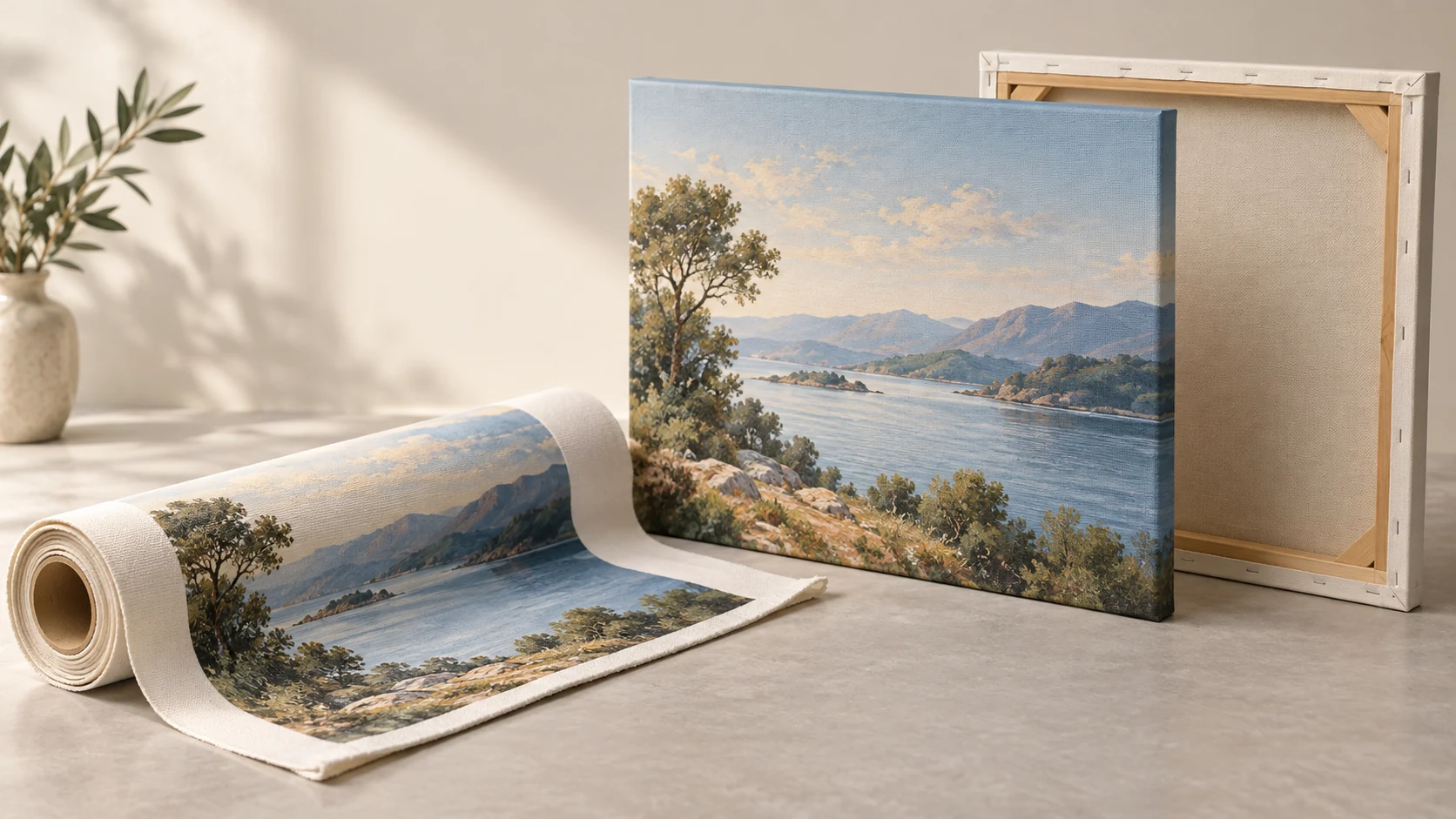
Canvas print dropshipping means a print provider produces your artwork on canvas and ships it to the customer after you sell it. Choose rolled, stretched or framed canvas first, then set the size and edge treatment. Those choices determine which part of the picture stays visible and what the buyer must do to hang it.
A portrait can look complete in a flat preview and lose part of a face when the fabric wraps around a stretcher. A room photograph can also suggest a frame or hanging kit that the actual product does not include. Settle the physical construction before preparing the file or setting the price.
The print-on-demand wall art guide compares canvas with paper and framed prints.
01
Rolled, stretched and framed canvas are different offers
A rolled canvas is printed fabric without the supporting stretcher. The buyer needs an appropriate way to mount or frame it. A stretched canvas has fabric pulled around a supporting frame, usually with the sides visible. A framed canvas adds a decorative outer frame; its finished dimensions can be larger than the canvas face.
| Format | What the buyer receives | Detail that changes the offer |
|---|---|---|
| Rolled canvas | Printed fabric, supplied without a stretcher | Mounting requirements and the usable image area |
| Stretched canvas | Printed fabric wrapped over its support | Stretcher depth, edge treatment and hanging hardware |
| Framed canvas | Canvas plus the specified outer frame | Frame finish, outer dimensions and included hardware |
“Ready to hang” needs confirmation. On the specific Prodigi stretched-canvas page, the standard construction is listed with a 38 mm depth and hanging equipment not included. That is a product detail, not a rule for every canvas supplier.
For a first portrait offer, choose one construction and one or two sizes. Write the inclusion clearly: stretched canvas, specified edge, no decorative frame, and the actual hardware arrangement. Do not leave the customer to infer these details from a styled room image.
Record both the visible face size and the outer framed size when a frame is included. They answer different questions: how large the picture appears and whether the finished item fits the wall space.
02
Choose where the picture ends
The edge treatment decides what happens when the printed fabric turns around the supporting frame. This is especially important for portraits, signatures and text near the boundary.

The current Prodigi product describes four choices:
| Edge choice | What happens around the side | A reason to consider it |
|---|---|---|
| Image wrap | The image continues around the sides | The picture has enough expendable background near its edges |
| Mirror wrap | Edge content is repeated around the sides | You want to retain the whole intended composition on the front |
| White edge | The side is white | A clear, neutral separation suits the artwork |
| Black edge | The side is black | A dark side treatment suits the artwork and room |
These are visual and production choices, rather than quality rankings. Mirror wrap can preserve a face on the front, but a reflected object at the edge may look unusual from the side. A solid edge avoids that repetition, though its appearance needs to suit the picture.
For the portrait, check the face, hair, hands and signature against both the front and side preview. If a hand turns around the stretcher under image wrap, choose a different composition or a supported alternative edge. Shrinking the entire picture without adjusting its background can introduce an unwanted border.
Download the exact product template. Stretcher depth is not the whole flat-file allowance: the file may also need material for the back, trimming and production tolerances. Estimating the template by adding 38 mm to every side can produce the wrong file.
Keep the selected edge in the product record. A customer choosing “12 × 16” should not unexpectedly receive a different wrap because the supplier account’s default changed.
03
Build the file for the canvas you chose
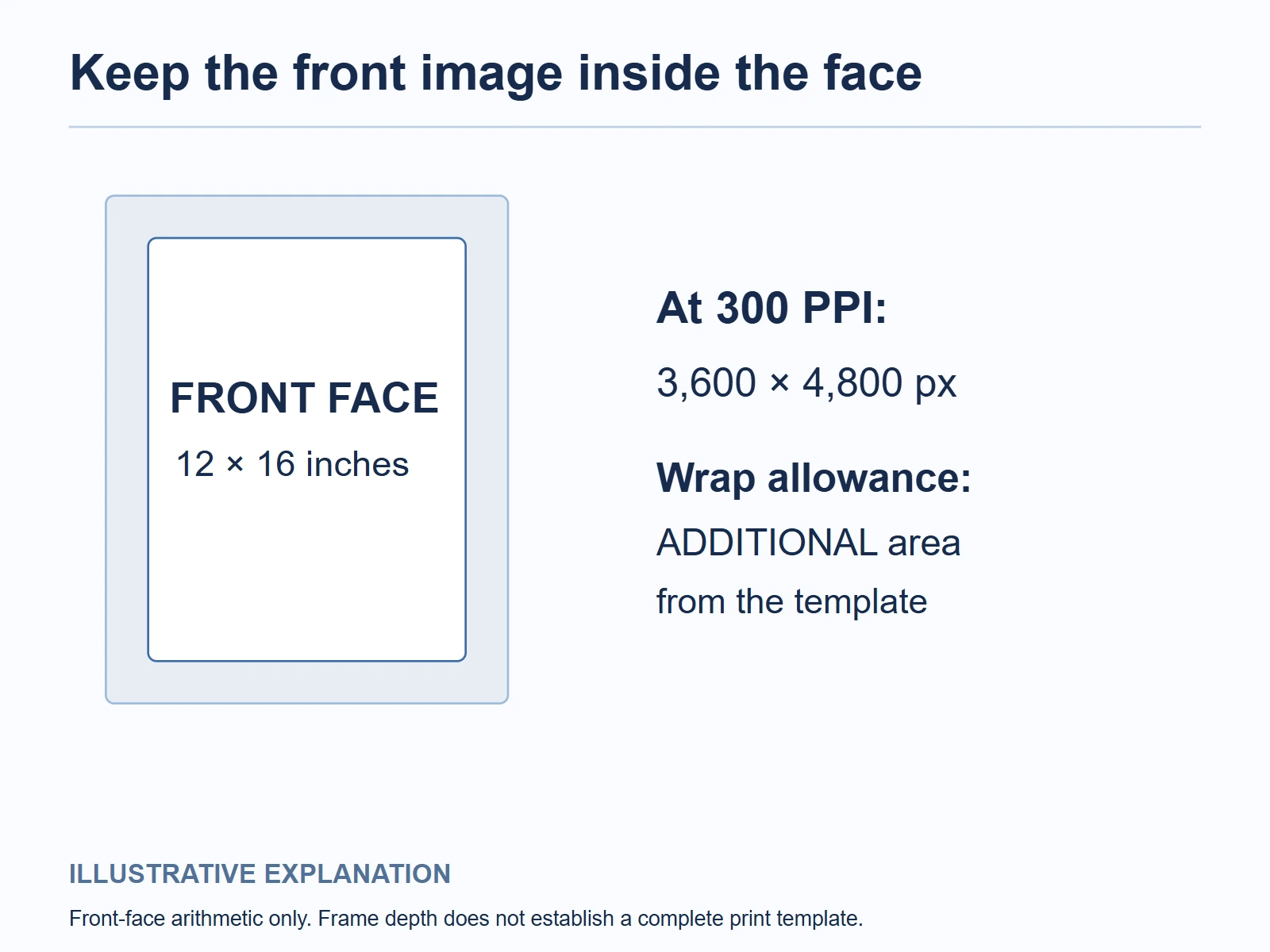
First check the shape. A 12 × 16 inch face has a 3:4 ratio; a 16 × 20 inch face has a 4:5 ratio. Enlarging the same file cannot make both shapes without cropping, adding space or changing the composition.
For illustration, a 12 × 16 inch front face only at 300 pixels per inch needs 3,600 × 4,800 pixels. That arithmetic does not include the edge and back allowances in the chosen canvas template.
Prepare one named version for each actual construction and crop:
- Open the template for the selected size and edge option.
- Place the intended front composition inside its front-face area.
- Fill the required edge areas in the way the product supports.
- Check critical details against the safe areas and all four corners.
- Follow that provider’s file format and color guidance.
- Remove production guides from the export and save the revision.
Prodigi’s specific product guidance lists JPG or PDF and an optimal 300 DPI, with a downloadable color profile. Printful’s wall-art file guidance describes its own formats and preparation. Follow the chosen printer’s requirements; the existence of a canvas category does not create a universal file standard.
Inspect fine lettering and the image’s original resolution before making a larger size. A high DPI value written into a file cannot restore detail that was absent from the source. If the picture needs a different crop, show that crop in the corresponding product image.
Screen brightness also changes how art appears. Approve the printed sample for color and texture instead of promising an exact match to every buyer’s display.
04
Compare providers on one finished canvas
Compare the item the buyer will receive, not only the word “canvas.” A thin rolled print and a deeper stretched canvas with a decorative frame can display the same artwork while having very different costs and delivery requirements.
Prodigi’s canvas range gives documented options to investigate. Picanova’s US B2B shop describes white-label print fulfillment and canvas branding options. These are supplier-owned descriptions, rather than independent evidence that one print is better than another.
Send the same comparison brief to each shortlisted provider:
One stretched portrait canvas, 12 × 16 inch face, stated stretcher depth, mirror wrap, no decorative frame. Please confirm the exact product, included hanging hardware, production origin for the destination, packing, one-order delivery cost and damage remedy. Artwork will be supplied against your approved template.
Include a delivery postal code and whether the buyer can order two pieces together. Ask where that exact product will be made; a global network does not establish a particular manufacturing country for every size and order.
Read product material and packing differences alongside the quote. A supplier can use region-specific materials or a different construction for a large format. If it changes the received item, describe it or choose a narrower range.
If you are deciding between different wall-art production networks, the Gelato guide addresses that provider’s separate operating model. Use its actual current product quote for a comparison, rather than substituting a network headline for a canvas specification.
05
Price delivery and the cost of one damaged replacement
A canvas shipment needs protection for its corners, frame and printed surface. The packed dimensions determine more of the shipping question than the flat picture dimensions alone.
Here is a hypothetical USD example:
| Item | Amount |
|---|---|
| Customer pays | $79.00 |
| Finished canvas | −$30.00 |
| Supplier delivery | −$12.00 |
| Store/payment charges | −$2.70 |
| Customer acquisition | −$14.00 |
| Left before remedies, fixed costs and tax | $20.30 |
If one replacement requires another $30 canvas and $12 delivery, an unrecovered $42 bill consumes just over two orders’ contribution at these assumptions. That does not predict a damage rate. It shows why the packing arrangement and supplier claim terms deserve attention before launch.
Keep three amounts separate: the cost of one replacement, an allowance spread across orders, and an actual credit recovered from a supplier. Counting a hypothetical allowance as a guaranteed supplier refund would overstate the available money.
Get the sample’s actual outer parcel dimensions and gross weight. Confirm any oversized, remote-area or destination charges for the planned service. A small canvas and a large canvas may enter different packing or shipping arrangements.
For a China-side supply proposal, the shipping calculator helps compare the stated parcel and service. The print provider’s own quote still governs its fulfillment route. Do not use the calculator to promise a charge for an unrelated provider’s network.
06
Approve a sample from the front to the back
Use the exact design, size and edge option you intend to sell. A small generic sample cannot approve the crop and packing of a larger portrait.
An illustrative first sample could be recorded as a 12 × 16 inch stretched portrait, mirror wrap, artwork version 3, with the supplier’s confirmed hardware inclusion. The current Prodigi example product code is GLOBAL-CAN-12X16; confirm its account options and destination before using it in an order.
Inspect the sample in separate views:
| View | What to check |
|---|---|
| Front | Subject, crop, color, surface and readable signature |
| Four sides | Edge treatment, alignment and unintended reflections or cut-off details |
| Back | Stretcher condition, finishing and promised hanging items |
| Parcel | Corners, movement inside the pack and received damage |
Photograph the face straight on and include a scale when documenting dimensions. A tilted lifestyle photograph can hide uneven stretching or make the canvas look larger than it is.
Check whether the received piece can be used as described. If hardware is excluded, the listing should say so and explain what the buyer needs to supply. If the supplier has added a hardware kit, verify that exact inclusion before changing the copy.
Retain the approved file, product reference, edge option and sample record. A later size or origin change can require another crop or construction check. A successful sample does not prove all future prints or long-term color permanence.
07
Send one approved order and resolve a bad delivery
When you publish the canvas, connect the storefront variant to the entire configuration. The same photograph with a size label is insufficient if it points to the wrong edge, construction or file.
For an illustrative SKU PORTRAIT-12X16-MIRROR-V3, match:
- The store order and provider order numbers.
- The exact canvas product, face size and edge option.
- Artwork version 3 and the approved front crop.
- Quantity, destination and included items.
- Supplier payment and production acceptance.
Run one controlled paid storefront order with your own details. Check the mobile listing and checkout before payment, then inspect the provider order and actual delivered item. A manually ordered sample answers the physical question; the storefront order also checks whether the connection sends the right configuration.
If production is missing or the file is wrong, find the existing order state before manually submitting another one. A correction before production and a paid remake after production have different costs.
For a damaged delivery, ask for photographs of the outer package, the affected corner and the canvas itself, together with the order number. Submit the claim within the provider’s current window, while giving the customer a clear proposed remedy. If the crop is wrong but the parcel is sound, compare the received front with the approved file and edge choice.
Do not wait for every supplier cost dispute to finish before explaining the next step to the buyer. Track the customer commitment and your supplier claim separately, then repair the file, mapping or packing that caused the problem.
Send AIDrop the canvas construction, face size, edge, artwork and destination if you want a China-side production or packing review. Those specifics make the request comparable with your existing provider’s offer.
The supplier documents cited in this guide were checked on October 14, 2026. The proposed configurations, inspections and costs are teaching examples, not a physical print test.
08
Canvas dropshipping questions
Does stretched canvas include a decorative frame?
Not necessarily. The stretcher supports the fabric from behind. An outer decorative frame is a separate construction or addition; state whether it is included.
Does every stretched canvas arrive ready to hang?
Check the exact product’s hardware inclusion. Some products exclude hanging equipment, so the listing and instructions need to reflect that.
Can I reuse one file for every size?
Only when the source resolution, proportions and product template support it. A change from 3:4 to 4:5 requires a crop or new composition; wrap allowances also need checking.
What happens if the customer changes their photo?
Agree on the approval and production cutoff. Before production, the supplier may accept a revised proof. After printing has started, a changed photograph can require a new paid job.
Should I start with the cheapest canvas supplier?
Compare equivalent finished items and delivered quotes first. A lower base price can exclude construction, hardware or packing that another quote includes. Approve the physical sample and remedy before choosing.

Furniture Dropshipping: Product Data, Delivery Scope and Damage Recovery
Furniture dropshipping needs more than a supplier quote. Verify the exact piece, cartons, drop-off service and damage

Home Decor Dropshipping: Fragility, Dimensions and Presentation
A decor listing needs more than a room photo. Compare appearance, packed dimensions and the recovery path
Candle Dropshipping: Choose the Jar, Scent and Shipping Plan
Build a small candle offer, compare individual dispatch with wholesale batches, price a complete order, and plan
