
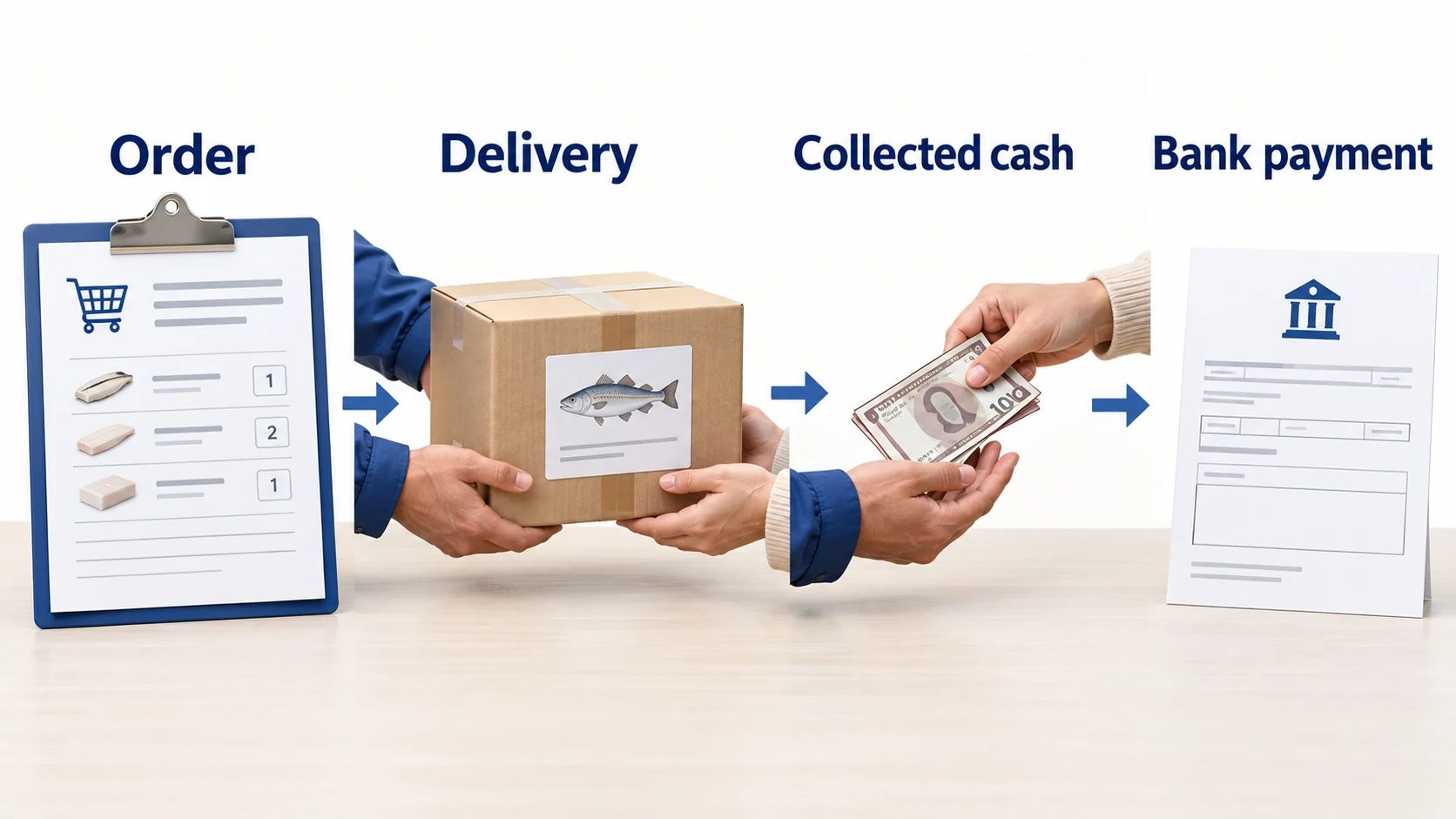
Zambeel connects sellers with product sourcing and order fulfillment, particularly in Gulf cash-on-delivery markets. Start with one eligible product in one country, with written delivery, failed-order and payout terms. A COD order is an agreement to pay on delivery. It is not money your store has already collected.
That difference matters when you buy advertising. A hundred checkout submissions can look encouraging, yet some customers will not confirm, some parcels will be refused, and the cash from successful deliveries may reach your bank later. You need to understand the whole sale before deciding how much to spend on the next one.
We checked the provider and Shopify pages on October 13, 2026. This is a review of public documents, not a test of Zambeel’s delivery performance. The figures in the worked example are hypothetical.
01
What Zambeel does in a COD sale
Zambeel’s Gulf service page describes product supply, order confirmation, packing, delivery and weekly payments. It lists store connections and a manual-order route. These services can save you from arranging each handoff separately, but the shop still has to choose a suitable product and make an accurate customer promise.
Follow the money as well as the parcel:
- The buyer submits an order for a particular item and price.
- The order is confirmed and accepted for fulfillment.
- A parcel is dispatched and reaches the buyer—or comes back.
- The buyer pays, and that collection appears in a settlement record.
- The net payment reaches the seller’s bank after applicable deductions.
Keep those events separate in your spreadsheet. If “orders” means checkout submissions in one report and paid deliveries in another, comparing their totals will give you a misleading picture.
Choose the destination before importing products. An item eligible for one market may have different stock, delivery or return arrangements elsewhere. The broader supplier guide explains other supply models; this article concentrates on the COD sale and its costs.
02
Check the plan and delivery bill before importing products
Compare account charges, goods and delivery together. “Free account” does not mean free fulfillment.
| Published source | Gold charge shown | What to confirm before paying |
|---|---|---|
| Provider page | $79 per month | Billing period, renewal and included service |
| Shopify listing | $79 one-time | Whether this is the same plan and applies to your account |
The descriptions conflict. Get the applicable bill in writing rather than choosing the cheaper interpretation.
For UAE orders, the provider advertises AED20 for confirmation, packing and delivery up to 3kg, and AED5 for returns. Its advertised extras include remote-area and overweight charges, plus a $1 lead/order charge when weekly confirmation falls below 50%. Ask for a dated quote for your addresses; these published terms do not establish every order’s final cost.
| Ask about this charge | The answer you need |
|---|---|
| Unconfirmed lead | Is it charged, and which confirmation period is used? |
| Dispatched but refused parcel | Are outward delivery, return delivery and goods all charged? |
| Remote address or heavier parcel | What changes for this postcode and packed weight? |
| Damaged or wrong item | Who pays for collection, replacement and the second delivery? |
The “0% COD tax” label is not a general statement that your business has no tax obligations. Keep taxes, platform charges and payment deductions in their own fields. For a cross-border sourcing quote, compare equivalent inclusions rather than the smallest headline price.
03
Price delivered orders, not checkout submissions
Here is a simplified UAE example. Imagine you dispatch 100 orders for a product sold at AED100. Eighty buyers receive and pay for it. The product costs AED40, outward delivery is AED20 per dispatched order, a failed parcel adds AED5 to return, and advertising for the batch costs AED1,500.
In this illustration, failed parcels return as saleable inventory. Their goods cost remains tied up in stock rather than becoming a permanent loss. The example also assumes outward delivery is charged on every dispatched parcel. Confirm both assumptions with the provider before using the calculation for a real budget.
| Batch item | Calculation | Amount |
|---|---|---|
| Cash collected | 80 × AED100 | AED8,000 |
| Goods used in completed sales | 80 × AED40 | −AED3,200 |
| Outward delivery | 100 × AED20 | −AED2,000 |
| Failed-parcel returns | 20 × AED5 | −AED100 |
| Advertising | Batch spend | −AED1,500 |
| Contribution before other costs | Remaining amount | AED1,200 |
Now keep the same 100 dispatches and advertising bill, but only 60 paid deliveries. Collections fall to AED6,000. After AED2,400 in goods, AED2,000 outward freight, AED200 returns and AED1,500 advertising, the batch loses AED100 before other costs.
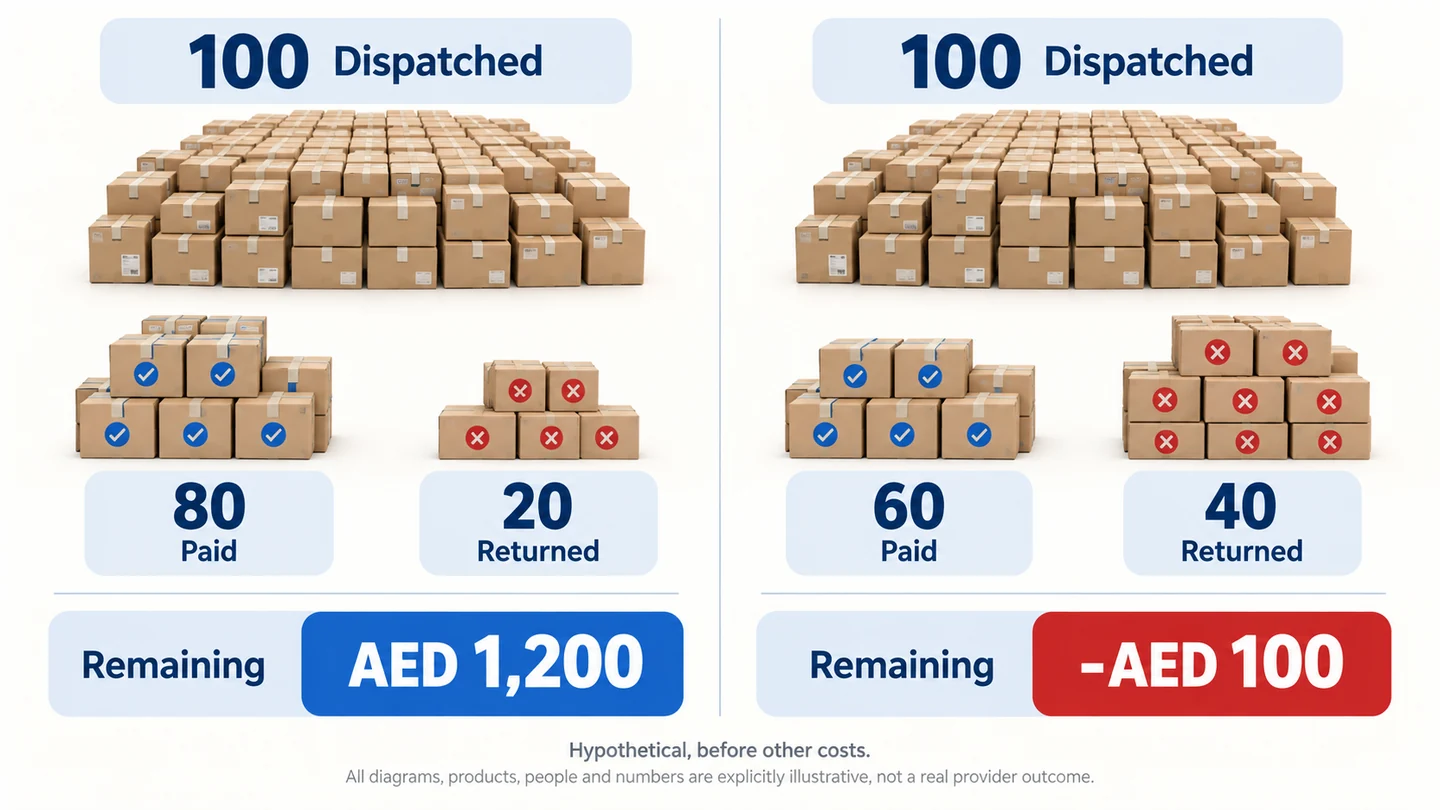
The product and selling price did not change. The number of paid deliveries changed the result. Under these particular assumptions, contribution is AED65 times the number of paid deliveries, minus AED4,000. You need at least 62 paid deliveries to get above zero before adding any other costs.
That is not a predicted Zambeel success rate. It is a way to calculate the delivery rate your own offer needs. Recalculate if failed goods are damaged, outward fees differ, taxes apply or a subscription has to be covered.
There is also a cash question. Even saleable returned goods cannot pay today’s advertising bill. Keep a separate cash forecast showing when you pay for goods and ads and when collections become available. The dropshipping cash-flow guide explains that distinction.
04
Connect one product and trace its first order
The Shopify listing describes fulfillment creation and fulfillment logs. It does not prove that an order in your particular store has reached the correct product or will be paid out correctly. Test a single controlled order before loading a large catalog.
For an illustrative setup, your store SKU might be UAE-BLUE-01, quantity one, with a COD selling price of AED100. That is your record label, not a real Zambeel product code. Link it to the exact supplier item, including its color, pack count and market eligibility.
Check the first order in this sequence:
- Save the store order ID, address, phone number, item and COD amount.
- Find the corresponding provider order ID. Compare the item and amount before dispatch.
- Record confirmation and acceptance separately from shipment.
- Check tracking, final delivery status and the amount actually collected.
- Locate that order in the settlement statement and bank payment.
If the provider record is missing, first check the connection, fulfillment log and product mapping. Do not immediately create a second manual order. A delayed connection could later submit the first one and produce two parcels.
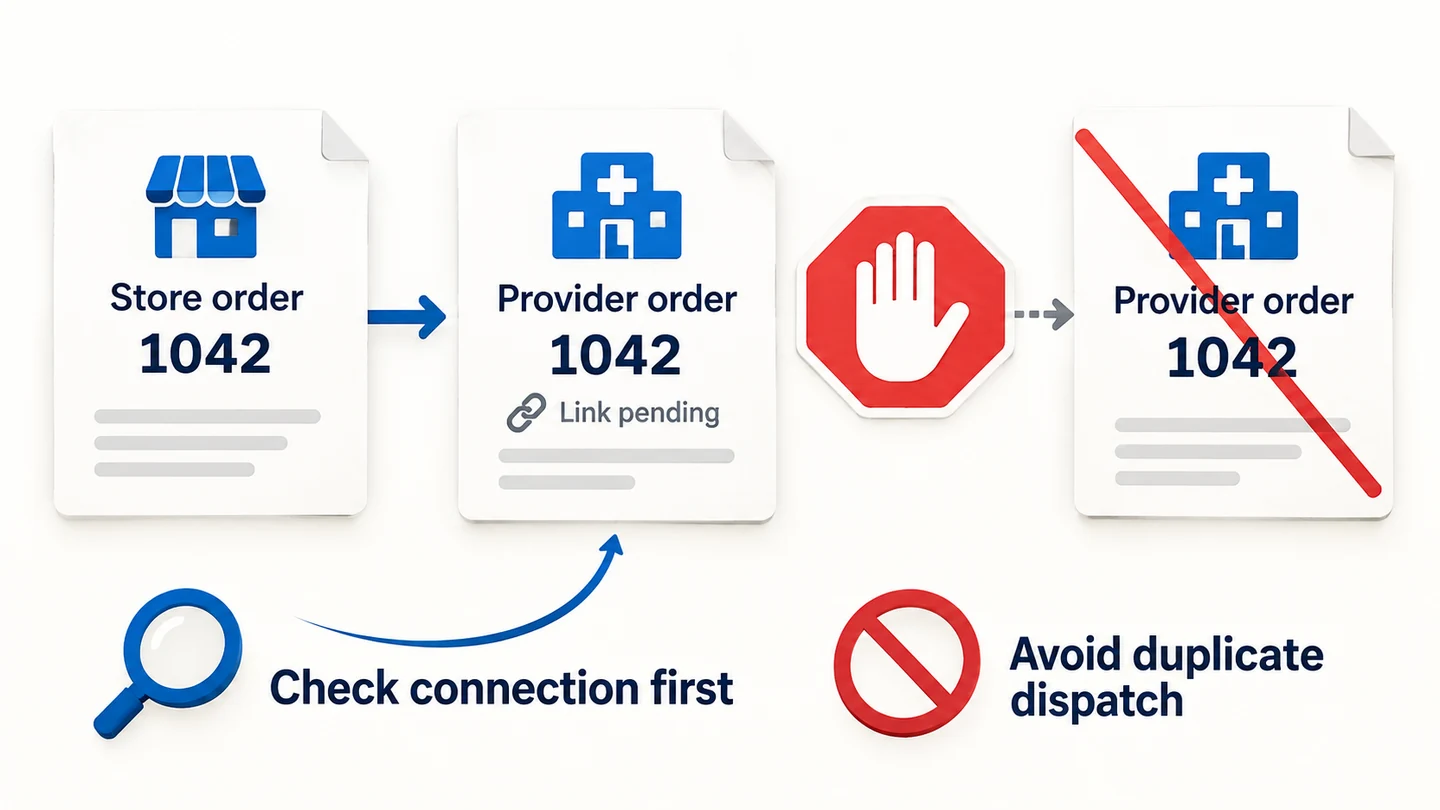
If the wrong product or amount appears, hold fulfillment and resolve the mismatch while the order is still changeable. Customer advertising should wait until this small, ordinary order can be followed without guesswork.
05
Set the Gulf return route before advertising
The public policy describes complaints within 30 days, free replacement requests within seven days, a Houston return address and no refunds. For a Gulf store, those statements leave one immediate question: where does this customer send this product, and who pays? Confirm the market-specific route before putting an address in your store.
Get written answers for three different events:
| Event | What the written instructions need to settle |
|---|---|
| Wrong item delivered | Required evidence, approval deadline and who funds the correct item and delivery |
| Fault found after delivery | Claim period, collection or return route, and replacement shipment charge |
| Parcel refused at the door | Return charge, handling and whether the goods remain available for another sale |
A supplier’s policy does not settle your obligations to the buyer. Reconcile the store’s wording and remedy with applicable consumer requirements before selling. A refusal to reimburse your store does not make the customer’s problem disappear.
06
Reconcile collected cash with the bank payment
The reseller agreement describes net disbursement after applicable deductions and addresses receiving-bank fees and exchange rates. The overview’s weekly-payment wording does not tell you the cutoff, reserves or first payout date for your account.
Request a sample settlement format and a written explanation of when an order becomes payable. Your record should connect these amounts:
| Record | Check |
|---|---|
| Customer collection | Was the agreed COD amount collected for the right order? |
| Supplier deductions | Do the goods, freight, returns and taxes match the agreed terms? |
| Provider payment | Which order rows and cutoff period does the transfer cover? |
| Bank credit | Do currency conversion and receiving charges explain the final amount? |
For example, a delivered order may appear in a later settlement because it missed a cutoff. That is different from an order omitted from every statement or an unexplained deduction. Investigate the exact missing step, using the two order IDs, rather than treating every difference as “late payment.”
07
When this route fits your store
Zambeel is worth investigating when you want an eligible product fulfilled through a local COD route and can explain the charges, customer remedy and payment cycle. Hold the launch if any of those answers remains unclear. A larger catalog will not fix an unprofitable delivered order.
If you instead need a specified product sourced in China, sample coordination, packing or an outbound shipping quote, you can send AIDrop your product and destination. Include the SKU, packed weight if known, expected order volume and required delivery service. That is a separate sourcing request; this article does not establish an AIDrop Gulf COD collection service.
08
Questions about Zambeel dropshipping
Can I start on a free plan?
The public pages show a free option. Confirm which features and markets it includes and what each fulfilled order costs. Free access does not cover the product, delivery, failed orders or advertising.
Does using Zambeel remove business-registration requirements?
Do not rely on a supplier headline for that decision. Your location, selling market, business activity and payment arrangements matter. Ask the relevant authority or a qualified adviser about your actual setup.
Is every order profitable if the product price is above its wholesale cost?
No. Subtract fulfillment, failed-order charges, payment costs and acquisition spend. For COD, calculate against completed paid deliveries and track the cash still waiting for settlement.
What should I ask if a payout looks too small?
Ask for the order-level settlement rows, cutoff date and itemized deductions. Compare the provider’s transfer with the receiving-bank credit. This identifies whether the difference concerns collection, charges, timing or currency conversion.
CJdropshipping Review: Costs, Warehouses, Quality and Fulfillment Fit
CJdropshipping is a practical option for sellers who want sourcing, store connections, packaging and fulfillment in one

CJdropshipping vs DSers: Who Sources, Pays and Ships the Order?
CJdropshipping can source and physically fulfill an order; DSers maps a store product to supported external suppliers

AutoDS Review: Evaluate the Automation You Would Actually Use
AutoDS can reduce listing and order work, but its value depends on your sales channel, tier, add-ons
