
US Direct provides access to US supplier products through Inventory Source. The supplier arrangement supplies and ships the item; Inventory Source handles the catalog and order connection. To use US Direct well, you need a supported selling channel, an eligible account, enough margin after shipping and software, and a first order that reaches a real shipment.
The distinction matters when something goes wrong. A product visible in your store has cleared the import step. It may still be unpaid at the supplier, unavailable or waiting for dispatch. This guide follows those separate jobs so you can set up a small range and see exactly where an order stops.
The public documents below were checked on October 13, 2026. This is a document-based setup guide; we have not installed the connection or tested a shipment.
01
Who supplies the product, and who moves the order?
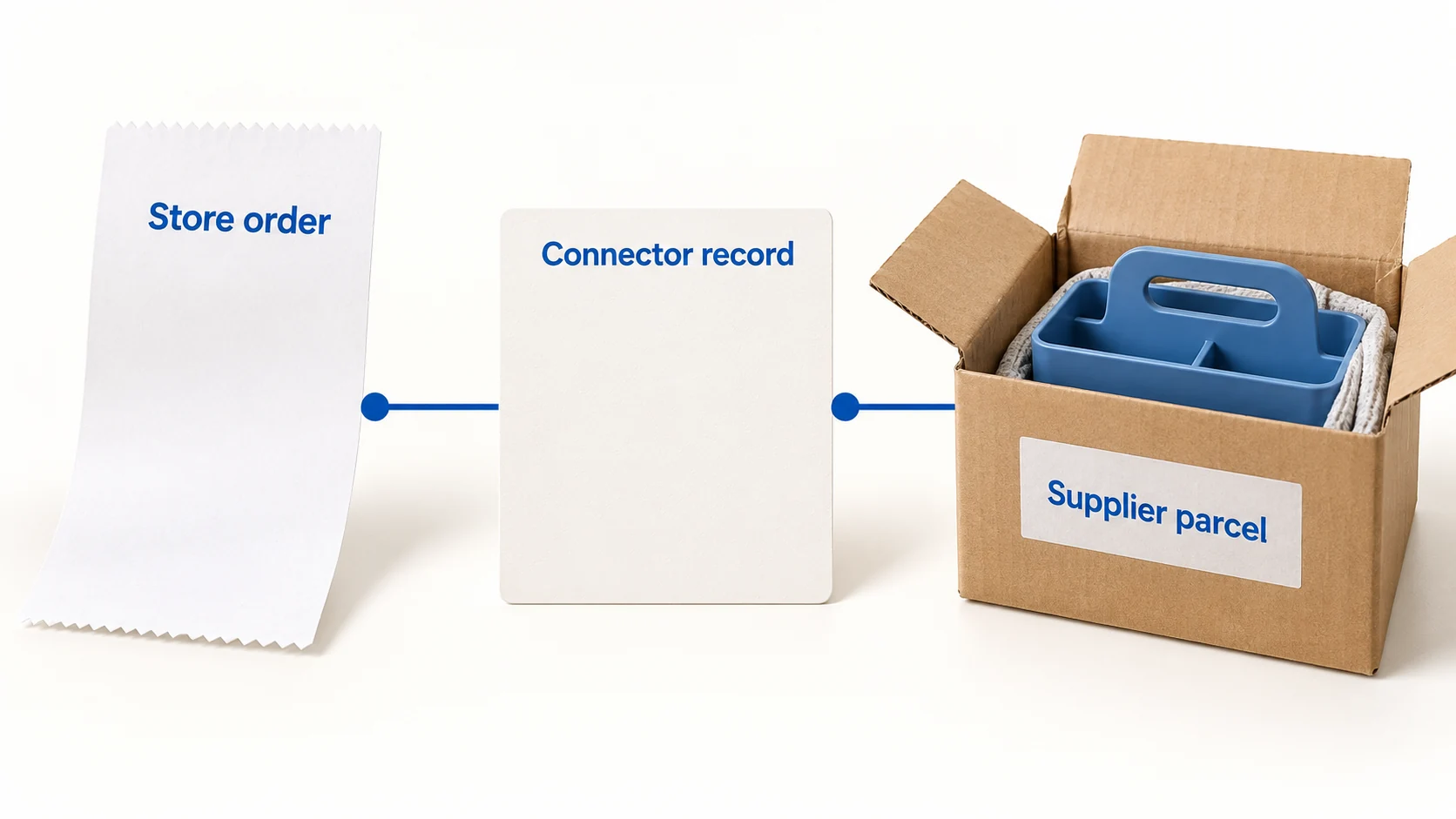
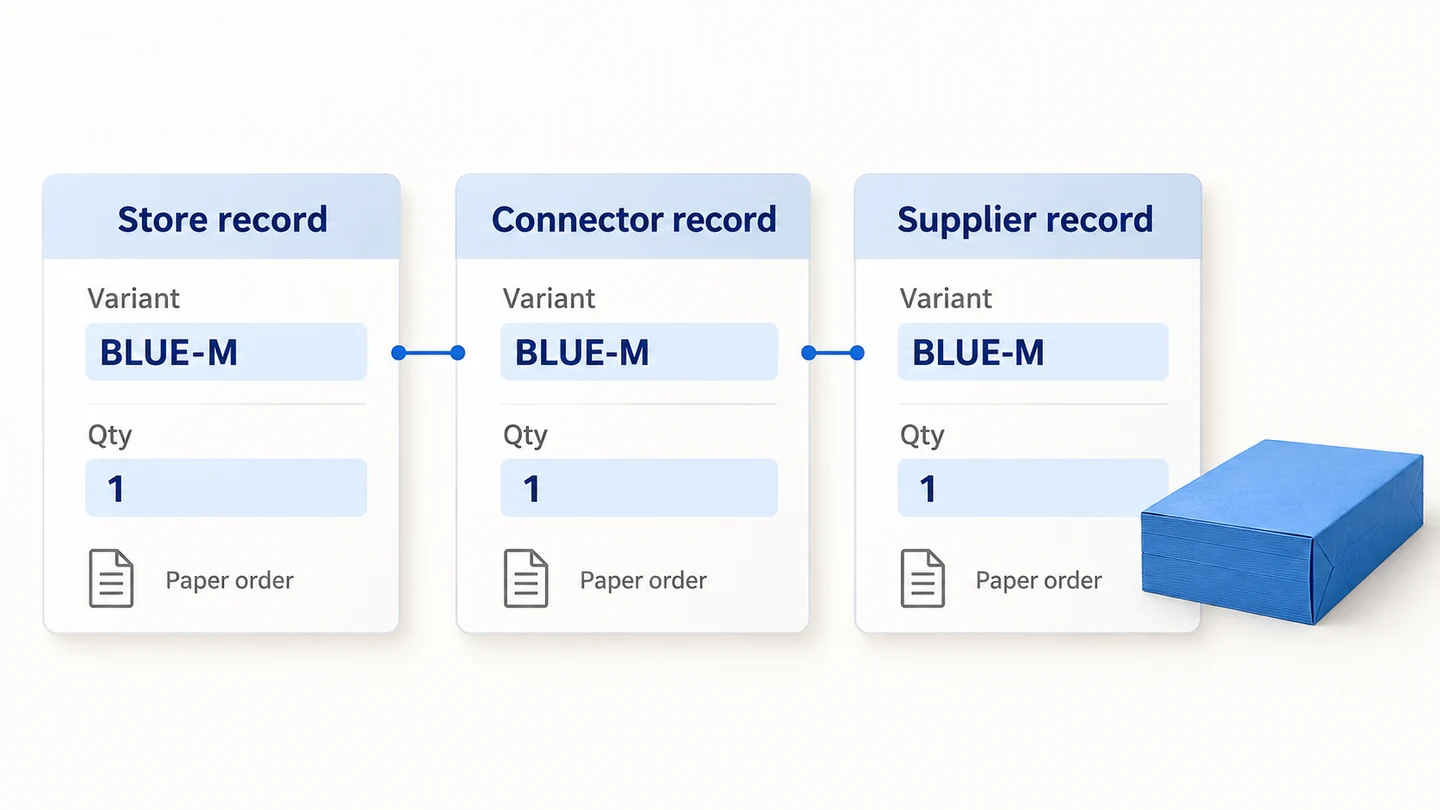
Think of a sale as three linked records: your customer’s store order, the software’s order record and the supplier’s fulfillment record. They need to describe the same variant, address and quantity. Matching the product title alone is not enough.
| Participant | Its job in this arrangement | What you should verify |
|---|---|---|
| Your store | Accept payment and make the customer promise | Variant, delivered price and delivery wording |
| Inventory Source | Connect catalog and order information | Correct supplier integration and order mapping |
| US Direct and its supply network | Charge and fulfill the supplier order | Acceptance, invoice, parcel and claim handling |
The US Direct overview currently describes a Full Automation plan for the connection, a free US Direct membership and optional paid membership features. Software expenses and supplier expenses therefore need separate checks. A current account quote is more useful than a review quoting an older subscription price.
For other US supply routes, see our US dropshipping supplier comparison. Use that broader choice before investing time in a connector that does not fit your store.
02
Check destinations and account requirements first
The US Direct site asks for business information such as a tax ID and resale documentation. Confirm the requirements for your business and selling channel before applying. Catalog access does not automatically grant permission to sell every brand on Amazon, eBay or another marketplace.
The shipping policy supports the lower 48 US states and excludes PO boxes. Use those actual restrictions in your shipping configuration. A Shopify checkout that accepts an unsupported address can collect money for an order the supplier cannot complete.
There is also an eligibility detail to clarify. The current Inventory Source overview says Full Automation is required, while US Direct’s FAQ describes some manual ordering under Inventory Automation. Ask which process your exact plan supports. Do not build a workflow around a button described in a different plan’s documentation.
The advertised catalog is a starting point for selection. Brand restrictions, product-specific limitations and account approval remain separate matters, as US Direct’s marketplace disclaimer explains.
03
Price a SKU after shipping and software
Choose one variant, one quantity and one representative customer address. Get the current goods price, shipping charge and any order fee. Then add your store’s payment fee and a reasonable planning allowance for problems.
Here is a hypothetical $49 sale. The $9.95 shipping figure is the published 1.01–5 lb tier checked for this review; the goods, order fee, software allocation and other figures are illustrations, not a supplier quote.
| Cost on this illustrative sale | Amount |
|---|---|
| Product | $24.00 |
| Published shipping tier used in the example | $9.95 |
| Assumed order fee | $2.00 |
| Store payment fee | $1.70 |
| Allowance for order problems | $2.00 |
| Allocated software expense | $4.00 |
| Total modeled cost | $43.65 |
| Amount left from $49 | $5.35 |
That remainder has to cover advertising, overhead and tax; it is not net profit. Ask whether the actual SKU’s weight and parcel qualify for that tier before putting $9.95 into your price sheet.
Software changes the economics at low volume. An illustrative $200 monthly subscription spread over 50 completed orders costs $4 per order; over 200 it costs $1. The bill does not fall just because your first month is quiet. Use your actual quote and a conservative order count, rather than a hoped-for sales target.
Delivery can also exceed the displayed flat amount. The shipping policy provides for extra charges where actual shipping is at least 50% above the charged rate, and heavy orders can be held for an actual quote. Price a bulky product with that possibility in mind. Our order-cost guide provides a fuller worksheet.
04
Connect one variant and trace one paid order
The overview’s setup sequence starts with an Inventory Source account, locating US Direct in its directory and adding the intended integration and plan. Follow the current instructions for your account rather than importing an entire catalog during onboarding.
Select an easy-to-identify variant with a stable product specification. Record the supplier SKU, store SKU, quantity and shipping address. In the store listing, inspect the live variant selector, price and availability on a phone as well as a desktop.
Use this small order record for the first transaction:
| Record | Example entry to replace with your real value |
|---|---|
| Store variant | BLUE-M, quantity 1 |
| Supplier SKU | Exact matching supplier code |
| Store order | Your customer order ID and payment time |
| Supplier order | Accepted supplier ID and payment state |
| Expected supplier bill | Goods + shipping + applicable fees |
| Shipment | Tracking number and its matching parcel |
US Direct’s FAQ describes paid orders moving through Inventory Source’s Order Manager and Dealer Portal. It also says payment should be authorized before capture in that process. Confirm the instruction for your channel and account; payment settings deserve a controlled test rather than an assumption.
After the test payment, verify that the supplier accepted the order and that the actual bill matches your worksheet. When tracking appears, check that it attaches to the correct store order. Finally, inspect the delivered product against the variant you purchased.
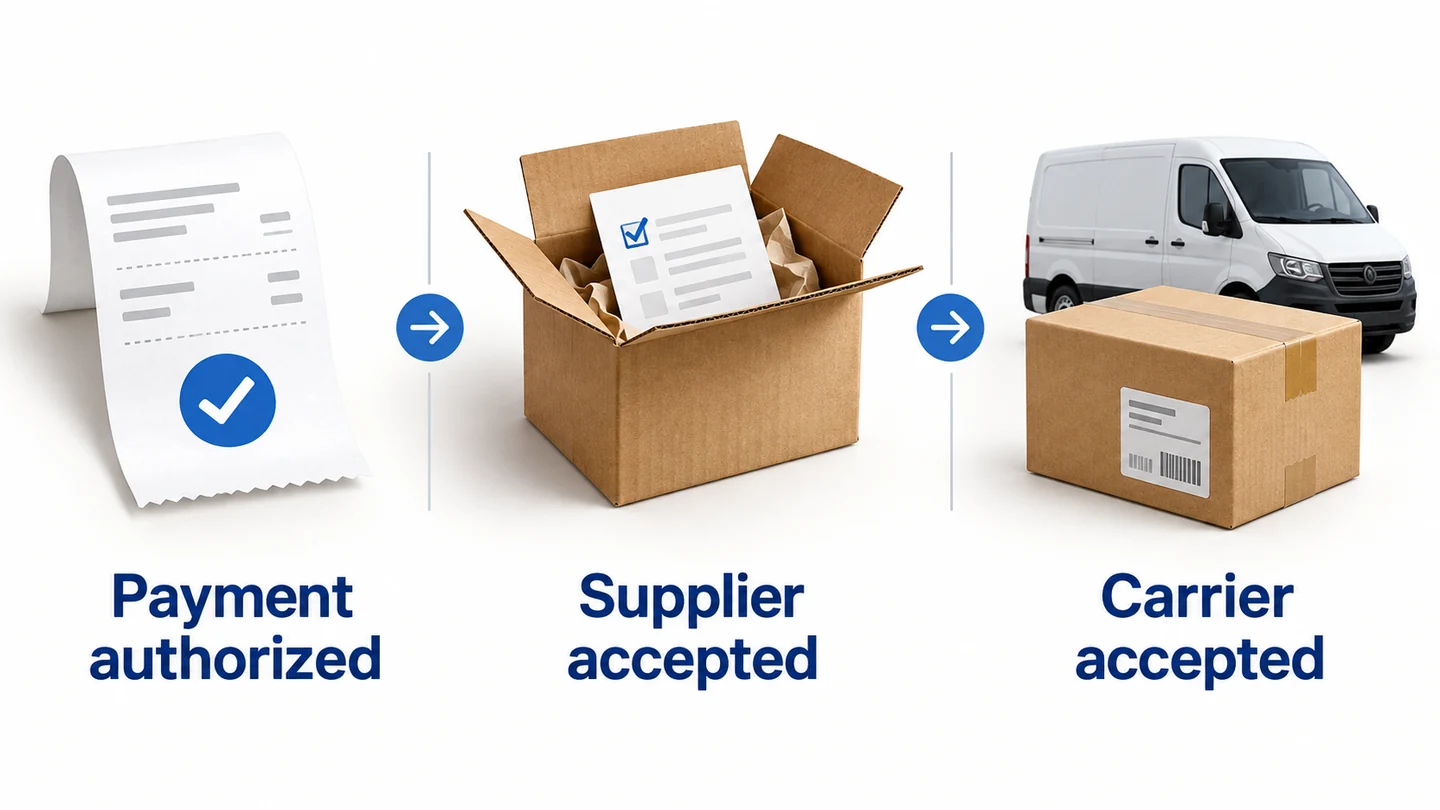
If the order is absent, work forward from the last confirmed event. An authorized store payment, a supplier acceptance and a carrier scan are different events. Recreating the order before checking the original can cause a duplicate shipment.
05
Write a delivery promise that includes processing
The shipping policy gives a 2–4 business-day dispatch window after a paid invoice and an expected 5–8 business days from order to arrival. The overview also uses a 3–5 day headline. Resolve which estimate applies to your selected supplier and product; do not simply choose the faster number.
Ask whether the estimate includes processing, when its clock starts, and whether the chosen warehouse can meet it. Put the confirmed scope into your listing and order confirmation. “US supplier” is not a substitute for a delivery window.
Inventory updates reduce manual maintenance, but a quantity in your store is not proof that stock is reserved for your customer. Inspect how quickly changes appear, what happens when a product reaches zero and whether a paid order can still be rejected. Record the event and response time during your trial.
For a first launch, avoid making your offer depend on the last few units of a fast-moving variant. A wider catalog gives you options, but it also creates more inventory relationships to maintain.
06
Understand the return before promising one
The US Direct return rules distinguish supplier claims from ordinary buyer remorse. They generally do not accept buyer-remorse returns. The stated claim window is 15 days for Honest Green and 30 days for other suppliers, with an RMA required before a return.
The page describes approval followed by a seven-business-day return window and default account credit, with a separate period to request a refund. Confirm the applicable supplier’s current instructions before sending a parcel. The return address and RMA must match the authorized case.
For damage, save the customer’s order ID, supplier ID, delivery date, parcel photographs and a clear photo of the issue. Explain to the buyer what your store will do next. A supplier’s limited reimbursement does not decide all of your customer-facing obligations.
Work out the financial gap before launch. If you choose to offer a change-of-mind return while the supplier does not, the cost may sit with your store. A margin that works only when every order is perfect is fragile.
07
Decide whether the automation earns its expense
Automation becomes useful when the work it saves is worth more than its bill and you can rely on the mapped order states. Estimate the time you currently spend updating stock, submitting orders and copying tracking. Then compare that with the actual subscription and the exceptions you still have to handle.
Proceed with a small range when one paid order is reconciled, your address restrictions work and your delivery and remedy terms are usable. Pause if order payment remains ambiguous or shipping surprises remove the margin. Importing more products cannot repair either problem.
If you are comparing US stock with a China-side sourcing arrangement, AIDrop can review the sourcing and fulfillment scope. Bring the SKU, destination, packed weight and expected volume. We can discuss sourcing, inspection and packaging coordination; this does not include administering a US Direct software account.
08
Common setup questions
Is US Direct the same company or product as Inventory Source?
They perform different jobs in the arrangement: supplier access and fulfillment versus catalog/order software. Verify both the supplier terms and the plan-specific connector process. Paying for one does not establish that every service from the other is included.
Can I sell these products on any marketplace?
No automatic permission follows from a catalog import. Check the selected brand, product category and channel requirements before listing. Keep written supplier authorization where the marketplace requires it.
Does discreet shipping mean my own branded packaging?
US Direct describes discreet or generic packing in its FAQ. That does not establish custom merchant packaging for every supplier or SKU. Inspect a sample parcel before promising a branded unboxing experience.
What if tracking has appeared but has no movement?
Check whether the carrier has actually accepted the parcel and how long it has been since the supplier’s stated dispatch event. A generated tracking number alone is not a delivery scan. Escalate with the two order IDs and latest confirmed event.
CJdropshipping Review: Costs, Warehouses, Quality and Fulfillment Fit
CJdropshipping is a practical option for sellers who want sourcing, store connections, packaging and fulfillment in one

CJdropshipping vs DSers: Who Sources, Pays and Ships the Order?
CJdropshipping can source and physically fulfill an order; DSers maps a store product to supported external suppliers

AutoDS Review: Evaluate the Automation You Would Actually Use
AutoDS can reduce listing and order work, but its value depends on your sales channel, tier, add-ons
