
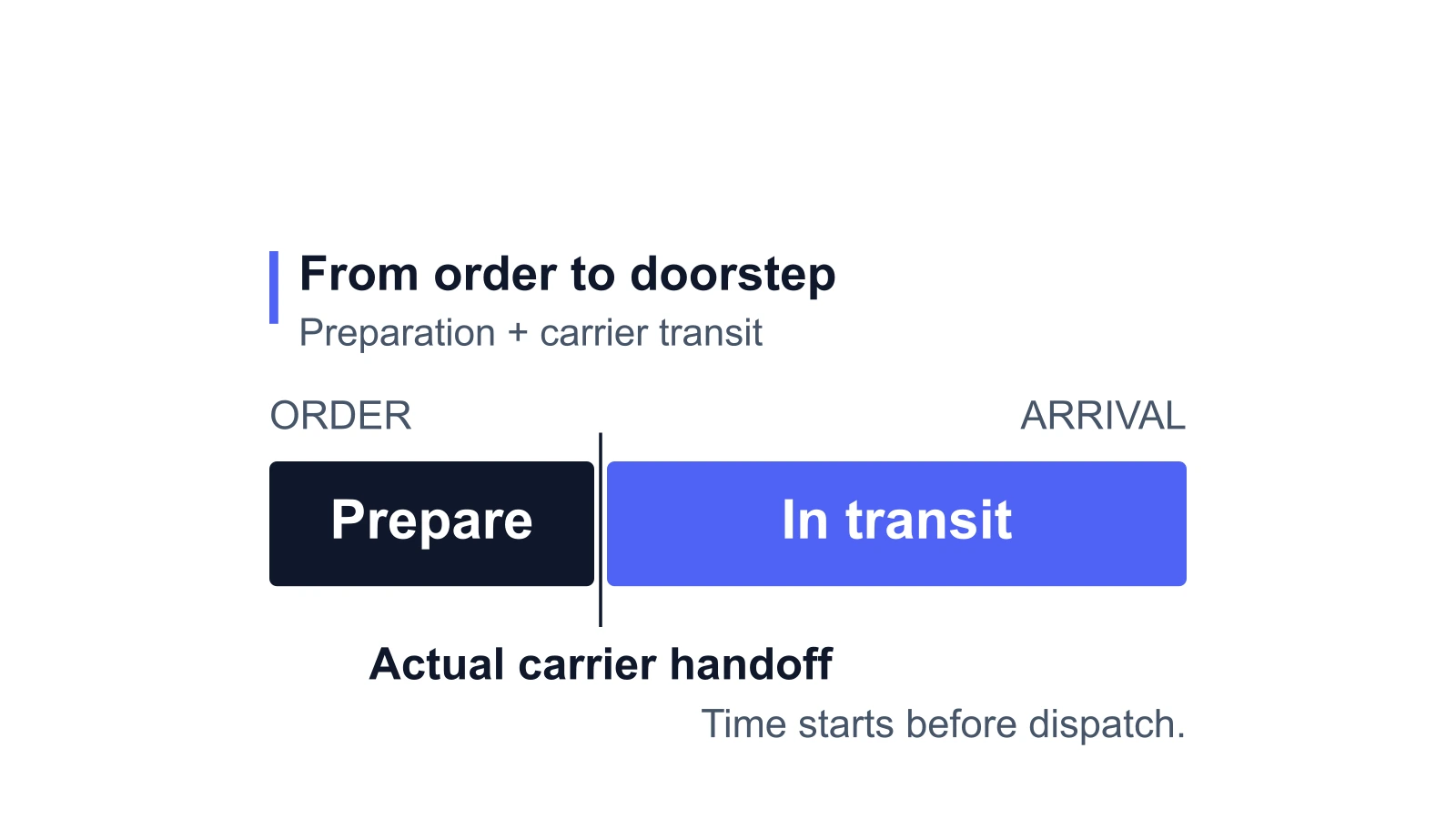
Dropshipping delivery can take roughly 4–8 business days for a named domestic supplier arrangement or 11–18 business days for a named China-to-US arrangement when routine processing and transit estimates are added together.
Those examples come from Zendrop’s published components. They are useful starting points for comparison, but they are not an industry-wide range or a delivery guarantee.
The number you put on a product page needs to match that product’s dispatch location, preparation time, destination and shipping service. A carrier’s transit estimate starts too late to describe the customer’s entire wait.
01
How long does dropshipping take?
These published examples show why the fulfillment arrangement matters. The totals below are simple sums of the stated components, checked in September 2026; they are not measured order-to-door results.
| Named arrangement | Processing or production | Shipping after dispatch | Routine component sum |
|---|---|---|---|
| Zendrop US supplier → US customer | 1–3 business days | 3–5 business days | 4–8 business days |
| Zendrop China fulfillment → US customer | 1–3 business days | 10–15 business days | 11–18 business days |
| Printful US fulfillment → US customer, standard domestic shipping | 2–5 business days | 3–4 business days | 5–9 business days |
- Zendrop publishes its US supplier processing and shipping estimates separately.
- Its China processing guidance gives the preparation component, while its US shipping-estimate explanation explicitly distinguishes US and China origins in business days. The processing pages allow for longer preparation during peak periods.
- Printful’s shipping page separates production from transit; its example is for print-on-demand, which includes making the product.
The Printful row applies to domestic US fulfillment and delivery. It does not cover a product made overseas and shipped to a US customer.
Use the table to identify the kind of arrangement you are evaluating. Before adopting a range, confirm the selected variant is actually available from that origin and that the stated service reaches your customer’s postal code. Cutoffs, holidays, a late supplier payment or an unavailable item can add time that a simple component sum does not capture.
02
Why the advertised shipping time can be misleading
A short shipping estimate may cover only the journey after dispatch. The customer has already been waiting while the order is reviewed, purchased from the supplier, prepared and handed to the carrier. Shopify’s fulfillment terminology distinguishes this preparation from transit when describing the full delivery time.
Check the starting event as carefully as the number of days.
- Does processing begin when the customer pays your store, when you pay the supplier, or when a customization file is approved?
- If an order sits unpaid in your fulfillment app overnight, that time still belongs to the customer’s wait even if it is outside the supplier’s processing clock.
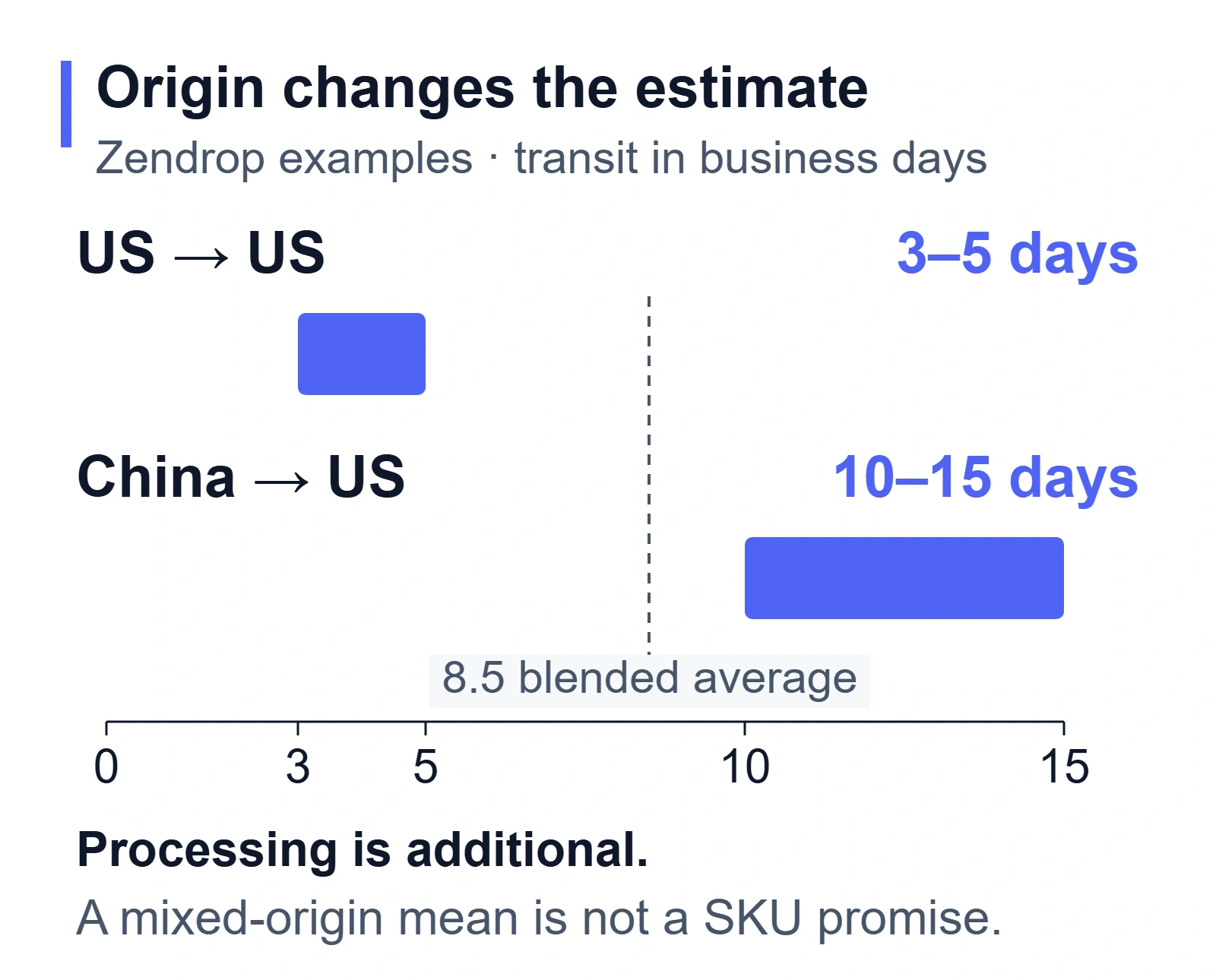
A blended average can also describe the wrong shipment. Zendrop explains that a displayed 8.5-business-day US shipping average combines shipments from different origins. Its stated US-to-US transit range is 3–5 business days; China-to-US is 10–15. The midpoint of a mixed pool is not a reliable promise for a particular China-origin product. Zendrop’s explanation of the blended estimate makes the origin distinction explicit.
When reviewing your own deliveries, compare the same origin, destination market and service over a stated period. Separate processing from transit so you can see where time accumulates. Keep overdue, undelivered parcels visible alongside completed deliveries; looking only at the parcels that arrived can make a troubled route appear faster than it is.
03
Get a quote you can use on the product page
Ask for a quote tied to the exact SKU and variant. A supplier’s general “US shipping” estimate is incomplete if one color ships domestically and another must come from China.
The useful details fit into one request:
- Product and origin: SKU, variant, quantity, current availability and actual dispatch location.
- Destination and service: country, postal code, shipping method and any product restrictions that affect the route.
- Processing: the event that starts the clock, the normal range, order cutoff, working days and local time zone.
- Transit: whether the estimate uses business or calendar days, when counting starts and which carrier calendar applies.
- Current exceptions: holiday closures, sourcing delays, peak-volume changes and whether the estimate already includes those effects.
Keep the reply with the date it was issued. When the origin or service changes, review the product-page estimate again. Spocket, for example, directs merchants to the processing and shipping times on each product listing, rather than treating its marketplace as one uniform delivery service.
- A test order can expose a wrong variant, an unexpected handoff or preparation that starts later than expected. It cannot establish a reliable upper limit by itself.
- Use it to check how the quoted process works, then assess repeated orders on the same route before narrowing the promise.
For a managed route review, provide the packed product details and destination to AIDrop’s global shipping service. The useful output is a product-specific route and estimate; this article does not establish an AIDrop delivery SLA.
Compare the price alongside the estimate. The shipping-cost guide explains how parcel size, destination and additional charges change the cost of the route you are considering.
04
Turn business days into a customer delivery window
Business-day arithmetic needs a calendar. The order cutoff, supplier working days, carrier working days and holidays can all move the expected date. Shopify’s fulfillment-time guidance includes preparation through carrier handoff, so creating a label is not the end of that interval.
Consider an illustrative order placed on Thursday after the supplier’s cutoff.
- For this example only, both the supplier and carrier use Monday–Friday working days in UTC+8, with no holidays.
- Processing takes two business days, beginning on the next working day.
- The carrier takes three to five business days, counted from the day after actual handoff.
| Event | Day in this illustrative calendar |
|---|---|
| Customer orders after cutoff | Thursday |
| Processing day 1 | Friday |
| Processing day 2; actual carrier handoff | Monday |
| Transit day 1 | Tuesday |
| Transit day 3; earliest estimated arrival | Thursday |
| Transit day 5; latest estimated arrival | Following Monday |
The customer ordered on Thursday and could receive the parcel from the next Thursday through the following Monday under these assumptions. Two processing days plus three to five transit days do not mean “arrives in three to five days” from checkout.
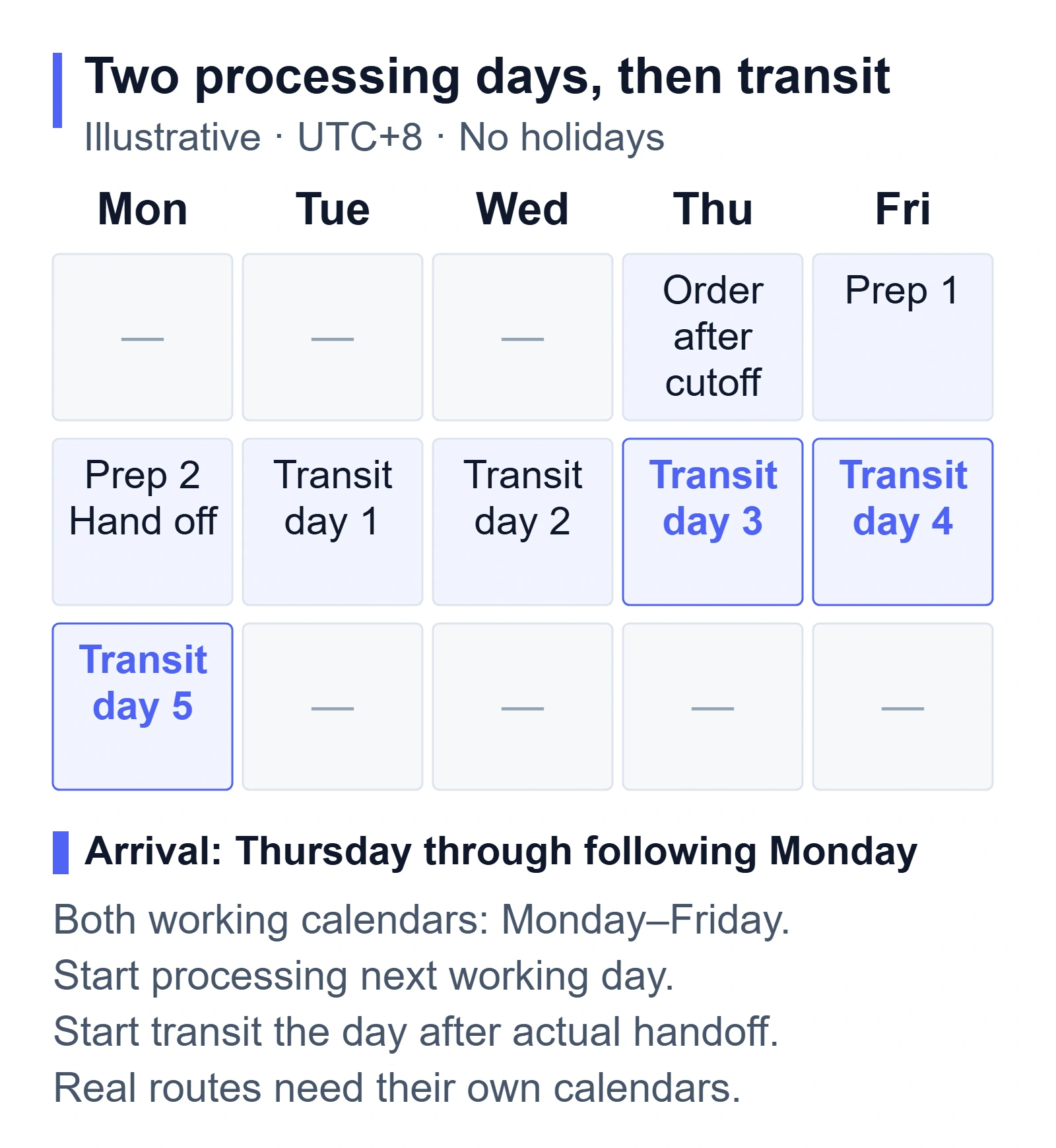
For a real shipment, use the calendars and counting rules in the quote. An overseas supplier and destination carrier may observe different holidays or time zones; the shared UTC+8 calendar above is only a teaching example. Convert the resulting dates to the customer’s local calendar before displaying them. Do not copy this example into a shipping policy as a standing promise.
05
Shorten the stage that is actually taking time
If orders spend most of their time waiting for stock, a faster carrier leaves that delay intact. Zendrop’s China processing explanation describes sourcing and movement into the fulfillment warehouse before preparation finishes. For your own arrangement, ask whether the selected variant is ready to pack or still needs to be obtained.
The guide to reducing dropshipping shipping times explains how to locate the delay and choose a change that addresses that stage before paying for a faster service.
- When preparation is the bottleneck, check supplier payment timing, unresolved variant selections, packaging approvals and stock availability. Clear the recurring cause before paying for a transit upgrade. The wider dropshipping supply chain helps place those handoffs in context.
- When transit is the bottleneck, compare services for the same packed parcel and destination. Check the actual quoted improvement, price and product eligibility. “Express” does not describe the preparation stage, and a route name alone does not establish an arrival date.
Holding proven products closer to demand can change the delivery calculation, but it introduces inventory and replenishment costs. Warehousing and 3PL options become relevant when stable demand justifies allocating stock in advance. A warehouse address is useful only if the right variant is physically ready there; a catalog listing does not prove that availability.
06
Explain the promise before checkout—and update it when it changes
- Show the estimate where customers choose the product and shipping option.
- Keep the order confirmation consistent with it.
- If some items ship separately, explain that each parcel can arrive on a different date.
For an illustrative product with confirmed two-business-day processing and three-to-five-business-day transit, customer-facing wording could read:
We prepare this item within two business days after your order enters processing. Delivery is estimated at three to five business days after carrier handoff. Orders placed after our stated cutoff begin processing on the next working day. See the shipping policy for the applicable working days and holiday schedule.
Replace those conditions with the actual product’s terms. If your checkout can show a correctly calculated arrival-date window, that may be easier to understand than asking the customer to add two intervals. Check that the calculation includes fulfillment time rather than displaying transit alone.
Use the shipping policy guide to turn the confirmed processing, transit, cutoff and destination conditions into terms customers can understand before they order.
When an estimate is at risk, establish which stage is delayed before sending an update.
- An item still awaiting stock needs a different explanation from a parcel already moving through the carrier network.
- State what you have verified, what action is underway and when you will provide the next update.
- Give a revised arrival date only when the current evidence supports it.
After dispatch, use the dropshipping tracking guide to interpret carrier events and investigate missing scans. That investigation should inform the next customer message; repeating the original delivery range does not explain a missed estimate.
07
Shipping-time questions
Can a dropshipping order arrive within two weeks?
Some arrangements can, but confirm whether “two weeks” means calendar days. The named domestic example above may fit; the China-to-US example can exceed it once processing and nonworking days are counted. Use the exact SKU’s route and calendar rather than the supplier’s blended average.
Do weekends count toward the estimate?
Only if the quoted calendar includes them. A business-day processing estimate and a carrier’s delivery schedule can use different working days. Confirm both, including holiday closures and cutoff times.
Will express shipping remove the processing time?
An upgraded carrier service changes the quoted transit segment. It does not automatically remove time spent sourcing, producing, checking or packing the order. Ask which stage the upgrade shortens before offering a faster total delivery window.