

Dropshipping dimensional weight charges for the space a packed parcel occupies. A 2 kg lamp box can therefore be priced above 2 kg. Measure the sealed outer box, apply this service’s divisor and rounding, and compare the result with the scale weight—not the product’s unboxed dimensions.
Start with the finished parcel, including protective material and outer carton. Product dimensions from a supplier catalog are not enough. The shipping-costs guide compares whole parcel quotes; this article investigates one frequent reason a quote changes after the parcel is packed or remeasured.
Explore the broader topic: Dropshipping Shipping Times: What to Promise Your Customers.
01
Calculate from the outer box, then compare with scale weight
Use the selected service’s calculation
Carriers commonly compare actual scale weight with a volume-based weight and charge using the higher applicable figure, but the formula, units, rounding, minimums and exceptions vary. DHL eCommerce’s US chargeable-weight guide, for example, explains the comparison and gives a centimeter divisor of 6,000 for its stated service context, along with a domestic small-volume exception. Do not transplant that divisor or exception to every DHL, FedEx, postal or local route.
Calculate the 4 kg example
Here is a hypothetical calculation using a 6,000 cm³/kg divisor and a carrier that, in this example only, rounds the final billable weight up to the next 0.5 kg. A boxed lamp measures 40 × 30 × 20 cm and weighs 2 kg. Volume is 24,000 cm³; dimensional weight is 24,000 ÷ 6,000 = 4 kg. The greater of 4 kg and 2 kg is 4 kg, so the example billable weight is 4 kg before any other service rule or surcharge.
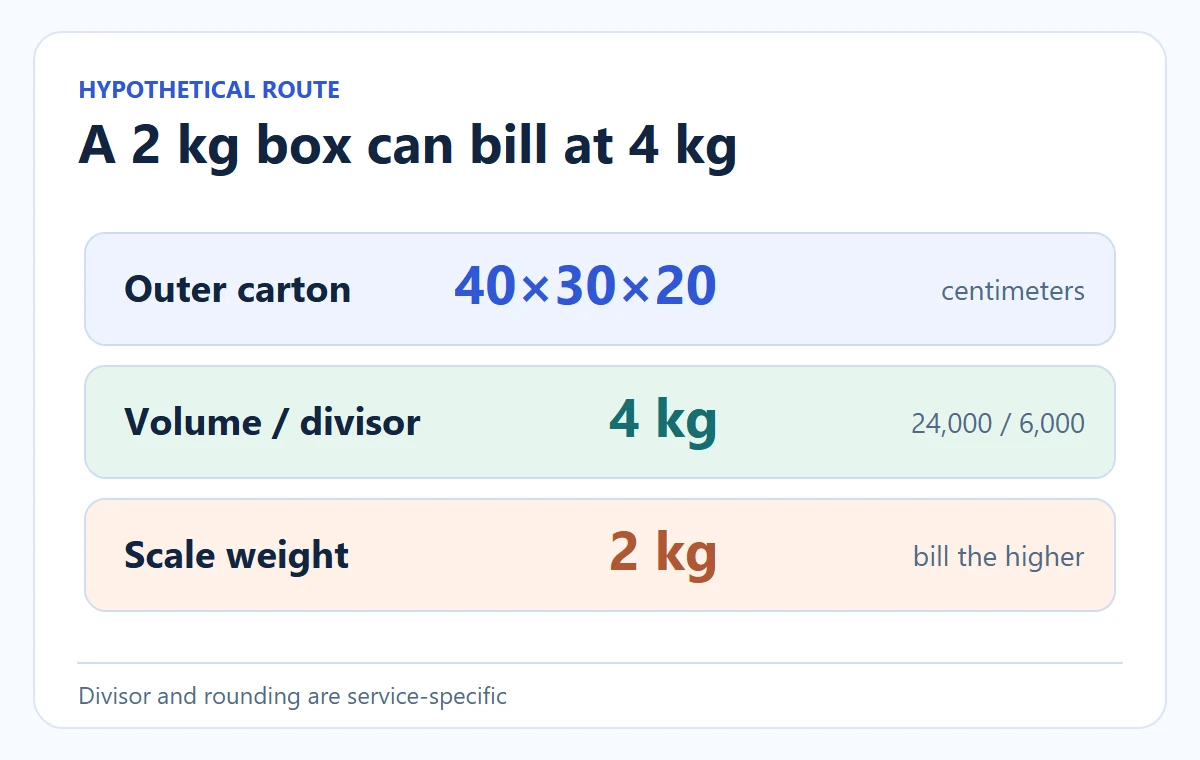
| Measurement on the finished parcel | Example value | Why it matters |
|---|---|---|
| Outer length × width × height | 40 × 30 × 20 cm | Carrier measures the box, not the product listing |
| Actual scale weight | 2 kg | Compare with dimensional result |
| Dimensional calculation | 24,000 ÷ 6,000 = 4 kg | Route-specific divisor is an explicit assumption |
| Example chargeable weight | 4 kg | Higher of actual and dimensional before other rules |
Find the missing packed-box measurement
If the supplier quoted shipping from an estimated 2 kg product weight, the difference is not an arithmetic mystery. The quote omitted the finished box’s space. A service may also remeasure the parcel and use its own dimensions, so keep your packing measurement and the carrier’s later record.
Measure the outside of the sealed carton at its longest points, not the product’s unboxed size or the printed carton specification. If a bulging side makes the parcel 22 cm high instead of the planned 20 cm, the example volume becomes 40 × 30 × 22 = 26,400 cm³, or 4.4 kg at the illustrative divisor. Under the hypothetical half-kilo rounding rule, that could move the billable tier from 4.0 to 4.5 kg. Two centimeters matter only because this particular parcel is near a tier edge; confirm the actual service’s measurement and rounding policy before pricing around it.
Convert millimeters before using a centimeter divisor
Keep units explicit in the quote request. A supplier may send millimeters, centimeters or inches; a carrier page may show a divisor for different units. 400 × 300 × 200 mm and 40 × 30 × 20 cm describe the same box, but a spreadsheet that divides the millimeter product by a centimeter divisor will be wrong by a factor of 1,000. Write the conversion beside the source measurements and make one person verify it on the sample parcel.
A worksheet for one packed parcel
Use the article’s hypothetical service: centimeters and kilograms, divisor 6,000, and final billable weight rounded up in 0.5 kg steps. It assumes no exception, minimum or oversize override. Do not apply this teaching rule to a different carrier contract.
Enter the six inputs
B2 length 40 cm; B3 width 30 cm; B4 height 20 cm; B5 gross scale weight 2 kg; B6 divisor 6000; B7 billing increment 0.5 kg. =IF(OR(COUNT(B2:B7)<>6,MIN(B2:B7)<=0),"HOLD",CEILING(MAX(B5,B2*B3*B4/B6),B7)) returns 4 kg.
Try the failures
Replace height 20 with 22: 4.4 rounds to 4.5 kg under this assumption. Leave a measurement blank or make the divisor zero: HOLD. If the supplier sends 400 × 300 × 200 mm, convert to 40 × 30 × 20 cm first; never put millimeters into this centimeter formula.
DHL eCommerce’s quoted 6,000 guidance also has a US domestic small-volume exception; it is not this universal worksheet. DHL Express instead typically cites 5,000. The same 24,000 cm³ box yields 4.8 kg before that service’s actual rounding. With the teaching half-kilo step only, it would become 5 kg. Confirm dimensions rounding and tariff exceptions separately.
02
Ask the supplier for the packed specification
Ask for the exact packed variant
Request the outer carton dimensions, gross weight, packaging version, number of units per parcel and any bundling rule for the exact SKU. If the supplier switches to a larger carton, adds protective material or splits one order into two boxes, your old quote may no longer apply. A lamp that looks unchanged to the customer can become more expensive to deliver because the packaging footprint changed.
Tie measurements to a packaging version
Save one record for the approved sample parcel: supplier item/version, packed length/width/height, measured gross weight, photo with measurement scale if available, route, carrier service and quote reference. On a later shipment, compare the actual carton with that reference. This is a useful place for AIDrop-style China-side packing coordination: the unit you need to inspect is the parcel that crosses the carrier counter, not an artist’s rendering of the product. The packaging guide covers protection and specification control; a smaller box is beneficial only if it still protects the goods.
A smaller box is a test, not an automatic saving
Quote the smaller protected box
Suppose a safe packaging trial reduces the lamp box to 35 × 25 × 15 cm while its scale weight stays 2 kg. Volume is 13,125 cm³; at the same illustrative divisor, dimensional weight is 2.1875 kg. With the example half-kilo rounding rule, it would bill as 2.5 kg. If the carrier quote for this specific route fell from a hypothetical $18 at 4 kg to $11 at 2.5 kg, the parcel would save $7 before any packaging or damage cost. These dollar amounts are not carrier or AIDrop rates.
Check protection alongside freight
Run a drop/handling or other appropriate protection check for the actual product before adopting the smaller carton. If a tighter box produces more broken lamps, a $7 freight saving can disappear in refunds, replacements and customer support. Measure both shipping variance and damage rate on a controlled pilot; do not optimize a formula while ignoring the product.
Measure three repeatable sample parcels
Before ordering a new carton, test whether the supplier can pack the lamp consistently at 35 × 25 × 15 cm for the same product version, plug or adapter, cushioning and labeling. Record three actual sample parcels, not one carefully compressed demonstration. If the first passes but the next two require an extra centimeter or protective layer, the new rate tier may not be repeatable. Ask the carrier for a quote using the measurements it will accept, then compare the first live invoice. The packaging decision has a savings hypothesis and a damage limit; both need observed results.
03
Reconcile the quote with the final carrier charge
Separate dimensions from other surcharges
Keep the quote and final invoice on the same order line. Match parcel ID, service, destination, packed dimensions, scale weight, divisor or tariff rule, chargeable weight, base price and surcharges. A higher invoice could be a dimension correction, a different destination zone, an address adjustment, an oversize rule, fuel or demand surcharge, duties arrangement, or a second parcel. Do not label every difference “dimensional weight” before checking the billing line.
Reconcile the 4 kg quote and 5.5 kg bill
For the hypothetical lamp, a useful discrepancy record is: Supplier quoted 40 × 30 × 20 cm, 2 kg actual, 4 kg chargeable at service X. Carrier billed 45 × 32 × 22 cm and 5.5 kg chargeable. Request carton photo, carrier dimension event and exact tariff/rounding method before accepting or disputing adjustment. Under the same 6,000 divisor, 45 × 32 × 22 = 31,680 cm³ and dimensional weight is 5.28 kg; a hypothetical half-kilo rounding rule could yield 5.5 kg. The difference is plausible mathematically, but the measurements and service rules still need evidence.

Update the quote when packaging changes
Check the timing too. A quote may be given before the supplier picks a box; an invoice arrives after carrier remeasurement. If you receive many adjustments, update the SKU’s approved packed dimensions and quote process rather than manually absorbing surprises forever. The shipping-rates article explains how those actual parcel costs feed back into checkout charges.
Make the dispute or correction request specific. “Carrier charged too much” is weak; “Parcel #P-1042 was quoted at 40 × 30 × 20 cm and 4 kg chargeable, while the invoice uses 45 × 32 × 22 cm and 5.5 kg. Please provide the measurement event, service tariff and surcharge lines” gives the carrier or supplier a checkable question. If the carrier measurement is right because the packer used a larger box, fix the packing specification or future quote. If it is wrong under the applicable contract, use the carrier’s documented adjustment process and keep its decision beside the invoice. Do not overwrite the original invoice number in your cost sheet.
04
Test products that are light, bulky or fragile first
Measure light, bulky variants first
Dimensional weight matters most when the package occupies substantial volume compared with its scale weight. Fragile lamps, pillows and large decorative items can be affected, but product category alone is not enough to decide. Measure the approved packed carton for the specific variant and route. Two sizes of the same product can cross different tariff thresholds. A bundle can use one larger box or two separate parcels; compare both options, including the customer’s delivery expectation and damage risk.
Quote single, bundle and largest-variant cases
Before listing a new item, run three quote cases: one unit to the main market, two units in the actual bundle/packing arrangement, and the largest or most awkward variant. Ask the supplier whether its quote includes the carton, handling, remote-area charges and the agreed duty/tax arrangement. Record what the carrier could still adjust. Then place a controlled shipment and compare its final invoice with the estimate. A calculator is useful only after the physical inputs and service rules are verified.
Calculate a bundle per actual parcel
For an illustrative two-lamp order, assume each lamp needs its own 35 × 25 × 15 cm carton at 2 kg actual, with the same hypothetical 6,000 divisor and 0.5 kg step. The calculation applies to each parcel, not the checkout’s item count.
Two separate cartons
Each carton’s dimensional result is 2.1875 kg, rounded to 2.5 kg. Two billable parcel weights total 5 kg for the weight comparison. Quote each shipment and its applicable minimum/surcharges separately; 5 kg is not itself a freight price.
One consolidation proposal
Adding the two raw dimensional results and rounding once gives 4.5 kg, which understates the separate-carton example. If the packer proposes one shared carton, measure that carton anew, including protection, and compare its actual service quote and damage test. Do not assume a one-box plan from a two-item order.
Close the pilot by comparing approved packaging, measured parcels and the carrier invoice. A lower predicted tier is useful only when the supplier can repeat it safely and the chosen carrier accepts those dimensions.
Protect the already-paid buyer’s terms
If the final charge changes after launch, review both sides of the order. The customer already paid a particular shipping amount under your store policy; a supplier or carrier adjustment is not automatically a new charge you can pass to that buyer. Use the variance to correct future pricing or packaging, and reconcile the paid order under its original terms.
If AIDrop Agent would pack or ship your goods from China, send the product SKU, sample dimensions, packed carton dimensions if known, destination and intended service through the review form. We can help identify what the quote must measure and where a test parcel is worth doing. Actual billable weight and price require the chosen route’s current tariff and physical parcel.
05
Frequently asked questions
Is dimensional weight the same as actual weight?
No. Actual weight comes from the scale; dimensional weight estimates the space a parcel occupies under a service formula. The carrier applies its own chargeable-weight rules, often using the higher figure, subject to route-specific exceptions.
Can I use one divisor for every shipping line?
No. Verify the units, divisor, rounding, minimums and exceptions for each carrier service and account. A formula from one carrier page or quote is not a universal rate card.
Why did the final invoice exceed my supplier’s shipping quote?
Compare the actual parcel and billing lines with the quote. The box may be larger, the service or zone different, another parcel added, or a surcharge applied. Ask for measurement and tariff evidence before changing product price or disputing the charge.
Dropshipping Shipping Times: What to Promise Your Customers
Use product-specific processing and transit estimates to set a delivery promise. Named route examples and a worked
Dropshipping Shipping Costs: Compare the Whole Parcel Quote
Calculate dropshipping shipping costs from packed dimensions, billed weight and fees. Compare a worked parcel quote, import
Dropshipping Tracking: Set It Up and Handle Missing Updates
Set up parcel-level tracking, interpret carrier events, and investigate missing updates without mistaking a shipping label for
