
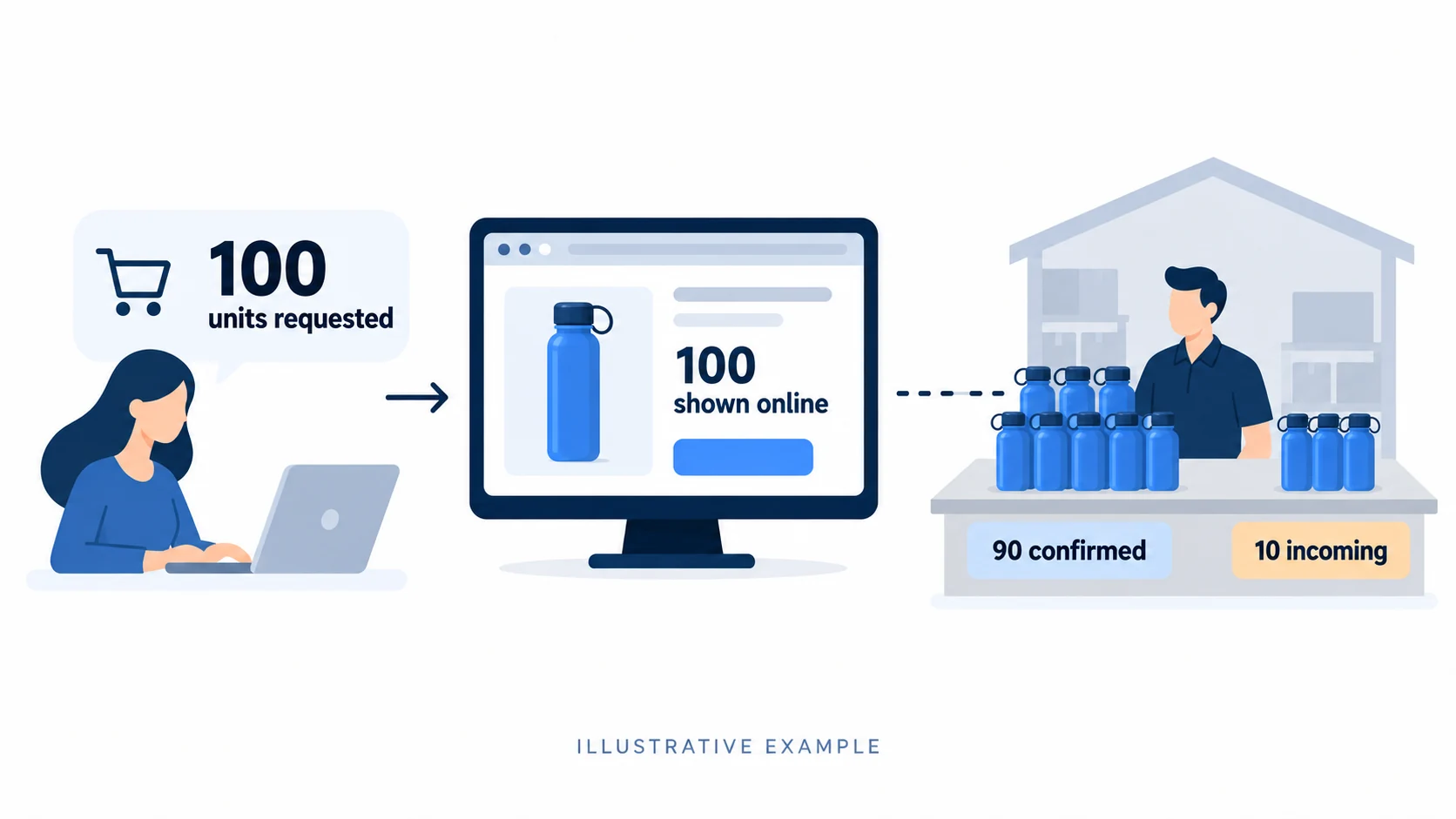
Yes, you can take a dropshipping bulk order from one buyer, but quote it only after the supplier confirms usable units, price, allocation and a delivery route that meets the buyer’s terms. A buyer might ask, “Can you supply 100 blue bottles, give us a better price, and deliver them next week?” The 100 shown on your product page are not automatically set aside for that order.
For one buyer placing a large order, first confirm the exact product and usable quantity, then get a dated supplier quote and a delivery plan for the whole order. Calculate what the buyer’s discount does to your margin and how much cash you need before the buyer pays the balance. Quote when those pieces are supported; hold while a material answer is missing; reprice or decline if you cannot meet the numbers or the promised date.
This is different from an app’s “bulk fulfillment” button, which may process 100 separate customer orders at once. Here, one customer expects one commercial agreement, even if the goods eventually travel in several cartons.
The buyer’s requested 100 units are also different from the supplier’s minimum order quantity: the latter is the least the supplier will sell you under its terms. Check both numbers before assuming a quantity discount.
Explore the broader topic: Dropshipping Fulfillment: From Paid Order to Delivered Parcel.
01
Start with the exact thing the buyer wants
Specify each variant before quoting
Ask for the product, variant, quantity, destination and any required packaging. “100 bottles” is not enough if 60 must be blue and 40 white, or if the buyer wants a particular lid, label or carton. Put each variant on its own line. The approved sample or specification should identify what the supplier is allowed to send, especially if the buyer will resell the goods.
Does the buyer accept split delivery?
Also ask whether the buyer needs all 100 units together. A conference organizer might have no use for the final 20 bottles arriving after the event. A retailer replenishing shelves might accept two deliveries. That answer changes both the shipping quote and what counts as an acceptable order.
Shopify’s B2B quantity rules illustrate why variants matter: a quantity rule or volume price break can apply to each variant, rather than to the combined cart. The store’s rule is only a checkout setting, though. It does not establish that your supplier has agreed to sell or reserve those particular units.
Write down before pricing: 100 units of the named variant, approved sample/version, packaging requirement, complete ship-to address, requested date, and whether separate deliveries are acceptable. If the buyer has not decided, your quote should say which assumptions it uses.
02
Find out whose “100 in stock” they are
A product page showing 100 available units can hide several very different situations. Your own warehouse may physically hold them. A supplier app may have imported a count that changes later. Ten might be inbound rather than ready to ship. A seller cannot make the third-party supplier’s goods available simply by creating a draft order.
Ask the source that will actually fill this order for a written, dated answer:
- How many units of the exact variant are ready and saleable now? Are any already promised to another buyer?
- Will the supplier allocate those units to this order, and until when? If production or replenishment is needed, what is its confirmed completion date?
- What happens if inspection rejects some units? Can the supplier replace them before the buyer’s deadline?
100 counted can mean only 85 usable
Suppose the supplier reports 100 blue bottles on hand. Ten are already committed to another customer, so only 90 may be available. If inspection then holds five of those 90, there are 85 usable units, not 100. Another ten due next week are incoming, not ready. Ask the supplier to allocate the 85 to this buyer and give a dated plan for the other 15. If the buyer needs all 100 before an event, the missing 15 changes the quote or the route; a store inventory number cannot resolve it.

Shopify’s inventory states distinguish available, committed, unavailable and incoming stock. Its draft-order reservation can reserve tracked on-hand inventory in the store. That feature is useful if the merchant controls those units, but a store reservation is not an allocation at an outside supplier. Save the supplier’s actual confirmation next to the buyer quote, and recheck it when the quote expires.
Reserve only stock you actually control
If these are your tracked on-hand bottles, the documented Shopify desktop route can reserve them for a draft. It does not reserve goods at an independent supplier.
Reserve with an expiry
Go to Orders → Drafts and open or create the draft. Add the exact variant and agreed quantity. Open its more-actions menu → Reserve inventory, set an expiry date/time and click Done. Inventory tracking must be active.
Check both stock records
Reopen the draft and compare the reservation and expiry with the quantity you control. Separately keep the supplier’s allocation confirmation and expiry. If only 85 inspected units are available, a saved draft for 100 does not provide the other 15.
Do not increase store inventory to hide the shortage. The 85-unit example above is hypothetical; it does not record an actual reservation.
03
Quote the delivered order, not only the unit price
The supplier’s per-unit price is the start of your cost, not the whole cost. Ask how many cartons will be packed, their approximate dimensions and weight, where they will ship from, and what the freight quote covers. A destination change or packaging change can alter the number. Identify who is responsible for import charges, tax, damaged cartons and replacement units where those issues apply. Do not hide an unresolved cost inside “shipping included.”
Copy this request and fill in the destination
A useful supplier request is concrete: “Please quote 100 units of variant B-204 to this destination, packed to the approved sample. State available quantity, unit price, carton count and dimensions, freight service and price, dispatch date, quote expiry, and how shortage or damage is handled.” This is a request for a real quote, not a claim that every supplier will accept those terms.
Give the buyer the same complete offer
Keep the buyer quote equally specific. Show the item and quantity, buyer price, what shipping covers, payment terms, expected dispatch, whether cartons can arrive separately, and the date the offer expires. If the buyer changes the variant, address or deadline, price it again. Shopify’s B2B draft-order documentation shows how a seller using that setup can record a negotiated line price, PO number and invoice. The draft records your proposed sale; it does not lock the supplier’s price or stock.
Record the agreed buyer quote in a B2B draft
For a store using Shopify’s B2B setup, its draft-order instructions let the merchant retain company details, negotiated price and a PO number.
Prepare the quote
Open Orders → Drafts → Create order. Select the B2B customer and correct company location; add the exact bottle variant and quantity. Enter the agreed line price, shipping and terms. Add the buyer’s PO number if supplied—do not invent one.
Save and inspect
To preserve the buyer’s quoted product price, use Products → More actions → Lock product pricing and Save. Reopen to inspect quantity, line price, lock symbol, destination and totals. Review any invoice before an authorized send; saving it is not payment or a supplier purchase.
A buyer-price lock does not lock the vendor’s cost or reserve its stock. Use the quotation’s actual expiry and obtain the supplier confirmation before release.
A supplier discount needs a written offer
Do not assume that a larger buyer order earns you a supplier discount. Ask for one in writing. Until it appears on the supplier’s quote, the cost sheet should use the price you actually have.
04
See what a 10% discount does to one order
Here is a made-up order, in US dollars, to show the calculation. None of these prices, payment charges or deposit terms is an AIDrop rate, supplier offer or industry average. The buyer wants 100 identical units; the un-discounted selling price would be $30 each. Assume the supplier quotes $18 each, and the five cartons cost $8 each to handle and $20 each to ship. For this illustration only, assume the payment provider charges 3% of the sale plus $0.30 for the single payment.
Buyer pays
Full price: $3,000; 10% off: $2,700
Supplier: 100 × $18
Full price: $1,800; 10% off: $1,800
Carton handling: 5 × $8
Full price: $40; 10% off: $40
Freight: 5 × $20
Full price: $100; 10% off: $100
Assumed payment charge: 3% + $0.30
Full price: $90.30; 10% off: $81.30
Contribution before other costs
Full price: $969.70; 10% off: $678.70
The contribution falls by $291
The buyer’s $300 discount reduces this simplified contribution by $291, not $300, because the assumed percentage payment charge falls by $9. The supplier bill and carton costs do not fall in this example. Your real calculation must add any applicable overhead, customer service, returns, duties, tax and other charges before you call the order profitable. It must use an actual carrier and supplier quote, not these invented numbers.
An $810 deposit leaves a $990 supplier gap
Cash timing is a separate test. Suppose the buyer and seller negotiate a hypothetical deposit equal to 30% of the discounted $2,700 product subtotal. That brings in $810. If the supplier requires the assumed $1,800 before releasing the goods, the seller must find at least $990 more even before paying for cartons and freight. A positive contribution on paper does not pay today’s invoice.
Use the deposit feature only where supported
There is no standard 30% deposit being recommended here. Your real agreement and payment route decide whether a deposit is possible and when the balance is due. For example, Shopify documents that its percentage deposit requirement on a B2B draft order is available only on Shopify Plus and is calculated on the product subtotal, excluding shipping and tax. Other stores need to check their own payment and invoicing options. If the cash gap fails your business’s limit, negotiate different terms that both parties accept, reprice, or decline. The broader cash-flow guide helps map several orders and due dates; this quote needs its own funding answer first.
05
Promise a shipment you can explain
Before quoting “next week,” ask whether the buyer means collection or delivery. Record the latest acceptable arrival date, then work backward through:
- Supplier allocation or production, with its confirmed ready date.
- Final inspection against the approved sample, then packing.
- Carrier collection, transit and any border processing.
For a firm deadline, ask the carrier which service and cutoff could support it. Keep any unconfirmed conditions visible in the quote.
One order may travel in several parcels. Shopify’s location routing can split it when no single location can fill the quantity.
Use its fulfillment tools to record partial quantities and tracking. An app-based service can accept or decline a request. Separately confirm that the outside supplier accepted this order and the buyer agreed to the delivery split.
Track the whole 100 units across cartons
For the imagined five-carton order, agree whether the cartons can leave on different days. Tell the buyer how each will be identified and when you will update them if one is late. A tracking number is evidence of a shipment record, not proof that every unit arrived. Keep a carton count and reconciliation against the 100 ordered units, then resolve any short parcel under the terms you agreed.
Promise only a shipment you can support
For online merchandise sales covered by the US FTC Mail, Internet, or Telephone Order Rule, a seller needs a reasonable basis for its represented shipping time and must follow the rule’s delay or refund requirements if it cannot meet that promise. That guidance does not settle every country’s law or every business-to-business contract. The practical point here is simpler: do not turn a supplier’s tentative date into an unconditional buyer promise.
06
Send a decision, not an optimistic “yes”
Use one sheet for the order. It should answer these questions before you request payment or release the supplier order:
Product and acceptance
Exact SKU/variant, 100 units, approved sample or specification, buyer’s packaging requirement
Supply
Ready allocation, source, date confirmed, replenishment or replacement plan, supplier quote expiry
Delivery
Destination, carton count and service, dispatch evidence, one or split deliveries, buyer’s latest acceptable date
Money
Buyer subtotal and terms; supplier, handling, freight and other cost quotes; expected contribution and cash needed before balance
Exceptions
Shortage, damage, cancellation and delay terms; who updates the buyer; final seller sign-off
Quote if the exact product, available or credibly producible quantity, total price, funding and ship plan meet your own limits and the buyer’s terms. Put expiry and assumptions in the offer. Hold if the supplier has allocated only 85 usable units or the freight quote is still missing. Reprice or decline if the requested discount, payment timing or deadline remains unworkable after you have real figures.
Tell the buyer what is still missing
A helpful hold response could say: “Our supplier can allocate 85 inspected blue units now. We are checking the other 15 and the freight to your address. We will send a firm price and dispatch plan when those are confirmed. If a split delivery works for your event, please tell us the latest date for each shipment.” That tells the buyer what remains open without pretending the missing units are reserved.
Recheck allocation before release
Once the buyer accepts the written terms, confirm the supplier’s allocation again before release. If your store sends an order to a fulfillment app, check that the service accepts it; a paid checkout alone does not guarantee fulfillment. Then record carton and tracking details, and update the buyer when the actual dispatch or delivery differs from the plan. For the ordinary order-to-door sequence beyond this one large quote, see the dropshipping fulfillment guide.
If the difficult part is getting an exact China-side product, packing or shipping quote, you can ask AIDrop Agent about that scope. Send the SKU, approved specification, quantity, destination and deadline so a real response can be scoped. Ask for a written response before treating any quantity, price or delivery date as confirmed.
Questions about one-buyer bulk orders
Is bulk fulfillment the same as a bulk buyer order?
No. An app can process many separate orders together. This article concerns one buyer’s quantity, price, funding and delivery agreement, even if several cartons are needed.
Does a draft order reserve my supplier’s stock?
No. Shopify’s tracked-inventory reservation affects the store’s own inventory record. Obtain a dated allocation from the outside supplier for the exact variant.
Should 100 units earn a 10% discount?
Only if the actual complete quote supports it. In the hypothetical example the supplier cost does not fall, so the buyer discount reduces contribution by $291.
Will a 30% deposit fund this example?
The illustrative $810 deposit is $990 below the $1,800 supplier bill, before cartons and freight. Negotiate actual terms or arrange funds; a positive margin is not cash in the bank.
Can I send 85 now and 15 later?
Ask the buyer. A split that suits shelf replenishment may fail an event deadline. Record the agreed quantities and latest acceptable dates before taking that promise.

Dropshipping Inventory Management: Keep Stock and Sales in Sync
Define supplier quantities, reconcile commitments once, and verify what automatic updates really do. Practical controls for promotions,
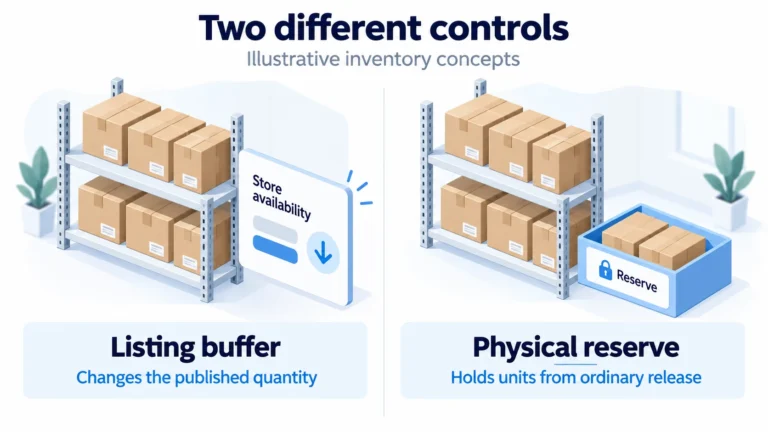
Dropshipping Inventory Buffer: Account for Update Delays Without Double Deduction
Set a dropshipping inventory buffer using source quantities and update delays. Avoid double deductions, shared-stock assumptions and

Dropshipping Inventory Forecasting: Know When Supplier Stock Will Run Out
A supplier’s shared stock feed is not your allocation. Forecast against accessible units and real lead time.
