
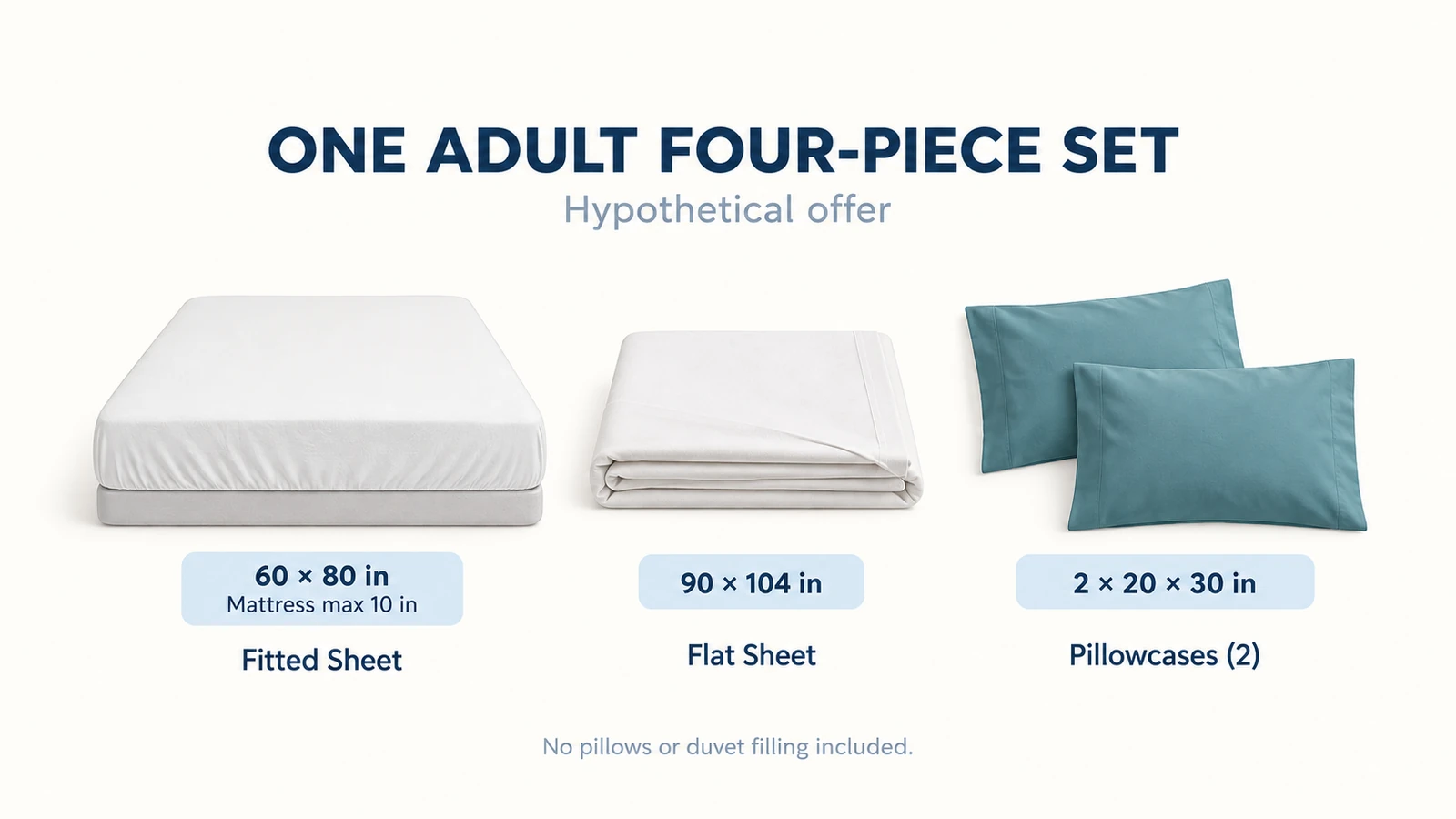
A bedding order needs to arrive as the set the buyer pictured: the right dimensions, the stated number of pieces and fabric information that matches the actual goods. You can sell that set without holding it yourself when a supplier agrees to pack and send each customer order. Before listing a small adult range, check the finished measurements and every included piece against a sample, then get a delivered quote for your chosen market.
The sale can go wrong before a parcel leaves the warehouse. A customer chooses “queen,” but their mattress has a thick topper. Another sees a duvet on the bed and expects the filling to arrive with the cover. A good bedding offer answers those questions before checkout.
You can sell ready-made bedding or have a provider print your design on selected items. Either way, your customer needs the right product and your store remains their contact when something is missing or does not match the listing. This guide focuses on ordinary adult bedding; infant sleep products and medical sleep claims need a different product review.
01
Start with the bed and the pieces
Choose the problem your first range solves: replacement fitted sheets, coordinated sheet sets, or duvet covers for customers who already own an insert. A narrow range makes it easier to explain fit and keep the right combinations in stock. If you are still comparing categories, the dropshipping products guide covers that broader choice.
For a fitted sheet, ask for the mattress’s length, width and total thickness, including a topper. Pocket depth is the sheet’s side depth; the supplier should also state the maximum mattress thickness its design supports. Those two measurements are not automatically identical because the sheet needs enough fabric to tuck underneath.
| Product | Measurement to match | What the customer needs to know |
|---|---|---|
| Fitted sheet | Mattress length, width and supported thickness | Whether it fits over the mattress and topper |
| Flat sheet | Actual sheet length and width | How much fabric hangs over or tucks under the bed |
| Duvet cover | Existing duvet insert’s length and width | Whether filling is included; usually a cover is sold without it |
| Filled duvet or comforter | Finished length and width | That this is the filled product, with its stated filling and care |
| Pillowcase or sham | Pillow dimensions and case opening | Number supplied; a decorative sham does not necessarily include a pillow |
On a phone, swipe the table sideways to compare every column.
Size names help navigation, but the measurements settle the choice. IKEA’s US DVALA fitted sheet gives a queen example of 60 × 80 inches, for a mattress up to 10 inches thick. Its corresponding sheet set lists one fitted sheet, one 90 × 104-inch flat sheet and two 20 × 30-inch pillowcases. That is four pieces, with no duvet or pillow filling. These are retail examples of clear descriptions, not a verified IKEA dropshipping program.
A different sheet can fit a different thickness even when its length and width match. Factory2u’s UK extra-deep king sheet lists 60 × 80 inches with a 16-inch pocket. Its allowance for tucking underneath belongs to that design; do not transfer it to another supplier’s sheet. Duvet names also vary: IKEA UK’s guide gives single 150 × 200 cm, double 200 × 200 cm and king 220 × 240 cm. Compare the customer’s actual insert, rather than replacing a US name with a UK name.
Check a topper before offering a fitted sheet
Suppose a customer has a 60 × 80-inch mattress, but its total thickness with the topper is 12 inches. The published DVALA example above supports a maximum mattress thickness of 10 inches.
What the measurements tell you
The length and width match that example; the 12-inch total thickness exceeds its stated 10-inch limit. Do not list it as a suitable fit just because both are called queen.
What to check instead
Ask for an option whose stated supported mattress thickness covers the customer’s total. Confirm its finished measurements, included pieces and care instructions. Use the exact proposed sheet on the intended bed in your sample check; a larger pocket-depth number alone is not proof of fit.
If you change the offered set, check its size choice and accepted order again. This is a measurement example, not a fitted-sheet test we performed.
Send a complete set request
Here is a hypothetical first offer to quote, rather than a product we have sampled: an adult white cotton sheet set with the four dimensions above. A useful supplier request would read:
Please quote one set sent directly to a US customer: one fitted sheet, 60 × 80 inches, with a confirmed maximum mattress thickness of 10 inches; one flat sheet, 90 × 104 inches; and two pillowcases, 20 × 30 inches. Proposed fabric: 100% cotton. Please identify the exact product code, available colors, fiber label and care instructions, packed weight and dimensions, protective packing, dispatch time, shipping charge to the supplied ZIP code, and the procedure for missing or wrong pieces. Confirm that the price is for one complete four-piece set, without inserts or pillows.
The supplier’s exact product code, often called a SKU, should follow the same size, color and contents from the listing to the order. Keep your set photo and its piece list together. If you also sell decorative throws or cushions, the home decor guide covers those products; they do not replace the bed-fit information this set needs.
02
Choose a supplier that can send the whole set
For ready-made bedding, a supplier with individual customer-address dispatch is usually the simplest route to try. You still need program approval, usable product information and a quote for your destination. A wholesale website with attractive sheet prices may only sell packs to your warehouse.
These are actual public program examples reviewed on September 28, 2026. Their terms describe different routes, rather than a tested ranking of suppliers.
| Supplier route | What its page offers | What to settle before selling |
|---|---|---|
| BeddingDropShip | Florida-based direct orders, no minimum order or dropship fee, product/carton/stock files; stated dispatch in 2–3 business days | Application documents, complete set availability, shipping and neutral packing |
| Sleepbella’s US program | Partner application and single-item US customer orders | Distribution price excludes US shipping; confirm the particular set and delivery estimate |
| DownHome | South Carolina factory dropship program; stated same-day weekday dispatch | Order cutoff, available product, holidays, destination freight and remedy terms |
| Prodigi bedding | Custom-printed bedding items fulfilled in the US, including duvet covers and pillowcases | Whether each item is separate or a coordinated set, material, print template, packing and full order price |
On a phone, swipe the table sideways to compare every column.
BeddingDropShip asks applicants for business or resale documentation and may request a $25 deposit credited to the first purchase. Those are its program conditions; they do not establish a universal bedding business-license rule. “No dropship fee” also leaves product, freight and other store expenses to pay.
A wholesale pack is not one delivered set
For comparison, Factory2u’s UK fitted-sheet page sells wholesale packs: ten singles or eight of other listed sizes. A displayed £92.50 ten-sheet single pack works out to £9.25 per sheet before any other applicable cost. That is a pack-price calculation in pounds, not a one-set US delivery quote. Individual customer dispatch was not established from that page.
For the proposed US four-piece set, ask one supplier for a dated order quote containing:
- The exact SKU, fabric, four included pieces, sizes, packed weight and current stock.
- Product, packing and freight charges to the customer’s ZIP, with import charges and importer identified if applicable. Dispatch country and manufacturing origin can differ.
- Return address and whether an approved supplier remedy is a cash refund, account credit or replacement. Clarify any minimum advertised price condition too.
If the supplier cannot confirm the complete sale unit or customer-address quote, do not publish that set yet.
03
Describe the fabric you can actually send
Choose fabric around the customer’s ordinary preference and care routine. Cotton, a cotton/polyester blend and polyester microfiber are different offers. Ask for the actual fiber percentages, construction and care information, then examine the selected version. Thread count alone does not tell you how a complete sheet will feel or hold up.
A blend should stay a blend on the listing
Factory2u’s example is described in its product body as 200-thread-count, 50% cotton and 50% polyester. Keep those details together rather than borrowing a different product’s cotton description. For your own sample, count the pieces, measure them, inspect stitching and fastenings, and follow the supplied washing instructions. Comparing dimensions before and after washing can reveal a fit problem worth discussing with the supplier. It is a sample check you can perform, not a test we have performed here or proof about every later shipment.
Keep the label and the listing consistent
Check four different statements before you copy a supplier description:
- Fiber and origin: The FTC’s US textile guidance covers many household bedding products. Most covered items need fiber, origin and responsible-business information, subject to exceptions. Use the finished product’s label and your actual seller/importer role.
- “Bamboo”: If the fiber is rayon or viscose made from bamboo, say so. FTC guidance does not support calling it simply bamboo fiber or claiming antibacterial or environmental benefits without evidence.
- Care and market: Give accurate washing instructions. The US apparel Care Labeling Rule does not automatically cover every finished household sheet. EU sales need the applicable EU textile-label information, including language.
- Certification: Check the OEKO-TEX STANDARD 100 certificate number, validity and finished article. Hohenstein explains that certified components do not automatically certify a set. Certification is not a health-treatment promise.
Your product page can now show real dimensions, maximum mattress thickness, every included piece, actual fiber content, care, dispatch location and the delivery estimate. Use an approved photo of that version or label a mockup clearly. If the supplier changes the fabric, dimensions or contents, review the replacement before continuing to sell the old description.
04
Price one complete delivery
A good product price can leave little money after shipping a bulky set. Work from the cost of one customer parcel, including every promised piece. Do not add packing or freight again if the supplier already includes it in the quoted total.
Here is a hypothetical US-dollar order for the four-piece set. These are teaching figures, not a quote from any provider above. The $68 sale excludes any sales tax collected for the authorities.
| One normal paid order | Amount |
|---|---|
| Customer payment for the delivered set | $68.00 |
| Set | −$26.00 |
| Packing, separately charged in this example | −$2.00 |
| Shipping | −$11.00 |
| Payment fee | −$2.40 |
| Advertising to acquire this order | −$11.60 |
| Money left after these order costs | $15.00 |
On a phone, swipe the table sideways to compare every column.
That $15 is the order’s contribution: money available for the store’s fixed expenses and eventual profit. One hundred otherwise normal orders would contribute $1,500. Subtracting $90 of monthly store expenses leaves $1,410 before income tax and any other unlisted costs or actual customer problems. Samples, duties, apps or other expenses belong in your own sheet where they apply; the example is not a margin forecast.
Have cash before the store pays you out
In this example, you pay the supplier $39 for the set, packing and shipping. Ten orders accepted before a store payout therefore require $390 of supplier funding. Advertising and other bills may also come due in that interval.
Keep refund funds separate from an expense
If you also keep $68 available for one full customer refund, those two purposes require $458 of available funds, before those other bills. The refund buffer is money kept accessible; it is not automatically an expense on every order. An actual refund or replacement changes the result when it happens. Payment-provider holds and payout timing can change how much funding you need, so plan from your own cash dates rather than the sales total on the store dashboard.
05
Follow the order from stock check to delivery
The supplier needs the same combination the customer selected, not a general instruction to send white queen bedding. A complete set may be unavailable even if a loose fitted sheet is still in stock.
- Confirm the exact set SKU, color, dimensions, piece count, customer address and latest stock update.
- Send the order through the agreed portal, file or connection. Obtain acceptance and the actual charge; a store order alone does not show the supplier accepted it.
- Have the supplier pack all promised pieces together, protect them from moisture and label the parcel correctly. Agree neutral packaging or branding before promising it.
- Record dispatch and tracking, then check carrier collection. A tracking number can exist before the carrier has the box.
- Give the customer a realistic update and follow exceptions until delivery or an agreed remedy.
Keep preparation and transport separate in your delivery estimate. BeddingDropShip’s stated 2–3 business days concern dispatch; the carrier still needs time to reach the customer. A vendor’s same-day statement also needs its cutoff, stock and holiday conditions. We have not tested these services or obtained a destination-specific delivery quote.
If a set is unavailable, pause that option and offer the customer an accurate new date, an agreed alternative or an appropriate refund. Do not quietly replace cotton with a blend, change the fitted depth or send two different white shades to complete the order. Record the version that was actually supplied so you can investigate the right parcel later.
06
Put the customer's order right
When a customer reports a problem, compare the order, the listing at purchase and the delivered set. For a fit complaint, ask for the mattress dimensions and topper thickness when relevant. For missing cases or wrong pieces, a photo of the received contents and product label can help. Request what you need to solve the order, rather than making the customer prove unrelated details.
A replacement must match the set
Missing pillowcases may be resolved with matching cases from the same set. Confirm size, fabric and color before sending them. If matching pieces are unavailable, discuss a complete matching replacement or an appropriate refund. The same approach applies when a supplier sends a shallow sheet against a correctly described deeper-fit order.
Separate the remedy from the supplier claim
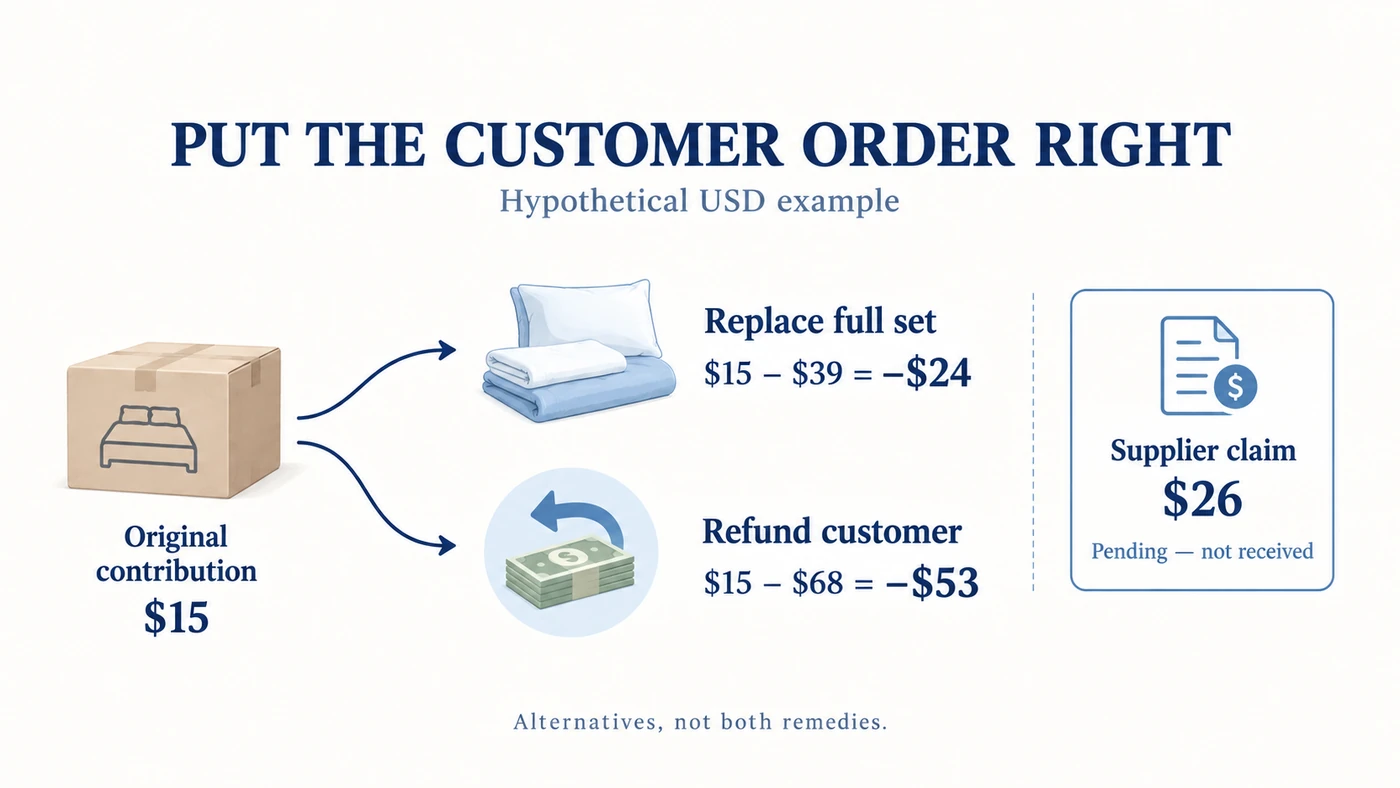
For the hypothetical $68 order, choose one customer remedy:
- Replace the whole set: Another $39 product, packing and shipping charge turns the original $15 contribution into a $24 loss.
- Refund the full order: If the original $53 of costs has already been spent, the result is a $53 loss.
The outcomes are alternatives, before any fee reversal, recovered product or other adjustment.
You might request a $26 product credit from the supplier. While that claim is still under review, it has not reduced either loss or replenished your cash. Keep the customer’s remedy moving under your sale terms and applicable law, while tracking the supplier request separately with the order, SKU, parcel details and relevant photos.
Match the return rule to the actual complaint
Ordinary supplier returns need authorization
BeddingDropShip’s return policy, rechecked October 11, requires an RMA requested within 30 days of delivery for an ordinary return. Goods must be unused, unwashed and in their original packaging. Its wrong, damaged or incorrect-item route has separate handling; do not treat those complaints as an ordinary change of mind.
Account credit arrives after the return
For an accepted ordinary return, the policy describes credit to your account within 14 business days after receipt. It also deducts shipping costs unless the return results from its error. Confirm the actual authorization, address and freight before asking a buyer to post the set. Supplier account credit is not cash already available for your customer’s refund.
A wrong size chosen from an accurate listing differs from faulty or misdescribed goods. Supplier change-of-mind exclusions do not automatically remove customer rights; opening the packaging is not a universal reason to reject a complaint.
For UK distance sales, government return guidance generally allows 14 days to notify cancellation and another 14 days to return, with refund and specific exception rules. Faulty goods have a separate route. Use the rules for your actual selling market and explain the return procedure before checkout.
07
Build a small range you can repeat
Before taking orders, you should have one complete offer: measured pieces, a clear fabric and care description, the supplier’s exact SKU and stock route, a full destination quote, a reviewed sample/version, and enough cash for the order and a customer remedy. Add sizes or colors when you can keep those same details reliable for each combination.
If you are considering a China-side bedding supplier, AIDrop’s product sourcing service can help coordinate supplier specifications, samples, packaging and shipment arrangements. Send the contact team a product link, the required pieces and measurements, fabric, customer destination and expected order quantity. You can discuss which operating work and product information are available for that route; this does not provide textile certification, legal approval or a guarantee that a supplier’s set will perform as claimed.
Questions before listing a bedding set
Does a duvet cover include the duvet filling?
Only if the offer explicitly includes it. A cover, filled comforter and sheet set are different purchases. Show the included-piece list beside the size choice, and make the photograph agree with it.
Will any queen sheet fit a queen mattress?
No. Compare length, width and total mattress thickness including the topper. Size names differ between markets, and sheets with the same length and width can support different thicknesses. Use the actual product’s supported measurements.
Does a four-piece set always include the same items?
No. Our example contains one fitted sheet, one flat sheet and two pillowcases. Another seller may count different pieces or decorative shams. Name and measure each item rather than using the piece count as the full description.
Can I describe microfiber or a cotton blend as cotton?
No. Keep the actual fiber description consistent with the finished label and supplier information. Softness, thread count and a photograph do not establish a fiber percentage. Resolve unclear composition before publishing the claim.

Furniture Dropshipping: Product Data, Delivery Scope and Damage Recovery
Furniture dropshipping needs more than a supplier quote. Verify the exact piece, cartons, drop-off service and damage

Home Decor Dropshipping: Fragility, Dimensions and Presentation
A decor listing needs more than a room photo. Compare appearance, packed dimensions and the recovery path
Candle Dropshipping: Choose the Jar, Scent and Shipping Plan
Build a small candle offer, compare individual dispatch with wholesale batches, price a complete order, and plan
