
Yes, you can sell yarn while a supplier ships each customer order. The useful offer is more specific than a wall of attractive colors: the buyer needs the right fiber, enough length and, where it matters, enough yarn from one dye lot to finish the project.
Start with a supplier that accepts individual customer orders. Then decide whether you are selling one ball, a multipack or a complete project kit. A wholesale discount alone does not answer either question.
For a first range, a few well-described yarns are easier to support than dozens of colors with uncertain batch availability. A customer who finishes a cardigan with your yarn has a reason to return. A customer who runs out and cannot match the last sleeve has a different memory of your store.
01
Where to look for a yarn dropshipping supplier
There are two practical routes to investigate: a dropshipping catalogue with yarn products, or a yarn brand/distributor willing to agree to customer-order fulfillment. The second route needs an explicit agreement; do not present every wholesale brand as a ready-made dropshipping supplier.
Start with an actual yarn catalogue
Doba’s knitting-yarn category showed yarn multipacks alongside other knitting-related products when reviewed on October 17, 2026. That makes it a discovery starting point. Open the exact product and supplier terms before relying on its availability, destination coverage, shipping charge or sold quantity.
Pay particular attention to the unit. If the supplier sells a set of three balls and your listing says “one ball,” every order starts with a mismatch. Likewise, a finished crocheted ornament is not a skein of yarn simply because both appear in a knitting category.
Ask a yarn wholesaler about the service you need
Darn Good Yarn has a wholesale application route. Estako describes volume purchasing and retailer accounts. Those pages establish places to enquire, not a guarantee that either business will ship one unbranded parcel per customer or pick a requested dye lot for your store.
Ask about an ordinary customer order:
Can you send six balls of this color, from one dye lot, to a customer at this destination? What happens if only four matching balls remain?
Include the expected order volume and ask for the complete delivered cost.
A brand that only ships cartons to your warehouse may still suit a stock-and-fulfill business. It does not suit a promise that you can list every color without holding inventory. Our craft supplies guide covers the wider choice between individual materials and complete kits.
02
Write the listing around the yarn, not just its color
Two products called “soft blue wool” can be very different purchases. One might be a small ball of a wool blend; another might be a larger skein of a different thickness. Describe the actual item the supplier will send.
A useful product record includes:
- Sold unit: one ball, one skein or a named pack quantity.
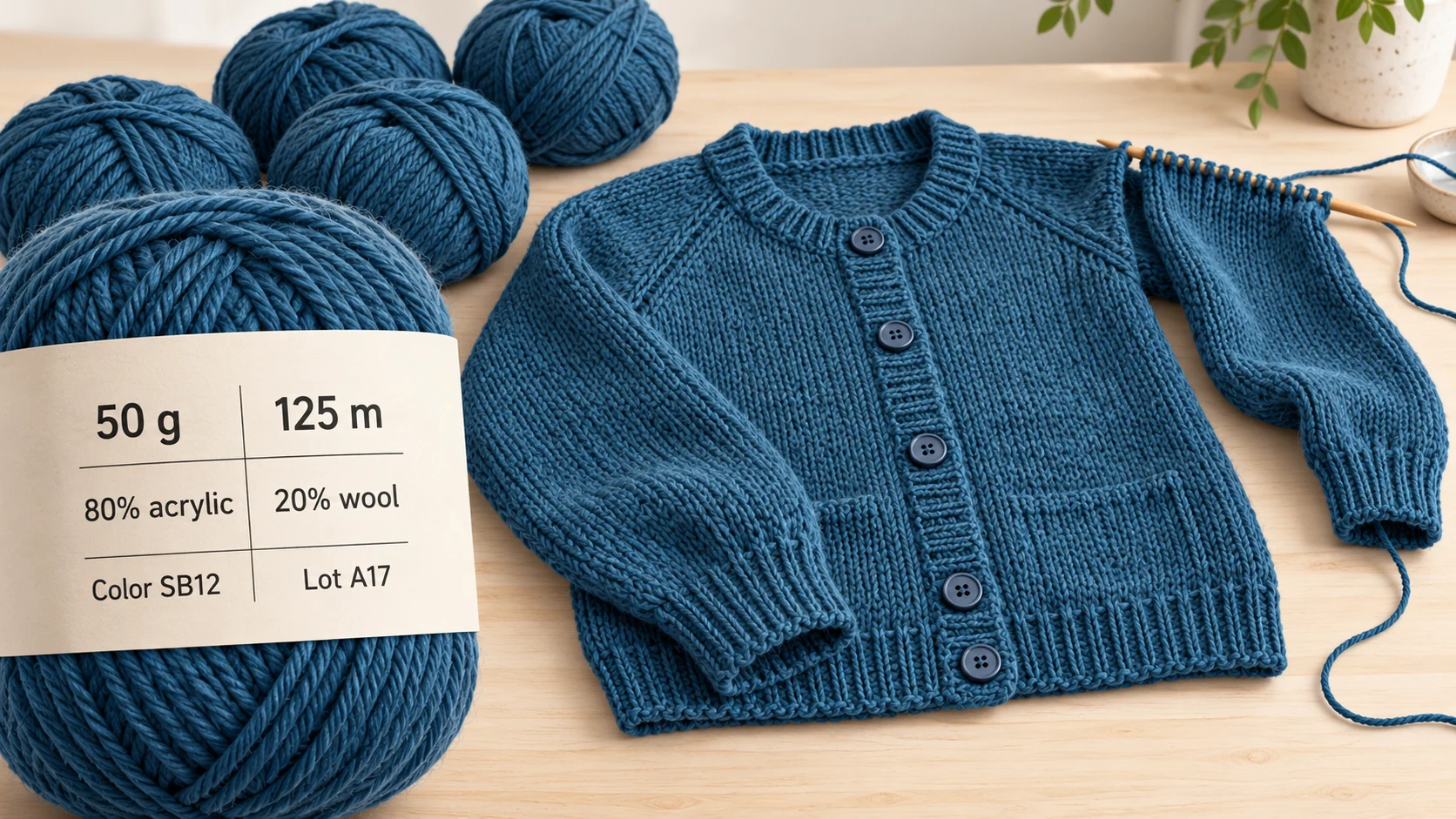
- Mass and length: for example, 50 g and 125 m per ball, with the supplier’s stated tolerances where available.
- Fiber composition: the actual percentages and names, rather than a vague “wool feel.”
- Thickness information: the stated yarn category and the relevant gauge guidance.
- Color identity: the color name and exact code, plus your dye-lot policy.
- Care and origin information: consistent with the product’s label and applicable requirements.
The Craft Yarn Council’s weight system describes thickness categories and typical gauge ranges. Here, “yarn weight” is not the same thing as the grams in a ball. A 50 g ball and a 100 g ball can belong to the same thickness category.
For US-facing sales, the FTC’s textile and wool guidance explains labeling requirements for covered yarns, including fiber content, origin and identification of the responsible business. Keep the physical label and online description consistent. Do not turn an unverified supplier adjective into a fiber or certification claim.
An example customers can actually use
Here is an illustrative listing excerpt. It describes an assumed product, not a yarn we have tested:
Sea-blue yarn, color SB12. One pack contains six 50 g balls, each with a stated length of 125 m: 300 g and 750 m in total. Fiber composition: 80% acrylic, 20% wool. This pack is sold as one dye lot; future orders may come from a different lot. Follow the supplied care instructions and check your pattern’s gauge before starting.
Publish that same-lot sentence only if the source can fulfill it. If your product is a mixed-color assortment, describe the individual colors and quantities instead. A photograph of six balls should not be used to sell one ball without a very clear explanation.
See our product-description guide for translating confirmed specifications into ordinary customer language. The specifications must exist first.
03
A project pack needs enough yarn from the right lot
A dye lot identifies a batch dyed together. Two batches carrying the same color name can look different. Lion Brand’s support explanation also notes that the difference can change with the lighting and that matching a previous lot should not be assumed.
For a shop, that changes the meaning of “in stock.” Consider this hypothetical shelf:
One color, six balls available: four are from lot A17 and two are from lot B18. You have six individual balls, but you cannot fulfill a promise of six balls from one lot.
One color, six matching balls available: all six are from lot A17. You can assemble that specific six-ball promise, provided those balls are still available when the order is accepted.
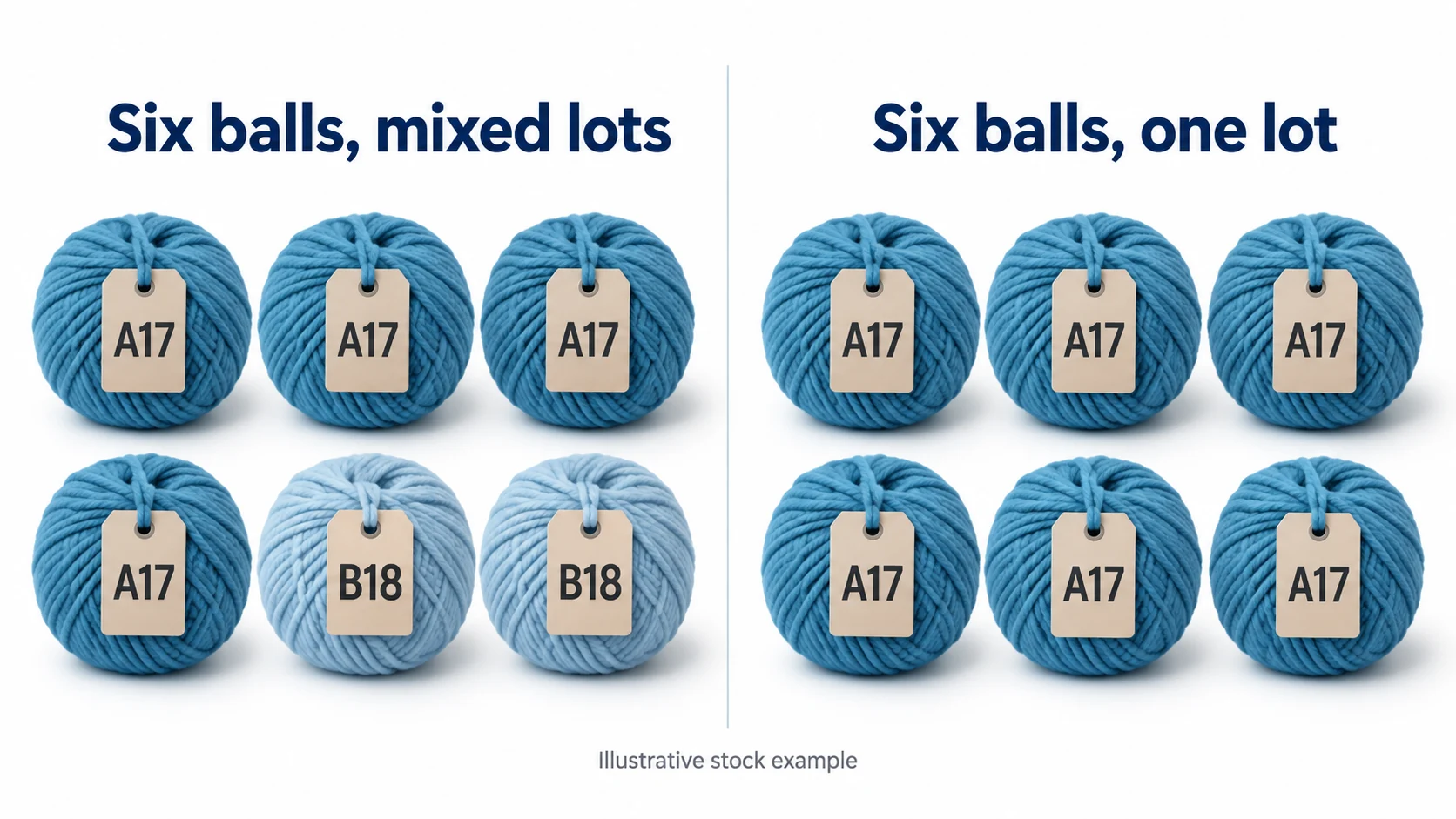
This is why a total stock number can be misleading. The customer buys materials that need to work together. Your supplier must be able to pick the set you advertised, not simply reach the right total by mixing batches.
Decide what happens when the matched quantity runs short
Use a clear choice before shipping:
- Offer a complete pack from another available lot, if the customer has not already started with an earlier batch.
- Offer a genuinely suitable alternative with the changed details disclosed.
- Offer a wait or cancellation/refund option where appropriate.
Do not quietly add two balls from another lot and hope the color difference is invisible. If a substitution affects a paid order, use the supplier-substitution process to obtain and record the customer’s choice.
An order note requesting the same lot is only a request until the supplier accepts it. If the source cannot reserve or report lots, remove the same-lot promise from your listing. You can still offer yarn honestly; you need a different customer promise.
04
Calculate skeins before calling another yarn equivalent
Equal ball counts do not mean equal yarn quantities. Start with the length the pattern needs, then divide by the length in each ball and round up to a whole ball.
For an illustrative project requiring 750 m, compare these two assumed products:
Yarn A: 125 m per 50 g ball. You need 750 ÷ 125 = six balls. They provide 750 m and weigh 300 g in total.
Yarn B: 200 m per 100 g ball. You need 750 ÷ 200 = 3.75, rounded up to four balls. They provide 800 m and weigh 400 g in total.
Four balls of Yarn B provide enough stated length for this calculation. That does not prove it will produce the same cardigan. Its fiber blend, thickness, construction and behavior after washing may differ. The arithmetic answers “enough length?”; it does not answer “the right fabric?”
Use a swatch to answer the fabric question
Gauge is the number of stitches and rows in a measured area. A pattern’s dimensions depend on the fabric produced at that gauge. If the same stitch count produces a wider swatch, the finished garment can also be wider unless the pattern is properly adjusted.
Follow the pattern’s swatch instructions with the proposed yarn and needle or hook. Wash and dry the sample as the finished item will be treated, then compare the measured gauge, feel and drape. Lion Brand’s substitution guidance discusses checking gauge, fiber and construction rather than relying on a category name alone.
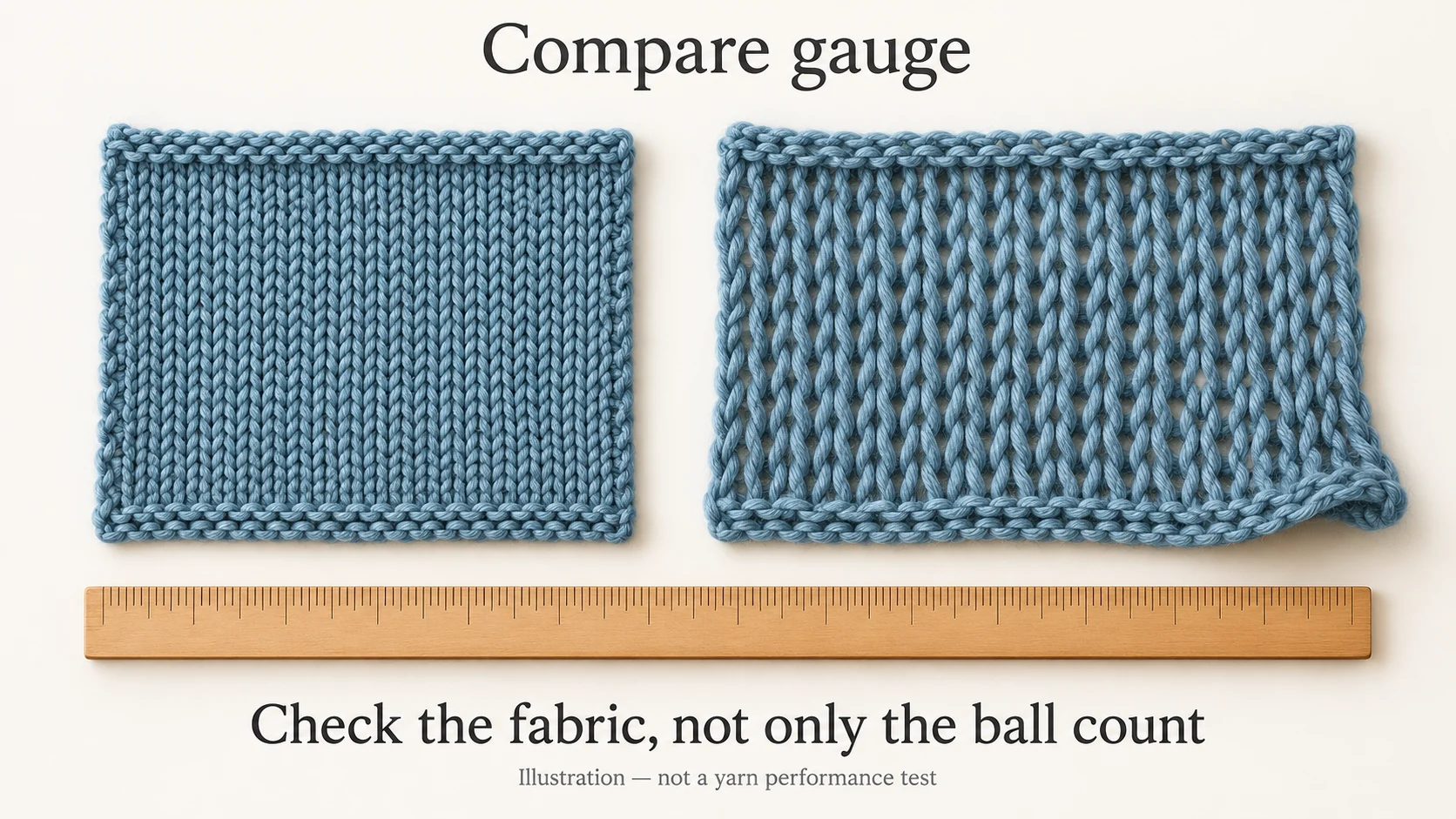
For a yarn shop, the practical consequence is modest: do not advertise an untested yarn as an exact replacement for a named pattern yarn. State its confirmed properties and let the maker evaluate suitability. If you sell a project kit, the yarn-and-pattern combination needs its own verification.
Allow for swatching, finishing and the pattern’s own quantity guidance when planning a pack. Do not assume the exact 750 m in our example is enough for every maker or recommend one universal extra-ball allowance for all projects.
05
Make the parcel and repeat order work
A single inexpensive ball and a six-ball project pack have different delivery economics. Compare the actual source quote for each: yarn, picking, protective packing, shipping and any applicable charges. A light product can still be costly to send when the parcel charge is large relative to the order value.
Use the bundle guide if you want to offer a project quantity as one product. First check whether the supplier’s system treats the pack as one item or several components, and whether it can keep the required lot together. A storefront bundle alone does not create matched stock.
What to look for in a sample parcel
- The ordered number of balls, with the advertised color and material information.
- Labels that remain readable, including the actual lot identifier where supplied.
- Clean, dry protection against dirt, moisture and snagging, without unnecessary compression that damages the presentation.
- A pack identity the receiving customer can match to their order.
Open the parcel as a customer would. Count the contents and compare the labels before using the yarn. For your own records, keep the supplier item, color, delivered lot and quantity together. A picture of the outer carton cannot establish that the six inner labels match.
Give repeat customers an honest answer
If someone asks for two more balls from their original lot, ask for the label code and check that exact batch. Do not promise a match from the color name alone. If the original batch is gone, explain that before accepting a matching-order promise; the customer may prefer a contrasting border, another project or no purchase.
For a wrong-lot delivery against an explicit same-lot order, retain the labels and ask for photographs showing the difference. Hold further affected packs while the source checks its picking stock. Resolve the customer’s order as well as the future pack listing.
If you want AIDrop to review a proposed yarn packing or fulfillment arrangement, send the product brief. Include the fiber/length specification, pack quantity, destination and whether same-lot picking is essential. We can discuss what needs confirming with the source; a general enquiry does not establish that a particular yarn or batch is available.
06
Questions about selling yarn without holding stock
Is buying wholesale the same as dropshipping yarn?
No. Wholesale describes the commercial purchase. Dropshipping describes who fulfills the customer order. A wholesaler may expect you to buy and store cartons yourself. Confirm the customer-order service, minimums and complete delivered cost separately.
Can I promise the same color on a later order?
You can promise the specified color code if you can supply it. A promise to match the previous dye lot is more specific and needs that batch to be available. Screen appearance is not a reliable guarantee of an exact physical match.
Can a customer return yarn after winding or using it?
Set a policy that distinguishes unused labeled yarn from wound or used material, and check the source’s conditions and the rules applying to your sale. A defect or a wrong item is a different question from a voluntary change-of-mind return. Do not promise that every used item can be returned to the supplier.
Can I include a free pattern I found online?
Free to read does not automatically mean free to reproduce or sell in a kit. Obtain the rights needed for the pattern and photographs, or link to an authorized source where appropriate. Listing a pattern in the pack contents makes its availability part of your promise.
Should I describe a soft yarn as baby-safe or hypoallergenic?
Softness is not evidence for those wider claims. Use confirmed composition and care details, avoid unsupported safety or allergy promises, and consider the intended finished product separately. Selling a ball of yarn does not verify every use a customer might make of it.
Gift Basket Dropshipping: Choose a Supplier and Keep the Gift Promise
A gift basket can be dropshipped, but the recipient must get the contents, message and delivery experience

Wedding Favor Dropshipping: Get the Count and Event Date Right
Wedding favors can ship directly to a host or venue, but the sold unit, guest count and
Party Supplies Dropshipping: Build a Kit That Arrives Complete
Some suppliers direct-ship party goods. A useful event kit still needs enough of each piece, a supported
