
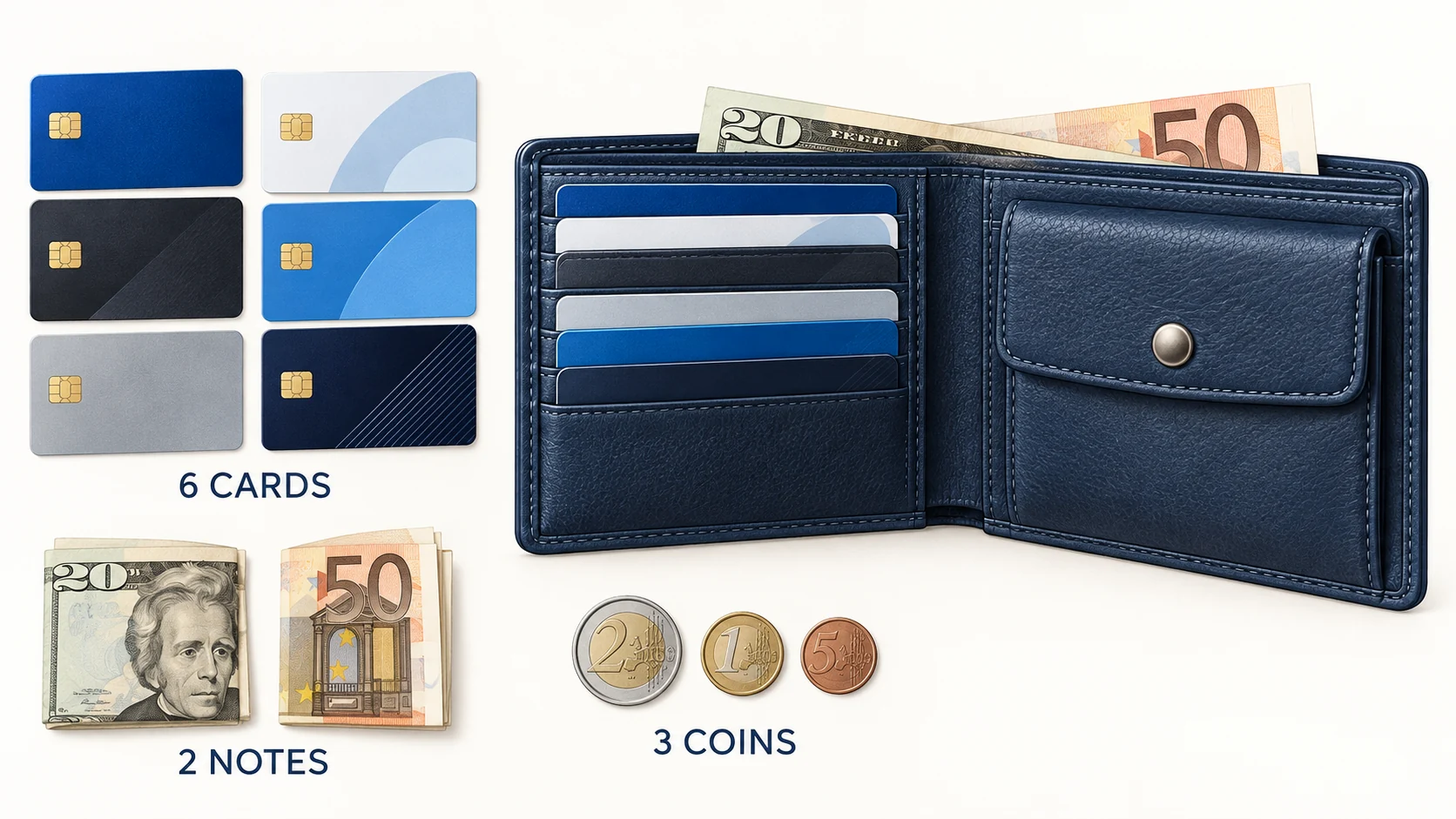
Wallet dropshipping can use ready-made accessory catalogs or POD wallets with original artwork. Start with the buyer’s everyday contents—cards, cash and coins—then verify material, usable pockets, closure and delivery terms. Keep leather and RFID claims specific to the selected product and its evidence.
A slim wallet photographed empty may become bulky when filled. A design described as “leather” may be faux leather. These are details a shopper needs before ordering, and details you can investigate before adding a long catalog to your store.
Provider pages were checked on October 13, 2026. This article assesses public information and proposes product checks; it does not report purchased samples or security tests.
01
Find a supplier for the kind of wallet you want to sell
A printed art wallet, a leather cash wallet and a compact card holder serve different reasons to buy. Choose that reason first, then look for an exact product that meets it.
| Supply route | Real option to investigate | Check before listing |
|---|---|---|
| Your artwork on a POD wallet | Printify personalized wallets | Actual material, product template, production and shipping |
| Ready-made brand wallets and card holders | Hertwill’s wallet category | Product-level territory, stock, wholesale price and return terms |
| Catalog sourcing | Doba’s wallet listings or an agreed sourcing partner | Exact supplier, composition, packing and order eligibility |
Printify describes faux-leather personalized wallets. Hertwill’s category contains different brands and product types, with regional shipping filters. Neither description establishes that every SKU is genuine leather or dispatches locally to your customer.
A category page is a shortlist, not a finished supplier decision. Obtain the specific SKU and destination quote. If pricing requires an account, get the current account price rather than presenting an old public estimate as the bill.
The clothing and accessories guide covers broader assortment choices. Keep this offer focused on what fits inside the wallet and how the buyer uses it.
02
Specify what fits when the wallet is full
Define a normal load—for example, six cards, two folded notes and three coins in a hypothetical everyday wallet. A card-only holder needs a different specification; a coin pocket adds bulk.
Measure the pocket openings as well as the outside. If you promise unfolded notes, check the currency your buyers use. “Fits cash” may describe another market’s notes.
In an illustration, a wallet might measure 18mm thick empty and 28mm with the intended contents. Neither number alone is a quality score. The difference tells the customer what “slim” means in ordinary use.

Use a sample to answer these questions:
- Can the intended cards go in and come out without excessive force?
- Does the closure work with the stated contents?
- Do coins sit in the intended pocket rather than spilling into the fold?
- Are the full wallet’s dimensions and weight appropriate for the buyer’s pocket?
Do not force in extra cards to produce a larger capacity claim. Keep the demonstrated contents and loaded measurements in the product record. An empty photo cannot establish comfortable loaded capacity.
03
Keep leather and RFID claims narrow
Material and RFID protection are separate features. A faux-leather wallet can carry artwork; genuine leather does not establish RFID protection.
Ask for the outside, lining and coating composition. Describe the selected SKU using its specification. A photograph cannot establish genuine leather.
For RFID, request an exact-model test and its frequency and use scope. Do not turn a badge into protection for every card, compartment or kind of theft.
| Evidence available | Sensible wording |
|---|---|
| SKU specifies faux leather | Describe the faux-leather material and documented care |
| SKU has a supported leather composition | Use wording that matches that composition |
| Provider advertises RFID but supporting scope is unclear | Ask for evidence; avoid a blanket security guarantee |
| Exact-model test with a defined scope | Describe only the supported feature and limits |
The customer still needs to understand the pockets, closure and finish. A dramatic “secure your money” slogan cannot replace those useful product details.
04
Approve the wallet the customer will carry
Prepare a custom design around the fold
Use the template for the exact POD product. Printify’s documented process includes choosing the wallet, opening its Product Creator, applying artwork and checking the mockup. The template’s print area and boundaries govern that design; do not reuse a flat greeting-card file unchanged.
Keep important names or initials away from cut and fold areas unless the template explicitly supports that placement. On a curved or folded wallet, text can be partly hidden even when the flat artwork looks balanced.

Save the product variant and artwork version together. If a personalized name is collected through the store, verify that it reaches the correct production file. Your store’s preview and the printer’s file need to say the same thing.
Inspect the first order in ordinary use
Order the selected wallet with your final design. Check the inside as carefully as the printed outside: pocket access, closure alignment, edge finish, stitching or bonding, and any loose or sharp part.
| Inspection | Record | Response if it fails |
|---|---|---|
| Pack contents and variant | Ordered SKU, color and included pieces | Hold the listing and correct the mapping or dispatch |
| Normal loaded use | Contents, closure and loaded dimensions | Revise the claim or select another product |
| Print and fold | Legibility, position and final file version | Adjust the file, then approve the changed version |
| Material and care | Specification and received labels | Resolve discrepancies before publishing |
Match the store order ID to the supplier order and invoice. If the accepted variant or artwork differs, stop or correct it before production becomes irreversible. The sample guide helps keep an approval tied to the version actually sold.
An ordinary sample inspection can reveal a closure problem or illegible initials. It does not prove years of wear, water resistance or RFID performance. Keep those limits close to the claims that need them rather than adding a vague disclaimer to everything.
05
Price a wallet and a workable remedy
Here is an illustrative sale: $32 received, $10 goods, $6 delivery, $1.25 payment cost and $2 remedy allowance. The remainder is $12.75 before advertising, tax and overhead. Replace the inputs with actual quotes and fees.
A wrong-name remake needs a separate calculation: another printed wallet, another delivery, and an agreement on who funds them. A spreadsheet reserve does not mean the supplier reimburses either cost.
Check design rights before selling. For a branded wallet, verify resale and packing terms. For your artwork, confirm commercial permission. Do not copy a recognized logo, pattern or packaging; see the copyright and trademark guide.
Make the product page easy to scan:
- What it holds: cards, cash and coins; useful loaded dimensions.
- What it is: verified material, closure and supported feature claims.
- What happens next: care, shipment and remedy.
Actual photographs support product evidence; artwork mockups should be labeled.
For China sourcing, send AIDrop the contents specification, material, closure and destination. Add personalization requirements and any feature-claim documents so the sample and packing quote relates to the wallet you will sell. Send your specifications to AIDrop.
06
Questions about wallet dropshipping
Is faux leather a bad choice for a printed wallet?
It is a different material choice, not something to hide. Assess the exact construction, print, care and buyer use. Describe it as faux leather and price the actual delivered offer.
Can I use the supplier’s “RFID blocking” phrase unchanged?
Ask for the exact-model evidence and scope first. Avoid promising protection against every frequency or every form of theft. If the evidence cannot support the phrase you want, narrow or remove it.
Will a wallet made for dollars fit other banknotes?
Check the usable note pocket against the buyer’s currency and the advertised folding arrangement. Outside dimensions alone are not enough.
Can personalized wallets never be returned?
Do not make that blanket statement. Change-of-mind terms, faulty goods, production mistakes and applicable customer obligations are different matters. Agree the provider remedy and write a store policy that works for your actual market.

Clothing Dropshipping: Sizes, Variants, Samples and Returns
Verify apparel sizes, variants, samples, labels and returns before launch. Build a clothing dropshipping offer around accurate
Clothing Dropshipping Suppliers: 5 Options for Different Stores
Compare Trendsi, Printful, Printify, Apliiq and BrandsGateway by clothing model, fit information, stock, shipping and return costs.
Shoe Dropshipping: Sizing Evidence, Variants and Return Exposure
A shoe listing needs model-specific fit evidence, exact size-color stock and a workable exchange route. Compare one
