

Tea dropshipping lets you sell tea while a supplier packs and sends each customer order. You can resell an existing brand or choose private-label packaging. Start with the form of tea, its ingredients, pack weight and shipping origin; loose leaves, tea bags and instant tea are different products.
A useful first range might serve someone who brews a pot each morning or wants a convenient drink at work. That choice helps you select the format and explain the product. A collection of vague “wellness” names makes both buying and customer support harder.
Explore this topic
01
Loose leaf, tea bags or instant tea?
Begin with a preparation habit. Someone buying loose-leaf black tea expects to measure leaves, steep them and strain the drink. Someone buying an instant blend expects it to dissolve. The same attractive pouch cannot make those products interchangeable.
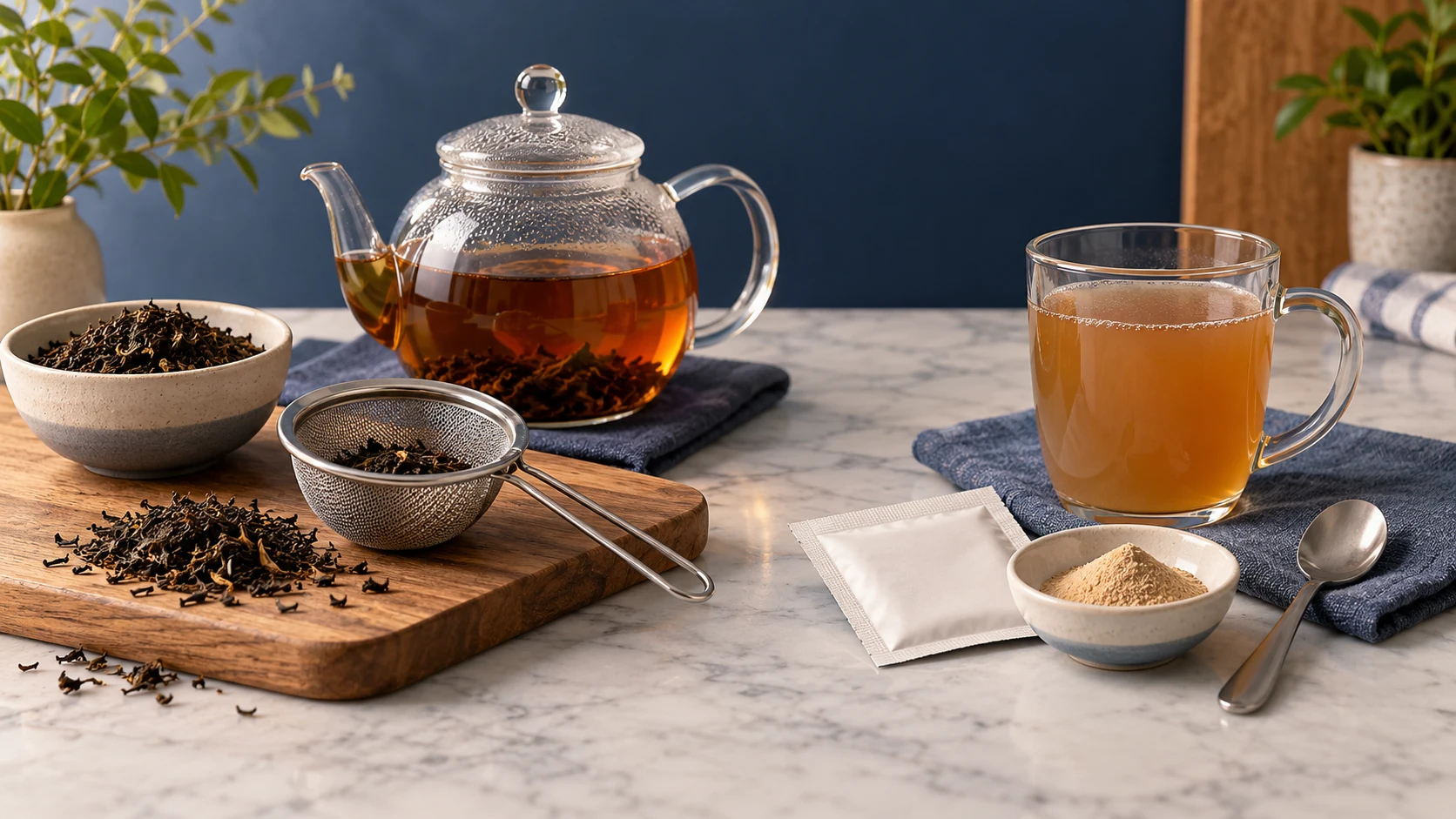
| Format | Information a buyer needs | Supplier question worth asking |
|---|---|---|
| Loose-leaf tea | Ingredients, net weight, dose and brewing directions | Is this the exact blend and leaf grade the sample represents? |
| Tea bags or sachets | Number of bags, weight and preparation | Are bags individually wrapped, and what is included in the pack? |
| Herbal infusion | Full ingredients and supported caffeine information | Can ingredients or flavorings change between batches? |
| Instant blend | Ingredients, serving size and mixing instructions | Is sweetener, milk powder or another ingredient included? |
Use the supplier’s exact ingredient information. A floral photograph does not prove a product is caffeine-free, and a tea name does not disclose everything in a flavored blend. Ask how any formulation change will reach your product page and label.
Keep the first offer small enough to understand. You might sell two familiar blends in one pack format, then expand after customers show you what they want. The broader product selection guide helps assess a niche before you build a large catalog.
02
Which tea suppliers actually ship each order?
Look for a supported customer-order route, not just the words “private label.” A business may blend excellent tea but require a wholesale purchase that your store then has to hold and ship.
The public programs checked on October 15, 2026 illustrate the differences:
| Route | What the public material establishes | What still needs confirmation |
|---|---|---|
| Dripshipper tea program | Branded tea fulfillment; this program page describes instant tea | Exact current SKU and format, account charges and destination availability |
| T-Swing / TeaSwan dropshipping | Direct shipping with custom packaging; an order-submission process | Current plan and registration charges, stock, customs responsibilities and landed quote |
| Dominion Tea private label | Wholesale packaged loose-leaf tea; 20 pieces per tea/package size and a $200 first-order minimum | Your receiving and individual fulfillment arrangements |
| The Tea Spot private label | Custom blending and co-packing for a branded range | Project minimums, development, production and any separate fulfillment agreement |
Treat the table as a starting shortlist, not a quality ranking. For example, broad Dripshipper landing pages mention loose-leaf tea, while its tea-program page uses instant-tea wording. Request the live catalog and exact product before advertising either format.
Also separate leaf origin from shipping origin. Tea packed or dispatched in the United States may contain leaves grown elsewhere. Ask for both facts and describe them accurately. A US warehouse address alone does not support a “US-grown tea” claim.
03
What goes on your branded pouch
Putting your brand on a pouch gives customers one business to trust and contact. It also makes accurate product information essential. Ask who prepares the label, who checks it for the intended market and how changes are approved.
For a US-oriented launch, gather the exact ingredients, net content, responsible business details and applicable nutrition and allergen information. Have the actual formula and label assessed where the requirements are uncertain. Do not assume that every tea has the same labeling obligations or that a supplier’s general statement approves your finished label.
The FDA’s label-claims guidance distinguishes claims for conventional foods and dietary supplements. Product presentation and claims matter. A herbal blend should not be assigned a regulatory category simply because the supplier calls it natural.
Describe the drink you can substantiate. Ingredients, flavor, preparation and pack contents are useful selling information. Claims about treating anxiety, curing illness or causing weight loss require a very different level of evidence and review. Removing those promises does not prevent you from explaining how the tea tastes or fits a brewing routine.
Keep an approved label file and revision number. When the blend, weight or required wording changes, update the supplier file and storefront together before releasing the revised product.
04
How fresh is the tea when it leaves the warehouse?
Shelf life starts before the customer clicks Buy. If a hypothetical tea has a twelve-month best-before period from packing and has already spent eight months in storage, four months remain at dispatch. Transport uses some of that remaining time.
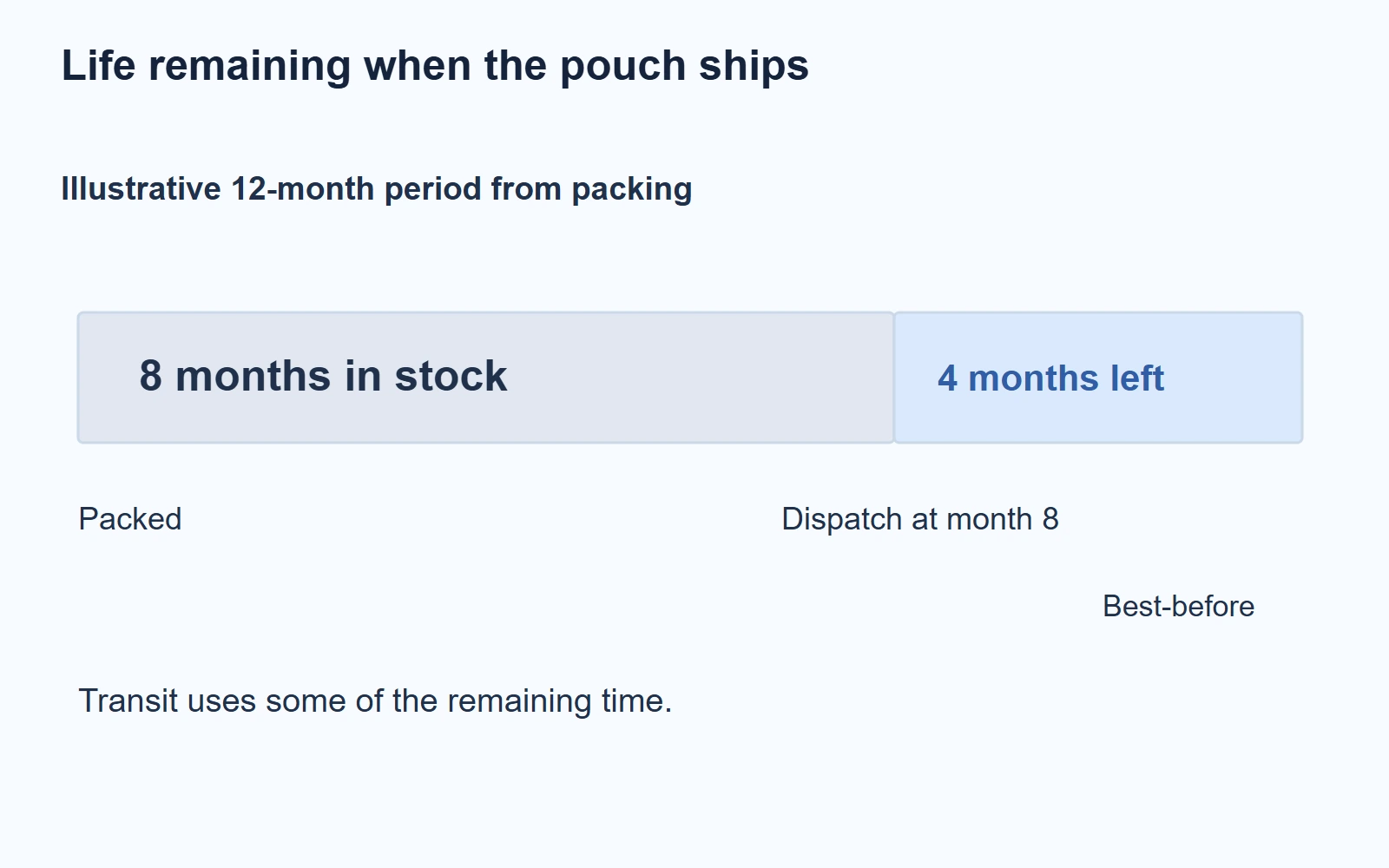
That calculation explains why “twelve-month shelf life” is an incomplete supplier answer. Ask for the minimum life remaining when a pouch leaves the warehouse. The appropriate minimum depends on the product, expected consumption and destination; the example does not set a universal tea-expiry rule.
Record these points in the supply agreement:
- The lot or batch reference and relevant packing or best-before date.
- Storage conditions and how the sealed product is protected from moisture and other contamination.
- A minimum remaining life at dispatch for the chosen SKU.
- What happens when stock is near that limit or the blend is unavailable.
- How you can identify affected customer orders if a lot needs attention.
For the buyer, give the actual storage and brewing directions. If you illustrate servings, show the assumption: a 100 g pouch used at 2 g per serving gives about 50 servings. A stronger recipe or a larger pot changes that number.
05
Does a two-pouch order make more sense?
A modest leaf cost can hide an expensive small parcel. Compare the basket customers will buy, including packaging and delivery, before setting a “free shipping” threshold.
Here is an illustrative comparison in US dollars:
| Order economics | One pouch | Two-pouch basket |
|---|---|---|
| Customer payment | $26.00 | $45.00 |
| Tea and packaging | −$8.00 | −$16.00 |
| Shipping | −$5.00 | −$6.50 |
| Payment fee | −$1.10 | −$1.65 |
| Customer acquisition | −$6.00 | −$6.00 |
| Remedy allowance | −$0.80 | −$1.60 |
| Contribution before fixed costs and tax | $5.10 | $13.25 |
The two-pouch basket works better here because the example assumes combined postage and one acquisition cost. Ask for that combined shipping quote. Different warehouses, tins or mixed suppliers can produce a different result.
Include registration, subscription, label development and other fixed costs separately. TeaSwan’s page contains both free-plan language and a one-time registration charge; “free” is not a complete launch budget. Confirm the charge that applies to your account and destination.
If a service costs $30 a month and you complete ten orders, that fee represents $3 per order for that month. At fifty orders it represents $0.60. That is an allocation example, not a forecast that the store will reach either volume.
06
From the approved blend to the delivered pouch
Use a proposed first-order record such as EARLGREY-100G-POUCH, label v2, exact supplier product reference and the chosen destination. Record the blend, pack size and label separately so a pouch-to-tin change cannot happen silently.
Then follow the whole route:
- Select the product in the store and confirm the cart names the format and net weight.
- Confirm the customer payment, then the separate supplier order and funding.
- Match the delivery address, packaging and label revision before release.
- Retain the lot reference where the fulfillment arrangement provides it, plus dispatch and tracking records.
- On receipt, compare the sealed pack, label and preparation directions with the approved offer.
TeaSwan documents manual order inputs on its program page. That is useful operational information; it does not establish that every store connection automatically places an order. Ask what creates the supplier request and how the supplier acknowledges it before you rely on automation.
Prepare a supplier-ready order request
For a manual route, turn the store purchase into a record the supplier can fulfill without guessing. Alongside the necessary customer delivery and contact details, make the product instruction explicit:
| Product instruction | Illustrative entry |
|---|---|
| Blend and supplier reference | Approved Earl Grey blend and the supplier’s actual code |
| Sellable pack | One 100 g pouch; quantity two pouches |
| Packaging | Approved pouch type, not a tin substitute |
| Label | Approved artwork v2 |
| Change rule | Hold and ask if that blend, pack or label is unavailable |
The distinction between weight and quantity matters. “Two” could otherwise mean two pouches, two cases or a different pack size. Match the supplier acknowledgement to the same unit before payment or release.
For a first tasting comparison, use each product’s own brewing directions and record the dose, water amount, temperature and steep time. Judge whether the listing’s flavor description is useful at that preparation. A disappointing cup made with different instructions does not by itself prove a bad batch; a sensory preference also cannot establish ingredient safety. Keep those questions separate when deciding whether to revise the description or investigate the product.
This is a proposed test, not a transaction we performed. Use actual results to set a delivery estimate that includes preparation and transit. A tracking number created after packing is not the same event as the carrier receiving the parcel.
A taste complaint or a product problem?
A customer saying “too smoky for me” needs a different response from one reporting an open pouch. Ask a focused question and identify the SKU and lot before deciding what to do.
For a damaged or unexplained broken seal, preserve photographs and lot details, contact the supplier and arrange an appropriate customer remedy. Do not direct the buyer to consume a questionable product or put opened returned food back into saleable stock. A possible safety issue needs qualified assessment and appropriate escalation.
For a taste preference, check whether the description and brewing directions were accurate. If buyers repeatedly expect a sweet drink from an unsweetened blend, improve the listing. If the actual product differs from its approved ingredients, pause the affected supply and investigate the change.
Never replace a sold-out tea with another blend without telling the buyer. Ingredients, caffeine and flavor can all change. Offer the supported alternative clearly or resolve the order another way.
For a custom branded range, send AIDrop your product and destination brief so we can review what sourcing, label coordination, packing and shipping work would be required. Food eligibility and the exact supplier arrangement need confirmation before a quotation. The private-label guide explains the broader production decisions.
07
Questions before selling tea online
Is private-label tea always made one pouch at a time?
No. Some suppliers fulfill individual branded orders; others require a production or packaging run. Ask about the exact SKU, packaging minimum and ownership of unused stock.
Does US fulfillment mean the leaves were grown in the US?
No. Dispatch, blending, packing and agricultural origin are different facts. Describe only the origins your product documentation supports.
Can I begin with my own tea blend?
You can investigate it, but development and manufacturing minimums can create inventory commitments. An existing blend with approved packaging is usually a simpler way to test the retail offer before commissioning a formula.
Can I promote tea as a treatment?
Do not make treatment or disease claims without the appropriate evidence and regulatory review. Ordinary flavor and preparation information can explain the product without inventing a health outcome.
Sources and scope
Public sources were checked on October 15, 2026. Supplier statements describe their offers; the calculations and order-checking procedure are illustrative and do not report an independent food-safety audit.
Gift Basket Dropshipping: Choose a Supplier and Keep the Gift Promise
A gift basket can be dropshipped, but the recipient must get the contents, message and delivery experience

Wedding Favor Dropshipping: Get the Count and Event Date Right
Wedding favors can ship directly to a host or venue, but the sold unit, guest count and
Party Supplies Dropshipping: Build a Kit That Arrives Complete
Some suppliers direct-ship party goods. A useful event kit still needs enough of each piece, a supported
