
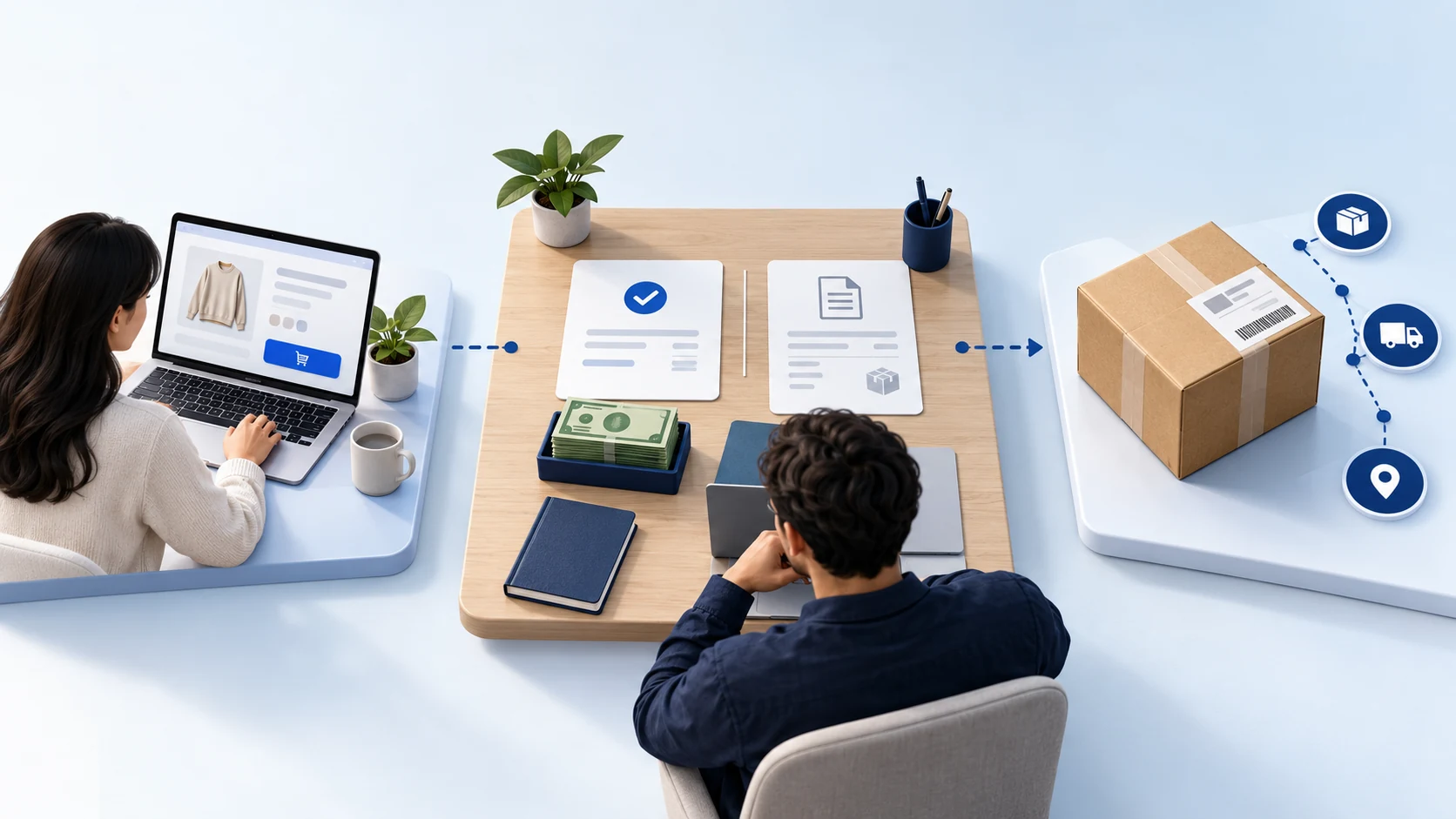
Yes, a dropshipping store may be able to take PayPal payments. PayPal itself describes dropshipping as a selling model. That is not approval for every seller, product or country. The useful question is whether your account can take the payment and whether you can buy and document the customer’s order if the proceeds are temporarily unavailable.
Imagine a customer pays for a desk lamp at noon. The supplier needs payment before it will pick the item. Your PayPal activity shows the sale, but the money is on hold. The customer still expects the delivery date shown at checkout. That gap between a paid order and spendable cash is what you need to plan for.
Explore the broader topic: Dropshipping Unit Economics and True Order Cost.
01
Can you use PayPal for your particular store?
Start with the actual account country, merchant and product. PayPal publishes dropshipping guidance, but that guidance does not approve your own account or tell you its available checkout products.
Use the seller’s own market terms
Use the terms and notices for the seller’s market. PayPal’s US merchant fee table is a US example, not a fee quote for a business registered elsewhere.
Before putting a PayPal button on a new store, write down four details:
- The legal business and PayPal account country: Account eligibility, available checkout products and terms follow the seller’s market and account.
- The specific product and sales channel: PayPal may review what is sold and how it is sold; a general article about dropshipping is no substitute for your own account status.
- The supplier’s payment and dispatch terms: The supplier may demand payment before your PayPal proceeds are available.
- The carrier and last-mile tracking available for this SKU: A number created in a supplier dashboard is not the same as verifiable shipment or delivery evidence.
You do not need to predict that PayPal will freeze an account. You do need to know where you would find a real notice. PayPal says the account alert and email explain why a particular payment is unavailable and which options may apply. Its funds-availability guide lists new or dormant selling history, disputes and changed selling patterns among possible reasons. None diagnoses your own payment without reading the account.
If you are comparing PayPal with another processor, use our broader payment-gateway guide for eligibility, total fees and payout timing. Here we follow one PayPal-paid physical order.
02
The buyer paid you; you still owe the supplier
Three numbers appear in a dropshipping sale, often on three different clocks. The customer pays your store. PayPal marks a transaction and an available or unavailable balance. The supplier sends an invoice or charges your purchasing account. A customer payment does not automatically pay that supplier invoice.
PayPal’s held-funds guidance explains that proceeds can be temporarily unavailable. A reserve or account limitation is different from a single order hold. Treat the notice and actual available balance as the source of truth; do not turn the article’s typical timeline into your dispatch promise.
Here is a simple cash test. Every dollar in the example is invented so the arithmetic is visible; it is not an AIDrop quote, PayPal rate or profit estimate.
Illustrative first order: The customer pays $60. The supplier requires $34 before dispatch. You want $6 of separate cash available for an immediate service or refund issue. PayPal shows $0 available from this payment today. Under those assumptions, you need $34 + $6 − $0 = $40 from other usable funds today. The $60 sale may eventually settle, but it cannot buy the lamp at the supplier’s deadline while it is unavailable.

Forty dollars funds the next step, not every cost
This calculation deliberately leaves out processing fees, advertising, taxes, packaging and actual refund cost. It answers one question only: Can you perform the next order step on time? If you need a complete per-order profit view, build that separately. A profitable sale on paper can still fail a supplier prepayment deadline.
03
Set up proof before the parcel leaves the supplier
PayPal did not pick, pack or ship the lamp. Your supplier did. But the customer bought it from you, and your payment account may be asked for evidence. Give the supplier the paid transaction’s shipping address and an order reference that can later connect the parcel to your store order.
The US Seller Protection terms are specific about eligible physical shipments: among other requirements, the seller must ship to the address in PayPal Transaction Details and provide valid shipping or delivery proof. PayPal describes proof with a verifiable tracking number, dates and destination information; for delivery, it includes delivered status. That US policy does not promise protection for every order or seller. PayPal decides eligibility under the applicable terms, claim type and evidence.
Know which problem Seller Protection covers
The current US Seller Protection terms require a US primary account address and distinguish the claim types below. Read the corresponding market’s terms for a different account country.
Unauthorized payment
For an eligible physical-goods claim, the US terms allow valid shipment or delivery proof subject to their timing and other requirements. Keep the transaction’s eligibility status and respond to PayPal’s requested documents on time.
Item Not Received through PayPal
The US program requires valid proof of delivery, including verifiable tracking, delivered date/status and matching destination. A created label or export-hub scan does not meet that delivered-proof description.
Wrong item or card-issuer non-receipt claim
The US terms exclude Significantly Not as Described claims and Item Not Received claims filed directly with the card issuer. Keep evidence and handle the customer problem, but do not call a delivered scan automatic protection for a wrong lamp or an excluded claim.
For preordered or made-to-order goods, the terms require shipment within the timeframe stated in the listing. Tracking can support evidence; it cannot extend a missed promise or make an excluded dispute eligible.
Think about the evidence as a short chain:
Customer checks out
What you need to retain: Store order ID, PayPal transaction ID and transaction shipping address
What it does not prove yet: That supplier stock was purchased.
Supplier accepts purchase
What you need to retain: Supplier order/invoice, SKU/variant and promised dispatch date
What it does not prove yet: That the carrier has the parcel.
Label is created
What you need to retain: Carrier name and proposed tracking ID
What it does not prove yet: That a pickup scan or delivery occurred.
Carrier moves parcel
What you need to retain: Verifiable tracking and shipment event
What it does not prove yet: That the buyer received it.
Carrier confirms delivery
What you need to retain: Delivered event and matching destination information
What it does not prove yet: Automatic Seller Protection or automatic release of funds.
Resolve a new destination before dispatch
An address change is a good place to slow down. If a buyer messages after checkout asking for another destination, do not simply forward the new address to the supplier and expect the original PayPal transaction to protect that shipment. The US terms tie an eligible physical shipment to the address in Transaction Details and say a redirected shipment can lose eligibility. Resolve the payment/order details and the buyer’s request before dispatch; the right remedy depends on the actual transaction and applicable terms.
Choose tracking that reaches the buyer’s destination
Ask the supplier or fulfillment partner which carrier will show the last-mile delivery event at the customer destination. A tracking number that stops at an export hub may be useful for customer updates, but it may not supply the delivered proof PayPal describes. If the supplier cannot show the carrier’s shipment and delivered records, fix that part of the service before relying on it for a PayPal-paid offer.
04
If PayPal holds a payment, respond to the actual notice
Open the actual payment and account notice. Identify whether it describes a payment hold, reserve, limitation or verification request; the steps for one do not automatically resolve the others.
PayPal’s US held-payment help directs sellers to Know your options under their balance for eligible release options. Read what your own account offers before following the physical-product steps below.
Add real tracking to the physical-goods payment
If your eligible held payment offers the option, follow PayPal’s current physical-product help route. Read the actual account notice first.
- Open Activity, select the relevant payment and choose Get your money when shown.
- Choose Product, then enter the truthful carrier/tracking details for that parcel. Check the transaction shipping address against the supplier order.
- Click Submit and keep the saved transaction and carrier record. A number or label is not evidence that the parcel is delivered.
- Check the actual available balance before funding the next order. Delivery evidence may help an eligible hold; it does not promise a release date or Seller Protection.
For eligible physical goods, PayPal’s US help describes adding tracking from an approved carrier and possible release approximately 24 hours after confirmed delivery. Exceptions can keep funds held longer. Verify your actual available balance; this is not a supplier payment deadline.
Do not mark a physical shipment as a completed service
The help page’s Service or virtual product → Completed route concerns a different sale type. Do not use it to describe an unshipped physical lamp as completed or delivered.
Hold release and Seller Protection are separate
Adding truthful tracking has two separate jobs. It can give PayPal information relevant to a held payment, and it can preserve evidence if a buyer later raises an eligible claim. It does not itself guarantee either an early release or Seller Protection. The latter has its own transaction, address, claim and proof conditions. A supplier’s dashboard status or a label without carrier events should not be described to PayPal or the customer as delivered.
Describe the real parcel state
If a buyer asks where the order is, answer with the real carrier state and the delivery estimate you can support. If dispatch has slipped, say so and offer a remedy consistent with your store policy. Prompt, accurate updates make the order easier for the customer to understand; they also give you a clean record if a later payment problem needs investigation. For a full claim-response sequence, see our dropshipping chargebacks guide.
05
Use one record to decide whether the next order is safe to accept
Ten orders need four hundred dollars under these assumptions
The first lamp may be fundable from your own cash; ten lamps sold before any proceeds become available are a different decision. For ten copies of the same invented lamp order, supplier purchases need $340 and the separate $6-per-order buffer needs $60. That is $400 of usable funds while all ten customer payments remain unavailable. The $60 is money kept free, not a supplier charge or a refund already spent.
Add any further cash needed for refunds, reships and ordinary operating expenses before deciding how many orders to accept. A PayPal hold or reserve changes when proceeds are usable; it does not move the supplier’s payment deadline or the delivery promise to the buyer.
Cap sales from usable cash today
Set an order-cap rule from cash you actually control, not from your displayed PayPal balance. If available funds cover only four supplier purchases, pause or narrow the offer before taking a fifth order unless another authorized funding source is ready. This is a working-capital decision, not a prediction of how long PayPal will hold any particular payment.
The first order is a rehearsal for the tenth. Keep one row per PayPal-paid order with the fields below. A spreadsheet is enough; it does not need a new app.
Store and PayPal transaction IDs
Lamp example: Store #1042; PayPal ID recorded from Transaction Details
Payment state and usable amount today
Lamp example: Paid; $0 from this payment currently available
Supplier amount and due time
Lamp example: $34 before dispatch, due today
Separate service/refund cash kept free
Lamp example: $6
Promised dispatch and customer delivery window
Lamp example: Use the actual promise shown at checkout
Transaction shipping address
Lamp example: Copy exactly from PayPal Transaction Details; check before supplier release
Supplier order and carrier
Lamp example: Supplier reference, carrier name and real tracking link
Latest carrier event and customer update
Lamp example: “Label created” / “Accepted” / “Delivered,” with date; message customer when expectation changes
If you can fund the order, your account and item are suitable, and the supplier supplies verifiable tracking, PayPal can be a workable option. If any one of those is missing, fix the missing condition first. PayPal’s approval and risk decisions remain PayPal’s; fulfillment evidence and the customer promise remain yours.
AIDrop Agent can review a China-side supplier and parcel handoff: what needs to be purchased, when it can dispatch, what tracking evidence the route returns, and where a delay would reach the customer. Send the order scenario for a scoped operating review. We do not process or approve PayPal payments for merchants.
Questions about taking PayPal for dropshipping
Can I pay the supplier from a customer payment on hold?
Not from funds that are currently unavailable. The lamp example requires $40 from other usable cash today. Check your real available balance, supplier amount and deadline before accepting more orders.
Does adding tracking guarantee the money clears tomorrow?
No. PayPal’s US help describes eligible release after an approved carrier confirms delivery, with exceptions. Follow your account notice and confirm the available balance; do not make the supplier’s dispatch depend on a predicted release.
Can I send the lamp to a new address requested by message?
Resolve the order and payment details first. The US Seller Protection terms require shipment to the transaction’s shipping address and exclude redirected shipments from eligibility. Do not assume a message changes the protected destination.
Does a delivered scan protect every dispute?
No. Claim type, account market, transaction and evidence conditions matter. The US program excludes wrong-item/Significantly Not as Described claims and Item Not Received claims filed directly with a card issuer.
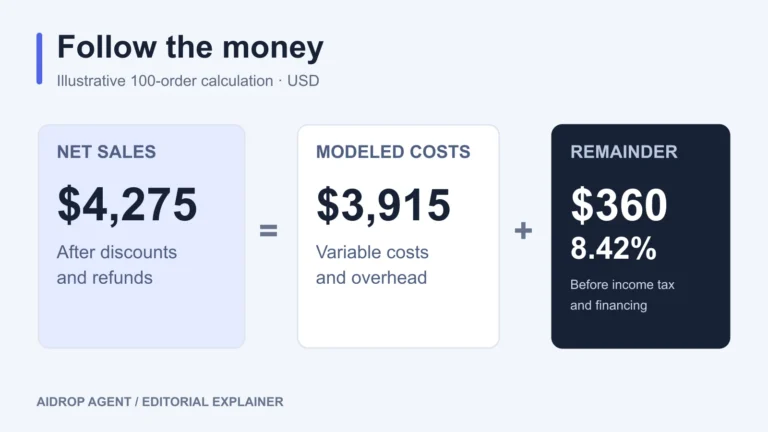
Dropshipping Profit Margin: Calculate What You Keep
Calculate dropshipping gross, contribution, and net margins. See how discounts, refunds, and ad costs change profit in

How to Price Dropshipping Products From Landed Cost and Risk
Calculate a retail price from the delivered cost of one variant, selling fees and required contribution, then
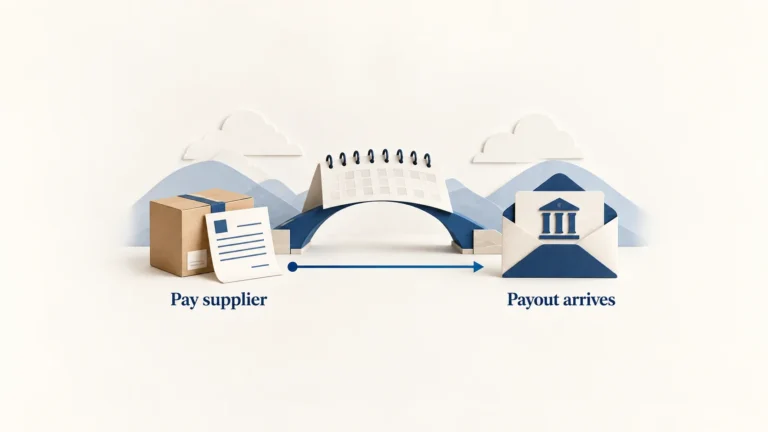
Dropshipping Cash Flow: Supplier Payments, Payouts and Refund Buffers
Plan dropshipping cash flow by date. Separate pending payments from usable cash, fund supplier bills, and test
