
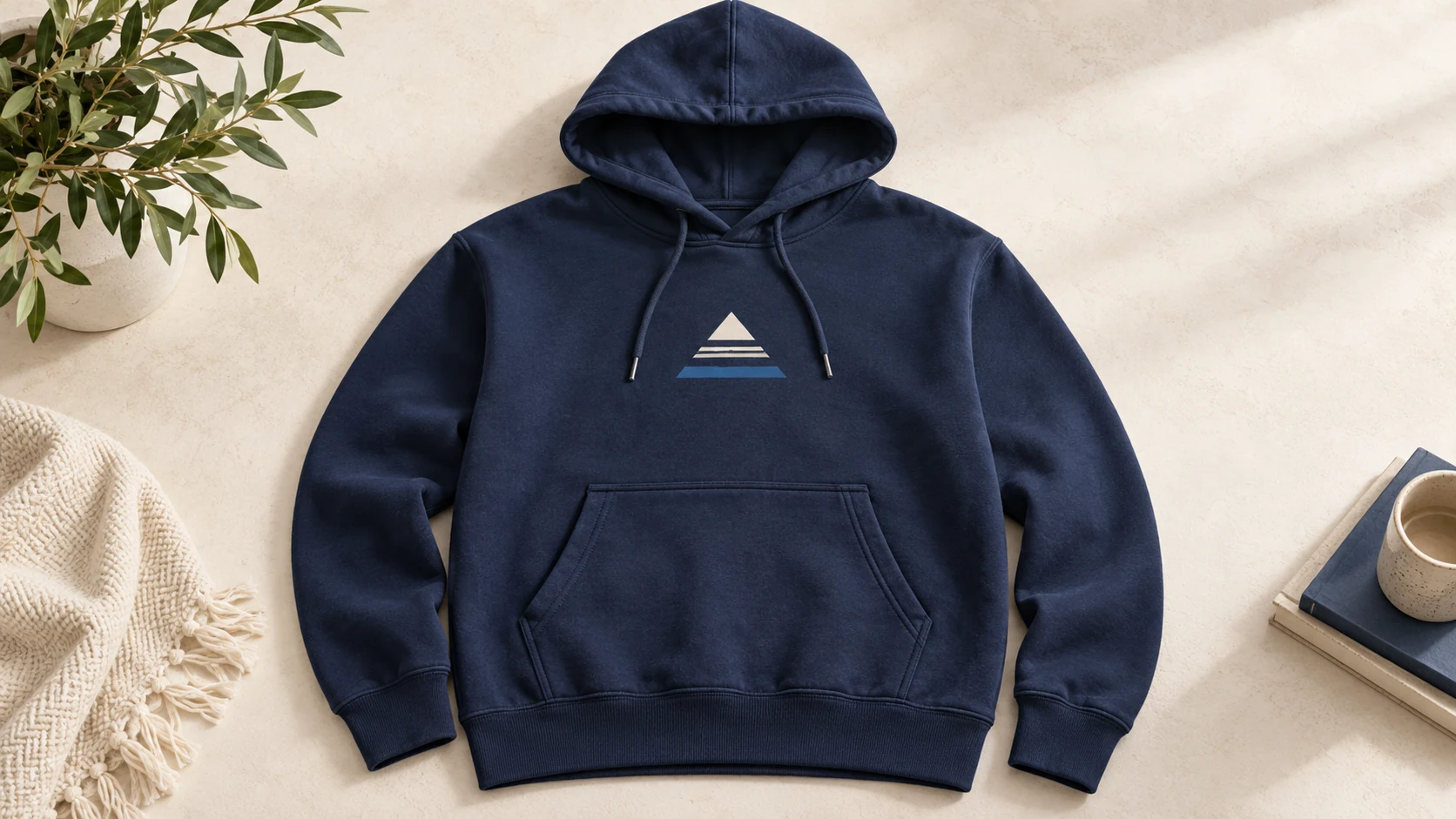
Hoodie dropshipping lets you sell a garment while a supplier prints or picks it and sends each order to the buyer. You can sell ready-made hoodies, decorate a stock blank on demand, or commission a custom garment. For an original printed design, choose the blank, fit and available decoration before uploading artwork.
Think of a small club ordering a navy pullover. The logo can look excellent on screen while the sleeves feel short, the pocket interrupts the print or the larger sizes cost more than the price you set. A useful first offer settles those details on one garment, then repeats it reliably.
The clothing dropshipping guide covers building the wider apparel range.
01
Choose the hoodie your customer wants to wear
Start with the wearer and use. A light event hoodie, a relaxed everyday pullover and a heavier streetwear piece are different garments. Putting the same drawing on each does not make them substitutes.
For the club example, choose an adult navy pullover with a front print. Before selecting a supplier, record the blank model, available sizes, composition, construction and garment measurements. “Blank” means the garment before your decoration is added.
| Product choice | Why it matters | Detail to obtain |
|---|---|---|
| Pullover or zip hoodie | Changes dressing, front construction and usable print space | Closure and front layout |
| Fabric and weight | Affects feel and the appropriate decoration | Exact model and color composition; stated fabric weight |
| Fit | Determines how the garment sits on the wearer | Garment measurement chart and its method |
| Pocket and hood | Can hide or interrupt artwork | Actual print areas and sample photographs |
| Sizes and colors | Adds variants with potentially different availability or prices | Supported combinations, not a category-wide list |
Printful’s hoodie catalog offers different styles and decoration options. Printify’s catalog lets sellers choose among products and print providers; the listed Gildan 18500 is one example with multiple providers. The catalog names give you a starting point, rather than a guarantee that every provider offers the same colors, sizes, print or delivery.
Ready-made apparel suits a store selling an existing style. POD suits a store whose distinction is the design on an available garment. If you need a different cut, custom fabric or unusual construction, ask about manufacturing and stock commitments instead of expecting a print upload to change the hoodie.
02
Match printing or embroidery to the actual garment
The decoration should follow the artwork and the blank’s supported methods. A small stitched club logo and a large photographic front print ask the production process to do different jobs.
DTG applies ink directly to a garment. DTF transfers a printed design onto it. Embroidery makes the image with stitches. Sublimation is used for supported fabrics and products; an all-over-print garment has different production files from a logo placed on a stock pullover.
Use those differences to narrow the choice:
- Small lettering or a simple logo: compare a supported print with embroidery at the actual finished size. Fine details can need revision when converted to stitches.
- Photographs or many colors: investigate the supported printing method and preview the image on the chosen garment color.
- A pattern across sleeves, hood and body: choose an actual all-over-print product and its separate panel templates.
Do not make embroidery the default just because it sounds premium. A very large, dense design can change the feel of the garment. Printful’s printing technique notes describe product and technique limits, including the possibility of heavy embroidery distorting thin fabrics.
Ask what the quote includes: one front placement, front and back, sleeve work, digitizing, labels or pack-ins. A second print location is an extra production choice, even when the source artwork is the same.
If garment branding is part of the offer, the Apliiq guide examines its separate label and decoration route. Choose that route for its documented features, then check its own current product and account terms.
03
Give buyers garment measurements they can use
“Medium” does not answer how wide or long the hoodie is. Size names vary among blanks, and customers need a way to compare the product with something they already wear.
Use the exact blank’s chart. Make clear whether its numbers describe the body or the garment, and show the units and measurement method beside it. A flat garment chest width is not the same number as a person’s chest circumference.
For example, an illustrative flat width of 60 cm describes roughly 120 cm around that part of the garment. It does not establish that the garment fits a 120 cm chest or that it is a standard US medium. The desired ease and the other measurements still matter.
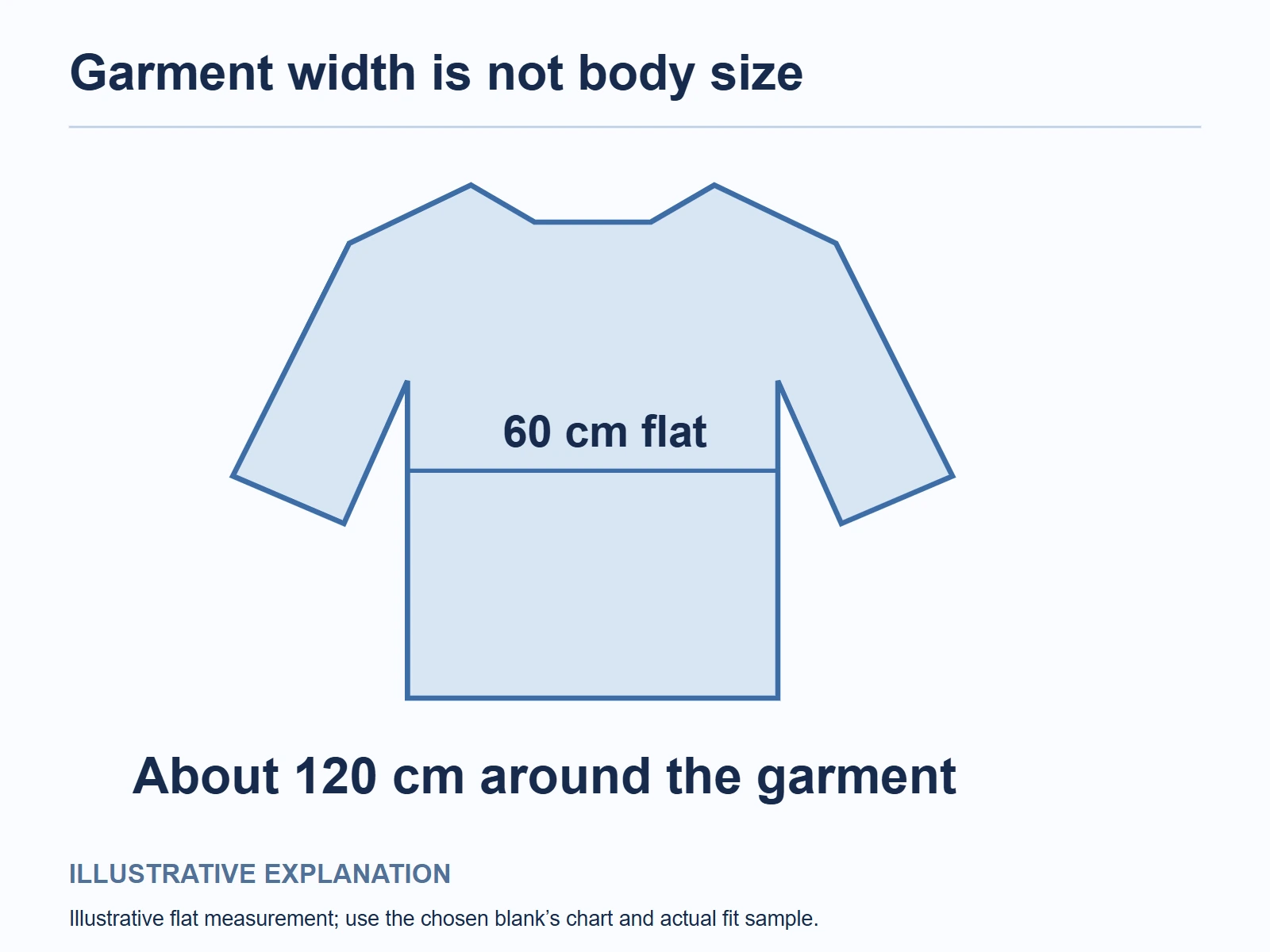
A buyer-friendly instruction is to lay a familiar hoodie flat and compare its chest width and length with your chart. Include sleeve length using the supplier’s stated starting and ending points. Mixing a sleeve measured from the shoulder with one measured from the neck creates a misleading comparison.
Keep a relaxed-fit description tied to that garment. If two suppliers label a blank “oversized,” compare the measurements and a physical sample before presenting them as the same fit. A photograph of a different model cannot establish the measurements of yours.
Start with a manageable set of sizes and colors. Three accurately linked sizes are more useful than a large dropdown that includes unavailable combinations or shares a chart from another blank.
04
Prepare a front print that fits above the pocket
Download the file guidelines for the selected product, method and print area. A front pocket shortens the usable space; a zipper or drawcord can affect where the buyer sees the design. Reusing a T-shirt layout can put the artwork where the hoodie cannot print it cleanly.
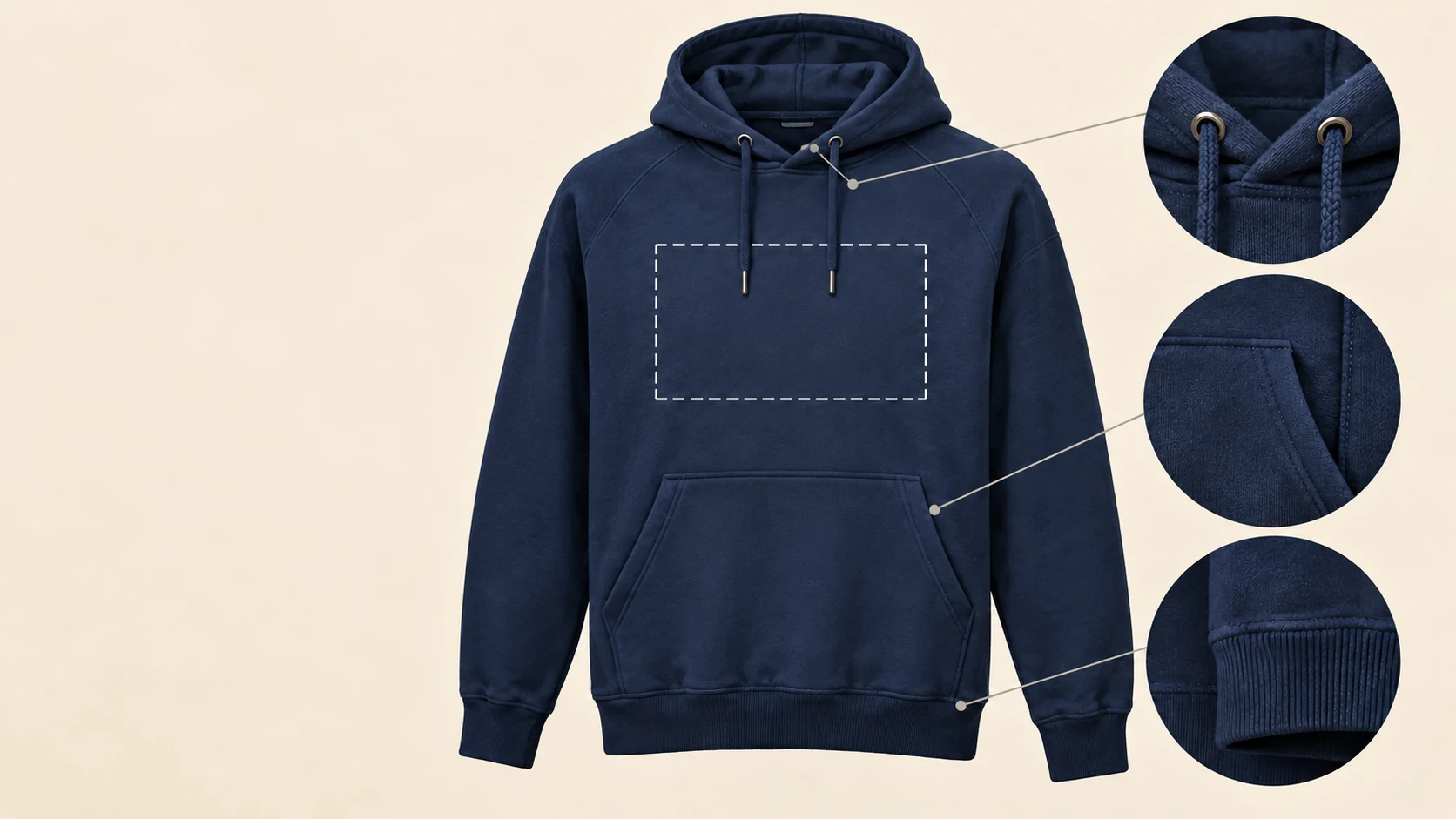
Printful’s file guidance explains product-specific templates, suitable file formats and color preparation. Use the selected product’s requirements instead of applying one resolution or bleed rule to every hoodie.
For our illustrative front logo, suppose the approved print measures 8 × 6 inches and the chosen process calls for 300 pixels per inch. The artwork would need 2,400 × 1,800 pixels at that size. This calculation describes the image; it does not prove an 8 × 6 inch placement is available on any particular blank.
Prepare the file in this order:
- Open the exact template and check the printable area and safe zones.
- Position the artwork at the intended physical size, clear of the pocket and any restricted areas.
- Check fine lettering at that size, not only in a large screen preview.
- Export the supported format. Use transparency when the design and print process need it.
- Remove template guides from the production file and save a named revision.
- Review the provider’s preview and any file-quality warnings.
Check the smaller and larger offered sizes. The print may occupy a different proportion of each garment, and available areas can vary. A logo that works on an extra-large blank can feel overwhelming or cross a limit on the smallest size.
Save the file as version 2, for example, and keep it with the blank and placement record. “Final logo” is not enough when a later revision has changed its dimensions or background.
05
Calculate the garment you will actually sell
A catalog starting price is rarely the whole order. Compare the selected blank, color, size, method, placements, branding and delivery address on one quote.
For illustration, a $59 hoodie sale could look like this:
| Item | USD |
|---|---|
| Retail revenue | $59.00 |
| Decorated garment | −$26.00 |
| Supplier shipping | −$8.00 |
| Store/payment charges | −$2.00 |
| Customer acquisition | −$10.00 |
| Remedy allowance | −$2.00 |
| Left before fixed costs and tax | $11.00 |
These are hypothetical inputs, not a provider quotation. The allowance is an assumption for planning exchanges, defects or other remedies, not a measured return rate.
Adding a $5 second print placement leaves $6 at the same selling price and other assumed costs. That may be worthwhile if customers value the extra design enough to support the price. It needs to be a deliberate offer change, rather than an unnoticed addition in the design tool.
Check larger sizes and every offered color. If one variant costs more, either price it accordingly or understand how its sales affect the overall contribution. Do not apply the cheapest displayed product rate to the whole dropdown.
Ask for a two-item delivery quote too. Two hoodies from one provider may share a shipment; mixed products or providers can create separate shipping charges. Use the actual configuration rather than assuming postage halves when the buyer adds a second item.
Finally, keep cash available for supplier production. A customer can pay your store before the payout reaches your bank. That delay does not remove the payment your fulfillment provider needs to make the garment.
06
Create the product and check one paid storefront order
Build one saved product before importing the whole catalog. Printful’s public creation route starts with choosing a hoodie, opening its design tool, uploading and positioning artwork, then saving it for ordering or selling. The current connected-store flow controls how that saved product reaches your storefront.
Make an illustrative mapping record like this:
| Record | Value to verify |
|---|---|
| Your SKU | CLUB-NAVY-L-V2 |
| Supplier garment | Exact selected blank model |
| Variant | Navy, size L |
| Decoration | Supported front method and approved placement |
| File | Logo version 2 |
| Customer order | Store order number and supplier order number |
Your SKU is an internal reference, not a universal supplier code. Match it to the provider’s actual product and variant identifiers.
Open the listing on a phone. Select size L, inspect the image and chart, add one item to the cart and enter a real test destination. Confirm the size, quantity, product charge and shipping charge at checkout.
Then place a controlled paid order using your own details. Check that the supplier received the correct blank, navy variant, L size and front file. Verify its payment state and production acceptance; seeing a paid store order alone does not settle those steps.
Follow the supplier order through dispatch and tracking to arrival. If it is absent or the variant is wrong, investigate the existing order and mapping before creating a manual replacement. Two submission paths can produce two hoodies and two bills.
07
Inspect fit, print and care after the sample arrives
A mockup checks composition. A received garment lets you check the actual blank, feel, fit and print. Do both; one does not answer the other’s question.
Record the product and variant, then measure it flat using the same method as the published chart. Check the pocket, hood, seams and closure. Try the movements relevant to the intended use, such as raising the arms or wearing another layer underneath.
Inspect the logo at its intended size. Compare its position with the approved preview, then look for missing details, unwanted backgrounds and text that became difficult to read. Keep the print assessment separate from whether you personally like the garment’s fit.
Follow the actual care label for a wash check. Record the method and compare the garment and print afterward:
| Before washing | After the permitted wash |
|---|---|
| Flat chest, length and sleeve measurements | Measurements using the same method |
| Logo position and visible detail | Any change in print, shape or placement |
| Fabric and seam condition | Pilling, distortion or other observed changes |
| Product and care label | Whether the listing’s care advice remains accurate |
There is no universal acceptable shrinkage percentage established by this example. Ask for the product’s specifications and agreed tolerances. A single sample also cannot certify every production batch or substantiate an organic or safety claim.
If the offered sizes or methods differ materially, sample those differences. Another print method, a zip-front blank or a substantially different print area needs more than approval of the original navy pullover.
08
Handle a wrong print and a wrong size separately
Begin with the complaint and the saved order. A correctly supplied L that the buyer dislikes is different from an M sent against an L order. Both need a customer response, but they need different evidence and cost recovery.
For a wrong print, compare the received image with the saved file and approved placement. For a garment outside its stated measurements, request photographs showing the agreed measurement method. For a wrong variant, match the supplier packing information to the store order.
Get the provider’s current claim window, return address and cancellation cutoff before launch. Do not send every customer to a supplier facility without instructions. Your store remains the buyer’s point of contact, and supplier terms do not automatically settle the customer’s rights.
Correct the relevant cause before accepting more affected orders:
- Replace the wrong saved file or placement and check the new preview.
- Repair a variant mapping and verify one order using it.
- Revise an inaccurate measurement chart or fit description.
- Pause a garment whose received construction repeatedly differs from the approved offer.
A made-after-order hoodie carrying your own standard artwork is not automatically a uniquely personalized consumer purchase. Avoid a blanket “POD means no returns” statement; use the actual product and market rules when writing your store policy.
For a separate China-side garment or packing proposal, send AIDrop the blank requirements, measurements, decoration, quantity and destination. We can review that sourcing and fulfillment scope. Questions about a Printful, Printify or Apliiq account should go to that provider.
Sources and scope
This guide uses public product and printing documents checked on October 14, 2026. The configurations, costs and inspection steps are illustrative or proposed, rather than tests we performed.
09
Hoodie dropshipping questions
Can I start with one hoodie?
Many POD products allow individual orders, but custom garment manufacturing and some branding options can have different minimums. Check the exact product and service rather than assuming every custom hoodie has no MOQ.
Is printing or embroidery better?
Choose the method that can reproduce your design on the selected blank at the intended size. Compare the sample’s appearance and feel, the setup cost and the charge for every placement. There is no single best method for all artwork.
Can I use one size chart for all my hoodies?
Only if it accurately describes those specific garments and measurement methods. Different blank models, cuts or suppliers can need separate charts.
Can I sell my own label as well as a printed logo?
Some providers offer garment labels or other branding. Confirm where the label goes, what information it carries, any stock or setup requirement and its cost. A printed logo alone does not change the manufacturer or fabric inside the garment.
Should I offer every country from the start?
Start with destinations where the quote, product eligibility, delivery estimate and remedy are clear. Additional markets can change shipping, labels, tax and the practical return route.

Clothing Dropshipping: Sizes, Variants, Samples and Returns
Verify apparel sizes, variants, samples, labels and returns before launch. Build a clothing dropshipping offer around accurate
Clothing Dropshipping Suppliers: 5 Options for Different Stores
Compare Trendsi, Printful, Printify, Apliiq and BrandsGateway by clothing model, fit information, stock, shipping and return costs.
Shoe Dropshipping: Sizing Evidence, Variants and Return Exposure
A shoe listing needs model-specific fit evidence, exact size-color stock and a workable exchange route. Compare one
