

Dropshipping can be a way to resell a product. The difference most sellers mean is where the item sits before a customer buys it. In the common stocked-resale route, you acquire goods and arrange storage and dispatch.
In dropshipping, a supplier keeps the goods and sends each customer order for you. In either route, the customer bought from your store, so you need a workable answer when the parcel is late or the item is wrong.
If you are choosing a route for a new product, do not stop at the names. Ask who will own or hold the exact unit at each point, who can check it, who will ship it, and where a return will go. Those answers reveal work that a tempting supplier price or “no inventory” claim can hide.
01
Clear up the labels before choosing a supplier
A reseller sells an item that another business made or supplied. Some resellers buy a carton and keep it in a shop or warehouse. Others arrange for a supplier to fulfill each order directly. Shopify even lists product reselling among types of dropshipping. So the useful comparison here is supplier-fulfilled reselling versus buying stock for resale, not a claim that resellers cannot dropship.
Take a simple insulated bottle. A store can buy 50 bottles, inspect them and ship one each time a buyer orders. Or it can display the bottle, accept the buyer’s payment, then send each order to a supplier that keeps and dispatches the stock. The storefront might look identical. The work behind the order is different.
| Event | Supplier-fulfilled resale | Stocked resale |
|---|---|---|
| Before a buyer orders | Supplier holds the available units; the store needs a trustworthy availability signal | Store has bought or committed to a quantity and needs a place to receive and hold it |
| Buyer pays the store | Store captures the sale and submits an accurate order to the supplier | Store allocates a checked unit from its own usable stock |
| Parcel leaves | Supplier packs and ships on the agreed service | Store or its warehouse packs and ships |
| Something goes wrong | Store answers the buyer and seeks a supplier remedy where appropriate | Store answers the buyer and inspects its own stock or warehouse record |
On a phone, swipe the table sideways to compare every column.
Physical stock and legal title differ
The table is about operations, not a universal rule about when legal title passes. A supplier may require prepayment, a deposit or special terms. A marketplace can impose its own seller-of-record requirements. Read the actual agreement and channel rules before describing the arrangement to customers. Shopify’s reseller guide covers several ways to source resale goods; its dropshipping guide follows the direct supplier route. Our full dropshipping guide covers the wider model.
“Reselling” sometimes means buying from another retail store after your customer orders, often called retail arbitrage. That is different from an agreed supplier relationship with stable IDs, stock access and a return route.
Retail sourcing needs separate permission
A retailer may not provide the packaging, blind shipping, account terms or channel permission your store needs. Check both the marketplace policy and the source retailer’s terms before using that route. Here, the comparison is between agreed supplier fulfillment and resale from stock you have received.
02
Follow a wrong-size order all the way back
The difference becomes easier to see after a mistake. Imagine that a customer orders a 750 ml bottle in blue but receives a 500 ml one. Both models begin the same way: the customer tells your store what arrived. “The supplier shipped it” is not a satisfactory reply to the person who paid you.
Trace the error at the handoff used by each route:
- Supplier fulfillment: compare the store order, submitted SKU, supplier variant confirmation, packing record and tracking. If you ordered blue 750 ml but the supplier packed 500 ml, the claim has a clear basis. If your catalog mapped 750 ml to the 500 ml supplier SKU, the error began in your store.
- Stocked resale: count and identify units when the carton arrives, then check the pick before dispatch. A purchase order for “50 blue 750 ml bottles” does not prove 50 correct units arrived. Shopify’s purchase-order process separates ordering from receiving.
Keep those records so neither party has to guess while the customer waits.
| Record to inspect | Why it matters in this wrong-size case |
|---|---|
| Customer order and product page | Establishes which size and color the buyer was promised |
| Supplier SKU mapping or accepted stock record | Shows whether the promised variant was available and correctly identified |
| Packing/dispatch record | Locates the point where the wrong item entered the parcel |
| Return or replacement instruction | Names who sends the right item, where the wrong one goes and who pays the movement |
On a phone, swipe the table sideways to compare every column.
Use variant IDs to trace the exact bottle, not just its product name. Two bottles can share a photo and still have different capacities, colors, lids or packaging. Keep the store variant, supplier item and physical label connected so you can locate the error.
Keep the four links for this exact unit
Make that traceability practical. In the direct route, record the store SKU, supplier SKU, accepted supplier order and parcel reference. In the stocked route, record the store SKU, purchase-order line, accepted warehouse quantity and pick record.
When a buyer reports the wrong bottle, those four links show where to investigate first. Without them, moving inventory into your own warehouse may simply move the same variant problem from a supplier feed into your picking shelf.
Reconstruct one mistake before choosing the model
Use the wrong-size bottle as a test record:
What the buyer ordered
Store order: BOT-BLU-750.
Supplier purchase and parcel
Supplier order and parcel: BOT-BLU-500.
Mapping finding
Finding: the product page was right, but the store-to-supplier mapping was wrong.
Fix this mapping before another paid order
Stop the affected variant, fix the mapping, decide the buyer’s remedy and test another paid order. Stocking the product would not cure that code error unless receiving and picking used the right variant too. Never relabel the 500 ml bottle as 750 ml to make the records look consistent.
Correct purchase, wrong package: inspect packing
Now change only one fact: the supplier order also says BOT-BLU-750, but the package contains 500 ml. The investigation moves to packing and supplier evidence. Under a stocked route, compare the purchase-order line with the accepted 750 ml count and the warehouse pick scan.
This small reconstruction tells you what control you need: variant mapping, receiving or picking. It also prevents a model switch undertaken for the wrong reason. Keep the buyer’s requested remedy and deadline visible while the business-to-business claim is investigated.
Give the wrong-item return an address and a decision owner
Suppose the buyer wants a replacement for the undamaged but wrong-size bottle. Confirm the authorized return address, time window, evidence, postage payer and replacement dispatch trigger. Do not send it to an address copied from an unrelated supplier listing.
If an item is also damaged, ask for its applicable photo/handling instructions separately. Keep the buyer’s agreed remedy visible while the supplier or warehouse investigates; neither the wrong variant nor a supplier claim becomes a completed replacement by itself.
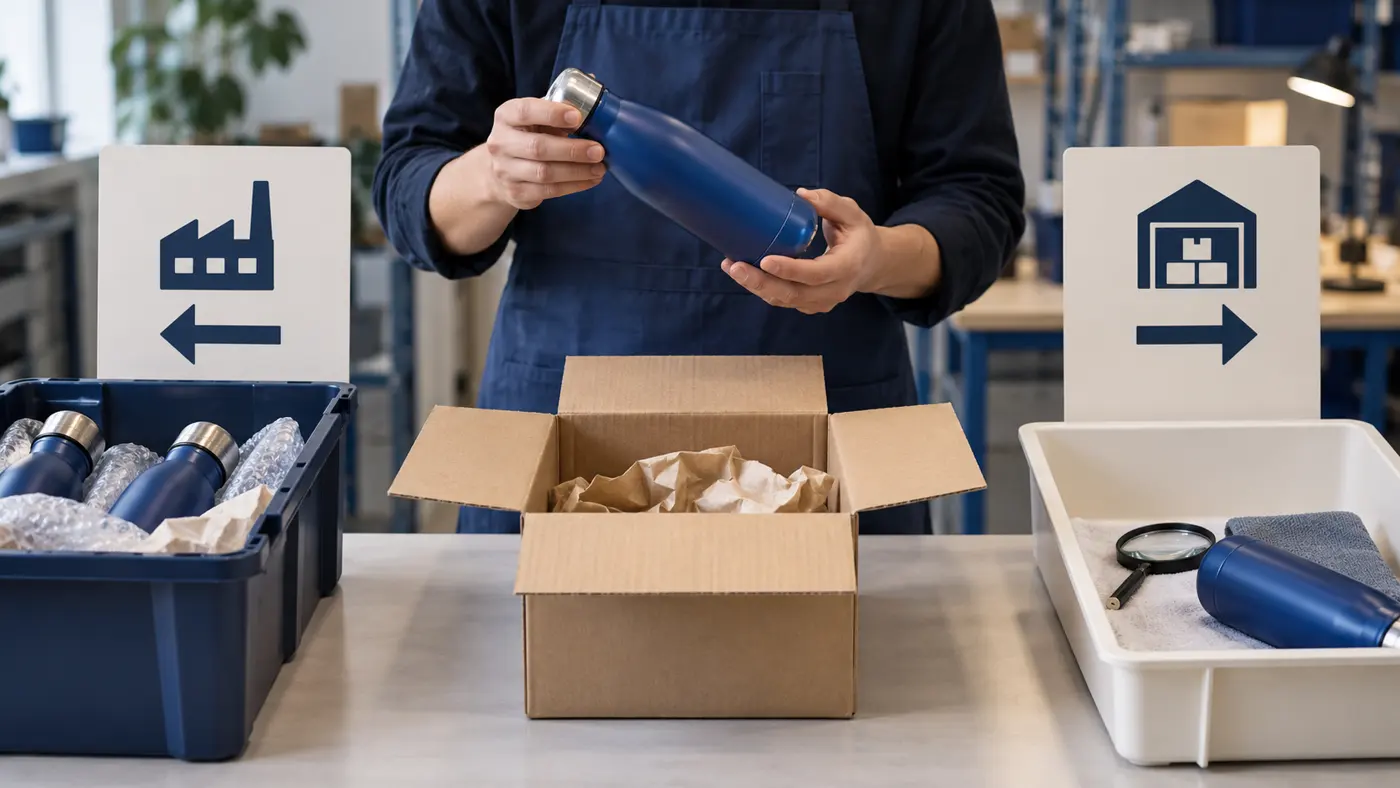
Inspect before putting the returned bottle back
With stocked resale, the wrong bottle may return to your warehouse for inspection. If it is undamaged and correctly identified, it might be saleable later; if it is damaged, it may need a supplier claim or disposal.
A warehouse adds handling and postage
That route can be easier to inspect but adds receiving, handling and sometimes postage in both directions. A low purchase price does not pay for a return by itself. The returns and refunds guide covers the buyer-facing sequence in more detail.
Confirm the actual receiver and payer
Do not write “returns accepted” on a product page solely because a supplier advertises an easy return policy. Your store’s customer promise, the supplier’s business-to-business remedy and any marketplace rules are different documents. Check the destinations you sell into and make the promise you can actually carry out.
03
Decide which product needs an inspection point
The route matters most when a buyer cannot judge a product from the listing. A bottle with a new lid, a garment with inconsistent sizing, or a kit with small parts creates different inspection work. With stocked resale, you can check a batch at receipt and reject mismatched units before they are listed as available. That control has a cost: receiving time, space, and cash committed to the batch.
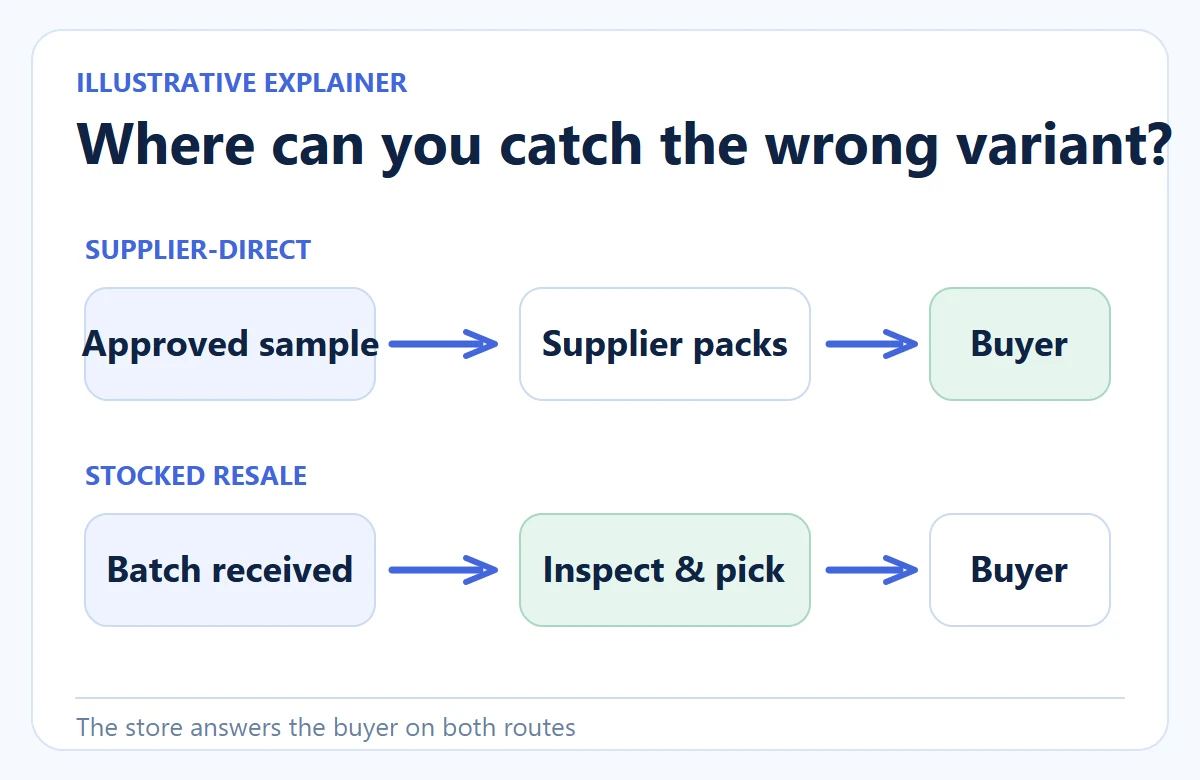
With supplier fulfillment, request an approved sample and a written variant and packing specification, then compare the first delivered unit and later changes against it. You have less direct access to every parcel, so the supplier’s check and exception evidence matter more.
Place inspection where this variant needs it
Use a product-level choice, not a store-wide label. For an untested color, a small supplier-fulfilled trial may reveal demand without a carton purchase. For a repeat item with frequent wrong-size complaints, receiving a limited batch may be worth its cost if a real receiving check catches the defect.
A weak supplier relationship will not become reliable merely because the store calls itself a reseller; a warehouse with no inspection rule will not fix the problem either.
Write one sentence before choosing: “For this SKU, the main avoidable failure is ; the person who can catch it before dispatch is ; the evidence they will record is ___.” If you cannot fill the second and third blanks, you have not yet found the operational advantage of switching routes.
04
Compare the commitment behind one sale
“Higher supplier price versus lower wholesale price” misses the timing of cash. Under supplier fulfillment, the store usually pays for an accepted order under its supplier terms. With stock, it pays or commits to a batch, inbound movement and storage before those units sell.
Stock may lower cost per shipped unit once enough orders arrive. Unsold units and the return process still belong in the comparison.
Compare like-for-like quotes
Ask for the same bottle, packaging, destination and service level in both routes. For the direct route, get the unit cost, per-order handling, payment timing, shipping, tracking and exception charges. For stocked resale, get minimum quantity, unit cost, inbound freight, receiving/inspection, storage, pick/pack, parcel rate and return handling.
If the supplier offers both, request both quote structures in writing. The wholesale-versus-dropshipping comparison walks a 100-unit example and shows why the lower per-unit price can consume more cash when sales are slow.
The promise behind the stock count
There is a second kind of commitment: what you can truthfully promise. Supplier stock can change before an automated feed reaches your storefront. Your own stock can be miscounted, damaged or reserved for another channel.
Confirm the next real dispatch
Neither “supplier stock” nor “my warehouse” means every listing is ready to ship. Before publishing a delivery estimate, test one paid order, watch the real processing time and check the tracking event. The inventory-sync guide goes deeper on stock signals and overselling.
A store can use both routes. It might stock a proven bottle size and let an agreed supplier fulfill a new color. The page must explain any different delivery window, and each order must route to the right source.
Explain both parcels before checkout
When a buyer orders both in one cart, check whether they receive one parcel or two. Describe that result before checkout. The choice changes the buyer’s order experience as well as unit cost.
Test the route that the customer will actually receive
Set up a simple acceptance sheet with three orders: a direct-fulfilled blue variant, a stocked black variant and a mixed cart containing both. For each, record the storefront SKU, fulfillment location or supplier, payment due, expected number of parcels, actual tracking references and return address.
Place controlled orders to a supported destination. Pass only when the blue order goes to the supplier, the black order decrements accepted stock, and the mixed cart sends the number of parcels and tracking updates the buyer was told to expect.
Correct the promise and rerun the mixed order
If the mixed cart is silently presented as one shipment while two parties dispatch it, correct the checkout and order email before scaling. If a stocked order is routed to the supplier because the warehouse quantity has not been marked available, fix the inventory-location rule; do not ask support to apologize for every new order.
Once a week, compare a few paid orders with their source and delivered unit. This operational evidence is more useful than declaring the entire store “a dropshipping business” or “a reseller.”
05
Choose one route for the product you have now
For the unproven bottle, try supplier fulfillment only if the exact variant, dispatch promise and return route work. Inspect the sample and follow one permitted paid order. Save its actual cost, parcel, delivery time and any remedy; a connected app alone proves little.
Test a received batch when repeat demand supports it
If orders become steady, ask whether a small accepted batch would improve cost or quality. Compare the stock route after including inbound movement, receiving, storage and returns. Switch only after the units have been received and approved; otherwise your store can show “in stock” while a carton is still in transit.
You can stock one repeat seller and leave new colors on a supplier-fulfilled route. The decision belongs to each SKU, not to a slogan printed over the whole store.
Before agreeing to either model, get four plain answers from the prospective supplier or operator:
Exact variant proof
Which exact SKU and variant will be shipped for this listing, and how will you prove it on a sample order?
Stock and payment commitment
Who holds the item before sale, and when does the store pay or take on the batch commitment?
Wrong-item operator
Who packs, tracks and fixes a wrong-item order, including the return destination?
Delivered and exception costs
What are the actual delivered and exception costs for the destinations you intend to serve?
If those answers are missing, the model comparison is not yet ready to become a customer promise. AIDrop Agent can help coordinate sourcing, sample checks, packaging and China-side fulfillment under an agreed scope. Share the product link or specification, destination, expected order volume and the point where your current supplier handoff fails through our inquiry page. That allows a real process and quote to be discussed without pretending every reseller needs the same setup.
06
Frequently asked questions
Can one store resell stocked products and dropship others?
Yes. Keep separate fulfillment locations or supplier mappings for each SKU and test a mixed cart. The buyer should see whether two items may arrive in separate parcels, and support needs both tracking references. Do not let the same available unit appear in both routes without an inventory rule.
What if I buy an item from another retail store after my customer orders?
That is a different arrangement from working with an agreed dropship supplier. Check the selling channel’s policy, the source retailer’s terms, packaging, receipt and return route before promising it. A retail listing does not give you stable stock access or permission to represent that retailer as your fulfillment partner.
Where should a customer send a wrong item?
Give the buyer the return instructions under your store’s policy, after confirming the case and the supplier or warehouse route. A supplier’s business-to-business return address may not be suitable for a buyer. Name who pays postage, who approves replacement or refund, and what evidence must be saved before sending an address.
What Is Dropshipping? How to Build and Run the Business
Learn how dropshipping works, earns money and handles risk, from product research and supplier checks to shipping,
How to Start a Dropshipping Business: From Offer to First Delivery
Start a dropshipping business with a clear offer, verified supplier, workable pricing, tested checkout, and a plan
Dropshipping for Beginners: Learn the Model and Test Your First Order
Learn dropshipping basics, choose a focused offer, budget for supplier payments and rehearse checkout, shipping and support
