
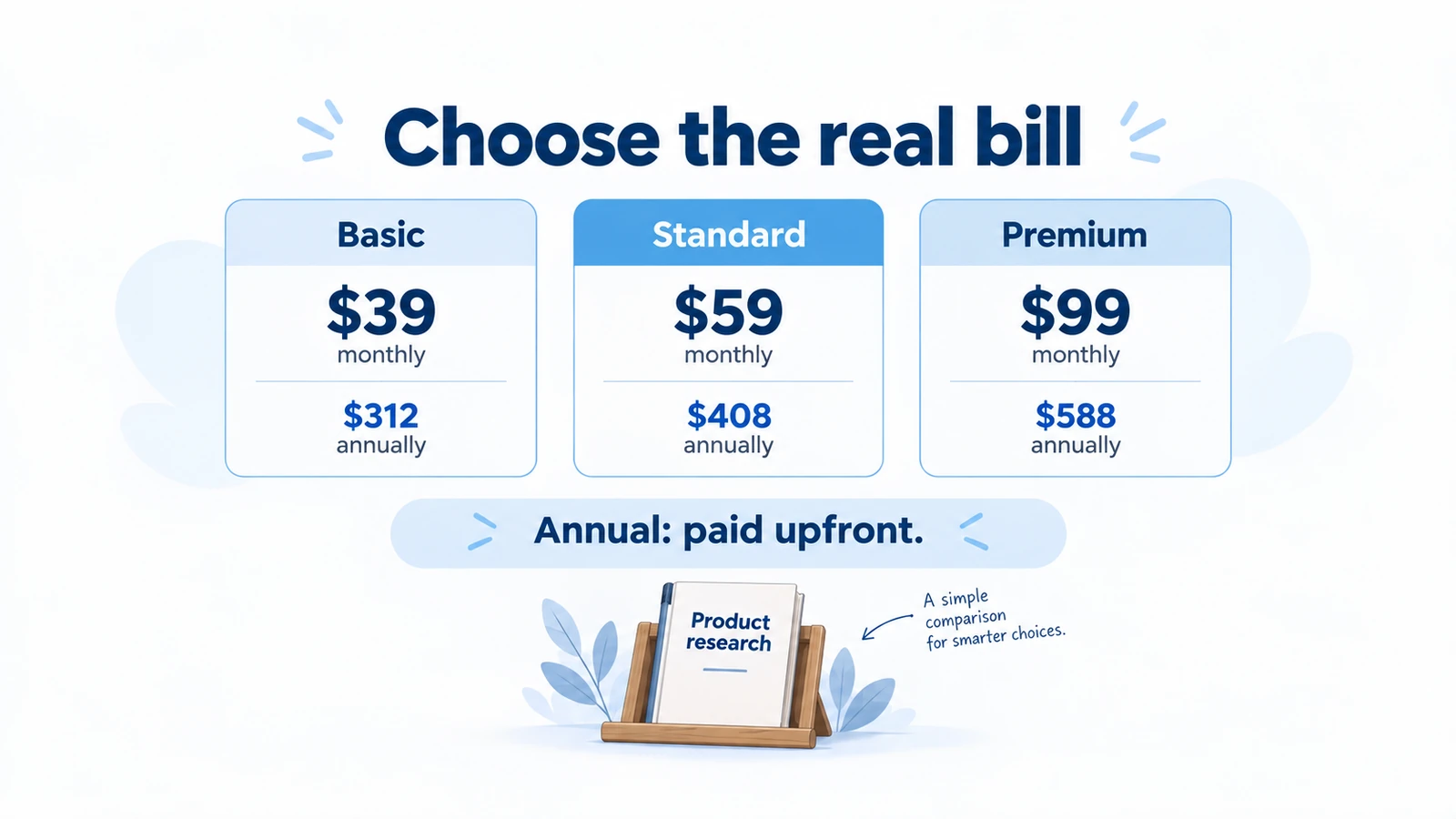
Dropship.io costs $39 a month for Basic, $59 for Standard or $99 for Premium. Annual plans charge $312, $408 or $588 upfront, respectively. The advertised annual equivalents—$26, $34 and $49 per month—are not monthly installments. Its three-day trial requires a card and turns into a paid subscription unless canceled in time.
For a first month of product research, Basic is a sensible starting point if its limits cover the work you actually plan to do. A more expensive plan buys more research capacity; it does not buy supplier stock, advertising results or a delivered customer order.
Imagine Alex researching a folding book stand. He wants to compare products and ads before ordering a sample, while keeping money for that sample. We rechecked the public prices, selected allowances and trial/cancellation help on October 11, 2026. Other detailed feature and billing examples retain their September 30 source date. No paid account, checkout or cancellation was tested.
Explore the broader topic: Dropship.io Review: Features, Prices and Who It Suits.
01
Compare the bill you will actually pay
The three subscription levels have both monthly and annual billing. Dropship.io’s pricing explanation confirms the following US-dollar amounts:
| Plan | Monthly bill | Annual charge paid upfront | Annual monthly equivalent | Savings versus 12 monthly bills |
|---|---|---|---|---|
| Basic | $39 | $312 | $26 | $156 |
| Standard | $59 | $408 | $34 | $300 |
| Premium | $99 | $588 | $49 | $600 |
On a phone, swipe the table sideways to compare every column.
Those savings assume the same plan is used for a full year at the listed prices. For Basic, twelve monthly bills total $468; $468 − $312 = $156. The Standard comparison is $708 versus $408, and Premium is $1,188 versus $588. Taxes, currency conversion and any later plan changes are not included in these comparisons; check the actual checkout total before paying.
For a short experiment
Two months of Basic cost $78 on monthly billing, compared with $312 paid upfront for the annual plan. If Alex stops using the tool after those two months, the lower annual equivalent has still taken more of his cash.
For sustained use
Nine Basic monthly bills cost $351; eight tie the $312 annual charge. At the listed prices, annual billing first becomes cheaper at nine whole months for Basic, seven for Standard and six for Premium. Choose from likely use and cash available now, not just the smallest “per month” headline.
Read the charge and renewal selection
Before accepting the charge, read which plan and billing cycle the checkout selects, when the trial ends and what will renew. A discounted annual equivalent can sit beside an annual payment option; the amount charged matters more than the large headline.
02
Buy the amount of research you need
The core tools help you find products, inspect shops and ads, follow selected accounts and gather ideas. Paying more mainly expands how much of that work you can do. A credit is a usage allowance for a particular tool, not money available to purchase a book stand.
The current official pricing page lists these capacities. Credit allowances reset with the billing cycle; daily searches and weekly product selections have their separate periods.
| Listed capacity | Basic | Standard | Premium |
|---|---|---|---|
| Product Library credits | 10,000 | 25,000 | 50,000 |
| Shop Library credits | 5,000 | 12,500 | 25,000 |
| TikTok shops tracked | 10 | 25 | 50 |
| TikTok products tracked | 25 | 50 | 100 |
| Ad Library credits | 10,000 | 25,000 | 50,000 |
| Advertisers tracked | 10 | 25 | 50 |
| Competitor Research searches | 20 per day | Unlimited | Unlimited |
| Creator Library credits | 3,000 | 6,000 | 10,000 |
| Weekly Product Drops selections | 20 of 40 | 30 of 40 | 40 of 40 |
| Shared AI Search credits | 100 | 200 | 400 |
| Shopify product imports per month | 100 | 250 | 500 |
On a phone, swipe the table sideways to compare every column.
Ask about Advertiser Library before buying for it
There is one unresolved discrepancy: Advertiser Library, which examines advertisers, has different allowances in the plan cards and comparison table—5,000/12,500/25,000 versus 10,000/25,000/50,000. Those are not the separate Ad Library allowances in the table above. If Advertiser Library is the reason you want a plan, ask support to confirm the applicable amount before purchasing; do not budget around the larger figure.
What those limits mean for one research project
A larger tier should remove a real limit
For Alex, the Sales Tracker follows selected TikTok shops and products. Basic’s ten shops and 25 products could cover a small book-stand investigation. If he needs an eleventh shop, he can remove an unhelpful tracked shop or consider Standard. Upgrading makes sense when a known limit stops useful work, rather than when a larger number looks more professional.
The AI search tool can match an image, video or link with research results; its allowance is shared across tools using that AI search. Do not assume every click in every library consumes credits in the same way. Check the relevant tool’s counter when using the account. Likewise, Competitor Research searches competing product listings, while the Portfolio supplies weekly product ideas. Those ideas still need supplier and customer research; inclusion is not proof a product will sell profitably.
Imports are not supplier fulfillment
The Shopify import allowances in the table cover product information, not supplier purchases or order fulfillment. The pricing page describes extra team seats as coming soon, so choose for the capacity available now.
03
Give the trial three small jobs
Dropship.io’s trial instructions describe three days of access with a card required. A temporary $1 authorization checks the payment method; the company describes it as refunded. That is different from a $1 subscription price, and a bank’s display or release timing should not be assumed.
Put the trial decision before the actual deadline
The renewal explanation says billing begins after the trial unless canceled. Before starting, Alex should identify the selected plan, monthly or annual cycle, actual expiry time and intended charge. Put the decision before that deadline, rather than planning to remember on “day three” without knowing the time zone.
Three focused jobs make the short trial more useful:
- Find a small shortlist of folding book stands and describe the buyer each might suit. Save the reason for considering each product, rather than accumulating hundreds of screenshots.
- Inspect competing product pages and ads. Note how they demonstrate the hinge, supported book size and intended desk use. An active ad is an idea to investigate, not proof of profitable orders.
- Decide which candidate deserves a sample by comparing likely product, packing and shipping costs. The research subscription cannot inspect a hinge or tell Alex how a particular supplier will pack his parcel.
Trial access does not mean unlimited usage
The trial page says tools are accessible, while other help wording describes additional paid-plan features. Do not infer that every trial allowance is identical to paid access or unlimited. Inspect what the actual account permits for your intended task. This is a suggested trial plan, not a report of our own account test.
04
Cancel in Plan, change your card in Billing
According to the current cancellation help page, the route is:
- Open the dashboard and select your name or email at the bottom left.
- Open Account settings, then Plan.
- Select the current plan and open its three-dot menu.
- Choose cancellation and complete the prompts.
Keep the cancellation confirmation
Check that the resulting subscription status and renewal information match what you intended, and keep the confirmation. If the status remains unclear, contact support before the unwanted renewal. Logging out, deleting a browser shortcut or letting a card expire is not a reliable cancellation method. The instructions here come from the help page, not a cancellation we performed.
Canceling and getting money back differ
Cancellation and refunds answer different questions. The company’s help says it does not refund a charge caused by forgetting to cancel before the trial ends. Do not treat an annual purchase as refundable for its unused months merely because cancellation is available. The public help page does not settle every consumer’s mandatory legal rights; if a charge is wrong, contact support with the actual plan, timing and receipt.
Change the tier or payment card separately
Read the prorated plan-change confirmation
To move between tiers, use the plan-change procedure and read the confirmation before accepting it. The help describes prorated changes: the charge or credit depends on the plan change and where you are in the billing period. “The difference is $20” is not a safe assumption for every Basic-to-Standard change, especially with different billing cycles. Read the amount and next renewal date shown for your own account.
Updating a payment card is a separate job in Billing. Keep the billing details accurate rather than hoping an expired card will end the contract.
Payment-method help lists major cards, including American Express, although the public FAQ omits Amex. Confirm that card at checkout if it matters to you. PayPal is not supported, according to the help page.
05
Leave money for the product after paying for research
Suppose Alex has $300 available. He budgets $39 for one Basic month, an assumed $35 for a delivered book-stand sample and an assumed $40 for a store or other setup cost. That leaves $300 − $39 − $35 − $40 = $186 for the other work. These sample and store amounts are illustrative; they are not a supplier quote or the stated price of a particular store plan.
The $312 Basic annual payment exceeds Alex’s entire $300 budget before he buys a sample. Its lower monthly equivalent does not solve that cash problem. He still needs to understand advertising, product purchases, shipping, returns and any taxes that apply to his actual business.

What would cover the research bill?
Seven contribution orders cover this bill alone
To judge the subscription later, suppose each retained order contributes $6 after the product, shipping, selling fees and the assumed allowance for problems, but before this software bill and other overhead. Covering the $39 Basic bill alone requires seven such orders: $39 ÷ $6 = 6.5, rounded up to seven whole orders. This is a break-even illustration, not a forecast that Alex will get seven sales or that the store becomes profitable after them. Different contribution per order changes the answer.
The useful result is a product decision Alex can explain. For the book stand, he should know the intended book size, hinge design, packaging and delivered cost well enough to decide whether to order a real sample. A full dashboard of saved products has little value if none can be supplied on workable terms.
Need a sample or packing answer?
For a candidate sourced from China, AIDrop’s product-sourcing service can help discuss supplier options, sample checks and packaging. Send the team the product link, destination country, expected order volume and the question you want answered—for example, whether the hinge and protective box suit the intended book sizes and shipping route. That conversation concerns the physical supply work; it does not provide Dropship.io account access, confirm its research estimates or guarantee a selling price or profit.
06
Check the name before subscribing
The prices in this article belong to www.dropship.io, the research platform. A similarly named Shopify App Store listing identifies InnovationLabs as its developer and points to a different product. The related dropshiptool.io site advertises its own trial and prices. Do not combine one company’s seven-day offer or app pricing with the other company’s three-day trial and annual bill.
Before subscribing, check the domain, developer or company identity and the billing information for the product you actually want. If a search result says “free plan,” ask whether it refers to the separate app rather than assuming the official research platform has a permanent free tier.
If the immediate problem is “a paid store order is not reaching my supplier,” more research capacity will not necessarily fix it. The dropshipping automation guide covers that different task. Keep the research subscription decision tied to finding and evaluating products, rather than buying a larger plan for a fulfillment problem it has not been shown to solve.
07
Questions before you subscribe
Is Dropship.io free?
The reviewed official offer is a three-day card-required trial followed by paid billing unless canceled. It is not a permanent free plan. A temporary $1 card authorization is not the cost of an ongoing subscription. Check that any differently worded offer belongs to the same company and account product.
Do unused credits make the subscription cheaper?
Credits are allowances for research usage, not cash rebates. The pricing page says they reset with the billing cycle; do not assume unused amounts accumulate indefinitely. Check the actual tool’s allowance and reset date, especially around a plan change. The two Advertiser Library numbers remain unresolved until confirmed for the intended plan.
Will finding a promising ad pay for the subscription?
Not by itself. An ad or product signal gives you something to investigate; it does not reveal all your supplier, delivery, refund and customer-acquisition costs. Alex should judge the tool by whether it helps him produce a useful shortlist and make a better sample decision. Then he can decide to keep it, cancel before renewal or upgrade for a specific limit he has actually encountered.
Dropshipping Automation Software: Compare Tools, Costs and Workflows
Compare dropshipping software by supplier fit, pricing, stock updates and order handling. Build a workable setup with
CJdropshipping Review: Costs, Warehouses, Quality and Fulfillment Fit
CJdropshipping is a practical option for sellers who want sourcing, store connections, packaging and fulfillment in one

CJdropshipping vs DSers: Who Sources, Pays and Ships the Order?
CJdropshipping can source and physically fulfill an order; DSers maps a store product to supported external suppliers
