
A dropshipping business for sale is worth buying only when its earnings and operating relationships can survive the handover. The listing price and revenue chart are an invitation to investigate. Before paying, reconcile store orders with payouts, supplier invoices and refunds; then confirm that the domain, traffic, supplier access and open-order obligations will actually transfer.
Buying a stock-light store does not remove inventory risk from the transaction entirely. It changes where you look. You may not inherit pallets, but you can inherit paid customers waiting for parcels, a supplier account that cannot be transferred and ads that stop working when the seller leaves.
Explore the broader topic: How to Start a Dropshipping Business: From Offer to First Delivery.
01
Find listings, then screen them quickly
You can search business marketplaces such as Flippa and Empire Flippers, or use a broker that handles ecommerce businesses. Shopify’s current acquisition guide describes these routes. A marketplace can organize discovery and sometimes verify displayed data, but a listing is not a replacement for buyer diligence.
Before requesting a full data room, screen the listing on five points: the age of the store, months of actual orders, source of traffic, the top products, and the seller’s stated weekly workload. Reject a listing that cannot distinguish revenue from profit or will not name the fulfillment model. If it passes, ask for confidentiality terms and underlying records. Do not pay a deposit simply to discover whether the store has a real supplier.
Screen an operating business separately from a prebuilt store
A ready-made theme with imported products may have no customers, earnings or established supplier operation. Ask which kind of sale you are viewing before comparing prices. On a marketplace, verification badges and seller descriptions are starting points; request the underlying records that support the particular revenue, traffic and profit claims.
Choose a business you can actually operate
Write your own acquisition brief first. A buyer who can operate a US home-goods store should not assume they can manage a UK electronics business merely because both listings say “dropshipping.” Product rules, returns, supplier accounts and customer expectations can be quite different. A narrower target profile makes the later diligence more useful.
02
Define what the listing includes
List the assets and permissions being sold
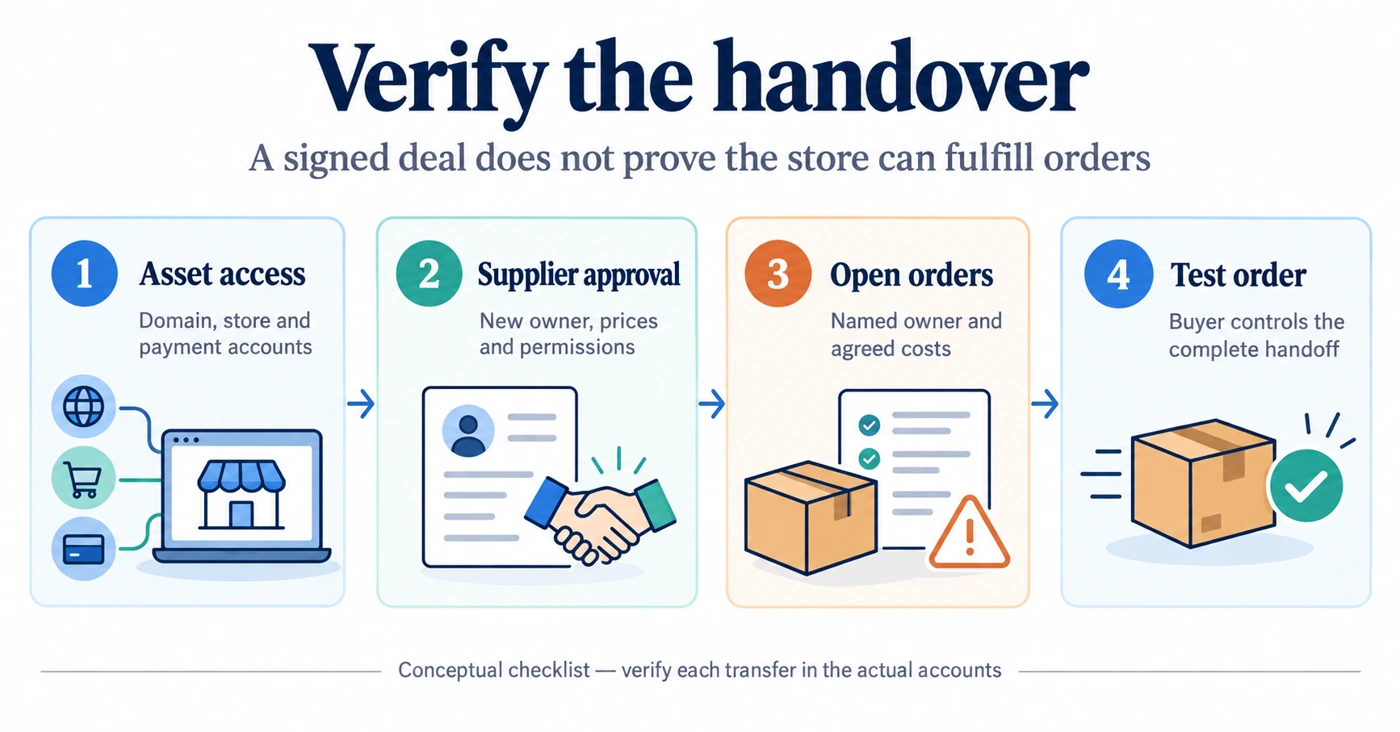
Ask the seller for an asset schedule before discussing a multiple of earnings. Does the sale include the legal entity, domain, Shopify or WooCommerce store, creative files, social accounts, email list, customer-service records, supplier agreements and remaining ad accounts? A screenshot of a store dashboard does not prove ownership of those assets or permission to transfer them.
For a small store, the transfer may be a purchase of website assets rather than the company. For another deal, it may be the whole entity with liabilities. The documents and tax treatment differ. Have professionals examine the actual agreement. Shopify’s 2026 business-acquisition guide treats financials, contracts and daily operation as separate diligence tracks. A buyer of a dropshipping store needs all three.
Get supplier continuity in writing
The least glamorous asset may be the most valuable: a supplier who will continue to ship the same product, on the same terms, to your customers. Ask who owns each supplier account and whether written permission or a new application is required. If the attractive margin depends on a personal discount or an informal agent relationship, it might disappear on day one. The supplier-agreement guide explains what needs to be written down.
03
Rebuild profit from the order level
Do not start with the seller’s claimed “net profit.” Ask for read-only access or exports that let you match a sample of orders to settlement, supplier payment, advertising spend and returns. Flippa’s due-diligence checklist also recommends access to underlying revenue and analytics evidence rather than a listing summary.
For each of the last three to twelve months, build a simple bridge:
| Line | Where to verify it | Why it matters |
|---|---|---|
| Customer payments | Store order export and payment processor settlement | Orders placed are not necessarily cash retained |
| Discounts and refunds | Store transactions and refund log | Gross revenue may include sales later reversed |
| Product and shipping | Supplier order/invoice records | The actual destination and service affect cost |
| Payment and platform fees | Processor and app statements | These fees can sit outside supplier invoices |
| Ads and creative | Ad accounts, creator invoices, agency bills | Ad-platform spend alone may understate acquisition cost |
| Chargebacks, support and replacements | Processor disputes and helpdesk | A profitable-looking cohort may still carry claims |
On a phone, swipe the table sideways to compare every column.
Rebuild the 90-day remainder
Here is a teaching example, not a valuation of a real listing. Suppose a store shows $30,000 of sales in 90 days. After $2,000 of refunds, $12,000 product cost, $5,000 shipping, $1,000 payment/platform charges and $6,000 ad and creative costs, $4,000 remains before fixed overhead, tax and owner work. If the listing advertises “$12,000 profit” by subtracting only product cost and advertising, it has omitted material order costs.

Reconcile timing before calling it missing money
Now compare that arithmetic to bank and processor deposits. The amounts will not line up by day because payouts, refunds and supplier payments occur at different times. They should reconcile over a defined period. Ask the seller to explain any difference instead of treating every mismatch as fraud or every screenshot as proof. Our profit-margin guide separates gross margin from a usable contribution number.
Review a handful of real orders end to end
Trace delivered orders and refund cases
Pick orders from an ordinary week, a peak week and a week with refunds. For each, follow the customer payment, supplier purchase, tracking, delivery and any support ticket. This tells you whether the claimed workflow is documented or kept in the seller’s memory. It also reveals split parcels, wrong addresses and replacement costs that a monthly P&L can hide.
Use staged evidence access
If read-only access is not possible before a confidentiality agreement, ask for a controlled screen share, redacted exports and independent verification. Access can be staged; verification cannot be replaced by trust in the listing copy.
04
Test whether traffic survives the seller
The Shopify marketplace guide points buyers to traffic diversity and owner dependence. For a dropshipping store, inspect the source of new customers and the durability of the content or creative. A store that sold mostly through one ad account and one winning video may need to buy that attention again immediately after closing.
Check what brings customers back
Look at organic search queries and landing pages, direct/returning visits, email-driven orders and each paid channel. Compare reported sessions to actual order cohorts. If organic sales rely on a single page ranking for a volatile query, treat it as concentration risk. If ads rely on the seller appearing in the video, get a license to the creative and a practical plan for future production.
Count buyers without double-counting audiences
Do not add social followers, email subscribers and site sessions into one inflated audience figure. Ask how many people bought, how many returned and what they paid to acquire them. A strong existing page can help; a list that cannot legally or practically be used after transfer is not equivalent to one.
05
Account for open orders and customer obligations
At the proposed closing date, export all paid-but-unfulfilled orders. For each, record supplier acceptance, amount already paid, parcel status, promised delivery date and the customer contact. Who pays the supplier? Who answers a cancellation? Who funds a return on an order sold before the transfer but delivered after it? Put these allocations into the purchase agreement.
Assign three inherited-order situations before closing
Use actual order IDs in the sale agreement. These are illustrative cases, not suggested universal contract terms.
Paid, not yet bought from the supplier
Record the customer money, pending supplier amount, agreed payer, dispatch promise and the person answering the buyer. Do not let both owners purchase the same order or assume a payout funds a still-unpaid supplier automatically.
Already with the carrier
Keep the supplier order, physical scan and promised delivery date. Name who monitors it, answers a cancellation and funds any agreed remedy. Store ownership can change while the original delivery obligation remains unresolved.
Delivered before closing, complaint afterward
Keep the original sale and delivery records, applicable policy and agreed support/refund owner. Closing the transaction does not establish that every past order is free of later claims.
Reconcile this list against the supplier and payment records at handover. Each outstanding case needs an owner and money arrangement; an export saying Fulfilled is not a settlement between seller and buyer.
Test the buyer’s supplier account
Ask for the supplier’s written plan for the ownership change. Can a new account inherit listings, prices, history or credit? Will an integration token stop working? Can the new owner continue to use approved product images? A trial order from the new account is a stronger test than a reassuring email about “smooth handover.” The cash-flow guide explains why settlement timing deserves its own worksheet.
Transfer control through each actual platform
The transfer plan should include access to the domain registrar, payment gateway, tax settings, customer support inbox, email service, analytics, ad accounts and product feed. Do not ask a seller to hand over passwords in a document. Use the platform’s ownership-transfer and permission process where available, then verify each asset works under the buyer’s control.
A Shopify handoff you can verify
This example is for a non-Plus store whose buyer is not already a store user. Follow Shopify’s ownership-transfer instructions, checked October 9, 2026; an existing user uses the Users route, and Plus transfers may need Plus Support.
Clear transfer restrictions
The current owner checks Capital and Credit, which prevent transfer, and an active Balance account, which requires Support. If Shopify Payments business information changes, contact Support. Agree separately who receives the domain and handles outstanding bills.
Send and accept the transfer
The owner opens Settings → General → Transfer store → Manage, chooses the option for a new owner outside the business, and continues through authentication and the buyer’s email. The buyer accepts the transfer email and checks the owner role in their own account.
Check the buyer’s setup
Verify business contact details, billing, payouts and tax details under the new owner. Then check domain access, app permissions, customer-support mail and the supplier agreement. Owner access alone does not transfer every external account.
Run an agreed first order
As a proposed acceptance test, use one approved SKU and destination after the buyer’s payment and supplier arrangements are ready. Match the paid store order to one supplier order, the right item and destination, and returned tracking. Confirm that order notifications and the customer’s support reply reach the buyer. Hold wider sales if any link fails.
06
Stress-test the part the seller still does by hand
Price the exception work that remains
Ask the seller to name the work they do each week. Does somebody manually resolve addresses, choose shipping lines, approve replacements or chase tracking? A store described as “automated” can be one person operating a hidden exception queue. Request a recent week of anonymized support and supplier messages. That tells you how much labor survives the transfer and whether you have the team to handle it.
If a seller says the refund rate is negligible, inspect when the relevant orders were delivered. A very recent sales surge can make refunds look low simply because buyers have not received products yet. Align returns with delivered-order cohorts and examine chargebacks by order date. This prevents a short acquisition spike from being presented as a stable, low-support operation.
Check today’s product and delivery promise
Open the top landing pages and the ads that sent traffic. Are claims and photographs accurate for the product currently shipped? If the store grew using a “free shipping in three days” promise that the supplier cannot meet now, the historic conversion rate is a weak baseline for the buyer. Compare the current page with a sample and destination quote before modeling future sales.
Find the products supporting contribution
Look for SKU concentration. A store can have several traffic channels but 70% of contribution from one product. If that product is seasonal or vulnerable to a supplier change, you are buying a narrower business than a large catalog suggests. Record the top five SKUs by contribution, not only revenue.
07
Make the offer conditional on operational facts
An early conversation can establish a price range, but a serious offer should state which claims you will verify: revenue and contribution period, supplier continuity, traffic-account access, content ownership, open-order treatment and transition support. The exact contract mechanism belongs to the deal and its advisers. The practical point is to define what changes the price or stops the purchase before a deadline pressures you to close.
For example, if a supplier says the buyer must reapply and will not keep the seller’s unit price, obtain the new terms and rerun contribution. If the lower margin cannot support existing ad cost, the buyer needs a different price or a different operating plan. A seller introduction is useful; supplier approval and a paid test order in the buyer’s own account are stronger.
Verify usable data and secure transfer
Personal data needs its own review. An email list is not automatically usable for every kind of marketing after a sale, and customer records should transfer through a secure process. Ask what privacy commitments the seller made and have the deal adviser check applicable rules. A customer CSV in an unprotected chat is not proof of a valuable, usable audience.
Budget for the first operating month
Plan a small post-close budget beyond the purchase price. It may cover supplier deposits, replacement creative, app subscriptions, returns on inherited orders and test shipments. A stock-light model still has cash demands. The purchase can be affordable while the first month of operation is not; separate those questions on the deal sheet.
08
Decide before the price becomes the argument
The business is more attractive when reconciled orders support the claimed contribution, traffic sources are understandable, supplier terms can continue and the seller can demonstrate a repeatable order process. A low asking price does not compensate for a supplier that refuses the new owner or a refund backlog that consumes the first month of cash.
Give the handover named owners
Write a 30-day transition schedule with named owners: supplier introduction, customer-service takeover, open-order reconciliation, ad and feed access, and one new paid test order. Keep a holdback or other agreed protection only if your adviser considers it appropriate for the deal. This is a transaction-specific question, not a universal instruction.
Ask for a supplier-route comparison
If supplier continuity is the weak link, we can help assess an alternative China-side sourcing and fulfillment route for the store’s current SKUs. AIDrop Agent would need the product specification, destination mix, order volume and existing shipping promise to make a useful comparison. The review form is the right place to send that operating information; it is not an appraisal of the whole business.
09
Frequently asked questions
Is store revenue enough to value a dropshipping business?
No. Revenue does not show supplier cost, shipping, refunds, acquisition cost or the owner’s labor. Verify the underlying order and payment records, then examine what will transfer.
Can I keep the seller’s supplier prices after buying the store?
Only if the supplier confirms the arrangement for the new owner or a transferable agreement supports it. Do not infer transferability from the seller’s past invoices.
What should be checked on the first day after closing?
Confirm access and ownership of each asset, the status of every open order, supplier acceptance of the new account, customer-service coverage and a tracked new test order.
What Is Dropshipping? How to Build and Run the Business
Learn how dropshipping works, earns money and handles risk, from product research and supplier checks to shipping,
How to Start a Dropshipping Business: From Offer to First Delivery
Start a dropshipping business with a clear offer, verified supplier, workable pricing, tested checkout, and a plan
Dropshipping for Beginners: Learn the Model and Test Your First Order
Learn dropshipping basics, choose a focused offer, budget for supplier payments and rehearse checkout, shipping and support
