
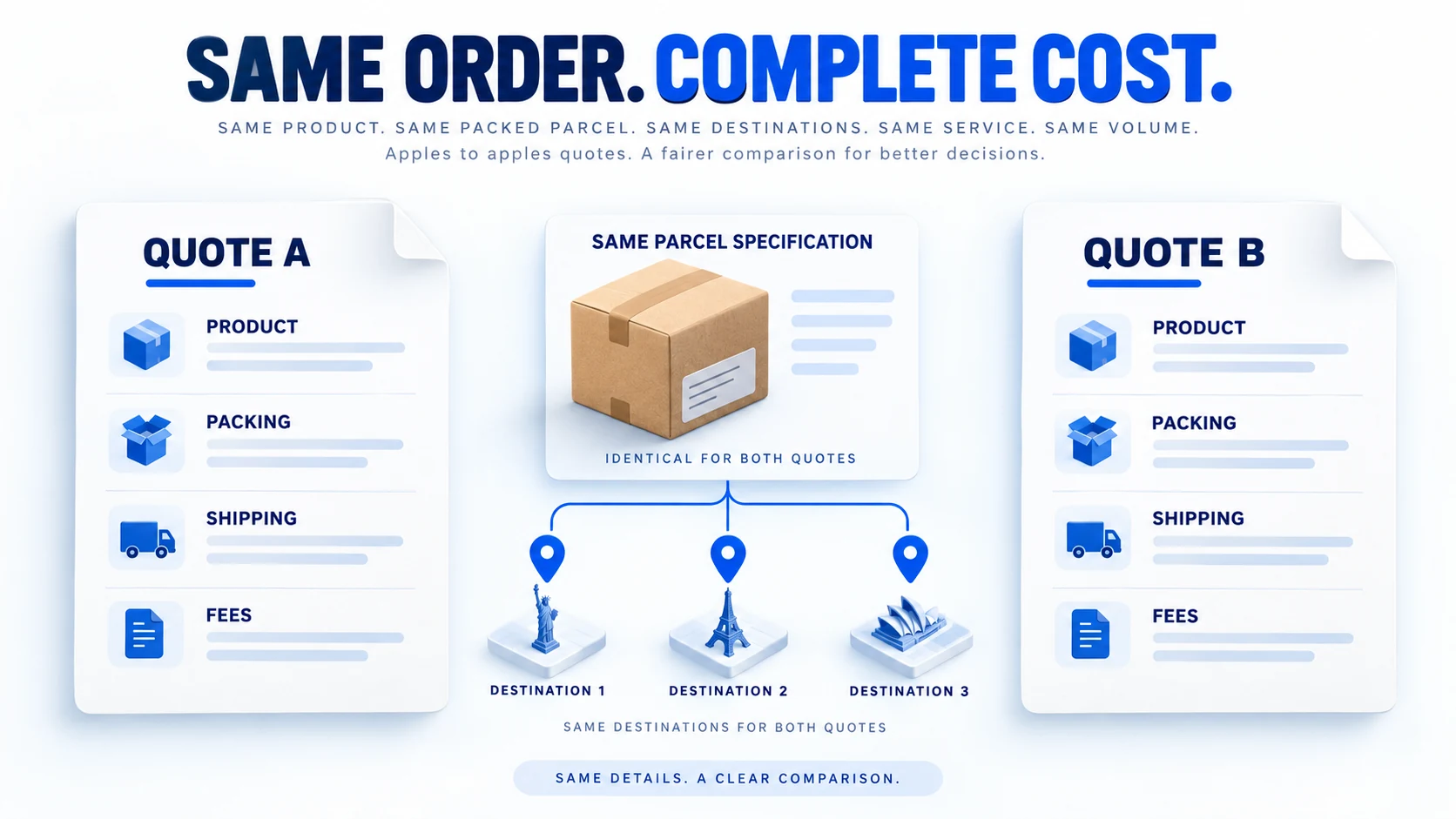
A supplier with a lower product price can still charge more per order. To compare quotes, give each supplier the same product, packed parcel, destinations, service and order volume. Calculate the charges for that order mix, then look separately at the cash needed for stock and deposits. A limited trial lets you compare the quote with an actual invoice and delivery.
In the worked example below, one supplier’s product is $0.45 cheaper, yet its quoted order costs $0.48 more after packing, handling, shipping and the account fee. The arithmetic is straightforward; getting both suppliers to price the same work takes more care.
The examples below use invented numbers to explain the calculation. They are not supplier quotations, current market rates or predictions of your costs.
01
Give each supplier the same order to price
Your request should describe what the customer will receive, down to the variant, accessories and packaging. Include the SKU, specification revision and approved sample reference if one exists. Otherwise, two plausible prices may refer to different products.
Price single-item orders, bundles and mixed carts separately where you sell them. Give a realistic monthly forecast and distinguish it from a purchase commitment: a rate conditional on guaranteed volume is useful only if you can meet that condition.
Use anonymized customer postal codes when you have them. A country-level quote may miss remote-area charges, residential charges or route restrictions. For a new store, an estimated destination mix is a reasonable starting point, provided the supplier knows it is an assumption and explains the cost of addresses outside it.
Your request should contain these comparable inputs:
- Product and packing: exact variant, quantities per order, packed weight and outer dimensions, or a request to measure them.
- Origins and destinations: dispatch warehouse and representative delivery postal codes.
- Service: tracking, expected transport method, any signature or insurance request, and the handling of duties and taxes.
- Volume and timing: trial quantity, low-volume month, expected month, peak pattern and intended start date.
- Commercial basis: currency, quote validity, payment method, minimums and all exclusions.
Allow alternatives, but ask suppliers to label them separately. A cheaper material or slower route may be worth considering; it should not silently replace the baseline. If you still need candidates, finding dropshipping suppliers is the preceding decision.
02
Rebuild the quote around a delivered order
The order total starts with the product, packaging, handling and outbound transport. Inbound freight, receiving, storage, inspection or customization may also apply. Keep charges paid by the recipient visible alongside your own: shifting a charge to the customer lowers your invoice without lowering the cost of getting the order delivered.
Convert each charge to the right unit
A receiving fee per carton needs the number of units in that carton before you can compare it with a per-unit fee. Storage charges need an assumption about how much space the stock occupies and for how long. For bundles, obtain the additional-item pick rate as well as the first-item rate.
Public provider pages show why this matters. ShipBob’s pricing page lists implementation, receiving, storage and order fulfillment, with customized quotes. CJ’s service-fee page distinguishes warehouse and service categories. These are different fee structures to map onto your orders, not evidence that either provider will be cheaper for you.
Keep three amounts in the comparison:
- Per-order charges: Product, packaging, handling, shipping and other work triggered by that order.
- Periodic charges: Monthly fees, applicable minimum-charge shortfalls and storage, allocated across the orders they support.
- Upfront cash: Stock, deposits, setup and packaging purchases, shown at their full amount as well as any justified per-order allocation.
Do not double-count bundled fees. If a fulfillment price already includes standard packing, add only the extra packing charge your request actually triggers. Ask the supplier to confirm both the inclusion and its limit—for example, standard materials versus a branded box stored on your behalf.
An unpriced item is still an unanswered question. Mark each service as included, additional or awaiting a price. If the supplier needs a sample weight or another input, record that dependency and the calculation it will use.
03
Work through a weighted three-destination example
Suppose a merchant is comparing the same lightweight, single-item order from two hypothetical suppliers. Both quote USD, the same packaging requirement and an otherwise comparable tracked service. The assumed monthly volume is 300 orders. Duties, taxes, payment fees and returns are not included in these sample totals and must be reconciled before choosing a real supplier.
The example uses three destination groups: 60% of orders to one main region, 30% to a second region and 10% to higher-cost addresses. These proportions are assumptions, not a typical dropshipping customer mix.
| Quoted component | Supplier A | Supplier B |
|---|---|---|
| Product per order | $4.80 | $4.35 |
| Packaging per order | $0.40 | $0.75 |
| Handling per order | $0.55 | $0.80 |
| Shipping: main region, 60% | $6.00 | $5.90 |
| Shipping: second region, 30% | $6.80 | $7.10 |
| Shipping: higher-cost addresses, 10% | $9.00 | $10.00 |
| Monthly account fee | $0 | $60 |
Calculate the shipping average
Multiply each shipping rate by its share of orders, then add the results:
- Supplier A: 0.60 × $6.00 + 0.30 × $6.80 + 0.10 × $9.00 = $6.54 per order.
- Supplier B: 0.60 × $5.90 + 0.30 × $7.10 + 0.10 × $10.00 = $6.67 per order.
At 300 orders, B’s $60 monthly fee adds $0.20 per order. Adding the product, packaging, handling and weighted shipping gives A: $12.29 and B: $12.77. B saves $0.45 on the product but costs $0.48 more on the matched order.
For the month, those subtotals are $3,687 and $3,831: a $144 difference. That is the result for this order mix and these included charges. It says nothing yet about actual delivery reliability, defect rates, customs charges or the cost of recovering failed orders.
Keep each destination visible
A weighted average helps budget the month, but it can hide an unprofitable destination. Keep the underlying lanes in your sheet and compare them individually. If a supplier cannot serve a postal code with the required tracking or product type, do not give that lane a low price and include it as if the service were available.
Also compare multi-item orders separately. The second product may add little shipping weight, or it may force a larger carton and a higher billing bracket. Multiplying the single-item quote by two is not a reliable substitute for a bundle quote.
04
Test low volume, bulky packaging and missing fees
Recalculate the same example at 100 monthly orders with the destination mix unchanged. B’s account fee becomes $0.60 per order, so its subtotal rises to $13.17. A stays at $12.29 under the example’s assumptions. The difference becomes $0.88 per order.
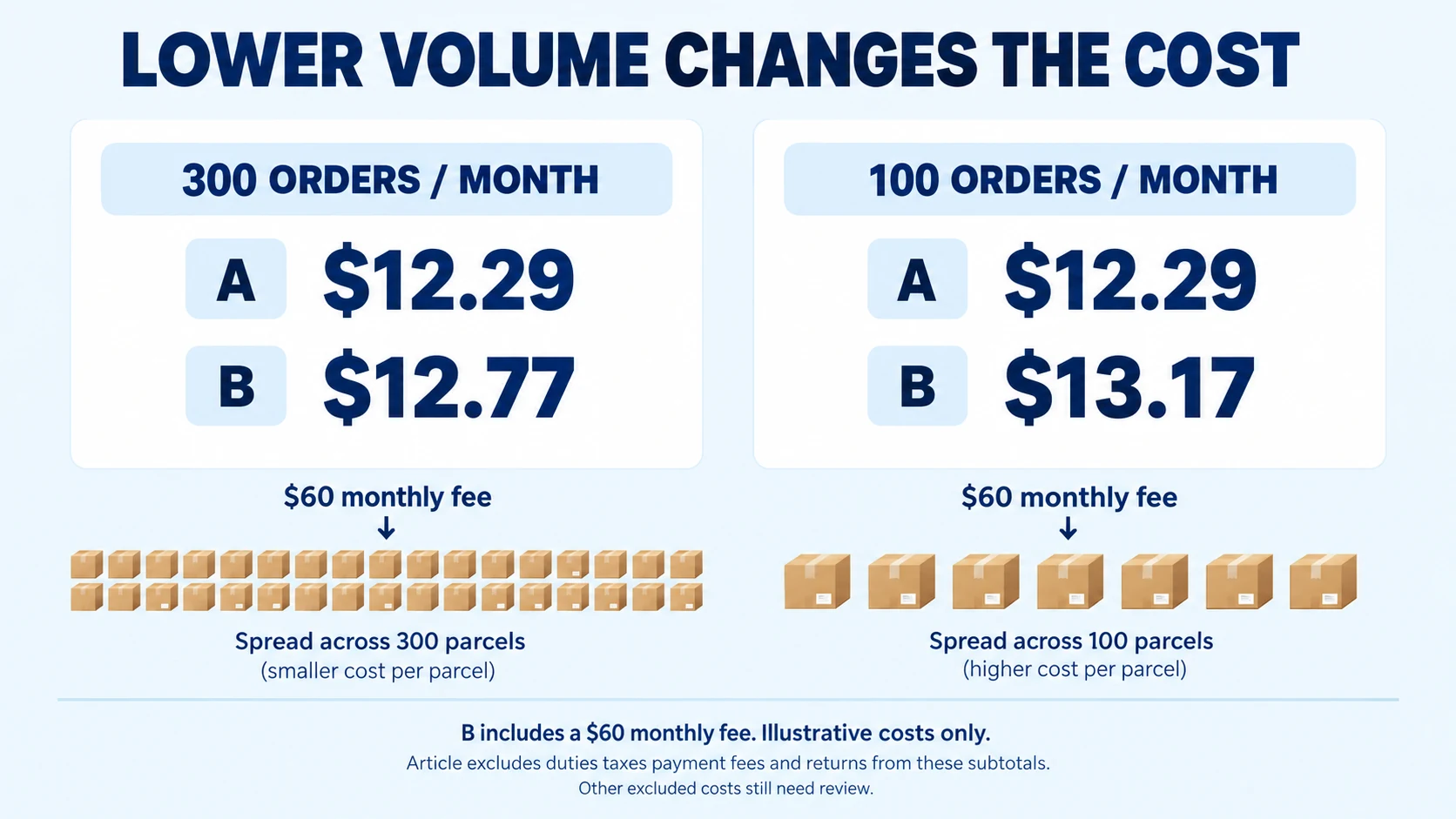
This is why an account fee and a minimum charge need separate treatment. A minimum may apply only to certain services, and qualifying charges may already count toward it. ShipMonk’s pricing explanation describes a negotiated monthly minimum linked to projected volume and pick fees. Obtain the precise formula and eligible charges for your proposal rather than adding a generic minimum on top of everything.
Measure the final parcel
Shipping can change when an item is packed. Ask whether the quotation uses product weight, actual packed weight or billable weight. Confirm the measurement and rounding rules for the quoted carrier service. A branded box with more empty space can alter the comparison even if the product itself is unchanged.
UPS explains dimensional weight as a calculation using package dimensions and a divisor. The applicable divisor and rounding depend on the rate or service. Use the rules in your actual quotation; do not carry a divisor from one carrier or account into another supplier’s estimate.
Use the price gap to prioritize clarification
In the 300-order example, A leads by $0.48 per order. If A has an unresolved extra fee and B’s equivalent service is confirmed included, an added A charge above $0.48 would reverse the price ranking. Below that amount, A remains cheaper on the stated costs; exactly $0.48 produces a tie.
The $0.48 gap gives you a useful question for A: does the missing service cost more than that? If both suppliers still have unpriced charges, the ranking remains provisional until you can compare the net additions.
For international terms, request a named delivery basis and clarify customs responsibilities. Trade.gov’s Incoterms guidance distinguishes delivery tasks, costs and risks from matters such as ownership and payment. A shorthand “DDP” or “tax included” label still needs a defined route, goods and commercial scope; it is not permission to compare unrelated product or payment assumptions.
05
Compare payment and stock commitments separately
Two quotes can have similar order costs but very different cash requirements. One supplier may accept payment per order. Another may require prepaid inventory, a wallet balance and a custom-packaging purchase before dispatch begins.
Alongside the per-order calculation, show when cash leaves the business:
- Before sales: deposits, initial stock, wallet balances and packaging.
- At replenishment: the next stock purchase and any minimum quantity.
- At exit: balance withdrawal, stock removal and disposal charges.
Unused stock may also incur storage immediately. An assumed resale value will not cover that cash requirement unless you have a realistic way to recover it.
Suppose a supplier offers a lower unit price if you buy 500 units. The unit saving matters only alongside the cash paid now, expected sell-through, storage and the risk of unsold inventory. Do not allocate the entire purchase across an optimistic future order count and describe the result as today’s confirmed cost.
Use the dropshipping MOQ guide to separate the product minimum from variant and packaging minimums. A low overall minimum can still leave cash tied up in a slow color or a large batch of branded boxes.
Setup costs need both figures: the amount payable now and the per-order allocation used in your comparison. Recalculate the latter when the order forecast changes.
06
Check the service behind the number
Price differences can reflect different work. One offer might include packing that the other leaves to you, or use a different route. Compare processing start conditions, dispatch cutoffs, stock availability, tracking and packing requirements; then request revised prices for the same service where necessary.
The sample checks the product and packing reference. The trial order shows how that parcel was handled on that route. Both help assess the quote, with limited reach: neither establishes a general defect rate or guarantees future performance.
Separate three records when evaluating a trial:
- The quote and assumptions accepted before the order.
- The actual invoice, including corrections and extra charges.
- The physical result, tracking events and any response to a problem.
If the invoice differs, identify the cause: different measured weight, packaging, remote address, exchange rate, service substitution or an omitted fee. Some changes can be valid under the terms, but they should be explained before the quotation becomes your budget model.
Include the cost of resolving errors
For returns and mistakes, establish what the supplier reimburses, the evidence it requires and whether the remedy is cash, credit or a replacement. Observed recovery costs can inform the model once you have enough data. Before then, use labeled scenarios rather than assigning an unsupported failure percentage.
The dropshipping profit-margin guide takes this supplier-cost subtotal into the wider business calculation. Advertising, payment processing, refunds and overhead still matter even after the supplier comparison is complete.
07
Send a clarification request and approve a bounded trial
A clarification request can be short. Send the same remaining questions to each supplier, for example:
Please confirm that this quote covers specification revision B, one unit in the stated package, the attached postal-code groups and monthly volumes. Mark the included services, additional fees and items awaiting a price. Please also confirm the expiry date and circumstances in which the price can change.
Attach the comparison inputs, not a competitor’s confidential quotation. Ask for a dated revision when a response changes the price or service. Keep the earlier version so you can explain why the comparison changed.
Before approving the trial, close the material gaps: product version, complete charge basis, payment recipient, dispatch terms, claims process and stock commitment. If a supplier cannot price the item until it measures a sample, authorize that limited step separately and return to the comparison afterward.
The trial approval should name the products, destinations and maximum initial spend. Once those orders are complete, compare the invoice and delivery results with the accepted quote. That gives the next purchase decision a firmer basis than the headline unit price.
08
Frequently asked questions
Should I choose the lowest delivered price?
Choose among suppliers that can meet the required product, service and commercial conditions. A complete lower quote is useful, but it does not establish reliability. Compare matched scope and verify the work before committing larger volumes.
How many quotes do I need?
Enough credible, comparable offers to understand the available tradeoffs. Three incompatible quotes are less useful than two complete ones. If there is only one feasible supplier, check its assumptions and alternatives carefully rather than treating a lack of competition as evidence of value.
Should returns be included in the cost comparison?
Record the prices and rules for return transport, handling, replacement and reimbursement. Include actual expected costs when you have a defensible basis. Do not invent a precise return rate for a product you have not sold; use clearly labeled scenarios to understand the potential effect.
What should I do when a supplier will not itemize a bundled price?
Ask for a written list of inclusions, exclusions and triggers for additional charges. A bundle can still be comparable if its scope is clear. If the supplier cannot explain what the amount buys or when it changes, keep that uncertainty visible and do not present it as a complete quote.