
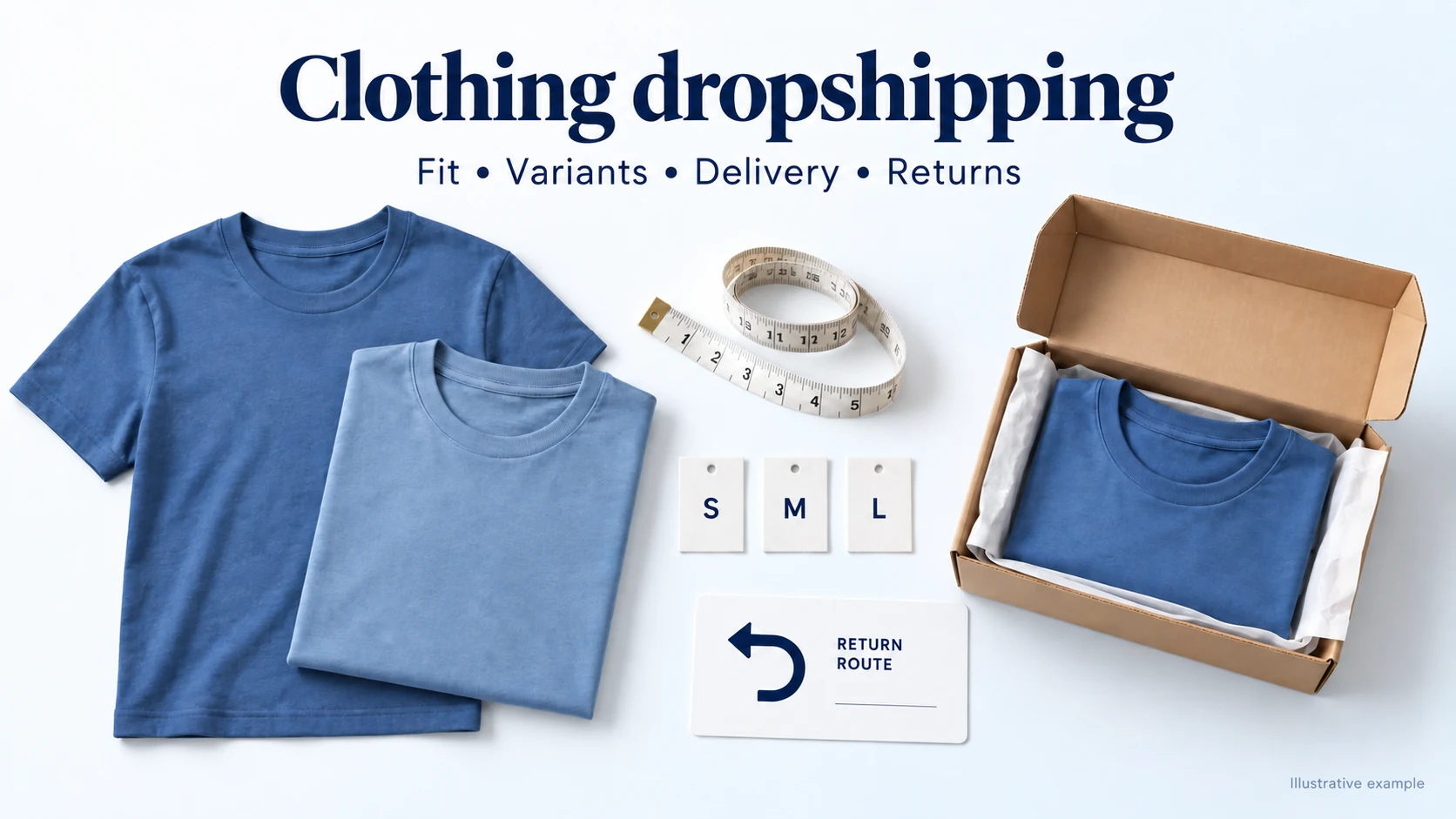
Clothing dropshipping lets you sell apparel while a supplier holds the goods and ships individual customer orders. Start with a focused range, verify the fit and product information, and test the supplier’s handling of variants, delivery and returns before expanding. The customer buys the clothing from your store, so you still need to resolve a wrong size, missing parcel or misleading description.
A clothing offer includes the fit information and the return route as well as the garment. Attractive photography cannot compensate for an ambiguous size chart or an exchange that costs more than the item.
The broader dropshipping products guide covers range selection. Here, the decisions concern apparel: which styles to carry, how to describe them accurately and how to keep a size-and-color catalog manageable.
01
Choose a clothing range you can explain and support
Begin with a customer and a use, such as relaxed everyday tops, a defined workwear style or printed apparel for a particular community. Decide what the buyer values: fit, fabric feel, a design, easy care, size availability or a specific delivery occasion. A large catalog with no consistent fit or purpose makes those expectations harder to meet.
For an initial range, a few well-understood styles can teach you more than hundreds of untested imports. You can inspect each product page, compare the samples and identify which item generated a return. This is a practical operating choice, not a rule that small catalogs always sell better.
Stocked apparel, print on demand or private label
Stocked apparel can be dispatched from an existing supplier range, subject to actual variant availability. You have limited control over the underlying cut, fabric and replenishment. Ask whether a reorder uses the same garment specification or simply the same catalog photograph.
Print-on-demand clothing adds production after the sale. The blank garment, print placement and production process all affect the finished offer. Sample the exact blank and design combination; a good blank sample does not demonstrate print quality. The print-on-demand guide explains the additional production decisions.
Private-label or custom-manufactured apparel may require inventory commitments, development costs or minimum quantities even when someone else ships the customer orders. Confirm who owns that stock and who pays for unsold sizes. A fulfillment arrangement does not remove the investment in a custom range.
Consider the difficulty of the first category
Close-fitting garments, structured tailoring and products with several fit dimensions need more explanation than a simple loose silhouette. That does not make them unsuitable; it means the sample plan and size guidance must match the task. A trouser buyer may need waist, rise, inseam and thigh information, while a top buyer may care most about chest, length and sleeve shape.
Treat children’s clothing, protective clothing and products with specialized performance claims as separate sourcing decisions. Do not assume that an ordinary fashion supplier’s documents cover those uses. The intended market and product determine which requirements need review.
Check when the customer will need it
Seasonal and occasion clothing has a timing constraint as well as a fit constraint. Work backward from the customer’s intended use, allowing for the supported processing and delivery time. Stop promoting a holiday or event offer when you can no longer support its arrival promise; an item delivered afterward may have little value to that buyer.
Test the appeal with content that shows the actual garment and explains who it suits. Compare the delivered price and offer with alternatives in the target market. Track purchase questions and completed orders alongside campaign costs, so a visually popular item is not mistaken for a commercially workable range.
02
Evaluate suppliers at the style and variant level
Find candidates through apparel wholesalers, manufacturer relationships, supplier marketplaces or print-on-demand providers. These are different routes to goods. An app may pass the order while another business owns the stock and packs it, so establish which party answers product questions and handles a claim.
Ask each candidate for the same small product brief. Include the style, size range, colors, destination, expected parcel contents and return requirements. Compare the responses against that brief rather than comparing an advertised starting price with a different garment.
A useful first exchange should establish:
- The supplier’s style identifier and a distinct identifier for every size and color.
- The actual dispatch location and service available to your destination.
- The size chart’s measurement method, units and stated tolerance.
- Fabric composition, care information and photographs of the labels.
- Sample availability and whether the sample comes from ordinary saleable stock.
- Stock-update frequency, substitution rules and replenishment notice.
- The return address, authorization process and treatment of wrong or defective goods.
Get a written answer on substitutions. A similar-looking top from another factory can fit differently even if the supplier calls both versions “medium.” Require approval before a replacement style or material is shipped under the existing listing.
Test the communication as well as the parcel
Send a specific question about a measurement or construction detail. An answer that identifies the product and explains how it was checked is more useful than “good quality” or “standard sizing.” Record unanswered points before ordering samples.
Then place an ordinary sample order through the route that customer orders will use. Record acceptance, dispatch, tracking and arrival. One successful parcel is evidence about that order, not a guarantee of every future delivery. Retain the record so later orders can be compared with it.
03
Separate garment measurements from body measurements
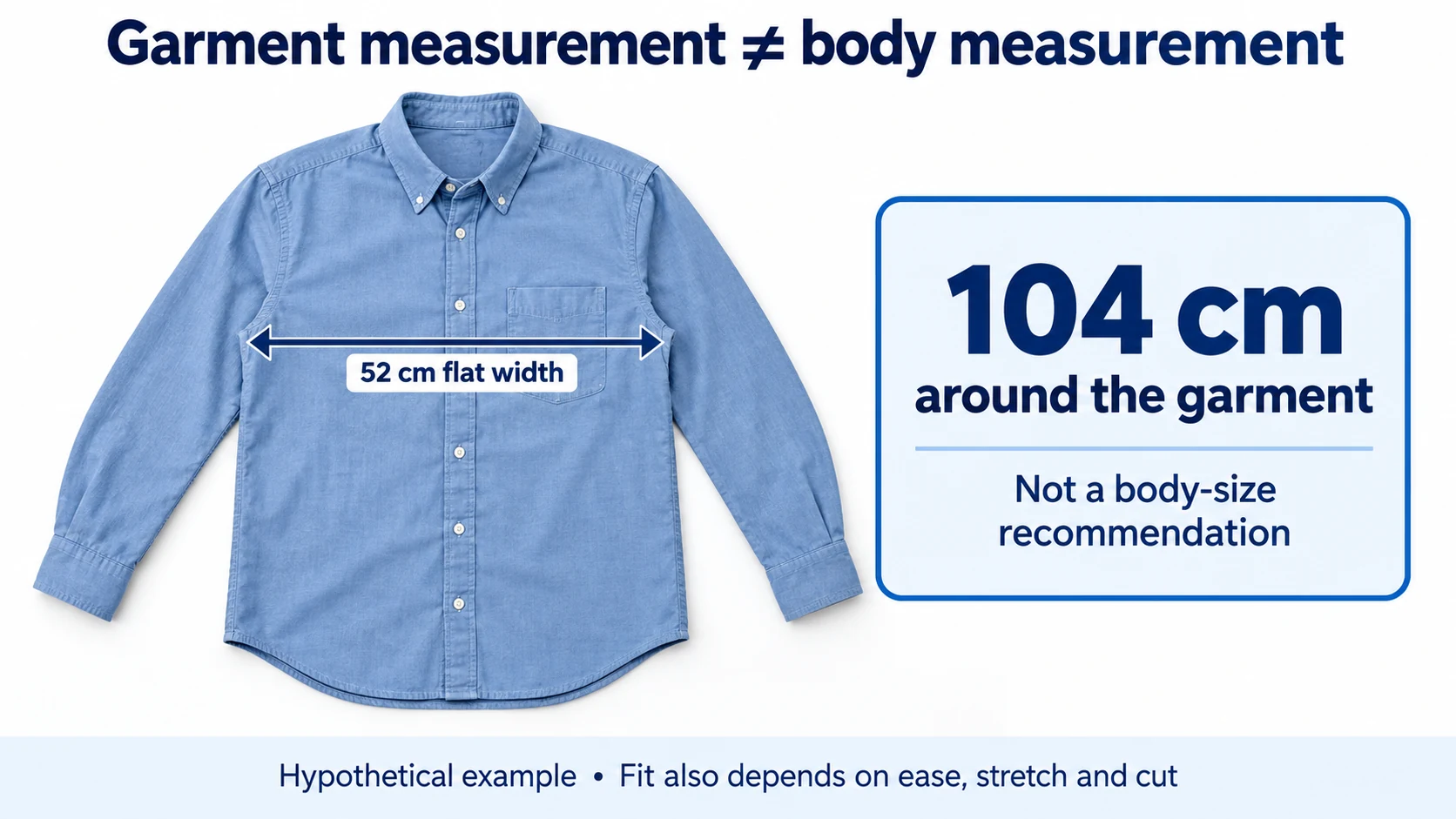
A garment measurement describes the clothing. A body measurement describes the person. Label the chart clearly and tell the shopper how to use it. A flat chest width measured across a shirt should not appear under a heading that implies a full body-chest circumference.
Printful’s shirt-measurement guidance distinguishes garment measurements from body sizing and shows why measurement points matter. Use the method applicable to your actual product; do not copy a provider’s chart into an unrelated supplier’s listing.
In a hypothetical shirt example, a flat chest width of 52 cm corresponds to 104 cm around the garment at that measurement line. It does not establish that the shirt fits a person with a 104 cm chest. Fit also depends on the intended ease, stretch, cut and the way the garment is worn.
Make the chart usable
- For a flat garment chart, show the measurement points and invite customers to compare with a similar garment they already like.
- Specify whether the item should lie relaxed, whether an elastic section is stretched and where length begins and ends.
- Use one consistent method across the chart and sample checks.
If you provide both centimeters and inches, check the conversions and rounding. Preserve the underlying measurement rather than rounding each source value repeatedly. Keep size labels beside the measurements; “M” is an identifier within this product range, not a universal measurement.
Explain the intended fit in ordinary language and support it with the product’s actual shape. If a photograph includes a model, give verified model measurements and the worn size only when you have them. Do not invent those details to make a supplier image look more informative.
Avoid a universal size conversion
A blanket instruction to buy one or two sizes larger can create a different mistake for another style. Resolve the chart for each product instead. If the supplier cannot explain whether a figure is a body or garment measurement, hold the listing until that ambiguity is resolved.
Ask for the supplier’s agreed production tolerance and compare the sampled item against it. Do not present a tolerance as permission for an inaccurate chart. If actual stock systematically differs from the listing, investigate the stock and correct the offer before taking more orders.
04
Sample the differences that customers will receive
A sample in one size and color cannot establish the quality of every variant. Plan checks around meaningful differences: the smallest and largest offered sizes, a pale and dark color, a stretch panel, a different fabric composition or a separate production source.
Use the dropshipping samples guide to record which configuration was checked. For clothing, add measured dimensions, construction details and the care procedure used. Keep an approved reference identified by style and date.
Inspect fit, construction and appearance
- Lay the garment flat and measure the agreed points.
- Check seam alignment, stitching, closures, pockets, hems and loose threads.
- Compare the color and fabric appearance under consistent lighting, and inspect whether the garment is more transparent than the listing suggests.
Try relevant movements on an appropriately sized wearer when feasible. Record what was observed rather than turning a single fitting into a universal recommendation. A garment can match its dimensions yet restrict movement because of its cut or construction.
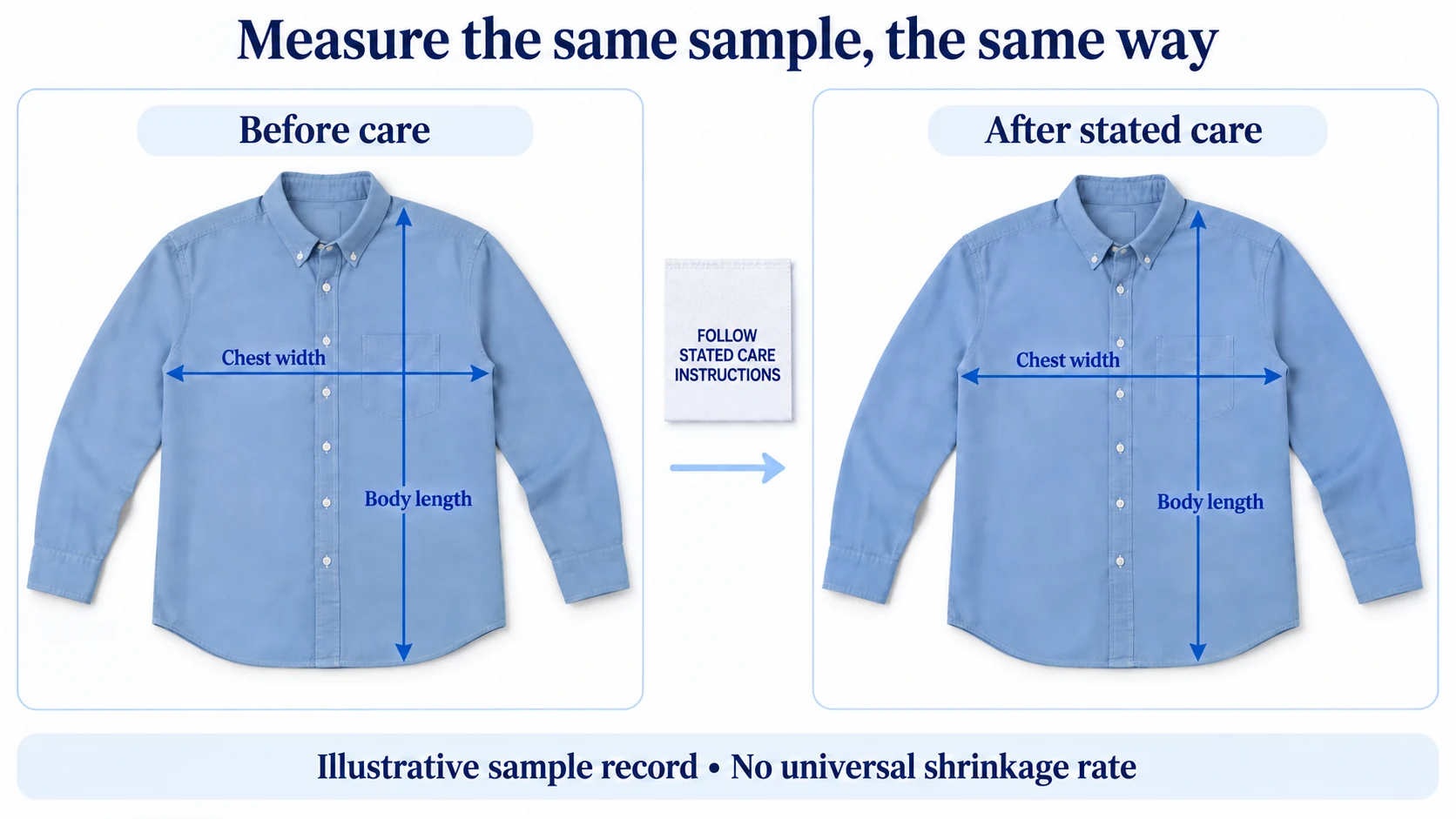
For an illustrative sample record, photograph the shirt and note its chest width and body length before care. Repeat those measurements after following the stated care instructions. The comparison can reveal a change in that sample; it does not establish a universal shrinkage rate for the whole range.
Keep checks within their evidence limits
An ordinary wash check can reveal a visible problem, but it is not a laboratory test or certification. Claims such as colorfast, antimicrobial or protective require evidence appropriate to the claim. Do not infer a fiber composition from touch or appearance.
If a sample fails, specify the defect and ask whether it is isolated or affects the available stock. Obtain a corrected sample or remove the variant. Avoid accepting a promise that the supplier will “be careful next time” when the product specification remains unclear.
Recheck when the fabric, factory, cut or fulfillment source changes. Ask for advance notice of those changes in the supplier agreement. Reusing the old photograph and style name can conceal a material change from both you and the buyer.
05
Build listings that reduce avoidable surprises
- Publish the actual material description, fit information, dimensions, care guidance and included items.
- If a photograph shows a belt, undershirt or other accessory that is not included, make that clear beside the offer.
- Match the selected color to the correct image and stock record.
Use images you are authorized to publish. Obtain permission for supplier photography and confirm that it depicts the shipped product. Generated fashion imagery can illustrate a concept, but it should not stand in for evidence of the actual garment’s drape, stitching or color.
Verify labels for the destination
For the US, the FTC explains that most covered textile and wool products require labels stating fiber content, country of origin and the responsible business identity. Care labeling is governed separately. Review the applicable details in the FTC textile and wool labeling guide rather than treating a supplier’s generic label as sufficient.
Request clear photographs of the labels on the goods you will sell. Compare them with the listing and supplier documentation. If the product description says cotton but the label identifies a blend, resolve the discrepancy before publication. A warehouse location does not establish the garment’s country of origin.
Other markets have their own requirements. Define the markets you will actually serve and review those obligations before enabling worldwide shipping. Keep claims about organic fibers, recycled content or branded materials out of the listing unless the evidence supports the exact wording and product.
06
Keep every size and color connected to the right stock
Three colors in five sizes create 15 possible variants for one style. Four such styles create 60. This simple hypothetical count explains why a small-looking clothing range can still require careful stock control.
Map each storefront variant to the supplier’s exact identifier. Test the option selectors, cart and submitted order together. A blue medium selected on the product page must remain blue medium in the supplier’s accepted order; a correct photograph alone does not prove the mapping.
Handle unavailable variants explicitly
Decide how the store responds when stock is unavailable or the stock feed is stale. It may hide the variant, block purchase or use a supported backorder process with an accurate promise. Never let a generic “in stock” label override an unavailable size.
Do not substitute another color or size without the customer’s agreement. If an order cannot be supplied as sold, contact the customer with the actual options and timing. Record their choice before releasing an alternative.
The inventory management guide covers stock updates in more detail. For clothing, review return and cancellation data by variant as well as by style, so a persistent problem in one size does not disappear inside the overall average.
07
Price the order after returns and replacements
Calculate the product cost, outbound shipping, payment charges, expected customer acquisition cost and the costs you retain when an order is refunded. Add packaging or handling charges where they apply. Sales tax collected for remittance should not be treated as available margin.
In a hypothetical 20-order trial at $40 per order, initial revenue is $800. Suppose each order costs $16 for the garment, $5 for outbound shipping, $2 in payment fees and $8 to acquire. Those costs total $620, leaving $180 before returns, overhead and tax.
If four orders receive full $40 refunds and the original costs are not recovered, the remainder falls to $20. If the merchant also pays $5 return postage for each, it falls to zero. This example assumes no supplier credit, fee reversal or resale recovery and is not a forecast of apparel return rates.
Use the example to identify your missing inputs
Ask what actually happens to a returned garment: can it be resold, who inspects it and when is any supplier credit issued? A credit that arrives later also has a cash-flow effect. Recalculate with your observed outcomes instead of adopting the example’s return frequency.
Keep enough cash to handle refunds while supplier payments and payouts are pending. Increase promotion only when completed orders give you a useful picture of fit complaints, remedies and retained contribution. An early sales total can look strong before returns have had time to arrive.
08
Agree on returns before the first customer needs one
Define where a customer sends an item, whether authorization is needed and how you handle fit changes, wrong goods, defects and late delivery. Confirm that the receiving address accepts the relevant parcels. Do not publish a supplier’s office address without agreement to process returns there.
Keep the customer remedy separate from your claim against the supplier. Their willingness to reimburse you does not by itself determine the customer’s rights. For example, the UK’s returns and refunds guidance explains cancellation rights for distance sales and separate obligations for faulty goods; it should not be generalized into a worldwide policy.
Diagnose the reason accurately
“Too small” may mean the wrong size was packed, the chart was wrong, the item fell outside the agreed dimensions or the shopper preferred a different fit. Ask for the information needed to distinguish those situations without placing unnecessary obstacles in front of a remedy.
Use a consistent return-reason record and attach it to the style and variant. If several complaints point to a chart discrepancy, pause the affected listing and inspect stock. If the measurements are accurate but the fit description is misleading, improve the page and photography.
The dropshipping returns guide explains the broader process. A useful clothing launch ends with a tested return route, not just a delivered sample: make sure someone can receive the parcel, identify the order and authorize the next step.
09
Frequently asked questions
Can clothing dropshipping be profitable?
It can produce a profit when the selling price covers the full order cost and customer remedies, but a markup alone does not establish that. Track retained revenue and costs after returns by style and variant. Do not substitute a general industry margin for your own order results.
Do I need to order every size as a sample?
There is no universal sample count. Cover the differences that could change fit or quality, then expand checks when evidence is weak or the range changes. At a minimum, do not describe an entire size and color range as verified because one configuration arrived correctly.
Can I use the supplier’s size chart?
Use it only after confirming the product, units and measurement method and checking it against relevant samples. Make clear whether it describes the body or the garment. Keep the supplier identifier and chart version so a later product change can be traced.
Should I start with worldwide shipping?
Start with markets for which you can support the delivery promise, product requirements and returns process. Opening more destinations increases the combinations you must test. Add a market when its shipping and after-sales arrangements are ready.