
Sagebrook Home says qualified partners may apply for its dropship program. A trade account alone does not establish dropship approval, and the public Designer Program’s no-minimum offer should not be treated as the terms of a separate dropship agreement. Start with the right account, then get a quote for the actual item, address and delivery service you intend to sell.
That distinction matters when a customer sees a vase, mirror or accent table and expects a straightforward home delivery. A catalog price can look attractive while leaving you without an agreed selling unit, delivery service or response to a damaged order.
The useful question is therefore more specific than whether Sagebrook offers dropshipping: can your approved arrangement deliver this item to this customer on the terms shown in your store?
01
Start with the right account and program
The current Sagebrook FAQ identifies qualified applicants for its dropship program. It also describes trade-account eligibility and a Designer Program. Keep those arrangements separate:
| Arrangement | What the public information establishes | What still needs its own answer |
|---|---|---|
| Trade account | Eligible businesses apply with a valid resale certificate and require approval | Whether your account is authorized for direct customer fulfillment |
| Dealer or Designer purchasing | The FAQ shows a $500 dealer minimum and no minimum for the Designer Program | Whether either term applies to the dropship agreement you are offered |
| Dropship program | Qualified partners may apply | Your qualification, order terms, fees, product coverage and delivery services |
A no-minimum purchasing account can still be unsuitable for the way you intend to fulfill orders. Equally, a general wholesale minimum does not prove that every approved dropship order must meet it. Neither inference replaces the actual program terms.
Apply for the operation you intend to run
Describe your store, selling channels, delivery countries and whether each order goes directly to a different retail customer. That makes the application about your actual use rather than a vague request for wholesale access.
One public program-information link currently redirects to the general shipping-and-returns page. That page is useful, but it is not a complete private dropship agreement. If you receive approval, keep the applicable terms with the account records so someone handling orders later can find them.
If your main decision is still which decor products to sell, start with the home decor dropshipping guide. This article concentrates on Sagebrook’s program and the order details that can change your promise to a buyer.
02
Quote the customer's actual delivery
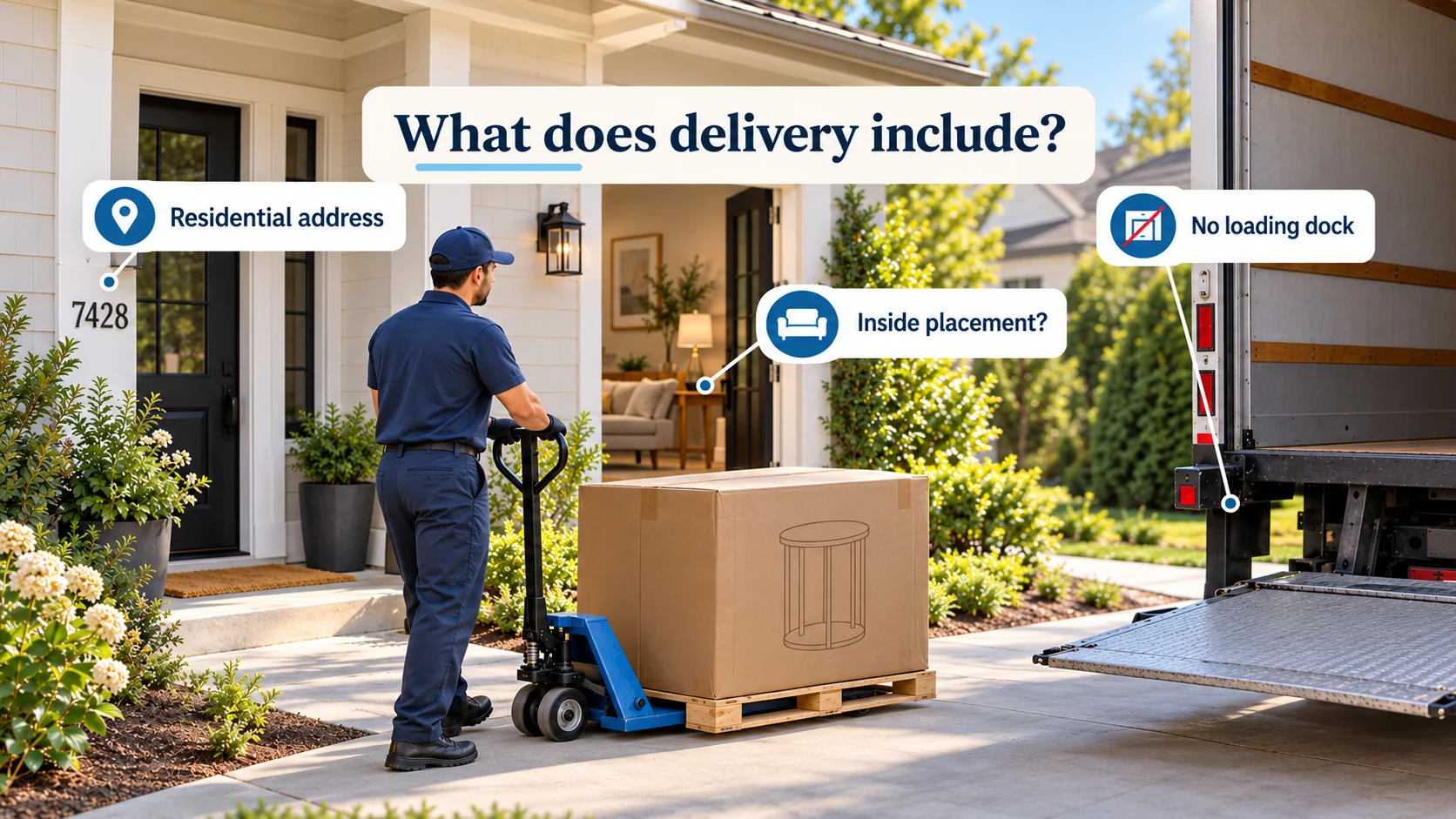
Imagine a customer ordering an accent table for a home without a loading dock. They expect it to be brought indoors. Your price calculation, however, assumes a standard commercial delivery. Both parties may be using the word delivery while expecting different work.
The public general shipping policy lists residential service at $50, liftgate service at $50 and inside delivery from $175. If all three apply to a quoted shipment, those service charges alone total at least $275. Goods and base freight are additional.
This is an illustration using general published charges, not a Sagebrook dropship quote. It does not establish that those services are available for your item, that every home order incurs them, or that the private program uses the same rates.
Match the service before comparing the price
Use the example to make one quote request precise:
| Delivery detail | Filled example for the quote request |
|---|---|
| Destination | A residential address; provide the actual ZIP code to the supplier |
| Receiving facilities | No loading dock; disclose access restrictions |
| Customer expectation | Placement inside the home, rather than an unspecified drop-off |
| Item and quantity | The selected accent-table SKU, confirmed selling unit and quantity |
| Price requested | Goods, base freight, applicable services and other charges itemized |
| Service answer needed | What the carrier will actually do at that address, including any exclusions |
Suppose the resulting offer covers delivery to a receiving area but excludes moving the table indoors. You have two workable choices: sell that defined service clearly or obtain a quote that includes the service you want to promise. Quietly describing both as home delivery leaves the disagreement for the customer to discover.
For comparisons with another supplier, use the same destination, quantity and service. Our supplier quote comparison guide explains how to keep that comparison useful. A lower number for a different delivery service is not yet a cheaper way to fulfill the same promise.
03
Choose a listing you can actually fulfill
An approved account does not make every catalog photograph a ready-to-sell offer. The customer buys a defined quantity of a defined item, with an availability and delivery expectation. Build that offer from an account-specific product record.
Resolve the unit before calculating margin
For a decorative item shown in a group, establish whether the listing sells one piece, a set or a case. Record what is included and what is only styling. A buyer who expects three coordinating pieces will not see a single-piece delivery as a small catalog misunderstanding.
The following is a working record for a fictional proposed listing, not an actual Sagebrook SKU or a tested order:
| Field | Proposed listing record | Release condition |
|---|---|---|
| Product identity | One selected ceramic vase; supplier SKU not yet recorded | Exact SKU and permitted description attached |
| Selling unit | Intended customer offer is one vase | Account quote confirms one sellable unit and its price |
| Availability | Catalog visibility only; no allocation confirmed | Applicable stock status and ordering process understood |
| Delivery | Customer address and service still unquoted | Written quote matches the service on the product page |
| Photos | A catalog image has been found | Permission for the actual intended use established |
This listing is not ready to publish. Its problem is not an unattractive description; the merchant has not established what can be supplied on the promised terms. Filling the missing fields may change the price, quantity or launch decision.
Incoming stock needs a different promise
The FAQ distinguishes stock and upcoming availability. An expected arrival is not the same event as an item being available for your customer’s order. If your arrangement permits backorders, explain the applicable process before accepting one; do not turn a replenishment estimate into a guaranteed dispatch date.
For automated stock or order handling, ask what your approved account actually supports and obtain the relevant setup information. The public documents reviewed here do not establish a universal Shopify app or feed arrangement. That is an information gap, not proof that a particular integration cannot exist.
04
What does the shipping clock measure?
The FAQ describes typical processing of three to five business days after placement and payment authorization. The general policy describes two business days after an order is confirmed and credit approved. Those statements use different starting conditions; neither is a ready-made customer arrival promise.
Think of one order as separate events:
- Your store accepts the customer’s order.
- The supplier receives and accepts the order under your arrangement.
- Any required payment or credit approval is completed.
- The order is prepared and dispatched.
- The carrier transports and delivers it.
A delay between your checkout and supplier acceptance does not disappear because a processing estimate starts later. Transit after dispatch is another period again.
Before publishing an arrival estimate, establish which processing terms apply to your account and add the destination’s actual transport service. Do not choose the shortest public number or relabel dispatch as delivery. There was no test shipment for this article, so it makes no measured delivery-speed claim.
05
Prepare for a fragile delivery before it leaves
A broken decor item creates two immediate problems: the buyer needs a response, and the supplier needs a claim it can assess. Preparing for the second should help the first, not leave a customer waiting while you search for the form.
For freight deliveries, the general policy calls for inspection and recording damage or shortages on the delivery paperwork. Give the receiving customer instructions suited to the service they will actually receive. Do not send parcel customers a generic warehouse-dock procedure and assume it covers their delivery.
Collect a complete claim for the invoice
The current claim page requests one form per invoice, photographs of each affected item and an additional group image for multiple affected quantities. It states both a delivery-based window of ten business days and an invoice-based window of thirty days.
For a fictional invoice containing two damaged decor pieces, a useful record would contain:
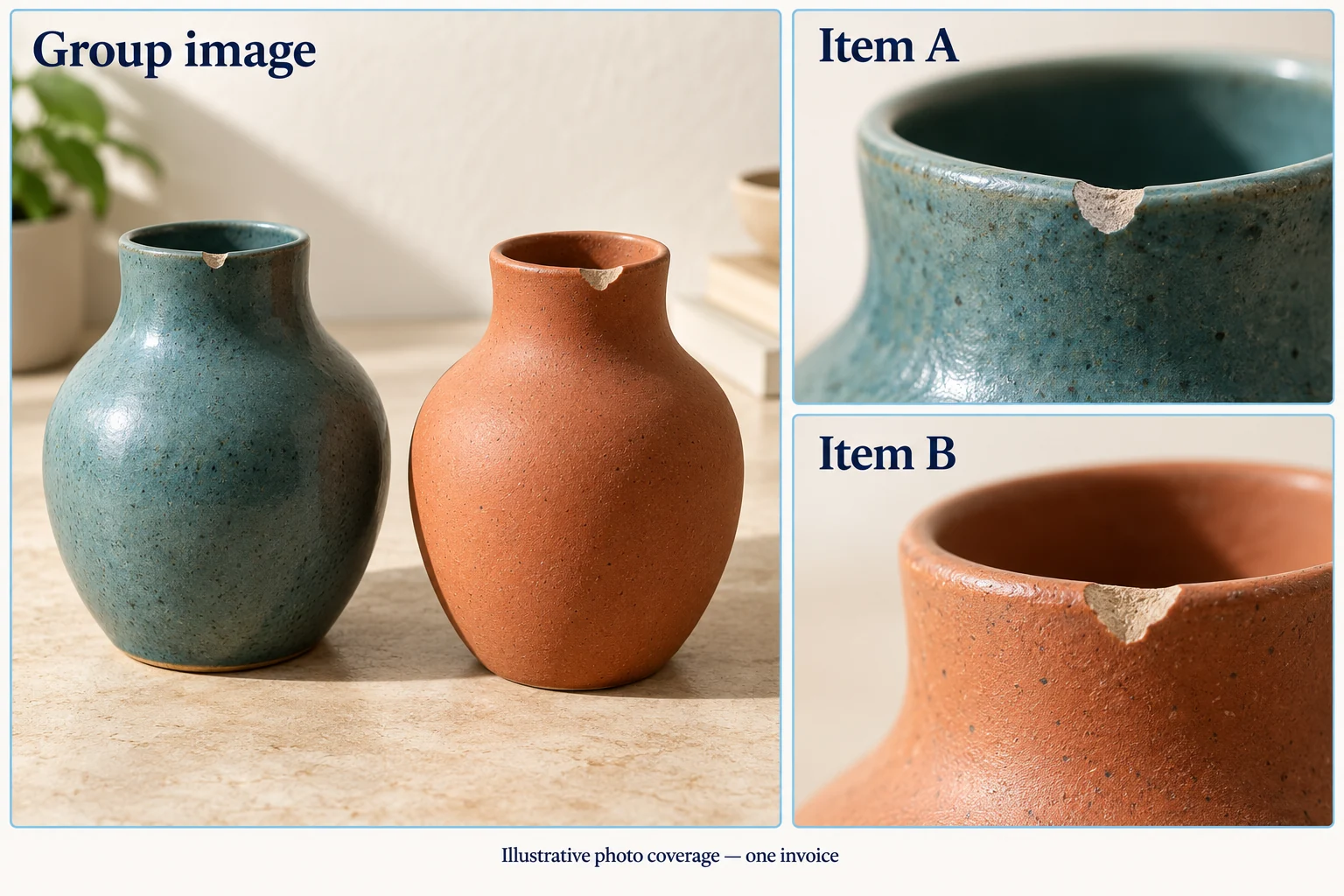
- The invoice and its date, with the affected item references and quantities.
- The actual delivery date and any relevant carrier/delivery record.
- A clear individual image of each affected piece, plus the requested group image.
- A description that identifies the damage shown, rather than merely saying the order is bad.
- The completed invoice claim submitted through the provider’s current instructions, with a retained copy.
Photographs are evidence of the condition being reported, not a guarantee that a claim will be accepted. Follow the applicable instructions for any further handling or evidence needed.
Do not use conflicting wording as extra time
The FAQ also uses a ten-days-from-receipt description. That is not identical to ten business days, and the invoice-based condition adds another limit. Report promptly and clarify the applicable terms rather than waiting for whichever wording looks more generous.
You also need a customer response while the supplier assesses the claim. Record what you told the buyer, the remedy you offered and what happens next. A supplier’s pending review does not explain the customer’s position by itself.
06
Your customer's return is a separate commitment
Sagebrook’s public information does not present ordinary returns as an unrestricted service. Authorized exceptions can involve costs, including restocking and transport charges; the general policy distinguishes non-damage/non-defect returns from other situations. Do not describe every damage claim as automatically subject to the same restocking charge.
Agree on the destination and costs
Before offering easy or free returns, decide who authorizes the return, where the item goes, who arranges transport and who bears each cost under the applicable terms. An address on an invoice is not permission to send something there without authorization.
Consider a customer who simply changes their mind about the color. That is a different operational case from a vase arriving broken. A retail promise that treats both identically may leave your store funding a service that the supplier has not agreed to provide.
Our dropshipping returns guide explains the separate customer and supplier records. Keep the customer’s remedy, the physical return and the supplier’s credit decision clear; they need not happen together.
If you are comparing this US-supply route with China-side sourcing, send AIDrop Agent the product, destination and packing requirements. We can discuss that separate route and the work it requires. We do not manage or approve Sagebrook’s program, and a China-side quote is not evidence of its terms.
07
Frequently asked questions
Does Sagebrook Home definitely have a dropship program?
Its current public FAQ says qualified partners may apply. That confirms an application route, not approval for every account or a public rate for every order. Obtain the terms applicable to your business before listing products for direct customer fulfillment.
Does the Designer Program remove the dropship minimum?
The public no-minimum statement refers to the Designer Program. It does not establish the minimum for a separate dropship arrangement. Ask under the program you will actually use rather than transferring a favorable headline between accounts.
Is shipping free on all dropship orders?
The reviewed primary documents do not establish that universal promise. General wholesale freight rules and a directory’s free-shipping claim are not an account-specific quote. Use the actual item, destination and required services to obtain a price.
Can I use the program for customers in Canada?
The FAQ directs Canadian customers to an authorized partner. That does not establish unrestricted direct delivery to Canada under a US dropship account. Confirm the appropriate route and terms for that destination before accepting orders.
Can I sell online if I do not qualify?
The FAQ describes buying and holding your own inventory as an alternative. That changes your stock and fulfillment responsibilities. It also does not grant unrestricted use of every catalog image; establish permission for the products and use involved.
Sources and scope
Sources checked October 26, 2026: Sagebrook Home’s linked FAQ, general shipping-and-returns policy and claim page. Account types, general terms and unknown private program terms are kept separate. Public processing and claim wording differs as described. The delivery calculation, listing record and claim scenario are illustrations; no account approval, sample inspection, private quote or shipment test was performed.

Furniture Dropshipping: Product Data, Delivery Scope and Damage Recovery
Furniture dropshipping needs more than a supplier quote. Verify the exact piece, cartons, drop-off service and damage

Home Decor Dropshipping: Fragility, Dimensions and Presentation
A decor listing needs more than a room photo. Compare appearance, packed dimensions and the recovery path
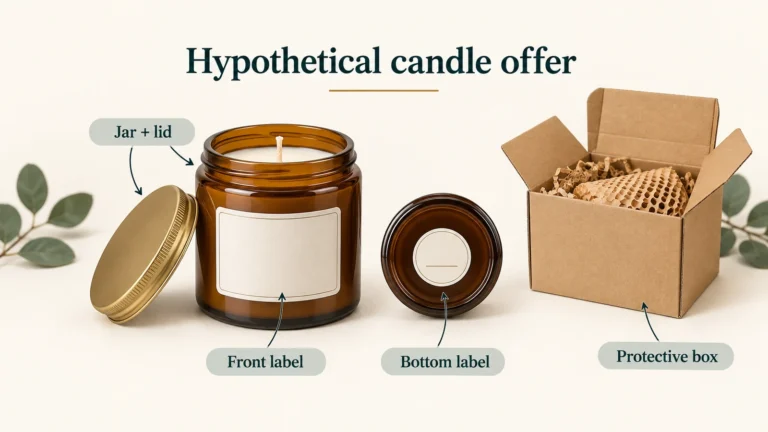
Candle Dropshipping: Choose the Jar, Scent and Shipping Plan
Build a small candle offer, compare individual dispatch with wholesale batches, price a complete order, and plan
