
Dropshipping suppliers can include wholesale distributors, marketplace sellers, manufacturers with individual-order services, and print-on-demand providers. Useful places to start include Shopify Collective, Syncee, AliExpress through DSers, SaleHoo, Worldwide Brands, Alibaba, and Printful. They provide different ways to obtain products and connect orders, so they should not be treated as interchangeable suppliers.
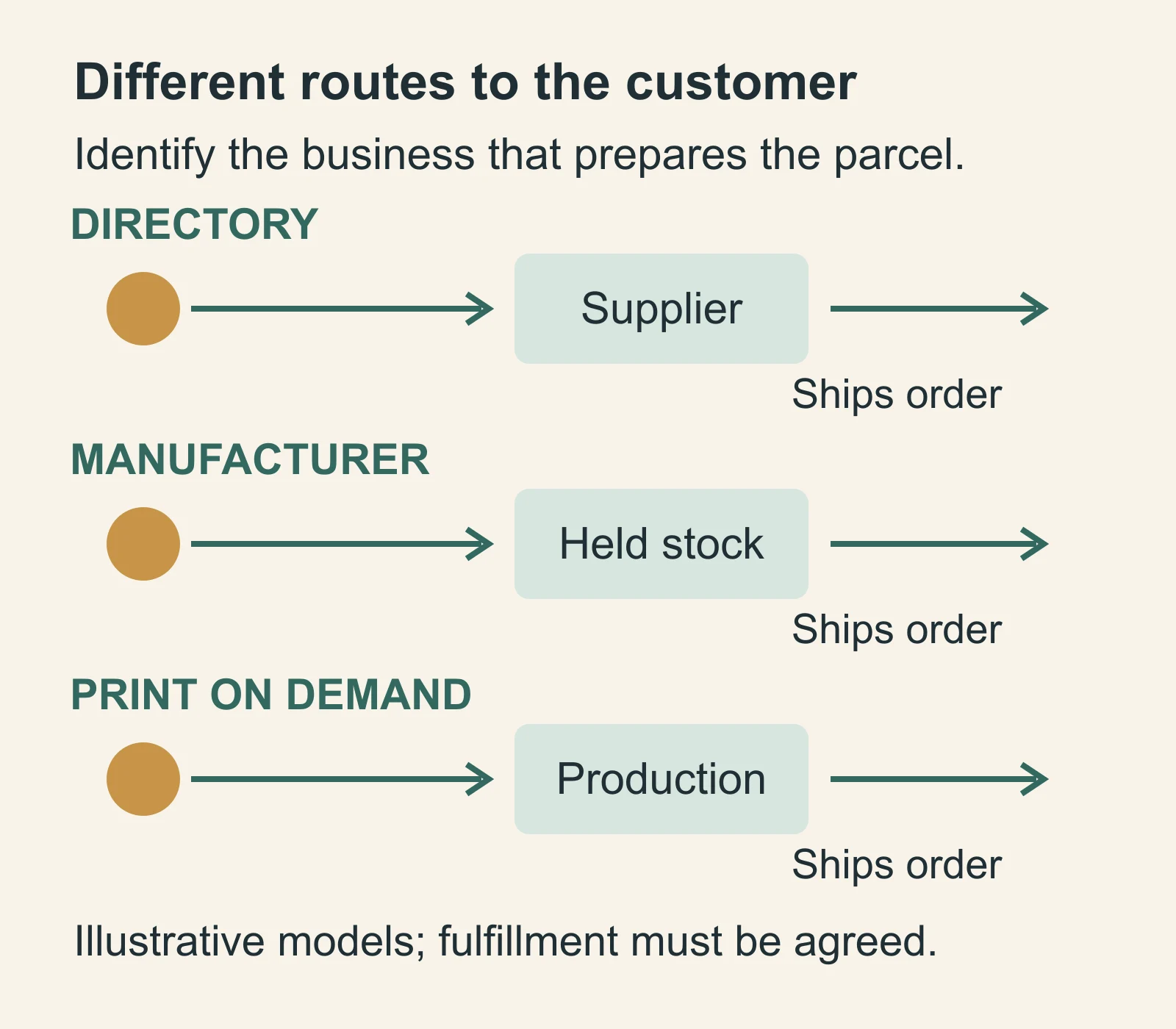
Choose a channel that fits what you sell, where your customers live, and whether you need existing stock or made-to-order goods. Then confirm the business that will actually prepare and ship each order. A familiar platform name cannot answer those questions for every product in its catalog.
This guide compares the options and their commercial implications. For the broader business model, see what dropshipping is.
01
Compare supplier channels before comparing company names
A directory helps you locate a business. A marketplace lets you buy from sellers. An integration moves product and order information between systems. A manufacturer produces goods, while a fulfillment provider prepares shipments. One company may perform several of these functions, but the agreement determines which ones you receive.
| Channel and examples | What you are accessing | Useful when | What still needs confirmation |
|---|---|---|---|
| Connected brand networks: Shopify Collective, Syncee | Products offered by participating suppliers | You want an assortment that fits an existing audience | Supplier acceptance, selling territories, shipping and returns |
| Marketplace plus software: AliExpress and DSers | Seller listings connected to your store | You want to investigate ready-made products without commissioning production | Exact seller, variant, stock location and order terms |
| Supplier directories: SaleHoo, Worldwide Brands | Businesses you can contact and evaluate | You want wholesale or dropship relationships beyond one marketplace | Whether the listed business accepts your account and ships individual orders |
| B2B sourcing: Alibaba | Manufacturers and trading businesses | You need production discussions, customization or stock purchasing | Minimum orders, ownership of inventory and individual-order fulfillment |
| Print on demand: Printful | Products printed after an order | Original artwork or an audience gives your merchandise a reason to exist | Product availability, production time, print quality and return coverage |
These are channel examples, not a tested reliability ranking. The same channel can contain both a suitable and an unsuitable option for your store. Start with the product you need to deliver, rather than the number of products a platform advertises.
02
What the main sourcing options actually offer
Shopify Collective: sell products from other Shopify stores
Shopify Collective connects Shopify stores so a retailer can import products offered by suppliers. Customer orders are forwarded to the supplier, and tracking information syncs back. Access depends on supported countries, currencies and eligibility requirements.
This is worth considering when another brand’s products complement your assortment. A store serving home-office customers, for example, could look for relevant accessories instead of creating every product itself.
The connection does not give you unrestricted access to every brand or selling territory. Confirm available products, pricing, shipping arrangements and return policies with the supplier. Consider whether the branded item strengthens your offer when shoppers can also compare it with other retailers.
Syncee: connect your store with participating suppliers
Syncee describes its service as a dropshipping and wholesale marketplace connecting suppliers and retailers across ecommerce platforms. Suppliers provide products and set shipping and order-billing details; retailers import products and purchase from the supplier when orders arrive.
The model can suit a store that wants to compare participating suppliers and connect their catalogs. It also gives you a reason to inspect the supplier’s own commercial conditions rather than treating the marketplace as a single shipping operation.
Ask how that supplier handles your destinations, inventory updates and order changes. Confirm which features your store integration supports. A product import that works correctly is only one part of a working order relationship.
AliExpress and DSers: separate the seller from the connection
DSers provides ecommerce integrations for connecting stores with AliExpress. That makes it an example of software helping you work with marketplace sellers; the application and the seller are different parties.
This route can be useful for investigating ready-made items and comparing listings before making a larger inventory commitment. Compare the exact variant, included accessories, ship-from option and delivery service. Similar photos do not establish that two listings contain identical goods.
If you change sellers later, check the product again. A replacement seller’s case, zipper, finish or packaging may differ even when the listing title looks familiar. Keep your store’s variant mapping and customer description tied to what the current seller actually supplies.
SaleHoo and Worldwide Brands: start with a supplier directory
SaleHoo’s directory includes wholesalers, manufacturers and dropshippers, with filters for characteristics such as location and minimum orders. SaleHoo describes the businesses as vetted. That is the directory’s description of its screening, rather than evidence that a particular item will meet your requirements.
Worldwide Brands also provides a directory of wholesalers and dropshippers. It says it verifies suppliers and connects members directly with them. This can be useful when you want a business relationship with a distributor rather than purchasing every item through a consumer marketplace listing.
For either route, ask whether the supplier accepts your type of store, permits your sales channels, and offers individual-order shipping. Wholesale availability does not automatically mean dropshipping availability. Directory access and a supplier account are separate decisions.
Review the access plan and the supplier’s own charges before paying. A directory can reduce the work of locating candidates, but you still need product-specific terms and an approved order arrangement.
Alibaba: useful for production discussions, with fulfillment agreed separately
Alibaba is relevant when your requirements extend to materials, specifications, packaging or buying inventory. A manufacturer may be able to make the item you want without being equipped or willing to send one parcel to each of your customers. Ask about that service explicitly.
Two Alibaba features also answer different questions. Verified Supplier involves third-party company assessment. Trade Assurance concerns covered orders and their agreed terms, using the platform’s specified order and payment process.
Neither feature establishes that every SKU is suitable for your market or that your desired daily fulfillment arrangement exists. Read the assessment’s scope and put specifications into the order agreement. If you buy stock, establish who owns it, where it is held, and how individual orders will be released.
Printful: produce printed products after customers order
Printful’s cost documentation describes an option without order minimums or a required monthly subscription on its free version. You pay for the product and fulfillment-related costs, including shipping. Your customer pays your store, and you pay Printful.
This suits products whose appeal comes from your design or audience: an illustrator’s tote, a creator’s shirt, or a print collection. Evaluate the actual blank product, print placement and finished sample. Allow for production as well as transit when setting expectations.
Return coverage deserves attention. Printful’s policy generally excludes ordinary buyer’s remorse and wrong-size or wrong-color selections, with destination-specific exceptions such as its Brazil policy. Your store’s customer obligations and promises need separate consideration; a supplier’s refusal to reimburse you does not resolve the customer’s request.
03
Local suppliers and local stock are different questions
A supplier’s business address tells you where the business is based. It does not establish where every variant is stored, which warehouse will dispatch your order, or whether a local return address is available.
For a specific product, confirm:
- Dispatch location: where the selected SKU will leave from, including any fallback location.
- Available stock: whether the quantity is physically available there and how updates reach your store.
- Customer route: which service handles the destination and what happens outside the normal coverage area.
- Return destination: where an approved return goes and who pays the relevant costs.
A nearby warehouse can shorten part of the journey, but processing delays, stockouts and destination coverage still matter. An overseas route may be workable when its costs and delivery expectations fit the offer. Compare complete orders to the same destination instead of labeling all domestic suppliers fast or all overseas suppliers slow.
For the timing questions behind that comparison, use the guide to dropshipping shipping times.
04
Establish who handles the order when something goes wrong
The supplier relationship becomes clearer when you follow an exception. Suppose a customer receives the wrong color. Which business investigates? Which record identifies the ordered variant? Who authorizes a replacement, and who pays to send it?
An app may transmit the order correctly while the warehouse picks the wrong item. A directory may have verified the business without participating in the sale. A payment-protection process may address your purchase while leaving you to manage the customer conversation.
A connected app does not transfer your customer responsibilities.
Shopify’s dropshipping guidance makes clear that merchants remain responsible for applicable retail obligations, including product safety and shipping and refund information. The relevant requirements depend on where the business and customers are located.
Before listing, establish a named contact and written arrangements for stockouts, substitutions, incorrect goods, damage, lost parcels and returns. Keep the supplier’s reimbursement process distinct from your customer return process. This makes it easier to respond promptly without promising a supplier-funded refund that has not been approved.
05
Compare the cost of the same completed order
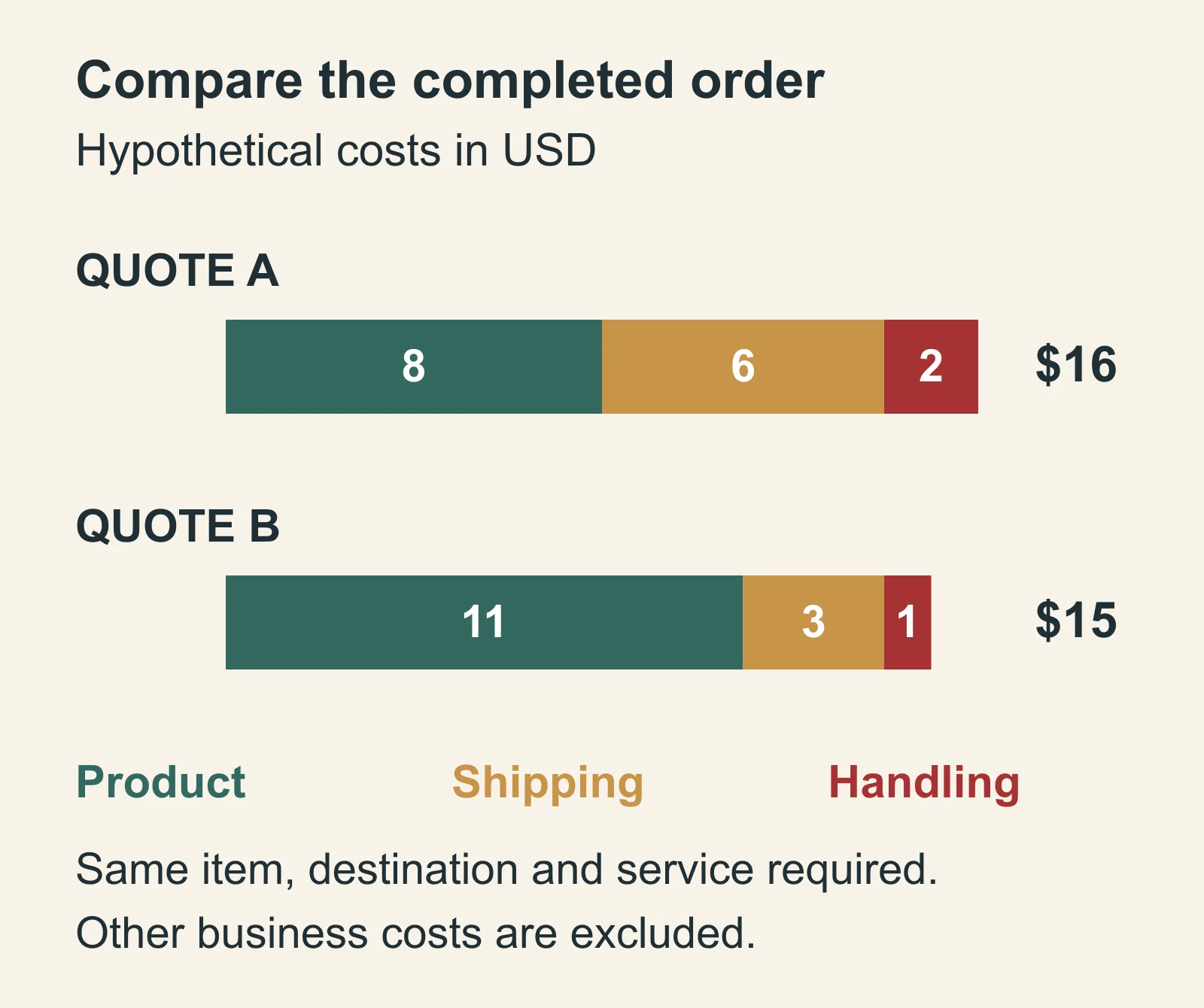
The lowest product price may not produce the lowest order cost. A supplier can quote a cheap item while charging more to prepare and ship it. Compare the same product specification, quantity, packaging, destination and shipping service.
Here is a hypothetical comparison, not pricing from any supplier named above:
| Cost component | Quote A | Quote B |
|---|---|---|
| Product | $8 | $11 |
| Shipping | $6 | $3 |
| Packing and handling | $2 | $1 |
| Total of these listed costs | $16 | $15 |
Quote B has the higher product price but a lower total for these three components. That conclusion holds only if the goods and services are equivalent. A slower service or different package can make the comparison misleading.
The table also leaves out costs that may apply to your business: payment fees, customer acquisition, taxes or duties, software subscriptions, storage, returns and replacements. An unknown charge should remain marked as unknown until clarified. Do not enter zero because a quote omitted it.
For a supplier serving several products, request a mixed-cart example as well as a single-item quote. Two products may trigger separate parcels, handling charges or origins. Use the dropshipping profit-margin guide to connect those costs to your actual selling price.
Separate access fees from inventory commitments
A subscription pays for access or software according to its plan. A product payment buys goods or fulfillment. A deposit for custom production can commit cash before customer orders arrive. Treat each separately in your budget.
Ask what happens if you stop using the service. Can you export order records? Is prepaid stock transferable? Are unused packaging materials yours? These questions matter most when a seemingly flexible supplier relationship starts to include inventory, storage or custom work.
06
Match the supplier model to the store you are building
A focused retailer adding complementary products
Start by comparing relevant distributors or connected brand networks. The useful advantage is an assortment that makes sense to the same customer, such as related desk accessories, rather than a large catalog imported without a reason.
Check whether the brands permit your channel and whether their delivery and return terms fit the rest of your store. A customer’s cart should have understandable shipping costs even when two suppliers fulfill it.
A creator selling original merchandise
A print-on-demand provider is worth evaluating when the artwork or audience is the reason to buy. Compare the specific shirt, tote or print format, not merely the provider’s total catalog size.
Budget for samples and an occasional customer remedy that the supplier may not cover. Clear measurements, print previews and production expectations should be part of the offer before promotion begins.
A store needing a distinct product or packaging
Direct manufacturing discussions or a sourcing agent may help when you need changes to materials, specifications or packaging, or coordination across suppliers. Those requirements can introduce minimum orders, deposits and stock commitments.
Compare the roles of an agent, supplier and 3PL before assigning the work. If you want AIDrop involved in evaluating a custom sourcing requirement, review the product-sourcing service and provide the product specification, destination and expected order pattern. The scope still needs to be agreed for that request.
07
Turn a shortlist into an approved supplier relationship
Once the channel fits, narrow the choice to businesses that can answer your actual requirements. The goal is to approve a product and an order arrangement, not just open an account.
Before sending customer orders, establish:
- The exact product and variants, with permission to use the listing assets and sell through your intended channels.
- A satisfactory sample and any required product documentation; a sample alone cannot establish every compliance requirement or future batch quality.
- A complete quote and agreed dispatch, tracking, stock-update and exception arrangements.
- A test of the normal order route, including what the customer receives and which records return to your store.
The detailed supplier-finding process covers outreach and order tests. The quality-control guide explains how approval should connect to ongoing checks.
If the product is still undecided, compare dropshipping product types first. For the wider set of sourcing decisions, return to the product and supplier guides.
08
Frequently asked questions
Can I use a dropshipping supplier for free?
Some channels offer free access or plans, but goods, shipping and other order costs still need to be paid. Check which features require a subscription and whether the supplier adds handling or other charges. Free access is not a complete operating budget.
Should I use one supplier or several?
One supplier can make coordination simpler when it covers your assortment well. Several can provide different products or alternatives, but they also introduce separate stock feeds, parcels and exception processes. Add suppliers because they solve a specific need, and test the resulting fulfillment arrangement.
Can I dropship branded products from a wholesaler?
Confirm resale authorization, permitted sales channels and any geographic restrictions with the relevant supplier or brand. A wholesale listing or product photo does not establish every permission your store needs. Keep the documentation connected to the products you list.
When should I consider a private dropshipping agent?
Consider one when sourcing, specification control, supplier coordination or packaging requires work beyond a catalog connection. Compare the proposed scope, fees and accountability with the alternatives. A private relationship still needs the same product, order-cost and service checks as any other supplier arrangement.