
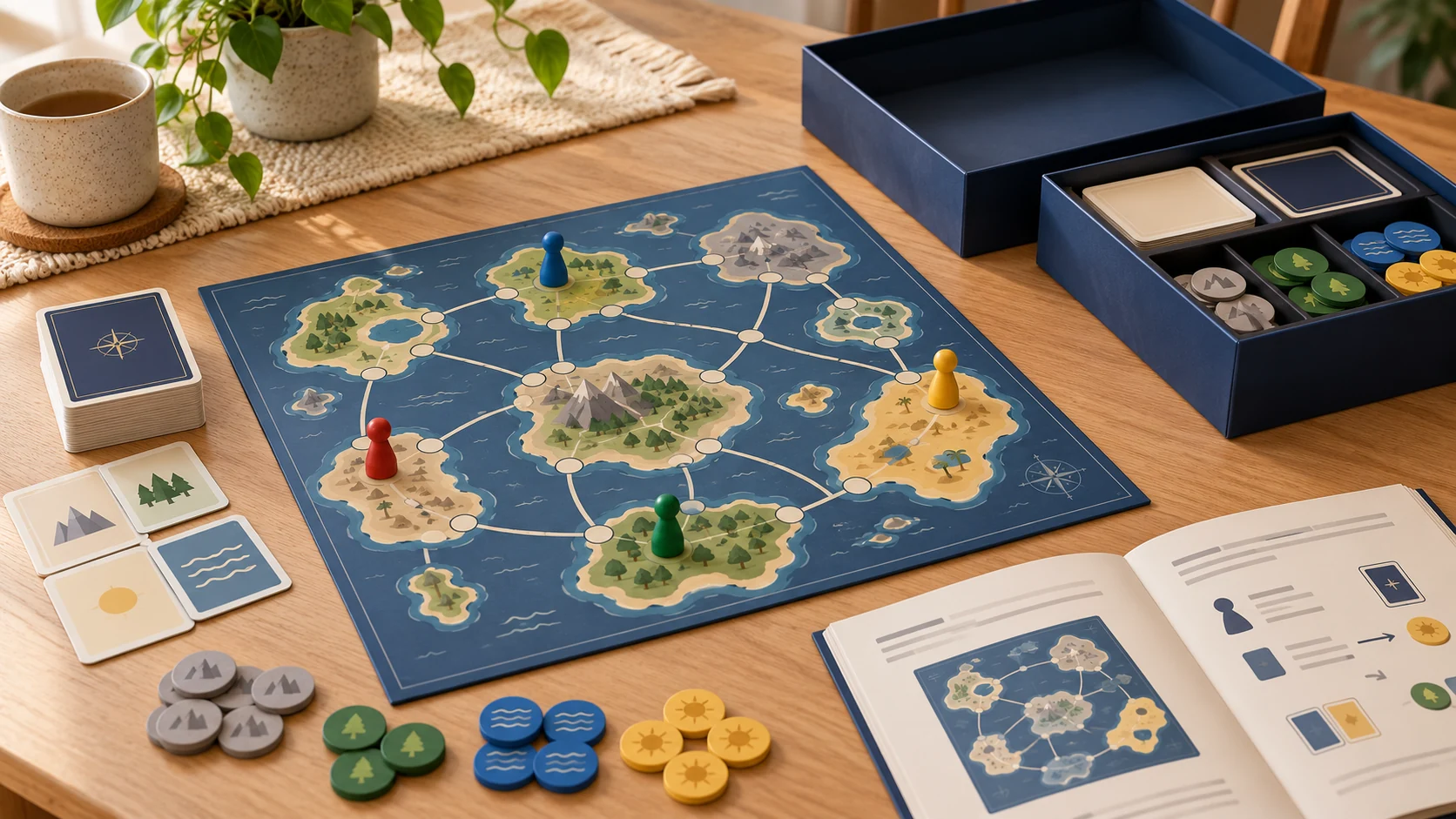
You can dropship board games through a distributor that agrees to send individual customer orders, or use print on demand for an original game you own. Confirm the exact edition, language, contents and delivery service before listing it. A wholesale account does not necessarily include customer-order dispatch.
The buyer’s goal is simple: open the box and play the game they expected. A different language, an expansion without its base game or one missing player piece can prevent that, even when the box looks right.
01
Choose retail resale or your own original game
These are different businesses. A store reselling a publisher’s game needs a legitimate supply route and permission for its sales channel. An original-game seller needs production files, rights to the content, a proof copy and time for manufacturing.
| Supply route | What the public material establishes |
|---|---|
| Broad dropship catalogue | BigBuy advertises dropshipping and a toys/games range. Establish the actual title, edition, destination, account costs and channel eligibility. The category page is not confirmation that a particular US customer order can be supplied. |
| Specialist game distributor | ACD Distribution offers trade accounts and a game catalogue. Ask specifically whether it supports your retail channel and individual consumer dispatch; do not infer that service from online wholesale ordering. |
| Your own print-on-demand game | The Game Crafter documents ordering a single proof copy, entering a shipping address and a production queue. Confirm the intended selling/fulfillment arrangement before promising automated store orders. |
The Game Crafter also offers a separate warehouse service. Sending your inventory to a fulfillment warehouse involves stocked goods, approval and storage/handling arrangements. It is different from producing a game only when someone orders it. The print-on-demand guide explains that wider model.
Get written channel approval for branded games
Ask about the store, marketplace and country you intend to use. Also obtain the current pricing, product-data and image-use terms. A product being visible in a distributor catalogue does not authorize every sales channel.
For example, Asmodee’s US retailer material contains account/channel policies and an online-application notice alongside its account comparison. Do not resolve potentially conflicting admission wording by choosing the sentence you prefer. Get a current answer for your business. These are publisher-specific terms, not rules for every game supplier.
Original games need the appropriate content rights
For an original game, use artwork, text and other content you own or have appropriate rights to use. A printer accepting a file does not grant permission to reproduce another publisher’s game. The US Copyright Office distinguishes ideas and systems from their protected expression; that distinction is not a licence to copy a rulebook or artwork.
02
Make the edition and language part of the product identity
“Same game” is not a sufficient order instruction. A title can have different languages, revised rules, junior editions and expansions. Save the publisher’s product identifier where available and the supplier’s exact product code.
An invented product record might look like this:
| Field | Illustrative entry |
|---|---|
| Store code | HARBOUR-EN-2 |
| Product | Fictional Harbour Routes, base game, second edition |
| Language | English rulebook and English card text |
| Contents | The second-edition component list |
| Supplier mapping | The supplier’s confirmed code for that same edition/language |
| Change rule | Hold and ask if the exact version is unavailable |
The code and game above are fictional; they illustrate the information to retain, not a product we offer. A barcode can help identify a version, but compare the actual publisher specification and box as well. Do not invent a barcode for a generic item.
A base game and an expansion are different purchases
A base game can be played as supplied according to its rules. An expansion may require a particular base game or edition. Put that requirement near the price and buying button, not only in the final paragraph.
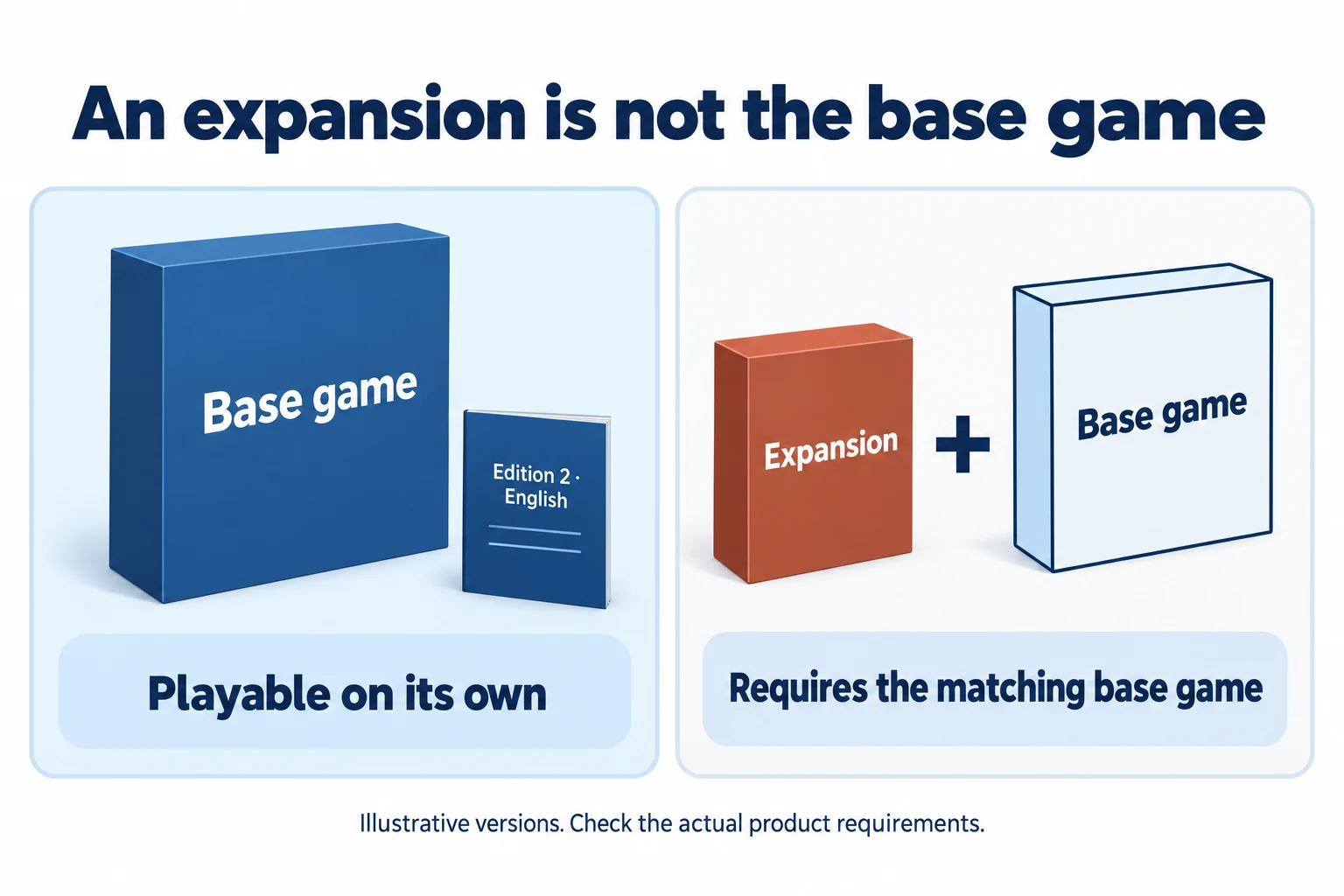
If an expansion needs the second edition, check that the stated compatibility is documented. A similar box or matching theme is not enough. Never substitute another language or edition silently when the ordered one sells out.
03
Help a buyer decide whether the game fits their evening
Someone choosing a game for two adults has different questions from someone arranging a quick family activity. An imported list of “best games” does not answer either buyer well.
Show the publisher-supported facts that change that choice:
- Players: minimum and maximum; explain solo or two-player modes only when documented.
- Time: the stated play-time range, with learning and setup described separately where useful.
- Reading and complexity: card/rulebook language and a plain explanation of the activity.
- What is required: base game, expansion dependency, app, batteries or additional items, if applicable.
- Age guidance: the actual supported guidance and warnings for that version.
A useful description says what players do: “Players take turns choosing routes and collecting the pieces needed to complete them,” for a hypothetical route-building game. “Endless strategic fun for everyone” tells the buyer much less.
Link an authorized rules page or explain setup in your own words from the actual game. If you have not played it, do not write “we tested this with beginners.” Distinguish the publisher’s stated play time from any observations you later make in a real playthrough.
04
Check whether one complete game can be played
Order one exact edition as a sample. The Game Crafter recommends reviewing one copy before ordering more or publishing an original game; that is a useful proofing principle for a new product.
Use the same edition’s contents list
For our fictional example, suppose the approved list is one board, 40 cards, four pawns, 24 tokens and one rulebook. This is an invented manifest. A real game needs its own list, including any differences between printings.
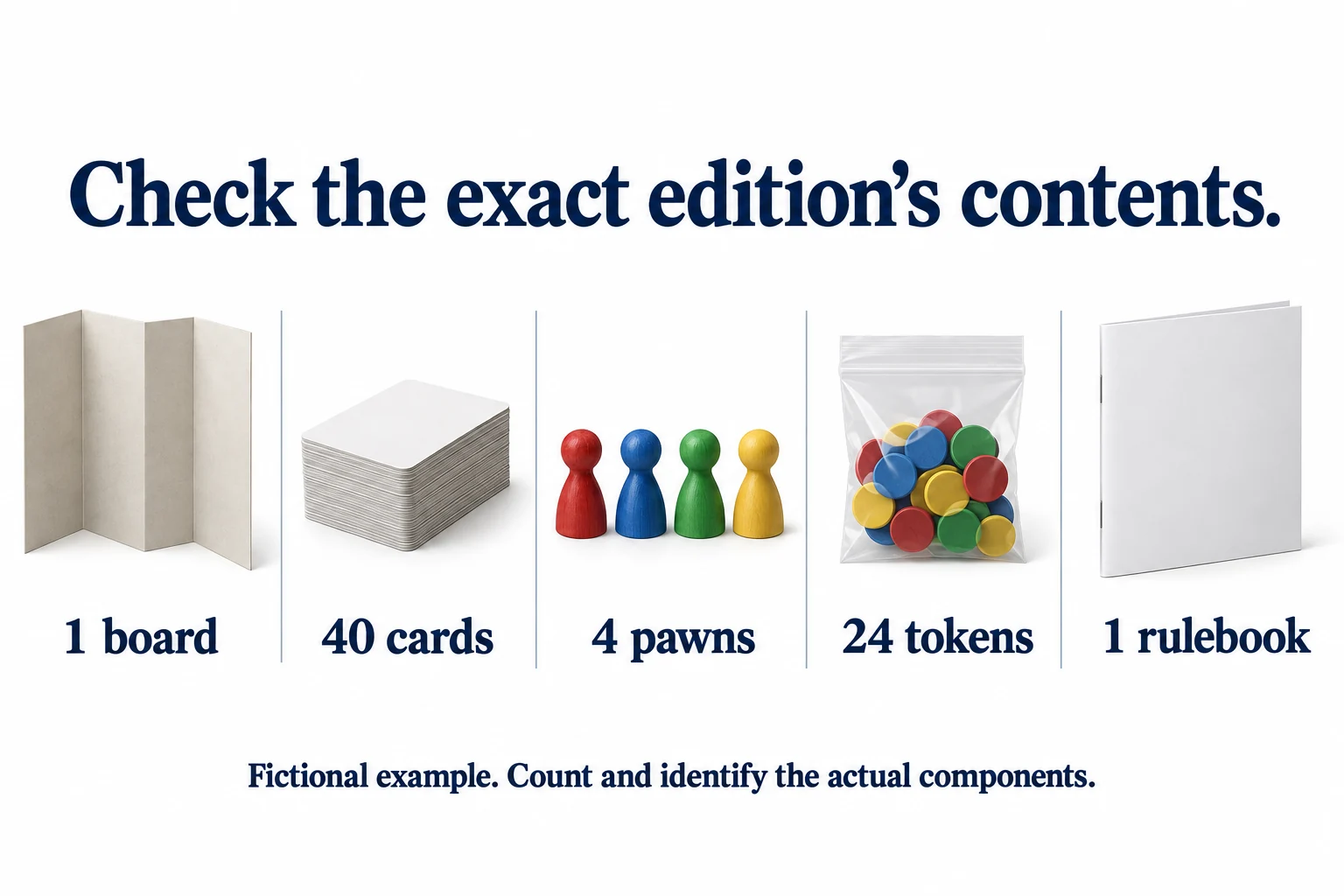
Check identity as well as count. Forty cards can still be wrong if one card is duplicated and another is missing. Confirm any numbered cards, player colours or component types the rules require. Do not break the seals on saleable customer stock to perform a sample check.
Walk from setup to a legal end condition
Use the sample’s actual rulebook. Lay out the starting components, confirm each required type is present, follow the actions and check that the stated scoring or end condition can be reached. Record unclear printing, unreadable text, missing references and component mismatches.
This proposed check can reveal an incomplete or confusing sample. It is not proof of game balance, replay value, regulatory compliance or universal buyer enjoyment. For an original design, proofing production files and testing gameplay are related tasks with different outputs.
Keep a reference record: exact version, supplier, sample date, component-list revision, photographs and the issue/resolution. If the supplier changes the printing, ask what changed before treating the new stock as identical.
05
Quote production and the protected parcel together
A game’s retail box is part of the purchase, especially for a gift or collector. Ask how the supplier protects corners, lid and contents in the outer shipment. A mailer that fits a deck of cards may be unsuitable for a heavy board-game box.
Request a quote for one exact edition and destination, including the game, any per-order handling, protective packing, freight and charges that apply. For a custom game, include production and the approved packaging. Keep account or setup costs separate from the per-order quote.
Allow for the remedy route too. A damaged box or incomplete game may require a replacement parcel or a return. Ask for that process before setting a “free shipping and free returns” offer that the order cannot fund.
A ship estimate is not an arrival date
The Game Crafter’s ordering help separates production from shipment: its estimated ship date refers to finishing production and dispatch, not delivery to the buyer. Its urgent production option also does not guarantee a particular ship date. Use the current checkout/service information rather than converting an estimate into a gift-arrival promise.
For stocked games, confirm availability before accepting a fixed deadline. For made-to-order games, describe production and transit separately. A shipping label created while the game is still being made is not evidence that a carrier has the parcel.
06
Keep the age and product records tied to the real game
Do not classify every board game the same way. The CPSC’s US children’s-product FAQ explains that general-audience traditional games and child-focused versions can be treated differently. Design, presentation and intended use matter; a junior version may require a different assessment from the regular game.
For a US children’s game, establish the applicable testing, certification, tracking and warning requirements for the specific product with the responsible manufacturer/importer and qualified support. The toy dropshipping guide covers that review in more detail.
Keep the actual age guidance and small-parts warnings visible where required. Adding an older-age badge to the webpage is not a substitute for a product-specific assessment. A visual sample count cannot establish chemical, small-parts or other safety compliance.
07
Prepare for a missing piece before the first sale
Ask the supplier what happens when the correct edition arrives incomplete. Can it supply the exact component? Who verifies compatibility, sends it, pays freight and updates the customer? If it cannot supply a piece, what replacement or refund arrangement is available?
Do not promise that the publisher always sends free spare parts. Asmodee’s cited US material directs buyers with damaged or missing components back to the original retailer for assistance. Other publishers and markets can use different processes. Your store needs a real response, even while supplier credit is unresolved.
| Customer problem | Useful next action |
|---|---|
| Wrong language or edition | Compare the ordered identifier with the box/rulebook; arrange the appropriate correction. Do not send a translated PDF as an assumed substitute. |
| Missing pawn or card | Identify edition and required component; obtain an approved matching part if that is an appropriate agreed remedy. Otherwise establish a suitable replacement or refund. |
| Crushed box | Obtain relevant photos, check whether contents are affected and follow the sale terms and applicable customer rights. A collector/gift offer should not quietly dismiss the retail box as irrelevant. |
The returns guide separates customer handling, physical returned goods and supplier reimbursement. Keep the order and actual completed remedy recorded. A request emailed to a distributor is not a replacement delivered to the buyer.
If you need China-side manufacturing or packing coordination for an original, appropriately licensed game, send AIDrop the component list, files, intended market and order plan. We can review the production/fulfillment scope before proposing a route. This does not grant publishing rights or replace product testing.
08
Questions before listing a board game
Can I dropship one copy of a game?
Only through a service that supports the exact item and destination. Some suppliers offer individual dispatch; others require wholesale stock. An original print-on-demand game can have a different production and proofing process from reselling a publisher’s boxed title.
Can I sell an expansion without selling its base game?
You can investigate that offer, but state the required base product and supported edition clearly. Make sure the customer understands that the expansion may not be playable by itself.
Does a supplier account mean I can list every game on Amazon?
No. Confirm publisher, distributor and platform eligibility for the title, channel and country. A wholesale login or downloaded feed does not override product-specific restrictions.
Will original-game orders automatically reach the printer?
Only if the chosen service and store connection actually support that workflow. Check how an order is submitted, funded and accepted, then verify a proposed order end to end. Do not confuse a separate stocked-warehouse integration with print-on-demand production.
Can I copy a successful game and change its name?
Do not treat a name change as permission to reproduce someone else’s artwork, text or other protected material. Develop original content or obtain the appropriate rights and specialist advice for the actual project.
Should I guarantee delivery for a birthday?
Only offer a supported commitment. Establish stock or production timing, destination service and the actual terms. A production estimate or fastest-looking shipping option alone cannot substantiate the promised arrival date.
Sources and scope
Sources checked October 19, 2026. Public supplier information establishes advertised services and policies, not account approval or an independent game test. The example title, code and component list are fictional; the proposed checks were not performed.
Gift Basket Dropshipping: Choose a Supplier and Keep the Gift Promise
A gift basket can be dropshipped, but the recipient must get the contents, message and delivery experience

Wedding Favor Dropshipping: Get the Count and Event Date Right
Wedding favors can ship directly to a host or venue, but the sold unit, guest count and
Party Supplies Dropshipping: Build a Kit That Arrives Complete
Some suppliers direct-ship party goods. A useful event kit still needs enough of each piece, a supported
