
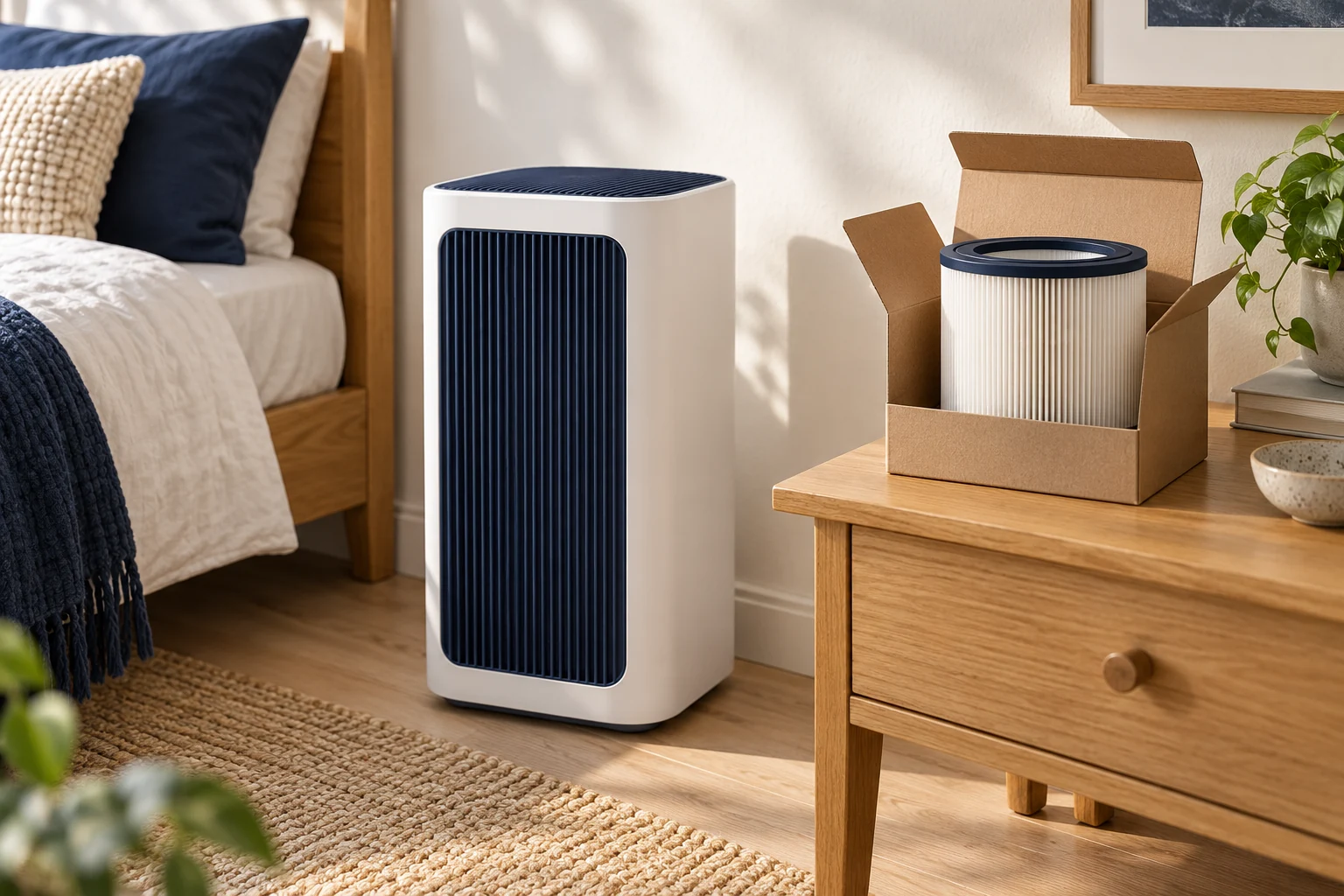
You can dropship air purifiers through a manufacturer’s dealer programme or a supplier marketplace that offers individual customer dispatch. Before listing a model, confirm four things: the market version, its supported room-size claim, the matching replacement filter and who handles problems after delivery.
The filter matters almost as much as the first sale. Imagine selling a bedroom purifier today, then discovering six months later that you cannot tell the customer which replacement to buy. A cheap unit has become an expensive support problem.
This guide focuses on a small store selling portable home air purifiers to US customers. Supplier offers were checked on October 19, 2026. They are sourcing leads, not tested recommendations or confirmation that your account, destination or chosen model is approved.
01
Start with a supplier that can ship one customer order
An air purifier manufacturer is not automatically a dropshipping supplier. Some will dispatch a single unit to your buyer; others expect you to buy a batch and arrange fulfillment yourself.
| Sourcing route | What to establish before using it |
|---|---|
| AllerAir dealer/drop-ship programme | Its dealer page explicitly invites drop shippers. Apply for the actual model, destination and sales channel; obtain dispatch, pricing, filter and support terms. The public invitation does not approve your store. |
| Marketplace catalogue | TopDawg lists an air-purifier category. Check the individual supplier’s stock location, product records, delivery charges and account requirements rather than treating a category listing as a guarantee. |
| Factory or private-label batch | LYL’s own FAQ describes wholesale and manufacturing for other brands, rather than individual dropshipping. A negotiated starter batch still needs somewhere to be stored and shipped. |
Do not use a factory’s bulk unit price as the cost of one customer order. It may exclude the retail box, individual dispatch, international freight and the replacement-filter stock you will need later. Compare quotations for the same model, service and destination.
For a dealer application, send a short, specific request:
We sell home products through [store/channel] to customers in [country and states]. Do you allow individual customer orders for [exact model]? Please confirm the market version, stock location, dispatch terms, neutral packaging, replacement-filter part number, delivered-order charges and who handles arrival damage or a later fault.
If the reply only quotes a carton quantity, ask whether individual dispatch is available. If it is not, you are considering a stocked wholesale model. That may still work, but it changes the cash and fulfillment plan. The broader electronics dropshipping guide covers compatibility and product documents across other electrical products.
02
Why two coverage claims can describe the same purifier
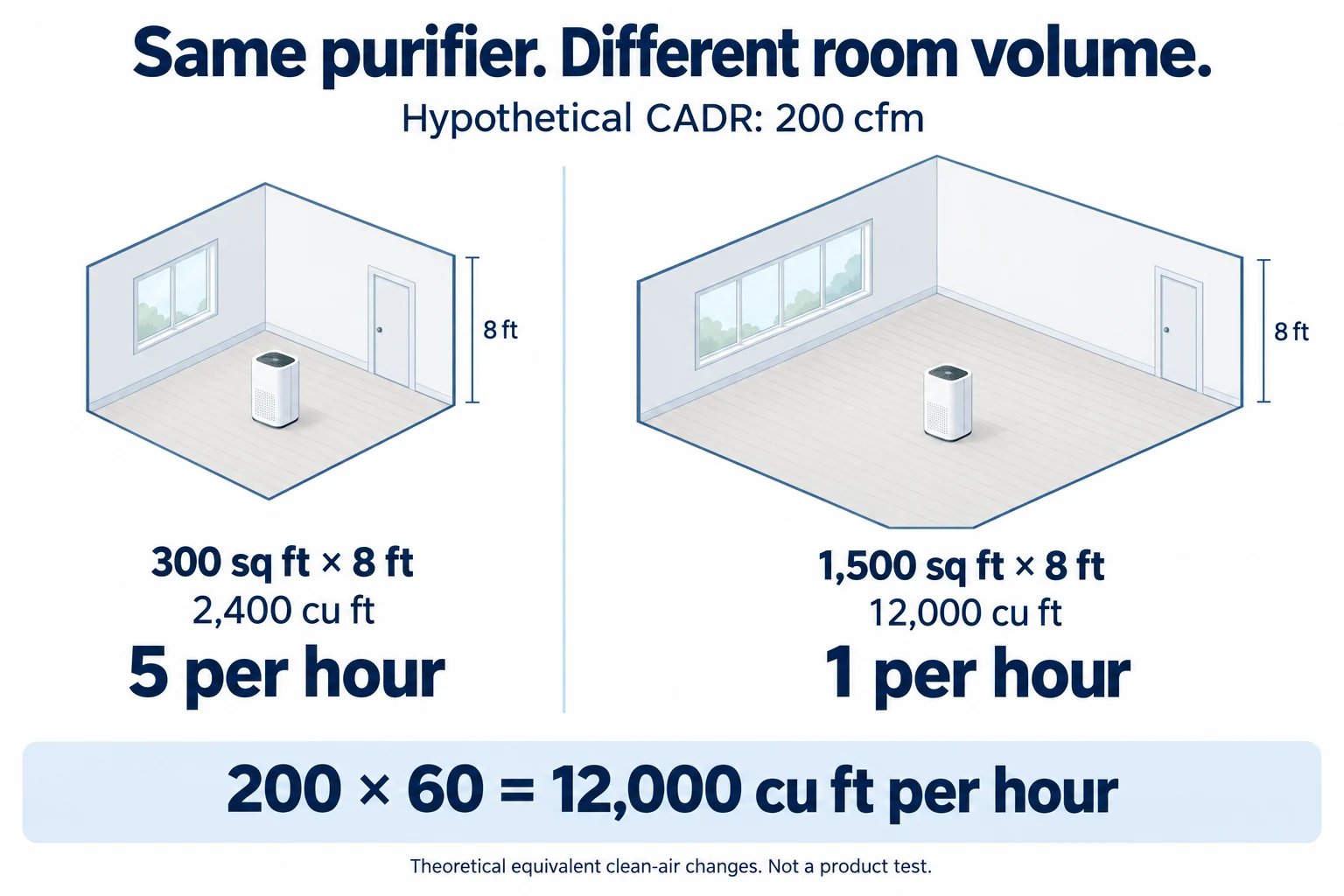
A seller may advertise one purifier for a 300-square-foot bedroom while another advertises a similar model for 1,500 square feet. Before deciding the second is stronger, look at how often each claim says the room’s air is cleaned.
CADR means clean air delivery rate: the volume of particle-cleaned air a machine delivers under its test conditions. A filter’s efficiency describes the filter; CADR describes the machine’s clean-air output. A “HEPA” label alone does not tell you how quickly a whole room receives that output.
A coverage example with the assumptions visible
Suppose an invented purifier has a supported CADR of 200 cubic feet per minute, at a specified fan setting. In one hour, that is 200 × 60 = 12,000 cubic feet of equivalent clean-air delivery. Compare two rooms with 8-foot ceilings:
| Room | Theoretical clean-air changes per hour |
|---|---|
| 300 sq ft × 8 ft = 2,400 cubic feet | 12,000 ÷ 2,400 = 5 |
| 1,500 sq ft × 8 ft = 12,000 cubic feet | 12,000 ÷ 12,000 = 1 |
The machine has not changed. The larger area assumes much slower cleaning. These are arithmetic illustrations, not measurements of a product or a promise of real-room results. “Equivalent clean-air changes” does not mean the purifier supplies fresh outdoor air or physically replaces every bit of room air once.
AHAM’s room-rating explanation uses 4.8 air changes per hour for its suggested room size. That is a rating basis to understand, not a universal medical recommendation. A headline based on one air change per hour is not a like-for-like comparison with it.
What to ask for when the numbers disagree
Get the exact model’s report or verified rating. Record the CADR value and unit, pollutant category, fan setting and room-size assumptions. Cubic feet per minute and cubic metres per hour are different units; do not compare the bare numbers.
The AHAM directory explains the separate smoke, dust and pollen CADR figures. Look up the actual model if AHAM verification is claimed. A logo on an unrelated model’s brochure is not that lookup.
Also check whether a quiet-mode claim uses a lower fan speed than the advertised room coverage. A buyer choosing a bedroom unit needs to understand the operating condition, not discover the maximum claim requires a setting they find too loud. Do not infer a quiet-mode CADR from a noise number; request the relevant specification.
03
Sell a purifier whose replacement filter you can identify
Create two linked product records: the machine and its compatible replacement. “Filter for our small purifier” is not a durable identification system once the supplier changes its catalogue.
For illustration, imagine the unit is AP-200-US and its approved filter is F-200. These codes are invented. Your real record should contain:
- Machine: manufacturer, exact model/version, supply-voltage label and supplier product code.
- Filter: manufacturer’s compatible part number, dimensions or identification details, included quantity and supplier order link.
- Customer route: where the buyer can obtain the correct replacement, its current delivered price and what happens if it becomes unavailable.
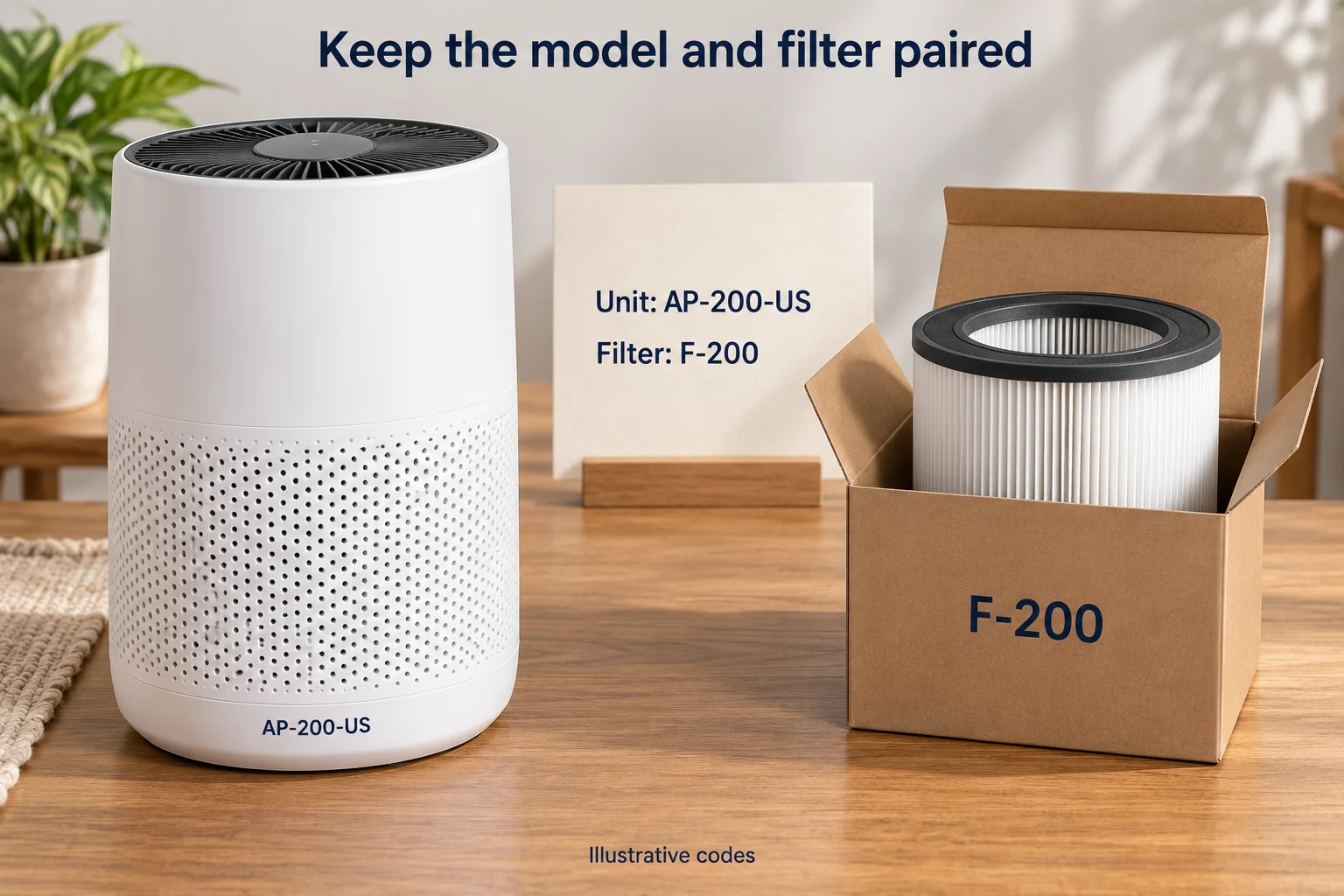
Ask the supplier to identify the installed filter and the replacement it is quoting. Similar dimensions do not establish that a third-party filter fits, seals or performs as the maker specifies. If alternative filters are allowed, obtain the manufacturer’s compatibility information instead of guessing from a photograph.
The EPA’s home air-cleaner guidance notes that filters need regular replacement and that overloaded filters reduce effectiveness. Publish the particular maker’s maintenance instructions; do not turn a convenient six-month marketing interval into a rule for every home.
Make the ongoing cost understandable
A customer comparing two units may prefer a higher purchase price if its documented replacement filters are easier to obtain. Show the unit price and the current price of the matching replacement separately. State whether that filter price is for one filter or a multipack and whether delivery is included.
Do not calculate a universal annual filter bill unless you have a defensible replacement assumption. A clearer explanation is: “Replacement filter F-200 costs [current delivered price]; replace it according to this model’s instructions and actual use.” If you sell filters, link the exact compatible product from the purifier page. Offer a subscription only when the product, replenishment interval and customer choice support it.
04
Check the market version and the claims you plan to publish
A US shipping address on a marketplace does not settle the electrical or regulatory questions. Match the supplied model’s nameplate, instructions and documents to the version you will sell. A plug adapter does not turn an EU-market unit into a verified US-market product.
These checks answer different questions:
| Evidence | What it does—and does not—establish |
|---|---|
| Model-specific electrical and market documents | Support review of the actual version for its intended destination. A collection of generic certification logos is not a substitute. |
| CADR report or verified model rating | Supports stated particle-cleaning output and conditions. It does not establish every gas-removal or health claim. |
| Applicable CARB certification and listing | Relevant to covered indoor air-cleaning devices sold in California. It is not a CADR ranking or proof that the unit treats disease. |
Confirm California eligibility for the exact model
For California sales, the California Air Resources Board (CARB) has covered-device requirements. Check the exact model in its certified-device list. Resolve an absent or mismatched record with the manufacturer and qualified compliance support before offering a covered device there. A different model’s certificate does not cover yours.
Keep product copy within the evidence
Avoid “EPA approved” product copy: the EPA does not certify or recommend particular purifier brands or models. Its ozone-generator guidance also explains why ozone claims need particular care. Do not promote an ozone-generating device as an ordinary occupied-room purifier or add unsupported claims about preventing illness.
Keep particle filtration, gas or odour removal, and medical benefits separate. A particle CADR number cannot substantiate all three. When a supplier’s sentence makes a broader promise than its evidence, remove that sentence while you obtain the relevant support.
05
Build the first listing around a room and a usable support path
Choose one clearly described use, such as a bedroom within the model’s supported rating. A page promising everything from a nursery to a whole house is harder to make accurate and harder for a customer to buy from confidently.
Use the actual manufacturer-supported facts to fill these listing fields. The bracketed text below is a drafting example, not a product offer:
Portable air purifier for [supported room use]. Model [exact version]. Particle CADR [value, unit and category] at [setting], with room guidance based on [area, ceiling height and air-change basis]. Includes [actual filter and accessories]. Replacement: [compatible part and purchase route]. Setup and maintenance: [model instructions]. Support: [your contact and the applicable written terms].
Put one proposed order through the whole route
Order a sample of the exact version through the intended supplier service. Our sample-approval guide explains how to keep the approved reference tied to later deliveries. For this product, record three useful outputs:
- Delivered identity: the order, carton, nameplate, included filter and instructions all refer to the same model/version. Photograph any mismatch before trying to use the unit.
- Ordinary setup: follow the manufacturer’s instructions, then check the listed controls and access to the filter. Do not open electrical parts or invent a home test of CADR, ozone or safety certification.
- Customer handoff: the tracking reaches the store, the included documents are appropriate, and the support team can locate the exact replacement filter and written claim route.
A sample can reveal damage, missing accessories or confusing instructions. It cannot validate a laboratory performance claim. Keep those two kinds of evidence separate when approving the listing.
Rehearse a problem before promising support
- Crushed carton or visible damage: use the supplier’s damage-report process and your customer-remedy policy. Do not ask a buyer to operate a visibly damaged electrical unit.
- Wrong replacement filter: compare its part number with the saved model pairing and arrange the correct remedy.
- Failure months later: review the actual warranty and customer rights. The supplier’s arrival-damage window answers a different question.
The warranty guide helps distinguish the customer promise from a supplier’s private reimbursement terms. Before advertising a warranty, identify the responsible business, covered failures, claim contact, return destination and who pays freight. “One-year warranty” is incomplete if nobody can tell the buyer where the machine goes.
If you want help coordinating China-side sourcing and fulfillment, send AIDrop the model, destination, intended room claim and expected order pattern. Include the replacement-filter requirement. We can review the sourcing and operating scope before proposing a route; a sourcing review does not replace model-specific testing or market approval.
06
Questions before choosing an air purifier supplier
Is a HEPA label enough to choose a product?
No. It describes a filtration characteristic, while the complete machine’s airflow, sealing and performance determine its clean-air delivery. Ask for supported CADR and model-specific evidence. Do not turn a filter-media statement into a whole-room or medical promise.
Can I use a supplier with stock in Europe for US orders?
Only after confirming the supplied version, permitted market, shipping service and support route. The warehouse location alone answers none of those questions. An available adapter or cheap international rate does not resolve electrical compatibility or market eligibility.
Should I advertise the largest coverage area on the supplier page?
Use a supported area with its conditions. If one figure assumes one air change per hour and another uses a higher rate, explain the difference. Keep the CADR units, fan setting and ceiling assumptions visible rather than choosing whichever headline looks bigger.
Do I have to sell replacement filters myself?
You need a credible route for the customer to obtain the correct filter. You can sell it or direct buyers to an appropriate source, subject to your agreements. Either way, identify the exact compatible part before the first purifier sale.
Is a low factory price a sign the product will be profitable?
It is only one input. Obtain the cost of the actual customer shipment, including the service you need, delivery, packaging and charges that apply. Then allow for selling costs and the support obligations you choose or must meet. A small unit-price saving is not useful if you cannot supply filters or fulfill the advertised remedy.

Electronics Dropshipping: Compatibility, Documents and After-Sales Support
Electronics can be dropshipped when the exact model works for the claimed setup and has applicable documents,

Auto Parts Dropshipping: Find Suppliers and Avoid Wrong-Part Orders
Find a usable automotive supplier route, keep part and vehicle details accurate, price a complete filter order,

Phone Case Dropshipping: Match the Phone Before You Sell the Case
Compare ordinary and printed phone-case suppliers, build an exact model-to-item map, prepare artwork and calculate what a
