
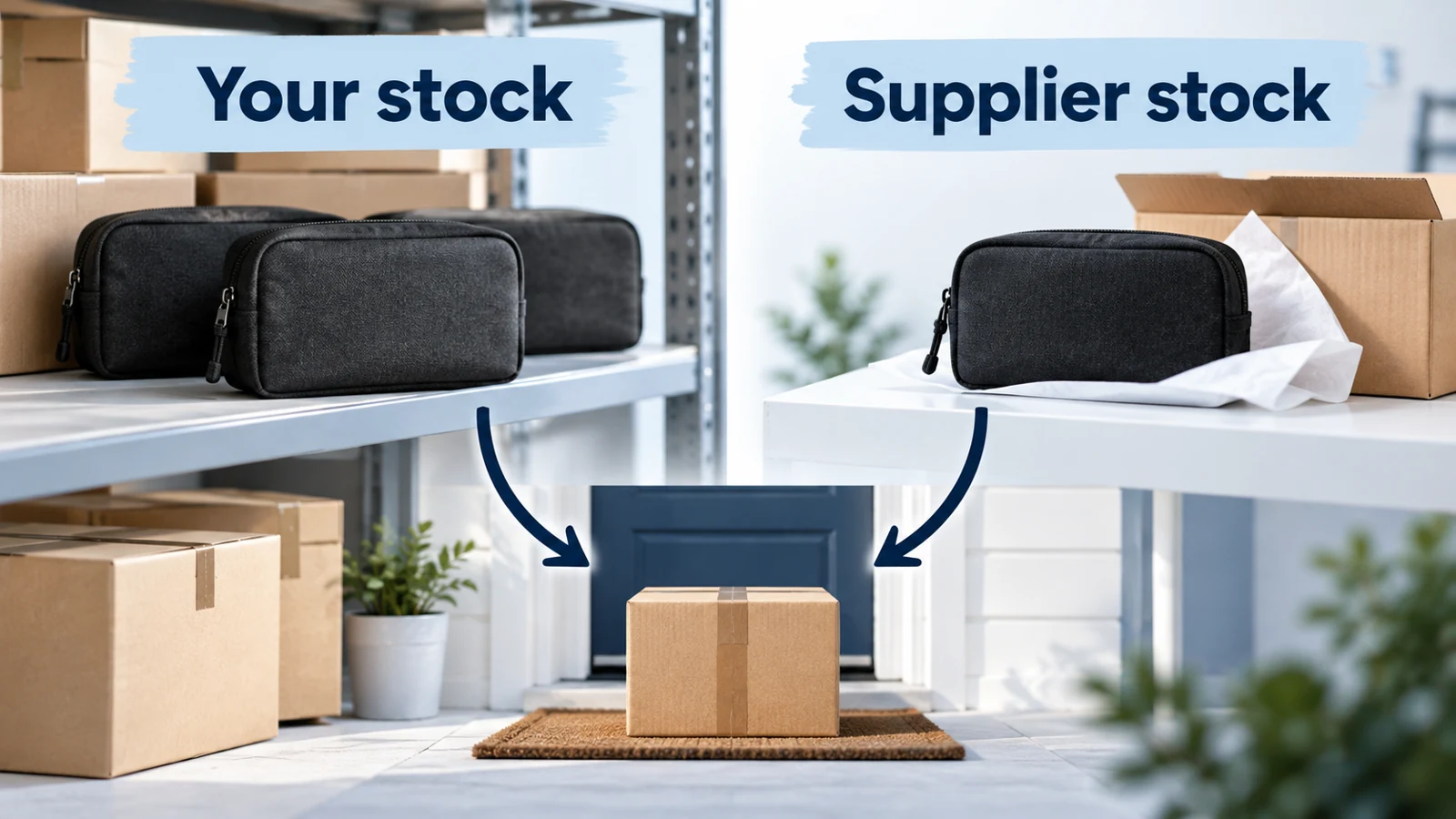
Hybrid dropshipping means keeping stock for part of your range while suppliers fulfill other items after each sale. You might own the black cable pouch that sells every week and leave five uncertain colors on the supplier route.
The reason to combine them is practical: stock can improve cost or dispatch for proven items, while buying per order keeps cash available when demand is uncertain. Make that decision for the exact variant, not the whole category.
You can use an agent or warehouse for the stock you own. Hybrid does not mean you have to turn your home into a packing room.
01
What changes when you own part of the stock?
There are two questions: who owns the goods, and who sends the parcel? A fulfillment operator can hold your products and a supplier’s products in the same building, even though the financial arrangements differ.
Bought per order: you purchase the item when you need it for a customer. The supplier held the goods before that purchase.
Bought in advance: you have already paid for a batch. You own those units while they wait for customer orders, whether they sit at home, in a local warehouse or with an agent.
The second arrangement gives you more control over an agreed batch, but it also commits money before demand arrives. A storage company does not take that stock risk simply because it holds the cartons.
The same variant can have both sources. Ten black pouches might be yours locally while further supply remains with a supplier. Your store needs to know which source should handle the next order and what happens when those ten run out.
The inventory-management guide covers the underlying stock records. Here, the first choice is which units are worth owning.
02
Which products are worth stocking?
Look at orders for the size, color and pack you would buy. “Pouches sell well” is weak evidence if almost every buyer chose black and the discounted carton contains five other colors.
There should be a clear benefit to the commitment:
- Repeated ordinary demand for that variant.
- A worthwhile saving after inbound freight, receiving and storage.
- A dispatch or delivery improvement customers value.
- A stable specification you can replenish without changing the offer.
Then consider what could leave the stock unsold. A seasonal print, changing product version or narrow size may be better purchased per order even when the overall range performs well.
Use normal demand rather than the best weekend
Suppose a creator promoted the bright pouch, producing a short sales spike, while black sold steadily before and after it. Buying both at the promotional pace assumes that the campaign will keep doing the same work.
Separate that temporary demand from the repeat orders. For a first batch, ask whether you could comfortably keep paying the other business bills if sales slowed. The forecasting guide develops the estimate; there is no universal daily order count at which every item should move into stock.
03
Will the lower unit price pay for the first batch?
Use one worked example. Buying a pouch after a sale costs $9. Buying ahead costs $7 per unit, plus $45 of one-time receiving and setup. Assume the other relevant costs are equal for this first comparison.
Each sold unit saves $2. You need 23 sales to exceed the $45 setup cost: 22 save $44, while 23 save $46. Any additional storage, financing or exit costs raise the amount to recover.
Now look at the whole purchase:
| First batch | Amount |
|---|---|
| Forty pouches at $7 | $280 |
| Receiving and setup | $45 |
| Cash paid upfront | $325 |
| Saving after eighteen sales | $36 |
| Setup still unrecovered at that point | $9 |
After eighteen sales, twenty-two pouches remain. Their purchase cost is $154. They may still sell, so that amount is not automatically a loss; it is also not cash available for tomorrow’s supplier invoice.
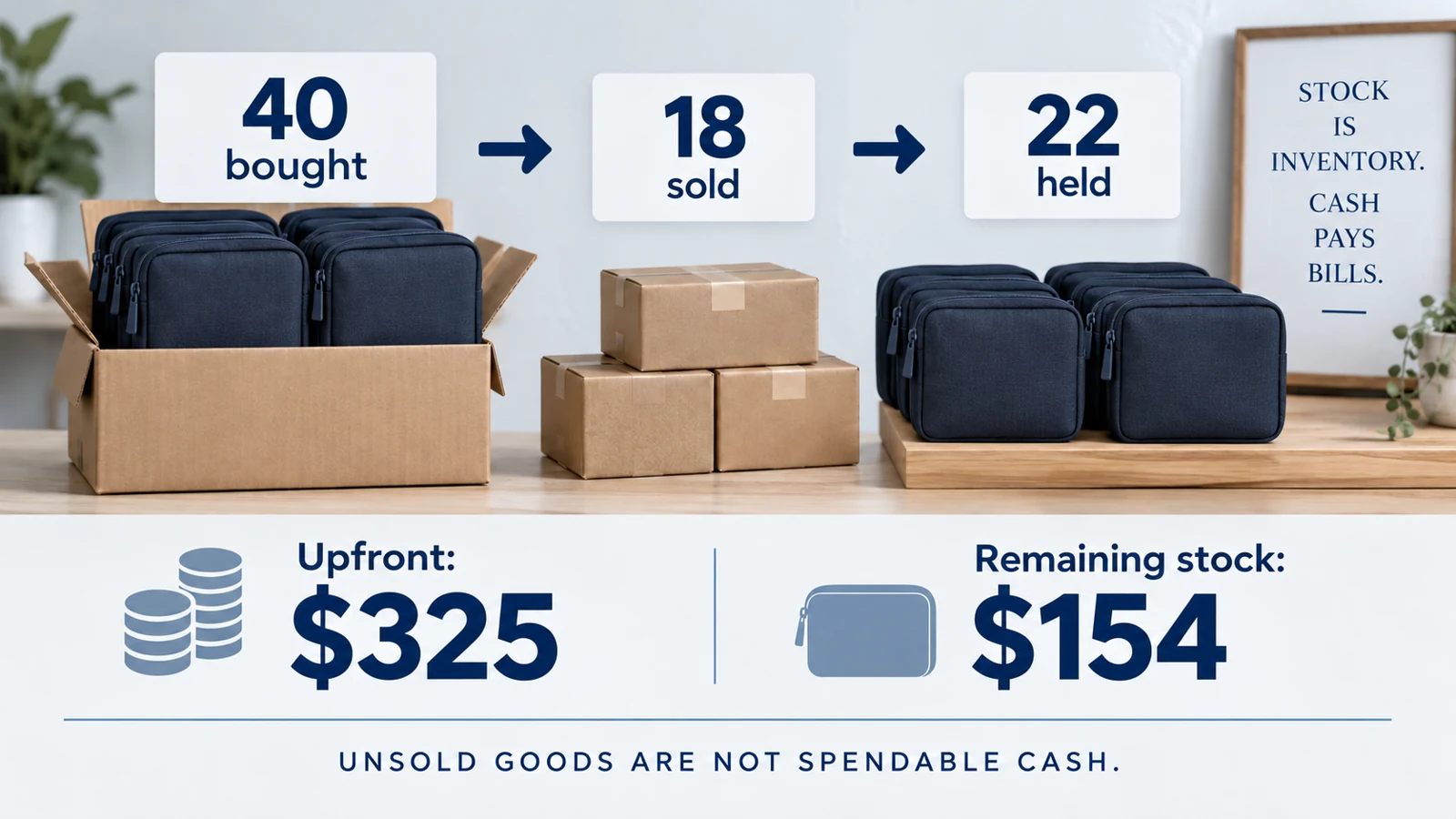
If you had continued buying per order, eighteen purchases at $9 would require $162 across those orders. The stocked option asks for $325 earlier. It may eventually cost less, but you must be able to fund the waiting period.
This is the decision a unit-price comparison misses. Keep a reserve for the supplier-only range, freight, refunds and replenishment. The cash-flow guide helps put those payments on a calendar.
04
Set up the two sources in Shopify
Shopify’s multi-location guidance allows the same product at store and fulfillment-app locations. Each location keeps its own quantity.
For the chosen variant, the documented path is Products → product → Inventory → Edit locations. Select the locations that can supply it, then choose Done and Save. Reopen the variant and compare the quantities.
Enter the goods represented by that location. The ten pouches you own should not become ten units at two warehouses merely because two systems see the record. A supplier’s advertised availability also needs the agreement behind it; it is not your own warehouse count.
Choose which location should go first
To prioritize local stock, Shopify’s routing setup describes Settings → Shipping and delivery → Order routing → Add rule → Use ranked locations. Move the rule first, put the preferred warehouse in the higher group, then choose Done and Save.
Rules run in order, and locations need to be eligible for the destination. A split-minimizing rule above your preference can change the result. Use this proposed setup with the actual app’s supported arrangement.
Inspect three cases:
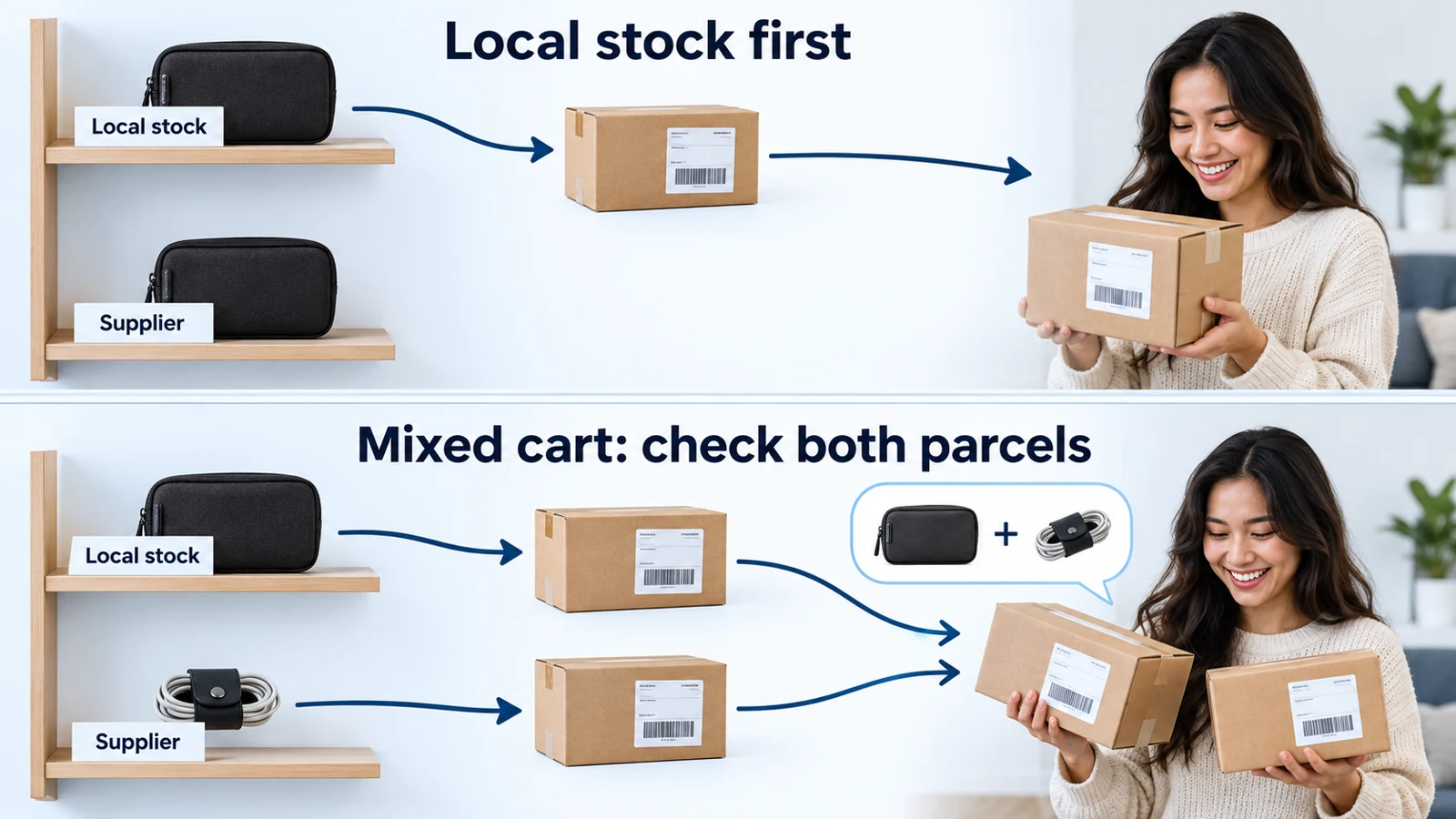
- Local stock available: does the eligible preferred warehouse receive the pouch order?
- Local stock exhausted: does the supported supplier fallback work, and do the out-of-stock selling settings match your promise?
- Mixed cart: which location receives each item, and does another system also create an unintended purchase?
Routing alone does not prevent overselling or cancel supplier work. If the assignment is wrong, look at stock at order time, eligibility and rule order before changing quantities.
05
Explain a mixed order before the buyer pays
A shopper may buy your stocked pouch and an organizer that remains with an overseas supplier. That can mean two parcels, two dispatch dates and two freight charges behind one checkout.
First, price the arrangement you will use. If the organizer travels to your warehouse before the customer shipment, include that journey and waiting time. If it ships separately, make the split visible in the product or checkout information.
A useful message identifies the items: “Your black pouch ships separately from the organizer. We will send tracking for each parcel.” Add supported dispatch or delivery information for the actual arrangement.
This is clearer than a store-wide local-dispatch claim that applies to only part of the catalog. It also stays understandable when a variant moves back to the supplier route after local stock sells out.
For a sample order, reconcile the complete basket: which item is in each parcel, what each shipment costs and what the buyer can see. Fix an unexpected second purchase or freight charge before increasing traffic.
06
Decide when to reorder, pause or return to dropshipping
Once the first batch sells, the next commitment needs another decision. Use sellable stock and ordinary demand, not just the original purchase quantity or the number displayed by a supplier.
Ask how much is ready now, which units are reserved or held, and how long the next approved batch would take. Compare that with the orders expected during replenishment. The forecast should use the variant you are actually reordering.
Reorder when repeated demand and a stable product still justify the cash and the lead time.
Reduce or pause a weak variant when it mainly sold during a promotion or when the product has changed.
Return to buying per order if the stock advantage no longer covers the commitment, provided that supplier route can support the offer.
Before transferring leftover stock, obtain the count, packing and release charges. Cheap or free storage does not establish free transfer-out. Include unused printed packaging in the decision too.
If you want to compare China-side stock and per-order options, send AIDrop Agent the variant history, intended batch and destinations. Ask for receiving, storage, order preparation and shipping separately so the stock decision uses the full service.
07
Hybrid dropshipping questions
Can a beginner use a hybrid model?
Yes, but a small tested commitment is easier to learn from. The reason to own stock should be a specific cost or service benefit, supported by the product and demand—not the label “hybrid.”
Does using a warehouse mean I do not own inventory?
No. Ownership depends on the purchase arrangement. Goods you bought can remain your stock while another business stores and dispatches them.
Can one SKU use local stock and a supplier?
Shopify supports multiple locations, but the actual app, inventory and routing arrangement must work together. Follow a controlled order and the fallback before relying on it.
Does buying ahead guarantee a higher profit?
No. Lower unit cost must be weighed against setup, holding, funding, slow sales and exit costs. The example’s $154 remaining stock is not a guaranteed loss or available cash.
The numbers illustrate the decision; they are not supplier or AIDrop rates. Platform steps describe public documentation, not a store configured for this article.

Dropshipping Inventory Management: Keep Stock and Sales in Sync
Define supplier quantities, reconcile commitments once, and verify what automatic updates really do. Practical controls for promotions,
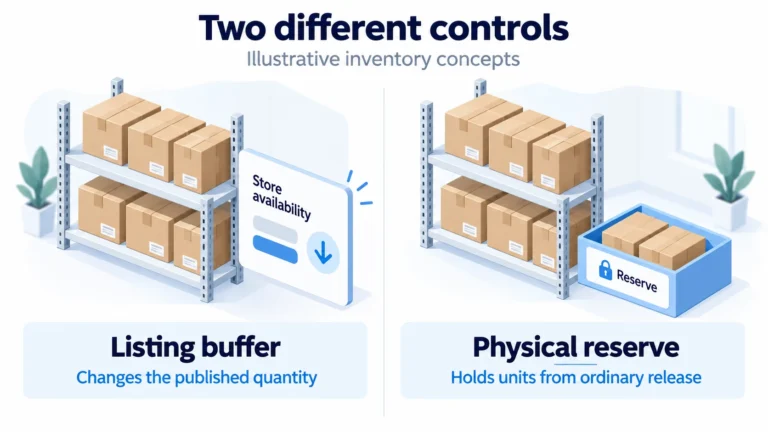
Dropshipping Inventory Buffer: Account for Update Delays Without Double Deduction
Set a dropshipping inventory buffer using source quantities and update delays. Avoid double deductions, shared-stock assumptions and

Dropshipping Inventory Forecasting: Know When Supplier Stock Will Run Out
A supplier’s shared stock feed is not your allocation. Forecast against accessible units and real lead time.
