
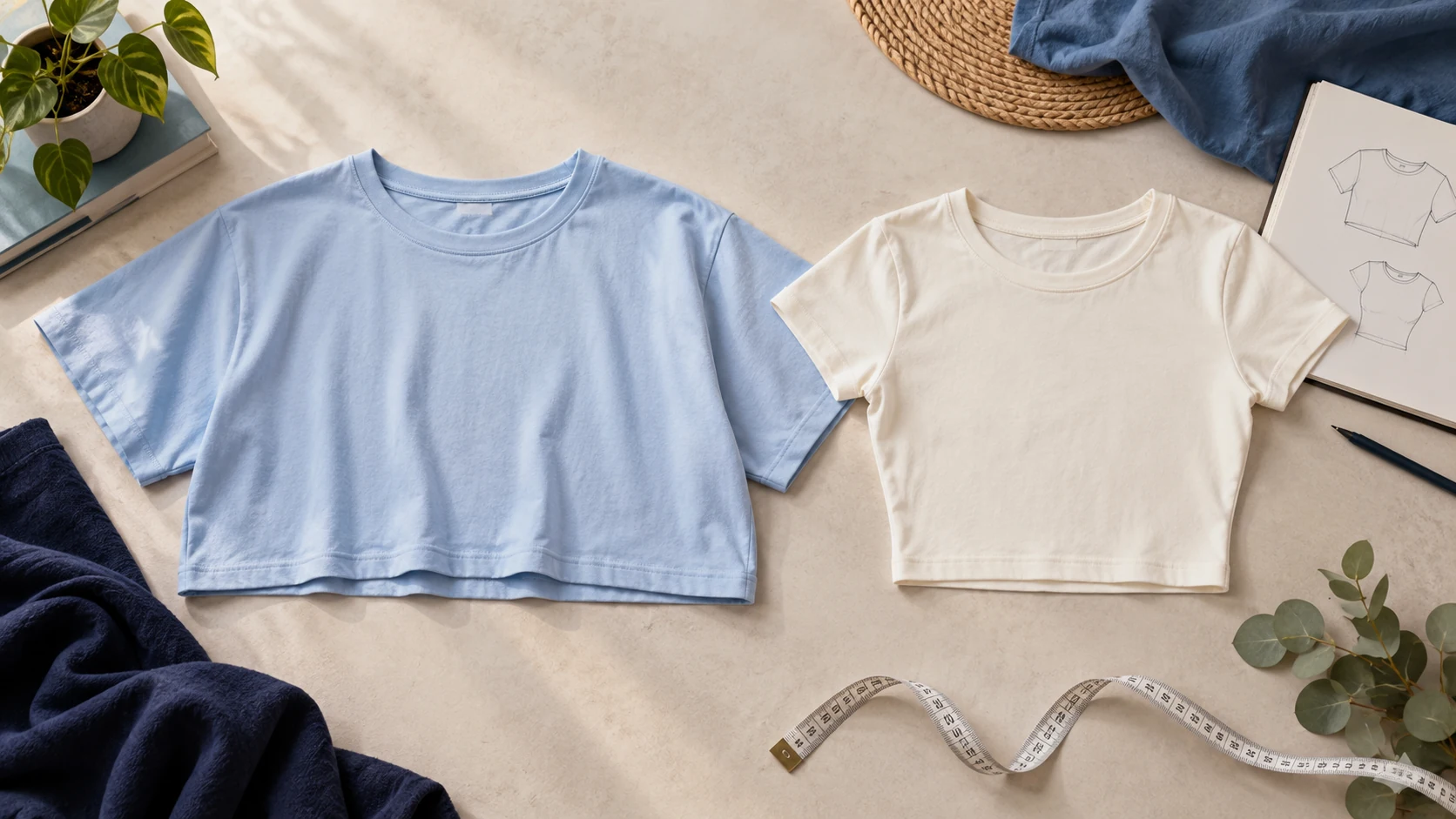
You can dropship crop tops as ready-made garments or sell your own designs through a print-on-demand supplier. Choose the actual cut and garment measurements before the artwork: a fitted baby tee, loose cropped tee and athletic crop top give customers different coverage and fit.
A buyer who likes the print may still return the shirt because the hem sits higher than expected. Your first job is to help that buyer picture the garment on their body. The supplier connection comes after you have an offer worth explaining.
01
The fit starts with the cut
Start with a sentence such as “a loose, short-sleeved crop for wearing with high-waisted jeans.” That gives you a useful buying brief. “Trendy women’s tops” leaves the supplier to guess the shape, fabric and amount of coverage.
| Style | What the buyer usually needs to judge | What your listing should show |
|---|---|---|
| Fitted baby tee | How closely it follows the bust and waist | Stretch information, garment width and length |
| Relaxed cropped tee | Whether the body is roomy and where the hem falls | Flat measurements and front, side and back views |
| Athletic crop | Movement, coverage and intended activity | Exact construction and supported use; avoid an unsupported support claim |
The fabric changes that experience. A stretchy fitted top can look smaller on a table than a loose cotton tee that fits the same person. Thickness, recovery and the pattern all matter. A supplier photograph gives you a starting point; a sample lets you check the actual product.
If your store is still choosing its overall apparel range, the broader clothing dropshipping guide covers that decision. Keep this launch narrow enough that you can describe every cut accurately.
Show the fit with garment measurements
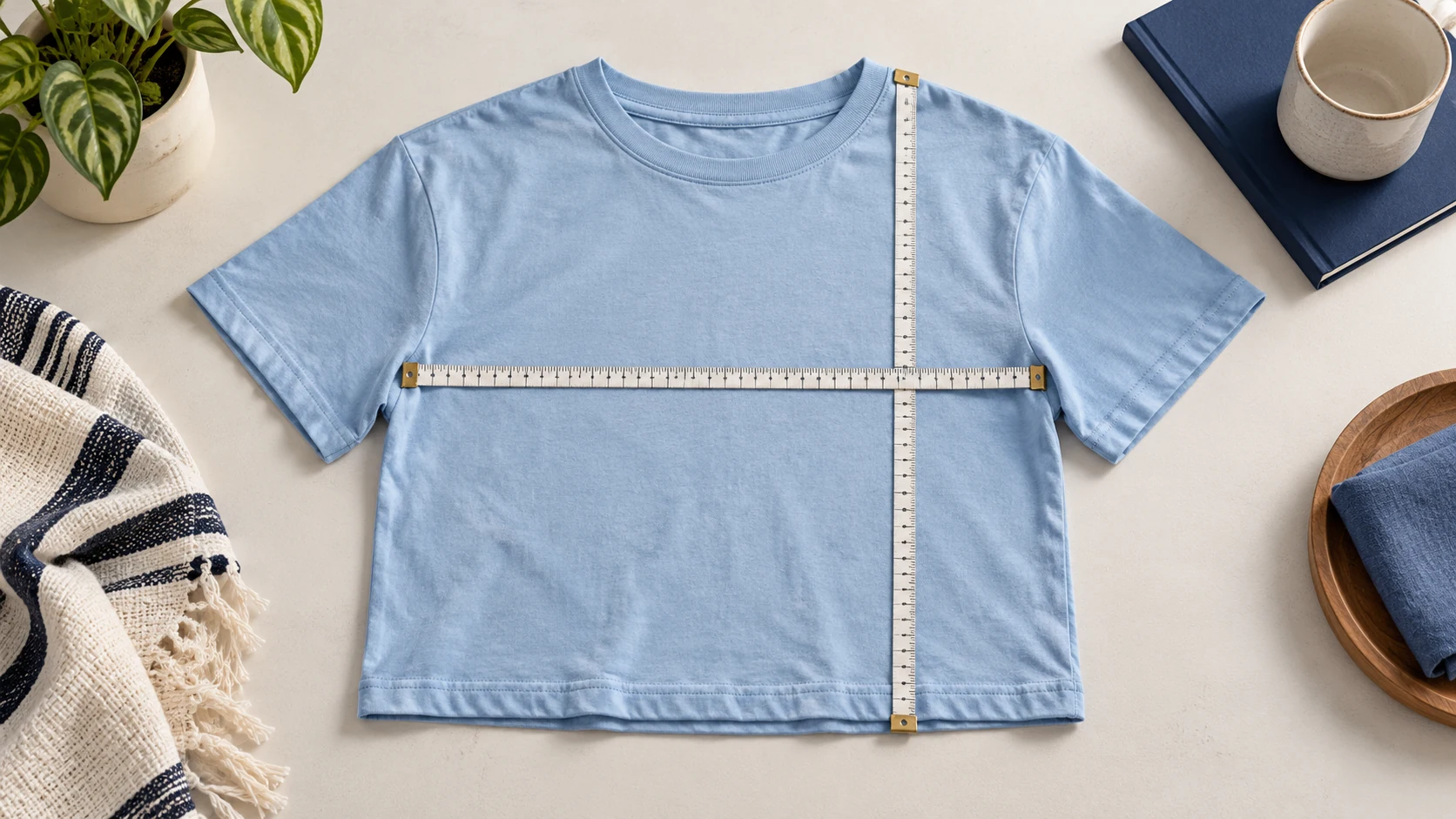
Label the chart as body measurements or garment measurements. A number headed only “chest” can mean either, and that ambiguity creates avoidable sizing mistakes.
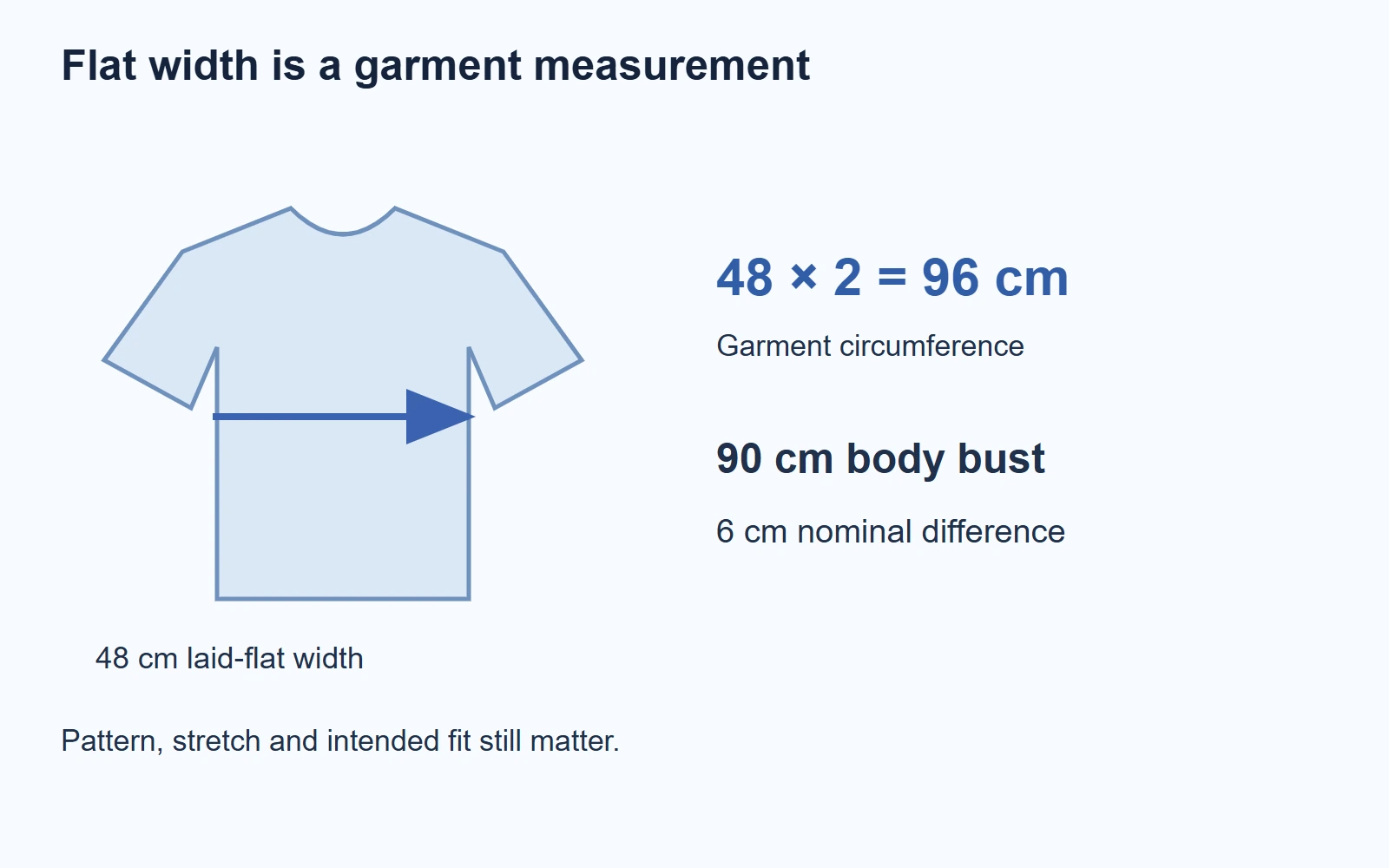
Consider this illustrative relaxed medium:
| Measurement | Example | Meaning |
|---|---|---|
| Chest width, laid flat | 48 cm | Width across the garment at the stated measuring points |
| Approximate garment circumference | 96 cm | Twice the flat width |
| Buyer’s bust circumference | 90 cm | A body measurement |
| Nominal difference | 6 cm | Extra circumference before accounting for shape and stretch |
Those six centimeters help explain roominess. They cannot guarantee the fit: a sleeve, armhole or hem may still feel wrong. For a fitted stretch style, the relationship can differ considerably. Use the chosen product’s chart and intended fit instead of creating a universal “add six centimeters” rule.
Length needs the same care. Show where the measurement starts—such as the high shoulder point—and where it ends. A buyer can then measure a top they already like. “Cropped” alone does not tell them whether the new shirt will meet their waistband.
When a supplier changes the blank, revisit the chart even if the store size still says M. Keeping the old measurements makes the replacement look equivalent when it may wear differently.
Turn the measurement into a product-page example
For that illustrative 48 cm medium, a useful listing might say: “Relaxed fit. Garment measures 48 cm across the chest when laid flat. Compare with a similar top you own; see the diagram for the measuring points.” Add the real length from the selected product’s chart. Leave the number unpublished until it is confirmed.
Your sample record can then connect the promise with a check:
| Check | What to record | What changes the decision |
|---|---|---|
| Chest width | Method, sample size and measured result | A material difference from the published chart |
| Length | Same start and end points as the chart | A hem position unlike the described cut |
| Movement | Ordinary intended wear and coverage | The selected cut does not suit the advertised use |
| Care | Supplier-approved washing and drying directions | A claimed care method is unsupported or produces an unacceptable result |
Agree a reasonable measuring tolerance with the supplier rather than inventing one after a complaint. If you evaluate the sample after permitted care, keep the before/after measurements and conditions. An unspecified “washed once and fine” note is difficult to use when a later customer reports a fit change.
02
Ready-made, printed blank or all-over print?
There are three practical routes. Buy an existing fashion style through a supplier that accepts individual customer orders; decorate a stocked blank with your design; or use a cut-and-sew POD product for an all-over pattern. The third route gives you more printed surface, with seams and pattern pieces to consider.
Printful’s crop-top catalog illustrates why the product name matters. At the October 15, 2026 check, its AS Colour 4062 ran from XS to 2XL, while its All-Over Print Crop Top ran from XS to XL. Other cropped products had different ranges. A provider-wide size filter does not mean every style comes in those sizes.
Qikink’s FA32 page describes a polyester, sublimation-printed crop and publishes an India-specific example including COD and GST. Use it to understand that particular route. Obtain a separate quote for your customer’s country instead of converting the displayed total into a supposed US delivered cost.
Before choosing, put two exact products next to each other. Compare fabric composition, cut, sizes, print areas, fulfillment origin and destination availability. Ask whether the quoted item can be sent singly to your customer and whether the quoted price includes decoration. A wholesale manufacturer may require you to buy the production run first.
03
Artwork on a shorter garment
A short garment gives a design less room. A slogan that fits comfortably on a regular tee can end up too close to the cropped edge or become difficult to read when reduced.
Work in physical dimensions before exporting. For example, an eight-inch-wide design at 300 pixels per inch needs 2,400 pixels across. That is a resolution calculation, not a claim that every supplier requires 300 ppi. The exact product template determines the file dimensions, safe area and any bleed.
For a cut-and-sew product, preview each pattern piece. Keep a name, face or important word away from a seam unless the supplier explicitly supports the result you want. A repeating motif usually tolerates small alignment changes better than a sentence crossing the front and side seam.
Use this short approval sequence:
- Choose the actual product and print method, then download its current template.
- Place the design at its intended physical size; inspect the smallest relevant garment as well as the main mockup.
- Remove guide layers and export in the required format and color profile.
- Order a sample and compare the print’s size, position and readability with the saved file.
Printful’s cotton all-over crop uses a different construction from a decorated blank. Follow that product’s directions rather than assuming that every all-over crop uses the same fabric or printing process.
Check the chosen size and print in one order
For a proposed first test, use a specific record: CROP-BOXY-BLK-M, supplier product and variant references, front design SUN-v3, and the saved chart. These are your control labels, not names of fields in a particular provider’s app.
Place the store order through the intended route. Check the buyer-selected size and color against the supplier order before production. Confirm that supplier payment succeeded; a customer payment in your store does not prove that the print provider has been paid.
On arrival, lay the garment flat and measure it using the supplier’s method. Check the label, seam finish, print placement and ordinary care instructions. Photograph the actual findings and save them with the order record. This is a proposed inspection, not a claim that we received or tested a sample.
If medium was ordered and large arrived, compare the store variant, supplier pick reference and garment label. Correct a mapping error before releasing another medium order. If the mapping was right, send the supplier the relevant order and label evidence. Simply editing the size chart would conceal the cause.
After a correction, repeat the affected size and design path. A successful manual order verifies the physical offer; an order sent through the store connection also checks whether the connection selects the right variant.
04
A $34 crop: what is left after delivery?
Suppose you sell a crop for $34. The following figures are a merchant example, not a supplier quotation:
| Per completed order | Amount |
|---|---|
| Customer payment | $34.00 |
| Garment and print | −$15.00 |
| Shipping | −$5.00 |
| Payment processing | −$1.30 |
| Customer acquisition | −$7.00 |
| Allowance for remedies | −$1.50 |
| Remaining contribution | $4.20 |
That remainder still has to cover overhead and applicable taxes. A full replacement can require another garment and another parcel. It is worth knowing that cost before promising free exchanges on every size choice.
Quote the sizes and print positions you will actually sell. Extra print areas, a different production location or a larger size may change the charge. If you use a paid provider plan, include its cost across a realistic number of completed orders rather than assuming a large future volume.
Decide how to handle three separate cases: a customer chose the wrong size, the garment differs from its published measurements, or the supplier sent a different size. Your customer policy and supplier reimbursement terms may treat these differently. Make the customer-facing offer clear before the first sale.
05
What the product page must show
Show the front, back and hem position. Use genuine sample photographs when describing fit; label illustrative artwork accordingly. If you publish a model’s measurements and worn size, those details must come from the actual shoot.
The product page should make these choices easy to find:
- The specific cut, fabric composition and chart type.
- The actual available size and color combinations.
- What is printed and where; whether the design shown is a mockup.
- Production time, shipping estimate and the applicable exchange process.
You can expand after completed orders show which questions buyers still ask. Repeated uncertainty about length calls for a clearer measurement or photograph, rather than another paragraph saying the garment is flattering.
For stocked or custom-sourced crops, send AIDrop the garment brief with the intended cut, measurements, fabric, design, destinations and expected order volume. We can review the sourcing, checking, packing and shipping work that brief requires. If you are comparing printed garments generally, start with the custom T-shirt guide.
06
Crop top questions
Can I sell a single custom crop top?
Many POD products support one-off orders, but confirm the exact product, destination and decoration method. A custom manufacturing quote with a minimum run is a different arrangement.
Should I tell every buyer to size up?
Use the product’s actual fit guidance. A blanket instruction can make a relaxed crop unnecessarily large and still fail to explain its length. Help buyers compare body and garment measurements instead.
Can a children’s T-shirt replace a fitted adult crop?
Do not assume equivalent fit. Neckline, armholes, shoulder shape and length can differ. Choose and describe the actual garment being sold, including its intended market.
Will the supplier pay for every size exchange?
Check the written terms. A manufacturing error, incorrect item and buyer’s size preference may have different remedies. Your obligations to the customer remain a separate part of the sale.
Sources and scope
This guide uses public product information checked on October 15, 2026. The measurement and cost examples are illustrative; the first-order procedure is proposed, not a report of a completed test.

Clothing Dropshipping: Sizes, Variants, Samples and Returns
Verify apparel sizes, variants, samples, labels and returns before launch. Build a clothing dropshipping offer around accurate
Clothing Dropshipping Suppliers: 5 Options for Different Stores
Compare Trendsi, Printful, Printify, Apliiq and BrandsGateway by clothing model, fit information, stock, shipping and return costs.
Shoe Dropshipping: Sizing Evidence, Variants and Return Exposure
A shoe listing needs model-specific fit evidence, exact size-color stock and a workable exchange route. Compare one
