

Curtain dropshipping can use ready-made window-treatment suppliers, POD panels or an agreed made-to-measure service. First define whether the listing sells one panel or a pair, the finished width and length, and the heading that attaches it to the rod. Those details decide whether the buyer can cover the window.
A customer can choose the correct color and still receive curtains that are too narrow, hang at the wrong height or contain only half the expected pair. You can prevent many of those problems by turning “a curtain” into a clear, measurable order before publishing the listing.
We checked the sources on October 13, 2026. Provider facts below are document-based; the measurements and cost examples are illustrations, not curtains we bought or tested.
01
Pick a curtain supply model
The supply model determines what the customer can choose and what information you must send.
| Model | Places to investigate | Order requirements |
|---|---|---|
| Ready-made panels | Bedding Dropship window treatments and other agreed catalog suppliers | Exact SKU, size, color, panel count and current stock |
| Printed fixed-size panels | Prodigi curtains | Selected construction, product template, artwork and quantity |
| Made-to-measure curtains | A manufacturer such as Dairui, subject to an agreed order service | Finished dimensions, heading, fabric, approvals, tolerances and fulfillment terms |
These are supply routes to investigate, not a ranking of delivery or sewing quality. A manufacturer accepting bulk custom production does not automatically accept one curtain order shipped to your customer. Confirm that arrangement explicitly.
Start with fixed sizes if you cannot yet support measurement questions and custom-order approvals. Made-to-measure can solve more windows, but a vague width or an unchecked heading can become an expensive remake.
The home decor guide covers choosing a broader range. Window curtains deserve their own specification because their fit depends on the room and installation.
02
Write the unit the customer is buying
A styled photograph may show two panels, a rod, rings and tiebacks. The listing must say which of them are included.
For a hypothetical standard item, an unambiguous description would read: “One curtain panel; finished flat width 50in; finished length confirmed in the specification; rod-pocket heading; rod and tiebacks not included.” Change every detail to match the actual product. Do not leave the pair count buried in a long supplier description.
Separate these fields in your product record:
- Number of panels per purchased unit.
- Finished width per panel, rather than combined pair width.
- Finished length and the point from which it is measured.
- Heading type and compatible installation dimensions.
- Sheer, lined or other documented construction.
- Included hardware and accessories.
Prodigi explicitly describes its curtain as an individual panel with a rod pocket. That matters when pricing a window needing multiple panels. One attractive mockup does not mean one purchased unit covers the whole scene.
03
Turn window measurements into an order
Measure the installed rod or track, not just the glass. Then decide how much fabric the selected construction needs. Fullness describes the extra fabric that forms the folds. Flat fabric width and the width covered by a hanging curtain are different measurements.
Curtarra’s measurement tool explains the idea through extra fabric and different heading choices. For an illustration, suppose a rod spans 80in and your chosen flat-panel arrangement needs 2× fullness. The combined flat width is 160in.
| Illustrative panel choice | Combined flat width | Fullness over an 80in rod |
|---|---|---|
| Two 50in panels | 100in | 1.25× |
| Four 40in panels | 160in | 2× |
| An approved custom pair totaling 160in | 160in | 2× |
The two 50in panels may reach across the rod when nearly flat, but they do not produce the same folds as 160in of fabric. Explain that difference rather than promising every pair will look like a heavily gathered room photo.
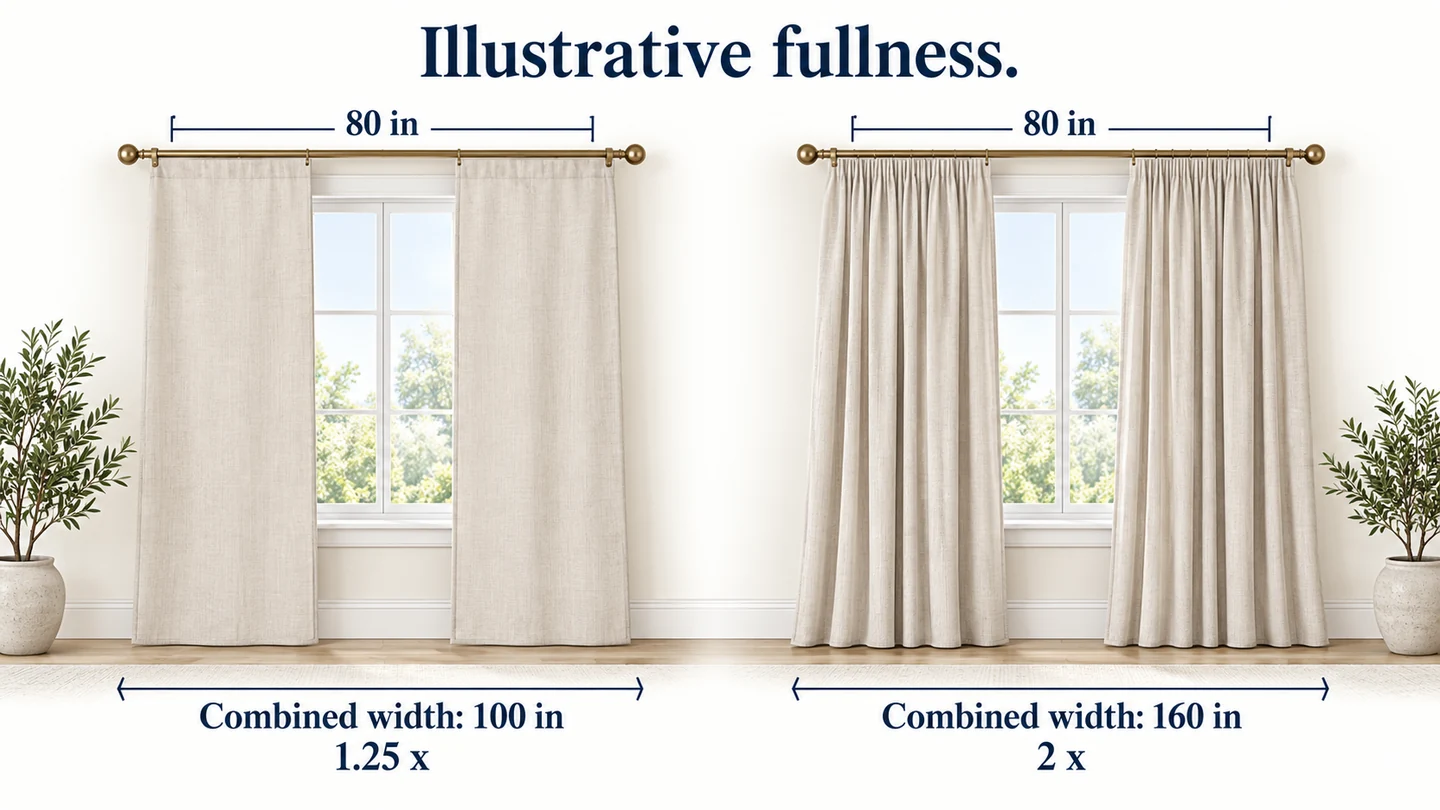
Do not multiply again if a supplier already quotes a pleated curtain’s finished coverage width. Ask whether its width means flat fabric, finished pleated width or total pair coverage. The answer changes the order.
Length also depends on the heading. A rod pocket, rings and a track can start the measurement at different points. Follow the chosen supplier’s instructions and state the measurement reference. Keep centimeters or inches visible throughout the approval.
04
Catch a unit error before it reaches the product page
Cross-check the supplier’s summary, variant table and written specification. We found a useful example of why this matters on Prodigi’s curtain page: the overview pairs 50 × 84in with 127 × 86cm, while the SKU table gives 1270 × 2134mm. There is also a much shorter length note elsewhere on the page.
84in converts to 213.36cm, not 86cm. The millimeter table is broadly consistent with 84in, but the calculation alone does not establish the finished product the provider intends to supply.

Hold that listing until the provider confirms the exact SKU’s finished length, measurement method and tolerance. Save the confirmation with the product record, then compare the sample against it. Do not quietly pick the dimension that suits your storefront.
This check is quick: convert one dimension yourself, compare it with the other units, and investigate anything that does not agree. A unit error copied into fifty variants becomes fifty customer problems.
05
Show how the fabric behaves in a room
Sheer, blackout-lined and semi-blackout curtains create different expectations. Start with the exact product description, then inspect a sample in a room where its intended use is visible.
- Look through the fabric. Note transmitted light through the center.
- Look around the edges. A lined panel can reduce central light while gaps still brighten the room.
- Record the construction. Show the actual fabric, lining and hanging behavior. A styled mockup only shows design intent.
- Match the claim to the evidence. Avoid “100% blackout,” “soundproof” or an insulation saving without support for that SKU. A clear description of a lined construction is already useful.
06
Price and verify the complete window order
Quote the whole order the buyer needs. For an illustrative four-panel arrangement, suppose each panel costs $18, combined freight is $12, packing is $3, transaction costs are $4 and a remedy allowance is $6. The total is $97. At a $129 selling price, $32 remains before advertising and taxes.
These are teaching numbers, not a supplier quotation. Use the actual quantity, construction, destination and packed parcel. Do not multiply a single-panel shipping estimate and assume it matches the cost of a four-panel order.
For the first controlled order:
- Save the approved specification and exact panel quantity.
- Match the store and supplier order IDs, variants and artwork version if printed.
- Confirm acceptance and production or dispatch timing.
- Check every received panel for the agreed finished measurements and consistent appearance.
- Compare the invoice and parcel with the quote before expanding the range.
Measure all panels in a set. One correct panel does not establish that the other three match. The sample guide explains how to keep approval tied to the product you will actually sell.
If you need a China-sourced curtain range, send AIDrop the finished specifications and target destinations. Include whether the order is one panel or a pair and which dimensions are already finished measurements. That gives sourcing and packing work a concrete starting point.
07
Handle a curtain that does not match the order
Compare the delivery with the recorded approval before deciding on a remedy. Get a full-panel photograph, a readable tape measure at the agreed reference points, the item label and the received quantity. Keep those beside the approval and supplier invoice.
| What went wrong | Response to arrange |
|---|---|
| Supplier sent a missing panel or a length outside the agreed tolerance | Request the appropriate correction or replacement; attach the corrected specification to the next dispatch |
| Listing described the supplied curtain incorrectly | Fix the listing and arrange the customer’s remedy |
| Buyer selected the wrong measurement | Explain the available remedy and relevant terms; “custom-made” does not automatically remove every return or fault right |
Pause any variant whose dimensions are still uncertain. Resolve the cause, then check that its revised record matches what can actually be supplied.
08
Questions about curtain dropshipping
Does a curtain listing normally include two panels?
There is no safe default. Read the exact SKU and state the panel count visibly. If a window needs two purchased units, explain that before checkout.
Is 2× fullness always required?
No. It is an illustrative fabric-to-coverage relationship, not a universal instruction. Construction, heading and the supplier’s width convention matter. Follow the selected product’s measurement guidance.
Can I promise blackout from a dark fabric photo?
No. Color is not evidence of light-blocking performance. Use documented construction and any applicable test evidence, and distinguish fabric transmission from gaps around the installation.
Can a POD provider cut any custom curtain length?
Only if that service is explicitly available. A fixed-size printed panel does not become made-to-measure because your store offers a length field. Confirm supported options before accepting them.

Furniture Dropshipping: Product Data, Delivery Scope and Damage Recovery
Furniture dropshipping needs more than a supplier quote. Verify the exact piece, cartons, drop-off service and damage

Home Decor Dropshipping: Fragility, Dimensions and Presentation
A decor listing needs more than a room photo. Compare appearance, packed dimensions and the recovery path

Candle Dropshipping: Choose the Jar, Scent and Shipping Plan
Build a small candle offer, compare individual dispatch with wholesale batches, price a complete order, and plan
