
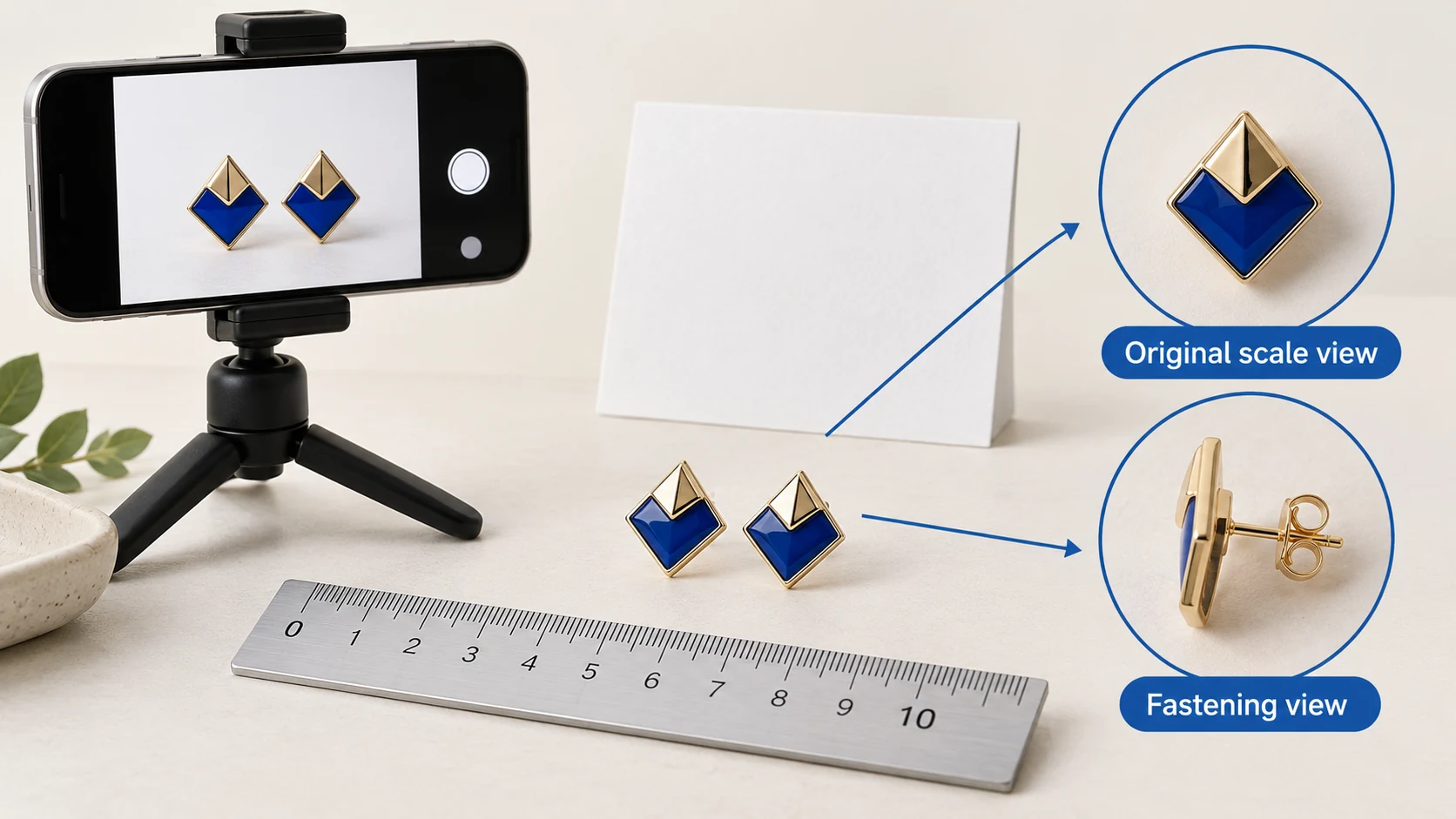
A useful jewelry dropshipping Instagram content plan answers the questions that stop someone buying: how big the piece is, how it moves, what it is made from, how it feels to wear and when it will arrive. Use those questions to create a small bank of original content, send interested viewers to the exact product page, then see which part of the path needs improvement.
You do not need thirty unrelated posts before starting. Begin with one verified product, eight purposeful feed posts over two weeks and Stories that fill in genuine questions. That is a trial schedule you can adjust, not a rule about how often every jewelry brand should post.
This plan is for a small store selling ordinary jewelry. Platform requirements were checked on October 13, 2026. The sample script and funnel numbers are illustrations; no sales result is claimed.
01
Start with the question behind the purchase
Choose one hero SKU and write down the hesitation a buyer is likely to have. Earrings often need scale and fastening information. A necklace may need chain length and pendant position. A ring needs the correct sizing method and a truthful material description.
Your content should make the product easier to judge. A close-up sparkle shot can create interest, but it may leave size and clasp unanswered. A straightforward scale shot can remove more uncertainty than another inspirational caption.
Use the verified product record behind each post: supplier SKU, material by component, dimensions, included quantity, care information, current dispatch origin and remedy. Our jewelry dropshipping guide covers that product work. The content plan cannot compensate for an unknown alloy or an untested fulfillment promise.
Avoid claims such as waterproof, hypoallergenic or tarnish-free unless applicable evidence supports them. If a customer asks a question you cannot answer yet, investigate it before turning it into a promotional post.
02
Make a small original content bank
When you have the actual sample, capture it once with several useful views. Keep lighting ordinary enough that the viewer can judge the product. Avoid heavy color changes that make the finish look different from the received item.
| Asset | Question it answers |
|---|---|
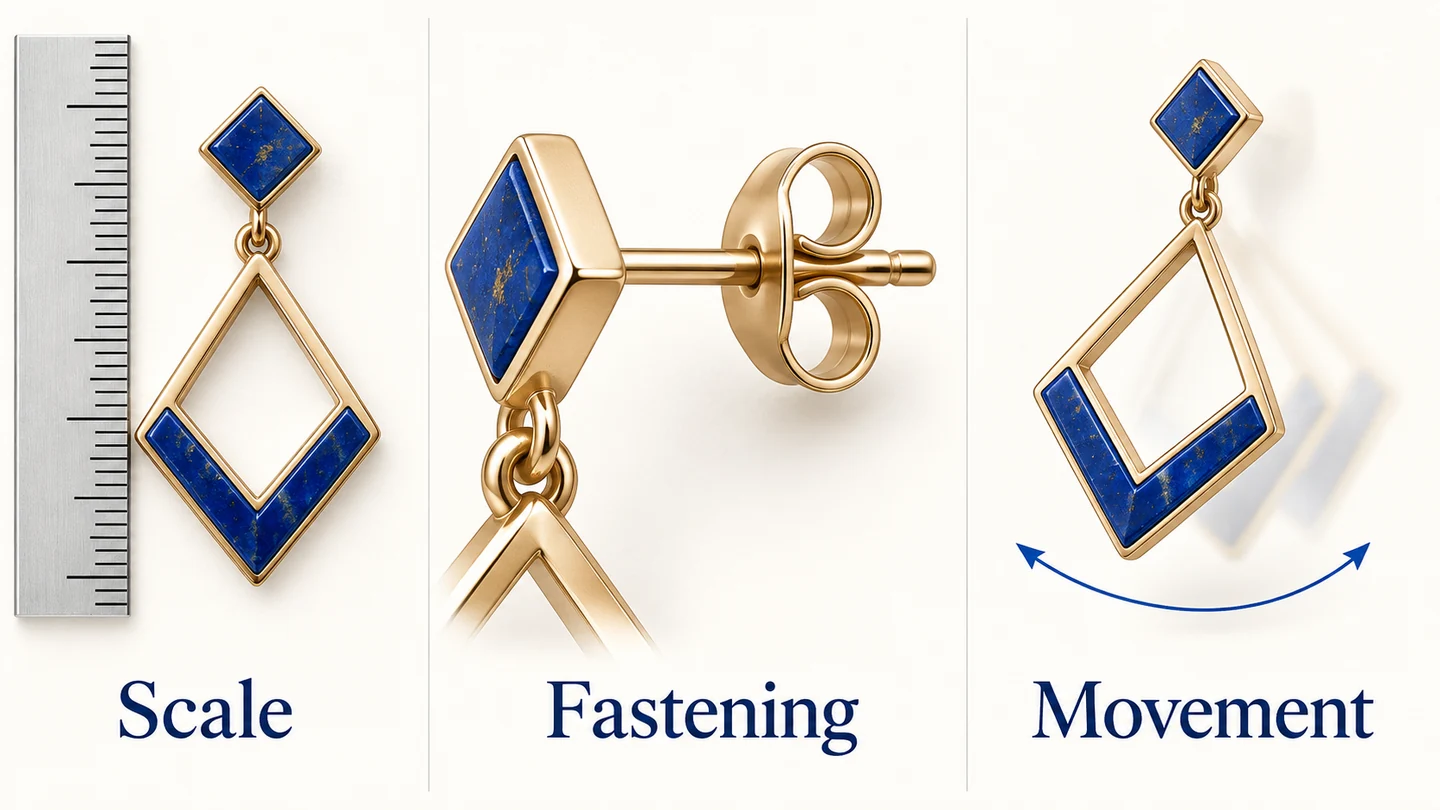
| Front and side close-ups | What does the shape and finish look like? |
| Piece beside a ruler or verified scale reference | How large is it? |
| Fastening demonstration | How does it open and close? |
| Short movement clip | How does it hang or move? |
| Included contents and packaging | What arrives in the parcel? |
| Care demonstration based on verified instructions | How should the buyer handle it? |
Use an authorized person if you show the piece being worn. Do not treat generated model images as proof of real fit, scale or customer experience. Supplier images also need permission and a match to the SKU you sell.
Keep the file names tied to the product and angle. A simple bank such as “earring-A-scale” and “earring-A-clasp” makes it easier to build a sequence without repeating the same glamour shot.
If the sample is not available, you can prepare the questions and captions. Leave material, comfort and received-parcel assertions unclaimed until you have the evidence to show them.
03
Use this two-week trial sequence
Each post below has a different job. Replace the example content with your actual product and verified details. The schedule is original editorial guidance, not a platform-prescribed frequency.
| Day | Feed post | Useful next action |
|---|---|---|
| 1 | Scale Reel: whole piece, close-up and verified dimensions | View the exact SKU’s size information |
| 3 | Carousel: fastening and included contents | Save it if deciding how the piece works |
| 5 | Material post: verified components and care | Read the complete product specification |
| 7 | Movement Reel: the actual piece in ordinary use | Compare its appearance with the product photos |
| 9 | Answer the most useful real question from week one | Send an unresolved question, without sharing private details |
| 10 | Styling comparison using the same piece and authorized images | Choose the relevant product, without implying outfits are included |
| 12 | Delivery and remedy explainer using current store terms | Check destination availability before ordering |
| 14 | Recap carousel: size, fastening, material and delivery | Visit the page if the piece fits the viewer’s needs |
Use Stories between these posts to collect questions, show another angle or clarify availability. Avoid publishing a poll as if its votes prove broad market demand. It tells you what that participating audience selected.
Keep one main idea per post. If the scale Reel tries to explain the alloy, refund process and five styling ideas too, it becomes hard to follow. The sequence lets you answer those questions at the point where they are useful.
You can create several posts from the same shooting session without making them duplicates. Change the question and supporting view, not only the caption’s first sentence.
04
Write captions that describe the actual object
Start with the question the post answers, give the verified detail, then offer a relevant next step. Use ordinary product language rather than phrases such as elevate your style or unlock timeless elegance.
Here is a fill-in example for a 20-second scale Reel:
- Opening, about 0–4 seconds: “Wondering how large these earrings are? Here is the actual pair beside a ruler.”
- Detail, about 4–12 seconds: Show the piece and add the verified length and width. State whether the listing sells a pair or one piece.
- Use, about 12–17 seconds: Show the fastening or an authorized worn view, using only supported observations.
- Next step, about 17–20 seconds: “The product page has the measurements, fastening and delivery information.”
Do not fill in dimensions from an editorial illustration. If a post says “lightweight,” explain the actual measured weight or use a more precise supported description. A personal comfort observation should be attributed as that observation, not generalized to every wearer.
For a material caption, distinguish the body, post, clasp and coating when the specification does. Calling a piece “gold” can imply something quite different from a verified gold-colored coating. Accurate nouns are more persuasive than vague luxury language when the buyer is deciding what arrives.
05
Send interest to the correct page
The destination should show the SKU featured in the post, not a homepage where the viewer has to search again. Match the image, variant, dimensions and availability. On a phone, inspect the path from the profile or product link through the product page and checkout.
If product tagging is part of your plan, check account eligibility separately. Shopify’s current Facebook and Instagram requirements cover:
- A public store and a verified purchasing domain.
- Appropriate professional Instagram and Facebook business connections.
- The required permissions and supported-market eligibility.
Posting content does not itself grant shopping approval.
If a tag is unavailable, use the legitimate link option available to your account and explain the path clearly. Do not promise a feature you have not enabled. The Shopify setup guidance can help identify account and connection requirements.
Paid or gifted creator collaborations also need appropriate disclosure. Instagram’s branded-content guidance addresses the paid-partnership label where an exchange of value applies. Keep that separate from an ordinary post by your own store, and check the applicable rules for the arrangement.
06
Measure where the path loses people
Assign a distinct campaign link where your available link placement and analytics allow it. One example is:
utm_source=instagram&utm_medium=organic_social&utm_campaign=oct_earrings&utm_content=scale_reel
That string labels traffic; it does not create a tracking system by itself. Verify that your analytics receives the values and that the product page opens correctly. Respect consent settings and avoid interpreting missing data as zero interest.
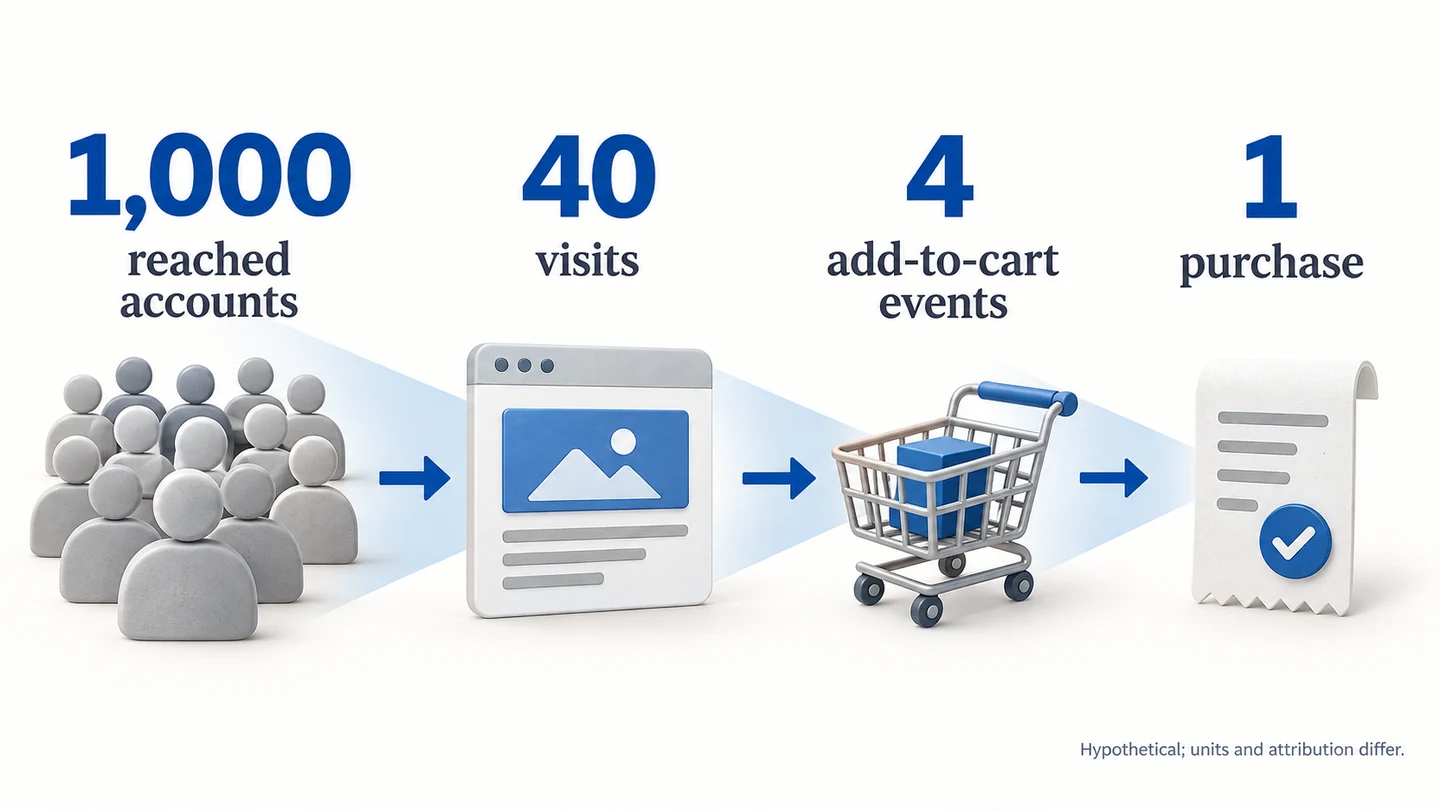
Imagine a trial produces 1,000 reached accounts, 40 attributed store visits, four add-to-cart events and one purchase. These are hypothetical figures, not a benchmark:
| Illustrative relationship | Calculation | Result |
|---|---|---|
| Visits compared with reached accounts | 40 ÷ 1,000 | 4% |
| Add-to-cart events compared with visits | 4 ÷ 40 | 10% |
| Purchases compared with visits | 1 ÷ 40 | 2.5% |
The units and attribution matter: reached accounts, visits and events are not necessarily the same people measured once. These ratios describe the recorded path; they do not prove the Reel caused the purchase.
Use the pattern to choose the next inspection. Plenty of reach but few visits suggests checking the next-step wording and link. Visits without carts suggests inspecting product fit, price, delivery and page clarity. Carts without purchases suggests checking checkout, total charges and payment friction. With small numbers, inspect actual issues before declaring a winning format.
Do not compare views from one post directly with purchases across the whole store. Keep the period, link and product scope consistent. The available account and post insights vary, so record the fields your account actually exposes.
07
Refresh the plan with real questions and a useful offer
At the end of two weeks, keep posts that answer a useful question and improve weak parts of the purchase path. A high-reach clip can still need a better destination. A lower-reach size post can still be useful to people close to a decision.
Use support questions and product-page behavior to plan the next sequence. If viewers ask whether the chain adjusts, show the verified adjustment. If they worry about delivery, clarify the actual destination and processing scope. If the product specification is missing, resolve that before posting more persuasion.
For a merchant considering a different jewelry supply route, AIDrop can review sourcing, sample inspection and packing. Send the SKU specification, destinations and expected orders. That offer fits a supply problem; it does not promise Instagram reach or sales.
The customer-facing conversion path is simpler: useful post → matching product page → clear delivered offer → order. Make each step easy to recognize before adding more content volume.
08
Questions about the Instagram plan
Do I need to post every day?
No fixed daily frequency is established here. This is a manageable trial built around eight useful questions. Adjust it to your ability to produce accurate original content and the audience’s response.
Can supplier photos replace all original content?
Use authorized photos only when they match the actual SKU. Original sample views are especially useful for scale, fastening and contents. Do not invent a received-item demonstration with generated imagery.
Can I say a poll proves the product will sell?
No. A poll reports responses from participants. Use it as a question lead, then compare real product-page and order behavior without making a sales guarantee.
What if my account cannot use product tags?
Check eligibility and connection requirements. Use an available legitimate link path while resolving the issue; content creation and shopping-account approval are separate tasks.
Which metric should I improve first?
Inspect the earliest clear break in the path for the featured product. Verify the link and page before blaming the creative, and consider sample size and attribution before treating a percentage as a reliable result.
Dropshipping Marketing: A Plan from First Visit to Repeat Order
Plan dropshipping acquisition, product-page conversion and repeat sales around realistic margins. Compare channels and measure costs and

Dropshipping SEO: Build Search Pages Customers Can Trust
A practical SEO plan for dropshipping stores: map searches to the right pages, verify supplier claims, link

Dropshipping Customer Retention: Earn the Next Order After the First Delivery
A practical retention plan for dropshipping stores: meet the first-order promise, choose a relevant follow-up, and measure
