
Choose one exact headphone model for a buyer’s task, then verify the sample, documentation, full delivered cost and defect route. Wired and wireless units have different radio, battery and shipping questions. A catalog photo or low unit price cannot approve either one.
This niche is attractive because headphones are familiar and easy to photograph. It is also unforgiving. Buyers can hear a weak microphone, feel a poor fit and notice if the advertised wireless feature is missing. A supplier swap to a “similar” unit can change the product your page promised.
01
Choose a use case before choosing a catalog SKU
A student who needs a cheap wired headset for online classes has a different requirement from a commuter who wants compact wireless earbuds. Start with the buyer’s task: clear calls, comfortable fit, low sound leakage, stable pairing, a certain connector or a replaceable cable. Then compare candidate products against that task.
Shopify’s headphones selling overview confirms the category can be supplied through dropshipping apps. Its generic price and shipping examples are not a current quote for your model. The useful question is whether your supplier can repeat the same spec and ship it to your market.
Connect model, accessory and destination
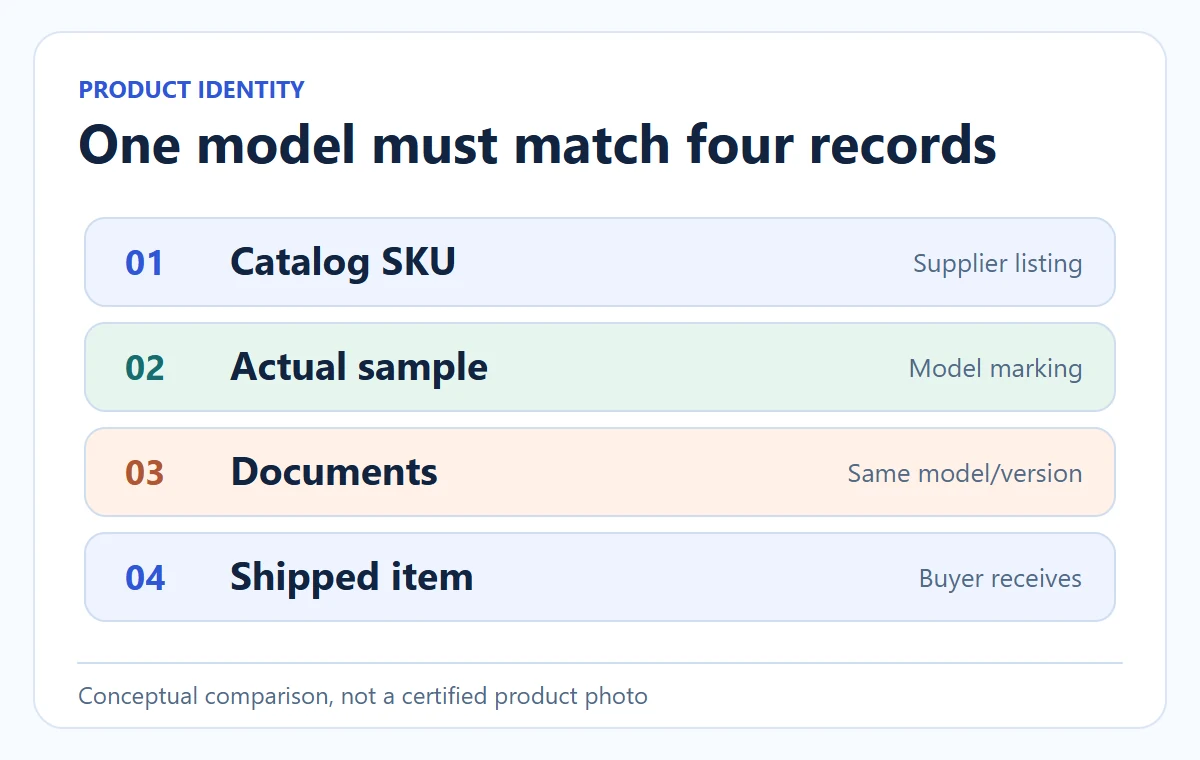
Write an exact-model brief with the manufacturer model number, supplier SKU, wired or wireless connection, color, included cable/case/tips, battery details if applicable, destination market and warranty route. That keeps a sales page, sample and fulfillment order pointing to one item. Our electronics-dropshipping guide covers broader product-family concerns.
02
Use the sample to test the claims a buyer can notice
Check the actual sample and saleable package
Order a sample through the same route customers will use. Check the printed model and contents against the quote. For wireless earbuds, pair and reconnect on two common devices, make a voice call in a quiet and noisy setting, test each button, charge the case and observe the playback time under a documented volume and usage pattern. Do not advertise a test result as a universal battery-life guarantee.
Keep a repeatable listening and pairing record
Test the approved sample under ordinary supported use. Save the device, settings and environment so a later batch can be compared with the same question.
Call and reconnect
For your two intended device types, record the phone/computer model, OS, connection or port, headphone model/version and app used. Pair, disconnect, reconnect and make an ordinary short call in the intended quiet and background-noise settings. Note a dropout or inaudible microphone instead of converting one good call into “works with every device”.
Contents and runtime
Photograph the actual ear tips, case and cable included in the saleable parcel. For playback, note starting charge, volume and enabled features, then record the observed run and stopping condition. Use supplier-supported charging instructions. Do not submerge the unit, force high-volume listening or improvise a battery stress test to prove a marketing claim.
If the intended call or connector fails, hold that claim and model while the supplier explains or supplies a corrected unit. An ordinary sample observation is not accredited radio, battery, water-resistance or safety certification.
| Listing claim | Test or evidence | If it fails |
|---|---|---|
| “Clear calls” | Short recording in the intended environment | Narrow or remove the claim |
| “Up to 8 hours” | Supplier test conditions and your own sample observation | State conditions or omit it |
| “Water resistant” | Matching model documentation and supported rating | Do not imply a rating from appearance |
| “Includes case and cable” | Open the shipped saleable package | Correct the photos and contents list |
On a phone, swipe the table sideways to compare every column.
A nice lifestyle photograph cannot replace that check. The sample guide shows how to approve a model version and retain the evidence. If you cannot order a sample or get a stable SKU, the product may not be ready for paid traffic.
03
Match radio and battery evidence to the actual unit
For a US offer, Bluetooth headphones have radio-equipment requirements as well as ordinary product and shipping checks. The FCC’s authorization explanation distinguishes intentional Bluetooth transmitters from other equipment and explains why the applicable authorization and identification must cover the device marketed. Verify the exact hardware and route with a qualified specialist.
Ask the supplier for evidence relevant to the exact product and verify that the identifier corresponds to the model on the sample, not to a different earbud in the same catalog.
A document for another unit does not approve this one
Do not write “FCC approved” on a page because the supplier sent an unrelated PDF. The applicable authorization route and labeling can be product-specific. If the documentation or importer role is unclear, have a qualified compliance specialist review it before selling. A wired model without radio has a different technical question; do not copy the wireless checklist mechanically.
Rechargeable earbuds also contain lithium batteries. PHMSA’s battery shipping guidance is a reminder that batteries in equipment require route, packaging and marking checks. Ask the supplier for battery specifications and the carrier service that accepts the complete saleable package to your destination. A $4 freight quote for a non-battery accessory does not prove that the earbud parcel can use that service.
| Evidence object | What to match |
|---|---|
| Sample and carton | Model number, battery configuration and included parts |
| Supplier product sheet | Same model/version and current claims |
| Radio authorization record where required | Identifiers for the unit sold in the destination market |
| Carrier acceptance and quote | Battery-containing package on the intended route |
On a phone, swipe the table sideways to compare every column.
A changed component needs matching evidence
Keep copies with the SKU. A later supplier component change may require a fresh check, even if the storefront product name stays the same.
Match the battery summary to the sold package
PHMSA’s lithium guidance explains UN 38.3 design tests and obtaining a test summary from the manufacturer, distributor or vendor. A generic battery PDF is not enough to match a new case or cell.
Ask for a traceable packet
Request the cell/battery manufacturer and model, test-summary reference and the battery configuration in both earbuds and the charging case. Match the summary to the actual sold version, then obtain carrier acceptance and a quote for that complete package and destination. Keep the actual service, packing and marking requirements with the quote.
Keep a dangerous defect out of the ordinary return flow
If a case is swollen, damaged or shows overheating, do not ask the buyer to keep charging it to make a video or mail it by an ordinary parcel label. Route the report to the supplier/manufacturer and qualified carrier for applicable safe handling and transport instructions. Battery-risk handling is different from a simple wrong-color return.
The radio identifier, authorized model or module/host relationship, battery design and carrier decision need separate matching evidence. Missing identifiers or an unexplained case revision block approval; similar photos do not resolve the gap.
04
Price the destination and the defective unit
Build a cost row using the headphone unit, packaging, battery-aware shipping, payment fee and expected support or replacement cost. Then compare it with a believable selling price and customer-acquisition cost. Do not take a low supplier quote for a bare unit and assume the complete saleable package ships at the same rate.
Shipping changes the pre-ad remainder
Imagine a $45 earbud offer. A supplier asks $15 for the unit; a compliant route to the target address is $9, payment and selling fees are $3, and you reserve $3 for defects and replacements. That leaves $15 before advertising and overhead. These figures are illustrative, not a market margin. If the actual freight is $14, the pre-ad amount falls to $10. The shipping-methods guide helps compare route promises instead of guessing from a catalog price.
Price the authorized defective-unit route
Ask the supplier how a buyer reports one dead earbud, a charging failure or a lost case. Does the whole item return? Is a video sufficient for a replacement? Who pays freight for a defect? Where does the parcel go? Put the answer into your warranty plan and customer support instructions before you need it.
05
Make variant changes visible before they reach buyers
Headphone suppliers may update chips, firmware, ear tips, charging cases or packaging without changing the sales title. A small revision can alter pairing, battery life or whether an old photograph is accurate. Ask the supplier how it identifies production versions and how it will notify you of a component change. Record the version shown on the approved sample and one later fulfilled unit.
Reapprove the model and changed claims
If a new batch arrives, do not automatically reuse the previous test. Compare the sample unit’s model marking, supplied documentation, physical accessories and the claims on your page. A different Bluetooth version or charging case can also change documentation and carrier requirements. If the difference affects a buyer decision, update the listing and obtain a new approval before sending more orders.
Test color mapping in the parcel
For a store with several color variants, map each color to an actual supplier SKU and photo. Do not let a customer select black while the feed sends white because both variants share a parent product ID. Check the variant in a paid test order and in the delivered parcel. The product-photos guide explains why the first image and the saleable variant must agree.
06
Test the return before relying on a warranty headline
Headphones can fail in ways a catalog cannot show: one channel is silent, the microphone drops calls, the case does not charge or the fit differs from what a buyer expected. These are not all the same supplier claim.
Ask what evidence is required for each, whether troubleshooting is allowed before replacement, and whether a customer must return an in-ear item. Hygiene and local consumer rules may affect what can be resold after a return; use the actual destination policy rather than a universal claim.
Rehearse a defective-unit workflow with your sample. Record the buyer’s description and order ID, a short test you can ask them to perform, the supplier contact and decision window, return or disposal instruction, and the replacement tracking. If the supplier will reimburse only after physical receipt, decide how quickly your store can make the buyer whole. The public warranty language must reflect the route your team can execute.
Compare two quotes using the same destination and remedy assumption. Supplier A offers the model for $15 plus $9 shipping and requires a $7 return parcel for a defect. Supplier B quotes $19 plus $7 shipping and replaces confirmed defects without return. At first glance A costs $24 and B $26 per clean order.
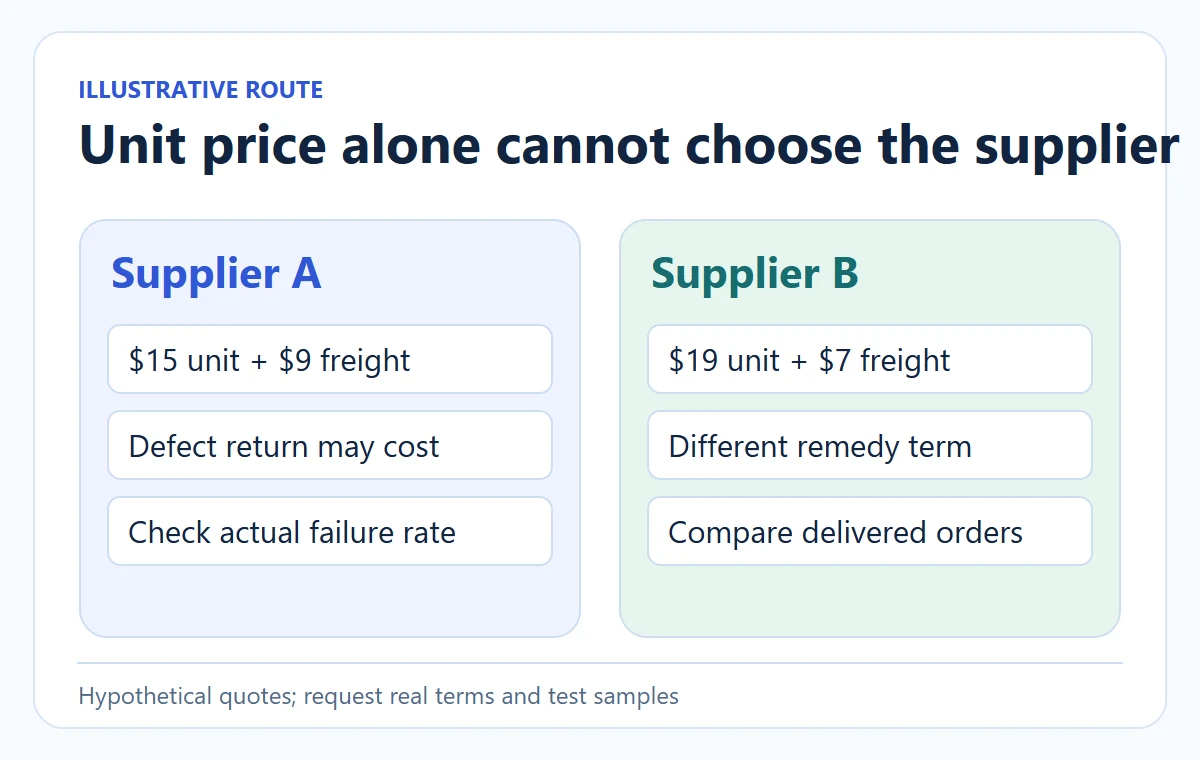
If a meaningful number of A units fail, the reverse-logistics difference could change the choice. Do not invent a failure rate to force a winner; order samples, document the terms and update the comparison with delivered-order evidence.
See what a $7 return route can change
Keep the two suppliers’ complete remedy terms comparable. Use this calculation only if the other defect and replacement losses are equal.
A conditional comparison
Supplier A’s clean forward cost is $24 versus B’s $26. If A also incurs $7 return freight on a share p of orders and B genuinely does not, that extra average return-freight cost is $7×p. At a measured 10% share it is $0.70; at 30% it is $2.10.
Use the condition, not a claimed winner
The $2 clean-cost difference would be overtaken by return freight alone when p exceeds 2/7, about 28.6%. Product defect loss, replacement freight, credits, processing time and buyer service can move that result. It is a sensitivity example—not an assumed failure rate or evidence that either supplier performs better.
For one silent earbud, link the store/supplier order, model/version, receipt date and ordinary symptom record. Request the authorized troubleshooting/remedy, receiver, freight payer and update date. For a battery hazard, use the safe exception route above.
07
Give the buyer a product page they can verify
Give buyers exact contents and support
Use plain descriptions: connection type, compatible devices or ports, exact included accessories, charging method, realistic size and warranty contact. If you claim active noise cancellation, water resistance or a specific runtime, keep the matching model’s substantiation. A claim should survive an ordinary buyer question, not merely fit on a graphic.
Photograph the actual sample on a neutral background, the included items laid out and a useful size or fit view. Label a conceptual lifestyle illustration as such if you use one; it cannot prove the hardware in the parcel. Include a short support route for pairing or defects. The page should give a buyer enough information to choose this model, not just the category “wireless earbuds.”
Before launch, ask someone who did not write the listing to compare it with the sample and the supplier packet. If they find a claim they cannot locate on the product or in a matching document, hold that claim. This is a cheaper correction than finding out through refunds and negative reviews.
Keep the first catalog small. Two well-tested models serving different jobs—a wired call headset and a wireless commuter earbud, for example—are easier to explain and support than 40 supplier variants that share unclear photos.
Answer with evidence from this model
If buyers repeatedly ask a question your page does not answer, add the answer only after verifying it on the exact model. A precise product page can improve conversion and reduce returns at the same time, while unsupported feature lists tend to do the opposite.
08
Make a launch decision from a model, not a niche trend
Release one model only after the sample and listing agree, destination documentation is matched, the carrier accepts the actual package, a paid test parcel moves as quoted, and the defective-unit path is known. If the result fails, try a different model or a wired product with simpler shipping and technical requirements. Do not replace the supplier without restarting the approval record.
Request an exact-model operational review
If you are sourcing headphones in China, AIDrop Agent can coordinate sample checks, packaging and fulfillment questions against a defined model. Send the model, intended market and desired shipping service through the review form. That permits a real operational review; it is not an automatic certification of a catalog listing.
09
Frequently asked questions
Are wireless earbuds harder to dropship than wired headphones?
They can add radio, battery, charging and carrier-routing questions. Difficulty depends on the exact model and destination. Both types still require sample, claim, cost and return checks.
Can I use the supplier’s FCC document for any similar model?
No. Match the evidence to the specific unit, identifier and version being sold. An unrelated document or badge does not establish that match.
Is a low supplier unit price enough to choose headphones?
No. Include the saleable package, destination freight, payment charges, likely replacements and acquisition cost. Test whether the product and service match the buyer’s expectation.

Electronics Dropshipping: Compatibility, Documents and After-Sales Support
Electronics can be dropshipped when the exact model works for the claimed setup and has applicable documents,

Auto Parts Dropshipping: Find Suppliers and Avoid Wrong-Part Orders
Find a usable automotive supplier route, keep part and vehicle details accurate, price a complete filter order,

Phone Case Dropshipping: Match the Phone Before You Sell the Case
Compare ordinary and printed phone-case suppliers, build an exact model-to-item map, prepare artwork and calculate what a
