
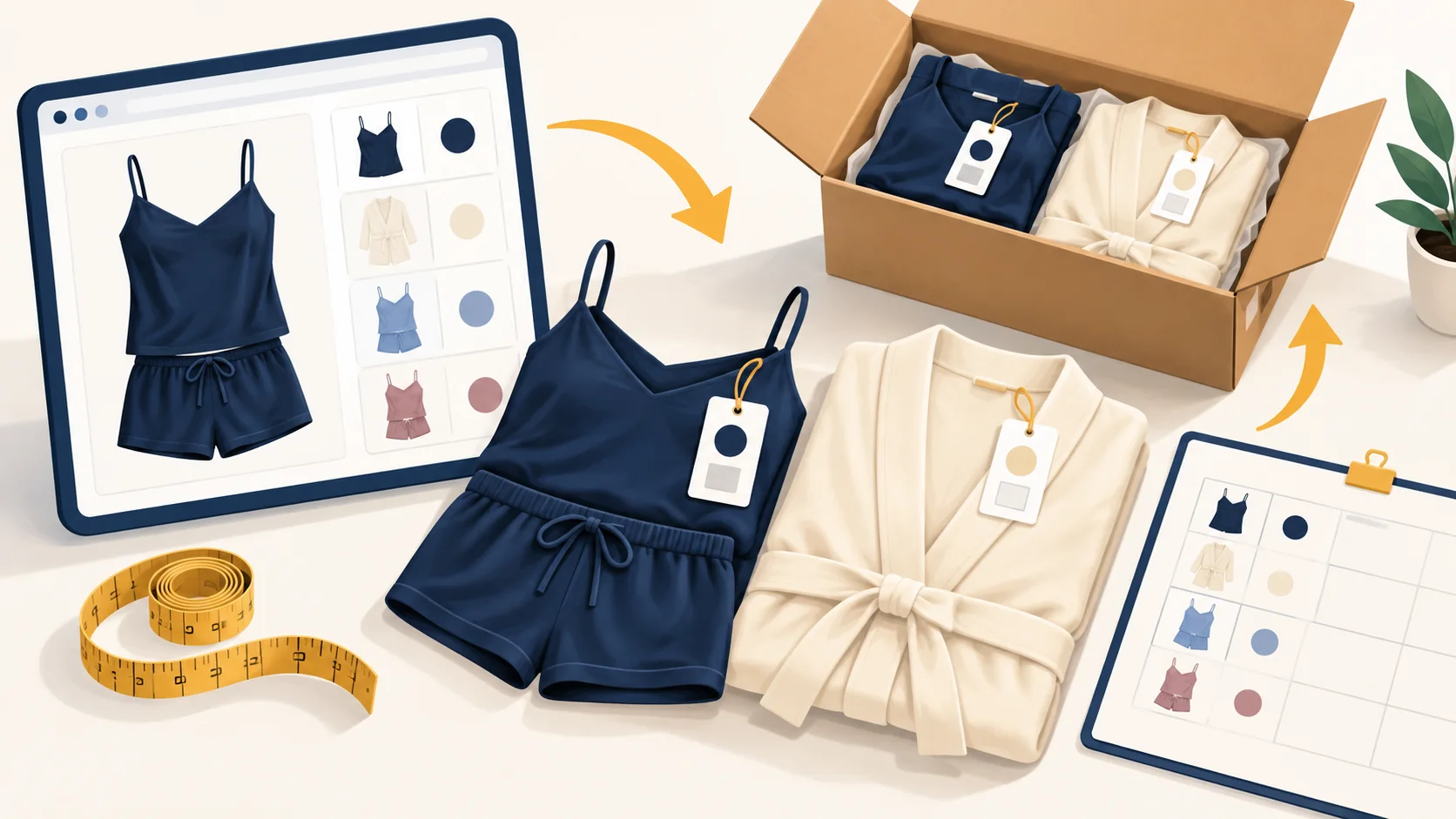
Yes, you can dropship lingerie. An approved supplier can hold the stock and mail each paid order to your customer. That lets a small store try a focused range without buying every size first. It does not make a supplier’s size chart, parcel or final-sale rule ready to paste into your own storefront.
Think of a two-piece set in a wholesaler’s catalog. A shopper needs to know whether the top and bottom fit, what the package reveals on the doorstep, and what happens if the wrong size or a damaged item arrives. Answer those questions for one real style before importing hundreds of listings. The general clothing dropshipping guide covers apparel range and sample planning; this page handles the details that make intimate items unusually easy to misdescribe.
01
Pick one item and confirm you can order it
Choose a narrow first offer: perhaps one adult two-piece set and a robe in a few colors. Note the supplier’s style code and every sellable variant—the exact size/color combination a customer can select. “Black set, medium” must map to a particular supplier order line, not to a broad collection page. A robe and a set may be in the same feed, yet their sizing and return treatment can be different.
Then check the actual program. BeWicked describes a lingerie dropship service in which an approved retailer lists the products, places individual orders after a shopper buys and the supplier sends the parcel. Its current public page also describes application review, a paid subscription, per-order handling, a product feed and a minimum-advertised-price policy. Those are conditions for that program, not a promise that any visitor can immediately place an order or that every supplier has the same costs.
Get the correct BeWicked account ready
Its program page, rechecked October 11, gives a separate dropship application and subscription route.
Apply, then activate
Apply on the linked dropship site and wait for the approval email. After approval, buy the annual subscription in that dropship account. A wholesale login does not replace this account; do not publish an available-to-buy style merely because the wholesale catalog opens.
Check the specific style
Once access is active, inspect the product feed and exact size/color order line. Check its advertised-price rule, live quantity and full parcel charge. Keep the supplier code with your store variant so a paid black medium set cannot become a different style.
Account access is the first step. The size chart, parcel and sample still need checking before a style goes live.
Check this style’s actual order terms
Ask a candidate supplier whether the specific style is eligible for its dropship route, whether account approval is complete, how the order reaches it, what price rules apply, and whether a color/size can be back-ordered. If an apparently cheap listing needs paid access and a handling charge for every parcel, the seller must know that before setting the retail price. Public catalog visibility is only a starting point.
Dropship, wholesale and private label differ
Be careful with the words dropship, wholesale and private label. In BeWicked’s description, dropshipping is individual orders without upfront stock; wholesale means you buy inventory; private label is a separate branded-product program. A seller wanting plain packaging or a new label cannot assume those come free with a one-at-a-time dropship account. For a broader product-choice framework, use the dropshipping products guide; here the decision is about the garment and its recipient experience.
02
Make the size chart belong to the garment
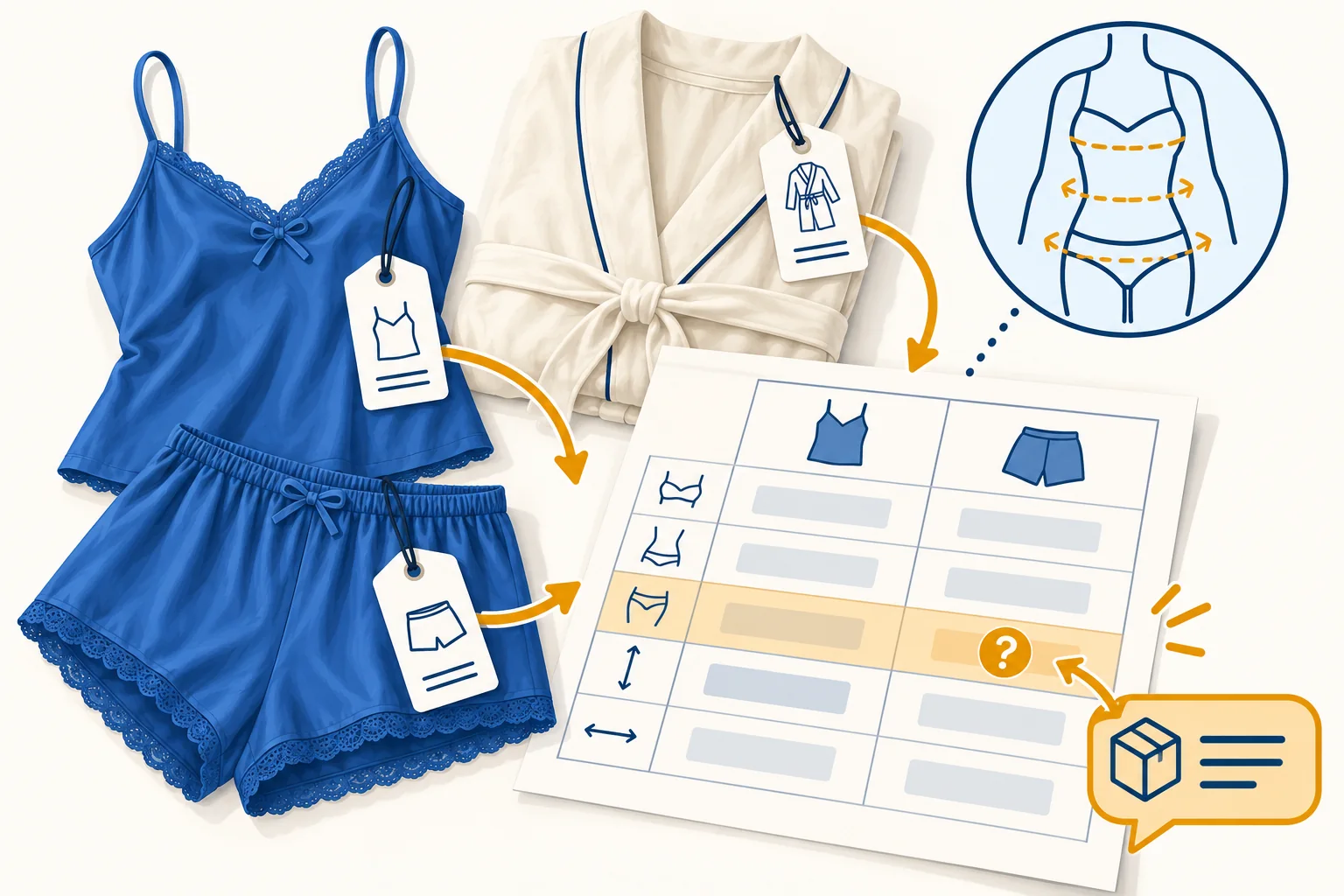
Lingerie sizing is not one universal S/M/L ladder. A stretchy robe may be described with a body-bust range. A structured bra may need band and cup information. A set may force the same top and bottom size even when a shopper needs different ones. If the supplier cannot split the set, say so plainly instead of implying that both pieces can be chosen separately.
Body circumference and flat width are different
Start by asking what a chart measures. A body measurement is taken around the shopper; a garment measurement describes the item laid flat or stretched to a defined point. A label such as 1X/2X is only an option name until you know the relevant body range, garment construction and intended fit. Put that information beside the exact product, with the measurement method and units, so a buyer need not guess whether “bust 40” means a body circumference or a flat width.
A paired set may not fit both pieces
Imagine a buyer whose body measurements place their top in one style-specific size band and their bottom in the next. If the supplier sells the set only as one fixed size, neither a generic “medium” label nor a roomy photograph solves that mismatch. Check whether mixed-size pieces can be ordered; if they cannot, say that the set comes as one paired size and show the verified body ranges for both pieces. Stretch matters too: a flat garment width is not a promise that every body at that number will fit comfortably. Use the maker’s supported range and an ordinary sample, not a conversion you invented from the label.
Do not silently repair the 2X row
BeWicked’s published size chart has separate single size, jump size, US numeric, bust, waist and hip columns. Its OS and Q rows cover different approximate body ranges; “one size” is not “fits everyone.” More importantly, its published 2X US numeric row reads 12–20, between 1X at 18–20 and 3X at 22–24. Those rows overlap in a way a retailer should not silently repair. The 2X body-measurement row might still be usable, but the numeric conversion needs the supplier’s answer for the specific style before you put it on a product page.
| Seller’s question for one style | What to record before listing |
|---|---|
| Is the top sized by band/cup, body bust or a jump size? | The supplier’s exact size code, measurement type, units and supported range |
| Can the bottom be selected separately? | Each top/bottom combination the supplier can actually ship |
Does OS, Q or 2X have a clear meaning here? |
Style-specific range and any corrected chart version; unresolved rows stay unpublished |
| Does the customer choose a color as well? | One supplier variant ID and live stock status for every selectable size/color |
On a phone, swipe the table sideways to compare every column.
Order a sample in a size you can measure, and compare it with the stated chart and construction. For a bra, note band stretch, closure and cup shape; for a robe, note length and wrap overlap; for a set, check whether the two pieces are paired as described. One sample does not prove every size in the run, but it tells you whether the listing language and label match an ordinary shipped item. Do not borrow a sizing table from a different supplier just because the labels look similar.
Hold that unresolved size option
If the supplier cannot resolve an ambiguous size row, hold that variant. A shopper cannot make a fair choice from a conversion the seller privately guessed. Later returns become expensive because the original promise was unclear, not because the buyer failed to read.
03
Keep the listing tied to the item in stock
Hourly stock is not a reservation
A supplier feed can make hundreds of styles appear ready. It may carry titles, descriptions, photos, prices and a stock field, but you still need one record per sellable size/color combination. BeWicked says its active feed updates hourly under its own program. That is useful, yet a feed refresh is not a reservation of the last black medium set. Decide what happens when a paid order arrives after a variant has sold out: offer an approved alternative, wait with the buyer’s consent, or refund promptly. Never substitute a different cut or fabric under the same image without approval.
Rewrite wholesale-oriented product text in language a shopper can use, while keeping verified facts intact. Name whether the listing is one set, two separately ordered pieces or a garment with an accessory. Give the actual fiber content, what is included, the care information, size guidance and any visible brand presentation. Avoid claims like “silk feel,” “seamless,” “hypoallergenic” or “fits all” unless the item itself supports them. Good photography matters, but it cannot fill in a missing fabric label or an unverified measurement.
Match the garment label and origin
For US sales, FTC textile guidance says most clothing needs fiber, country-of-origin and responsible-business information on labels, with care labeling covered by a separate rule. It also addresses country-of-origin statements in internet advertising. Ask for photos of the actual garment and care tags and confirm that your product-page statement matches that item. A parcel mailed from California does not by itself make the garment “Made in USA.” This article cannot determine every requirement for every accessory or fabric; check the chosen product rather than copying a supplier category-wide claim.
Treat the product feed as a draft inventory list, not as editorial approval. A style is ready only when the sellable variants, actual garment details, label evidence and substitute policy agree. The broader supplier guide covers the general partner relationship; your immediate task is to get this one listing right.
04
Ask what the shopper actually receives
“Discreet shipping” can mean several different things. Is the outer mailer plain? Does the shipping label name the supplier? Does a branded box sit inside? Is there a packing slip with a price or return address? Does the garment have an inner bag or hygiene seal, and what does opening it change? Get answers for the parcel a customer will actually receive, not just for the supplier’s website design.
Confirm the parcel, not the indexed excerpt
There is a good reason to inspect an ordinary order. A search excerpt for BeWicked described a package without its brand on the outside, but the current opened dropship page says orders ship in BeWicked packaging and the retailer supplies its own packing slip. Those statements should not be blended into “unbranded.” The excerpt may lag a changed page; the current program wording still cannot show exactly what a recipient sees. Ask the supplier for a current packed-order photo or send one ordinary sample order to a trusted address. Until then, do not promise a blank exterior or your own brand.
GoodBase’s current returns page describes B2B claims and sealed-item conditions; it does not establish neutral packaging. Ask each candidate for the actual outer mailer, label, inner presentation and packing slip. Do not turn a vendor’s return policy into a promise about what appears on a doorstep.
Ask what seal this style actually has
The inner seal deserves its own answer because it can affect an intimate item’s condition and the return discussion. Ask what, if anything, the supplier seals, whether every style uses the same packaging, and how a customer should photograph a damaged or opened package without exposing more personal information than needed. A generated illustration or a supplier mockup cannot prove that an actual order arrives sealed. Make the customer-facing promise only after checking a real parcel or a clear supplier specification that matches the selected style.
05
Write the wrong-size and wrong-item answers separately
“I chose medium but it does not fit” is different from “You sent large,” a torn item or a missing bottom. Give each case its own customer outcome.
The supplier’s trade policy determines what you can recover from it. Your retail policy and applicable customer obligations determine how you help the buyer. Work out both before copying a wholesaler’s “final sale” wording.
BeWicked’s terms, rechecked October 11, say dropship returns are not accepted and damaged, incorrect or short goods must be reported within five business days of receipt. They also say not to ship physical returns to the supplier. Request instructions for the actual claim before directing a buyer’s parcel anywhere.
GoodBase’s B2B policy gives a different example: defect or wrong-item claims within 14 days, with order details and relevant photos; it contracts with the trade account holder, who handles retail customers. The page also labels itself an informational template. Confirm the terms of your actual account. Neither page establishes one universal US hygiene rule or your store’s obligations to its buyer.
| What the buyer reports | Your first check | Supplier question and possible seller action |
|---|---|---|
| Correct item, fit disappointment | Was the size guidance accurate and the seal intact? | Is a sealed return or exchange allowed upstream? If not, decide and disclose the store’s own funded remedy. |
| Wrong size/color or missing set piece | Compare the order variant ID with the packed item and labels. | What evidence and deadline does the supplier require for correction? Arrange the right replacement or refund to the buyer. |
| Torn seam, stain, broken closure or damaged package | Record photos of the defect and parcel, keeping intimate details private. | Ask for authorization and whether the item must be returned, replaced or discarded; do not direct a parcel to an unconfirmed address. |
| Buyer opened the inner bag and changed their mind | Check what seal existed and what the storefront disclosed before sale. | Upstream return may be limited. Your customer reply must still follow your actual policy and applicable obligations. |
On a phone, swipe the table sideways to compare every column.
Write the claim clock into your process. If a supplier needs damage photographs soon after delivery, a delayed internal handoff can make a valid complaint hard to recover. Tell the buyer how to contact you, not just the supplier. Ask only for evidence relevant to the error: order number, garment/label and parcel condition. A customer need not send a modeled photograph to prove that the wrong size label arrived.
Keep the matching set complete
Also decide what happens when only half a set is available. BeWicked’s shipping terms describe possible back-ordering of a partial order unless cancellation is requested. A shopper who bought a matching set may reasonably reject one piece now and the other later. Ask whether the supplier can hold the order intact or cancel it before you promise a single complete set.
06
Price the whole order and test one ordinary parcel
Suppose the wholesale item looks inexpensive. The delivered order may still include program access, handling, postage, payment cost, customer support and occasional size or defect resolution. BeWicked’s current public terms show an annual access charge, a per-order handling charge, listed domestic postage and a package item/weight limit for its own program. Those figures may change after account approval or over time; they are not AIDrop rates or a market average. Use the actual current terms for the chosen partner before setting the retail price.
Count parcels and handling before pricing
For a set and robe in one basket, check whether they fit the provider’s per-package item and weight rule. If they become two parcels, the buyer may see two deliveries and the seller may pay additional postage. Ask whether the program charges handling once per order or once per parcel, and how a partial back-order is billed. A margin calculation that uses only the wholesale garment price is incomplete.
See what the shipping upgrade leaves
On October 9, 2026, BeWicked’s linked program page listed $100 annual access, $6.95 handling per dropship order, and domestic USPS shipping at $5.50 for Ground Advantage or $12.50 for Priority Mail. It also listed a limit of five items and 4 lb per order. Confirm your actual account and parcel quote. Here is an arithmetic example with an assumed $34 sale and $14 garment, not a quoted style or an approved advertised price.
Customer revenue
$34, excluding any collected sales tax.
Assumed garment cost
−$14.
Published per-order handling
−$6.95, if those terms govern the order.
Published Ground Advantage shipping
−$5.50, if the parcel and destination qualify.
Assumed payment cost and ads
−$1.20 and −$4.
Amount remaining
$34 − $14 − $6.95 − $5.50 − $1.20 − $4 = $2.35 before annual access, other overhead and customer remedies.
Switching that assumed order to $12.50 Priority Mail adds $7, turning $2.35 into a $4.65 loss before the same remaining bills. If you spread $100 annual access across 100 planned orders, it adds $1 per order and leaves $1.35 on the Ground example. The subscription is paid under its billing terms, not collected one dollar at a time. Use a supported selling price and your real basket charges before offering an upgrade.
Place a normal sample order through the same route a customer order will use. On arrival, check the exact size/color style code, both pieces of any set, measurement and seam finish, care/origin labels, inner bag, outer label, packing slip and delivery timing. Record the real cost of that test, including any program and shipping charges. A sample with a special sales representative arrangement may not reveal what ordinary automated orders look like.
Delivery alone does not pass the sample
If the received size differs from the chart or the package differs from the promise, correct the listing or pause the style. Do not tell shoppers that a sample “passed” just because the carrier delivered something. The test is useful only if it compares the parcel with the actual product page and your written supplier terms.
07
A list-or-hold decision for two starter styles
Here is a fictional store decision. The merchant wants to list one black two-piece set and one robe. The supplier has not yet approved this merchant’s dropship account, the set’s 2X row still has the published numeric inconsistency, and the outer-package wording conflicts with an older search excerpt. No sample has arrived. The decision remains on hold until the account, chart, packaging and sample are confirmed.
| Product decision | Evidence in hand | Decision |
|---|---|---|
| Black set in clearly mapped sizes | Supplier chart is available; exact top/bottom pairing, labels, live variant IDs and ordinary packet remain unconfirmed. | Hold the listing until the selected style and sample answer those questions. |
The set’s 2X option |
Public numeric row appears inconsistent with adjacent rows. | Do not publish 2X guidance from a guessed conversion; request a corrected style-specific range and a dated answer. |
| Robe | Simpler fit may be possible, but its own material, length, variant, labels and package have not been checked. | Hold this style too; “robe” does not inherit the set’s chart or return terms. |
| “Plain package, easy returns” marketing line | The opened supplier page and an indexed excerpt disagree on packaging; supplier policies differ on sealed/used and defects. | Do not make either blanket promise. Inspect a parcel and write the store’s own case-by-case policy. |
On a phone, swipe the table sideways to compare every column.
The seller’s next message can be short and specific: “For style [code], please confirm the body-measurement range and correct US numeric conversion for 2X, whether top and bottom are separate variants, the current outer mailer/label and inner seal, the fees for an ordinary set-plus-robe parcel, and your process for a wrong, damaged or opened item.” Ask for current product/label photos and a normal sample order. If the supplier cannot answer, choose another style or provider instead of hoping the mismatch stays invisible.
If you have a shortlist of adult intimate garments and want to see whether sourcing, package checks and order handoffs can be scoped for your market, ask AIDrop Agent about the specific requirement. That starts a conversation about what may be possible; it does not confirm that AIDrop produces, stocks, seals or discreetly ships lingerie.
Questions before listing intimate garments
Can I begin with a wholesale login?
The reviewed BeWicked route uses a separate approved dropship account and active subscription. Another supplier may use different terms. Check how your exact style can be ordered before publishing it.
Does one size mean it fits everyone?
No. Use the selected style’s supported body ranges and construction. A set may pair top and bottom in one size; confirm whether they can be chosen separately.
Can I promise discreet or unbranded delivery?
Only when the actual selected parcel supports that promise. Confirm its mailer, outer label, inner product branding and packing slip separately; neither a feed image nor these illustrations is parcel evidence.
Does final sale let me ignore a wrong item?
A fit preference and a supplier mispick are different cases. Give the buyer an outcome under your actual retail policy and obligations, then pursue the separate supplier claim within its deadline.
Is the cheaper shipping method enough to make the set profitable?
No. The $2.35 example still excludes annual access and other bills. Use the approved selling price, actual parcel charge and remedy costs; the same example loses money after the assumed Priority upgrade.

Clothing Dropshipping: Sizes, Variants, Samples and Returns
Verify apparel sizes, variants, samples, labels and returns before launch. Build a clothing dropshipping offer around accurate
Clothing Dropshipping Suppliers: 5 Options for Different Stores
Compare Trendsi, Printful, Printify, Apliiq and BrandsGateway by clothing model, fit information, stock, shipping and return costs.
Shoe Dropshipping: Sizing Evidence, Variants and Return Exposure
A shoe listing needs model-specific fit evidence, exact size-color stock and a workable exchange route. Compare one
