

Real hair dropshipping options include Private Label’s app and store route, JazzWigs’ individual-order dispatch service, and Bella Hair NYC’s dropship inquiry route. Choose the vendor that can supply your exact extension or wig, serve your customer’s destination and explain how orders, payment and returns work.
With hair dropshipping, your store sells the product and pays the supplier to send it to the customer. You avoid holding that stock yourself, but you still have to describe the hair accurately, fund the order and help the customer when the color, texture or contents are wrong.
A vendor’s name or a “10A” label is not enough to choose the offer. Begin with the physical hair unit your buyer needs, then compare the service that will get that unit to them.
Explore the broader topic: Beauty Products Dropshipping: Claims, Ingredients and Supplier Records.
01
Compare vendors by the order they can fulfill
Choose the route before the hair grade
These providers describe different routes, not interchangeable guarantees of quality. Their actual program pages were reviewed in September 2026. Confirm the product, stock, destination and terms for your account before taking customer orders. If you are considering the named Dropship Beauty service, our Dropship Beauty review separates its app, store packages and continuing charges.
| Vendor | Published order route | What to confirm |
|---|---|---|
| Private Label | Atlanta warehouse dispatch through Dropship Beauty or its store route; describes no inventory purchase, minimum order or quota | Exact hair product, app/store eligibility, branding, supplier-order price, destination and current return terms |
| JazzWigs | Individual eligible bundles, closures and wigs with neutral packing; custom options have additional conditions | Stock versus custom production, exact contents, duties, packaging/branding charges and governing return policy |
| Bella Hair NYC | Invites dropshipping arrangements through an email inquiry | Whether the requested product and destination are accepted, and how payment, dispatch, branding and returns will work |
On a phone, swipe the table sideways to compare every column.
Dispatch location is not hair origin
Private Label’s US warehouse is a dispatch location. It does not establish where every hair product was sourced or manufactured. JazzWigs’ country and texture descriptions also need to be kept separate from a verified origin claim.
A direct supplier can be practical without an app if you can send exact orders, obtain acceptance and keep tracking connected to the customer. An app may help import products or transfer information, but its presence does not guarantee every variant is available or that an order was paid and dispatched.
If you want your brand on packaging, ask which labels, bags or inserts the provider can supply, at what quantity and cost. JazzWigs distinguishes ordinary neutral dispatch from conditional private branding. The private-label guide explains why a logo option does not automatically mean free custom packaging.
Marketplaces and wholesalers can widen the choice, but a listing with one-unit ordering is not proof of individual customer dispatch. Ask the seller to confirm that service, the return address and destination costs in writing. Do not treat a vendor directory’s ranking as product approval.
02
Specify the hair before comparing prices
Decide what the buyer is purchasing. Similar photographs can represent different products and amounts of hair:
- Weft bundles: lengths of hair attached along a sewn strip. Specify the number of bundles and the net hair weight.
- Clip-ins: pieces attached with clips. Specify how many pieces and clips are included and the total weight of the set.
- Tape-ins: extensions using a tape attachment. Clarify the pieces, weight, care and installation/removal requirements; do not promise that an adhesive suits every scalp.
- Closures and wigs: a closure helps finish part of an installed style; a wig is a complete unit with its own cap, hair and construction. Lace dimensions, cap size and included parts affect the offer.
A first range could focus on one texture and a few confirmed lengths rather than every type in the catalog. Think about a buyer ordering straight bundles for an appointment: wrong color or insufficient hair matters more than a dramatic grade name.
Fill a precise bundle request
Our hypothetical offer contains three black straight weft bundles, each with a target length of 18 inches and target hair weight of 100 grams. No closure is included. The actual supplier must confirm the product, measurements, composition, care and packing before the offer is used.
Ask how length is measured. Curly hair may be described by stretched length, which is different from its hanging appearance. Show the actual measurement method and accurate photographs rather than expecting customers to infer length from a model.
JazzWigs’ FAQ describes its relevant bundles as 95 grams with a 5-gram tolerance. If three units of that particular offer govern the order, their combined weight could be 270–300 grams. That is not a weight rule for every vendor, clip-in set or wig. Three bundles also do not guarantee enough hair for every head size, length, style or desired fullness.
Ask for the exact bundle order rather than a grade name:
Please quote three black straight 18-inch weft bundles for one US customer order, with no closure. Confirm the length-measuring method, net grams and tolerance per bundle, actual fiber composition and processing, color code, care instructions, sealed packing, sample cost, current stock, dispatch and shipping charges, and wrong-product or defect procedure.
For a wig, replace that brief with the actual cap measurements, lace size, parting arrangement, length, color and hair amount. Ask how any advertised density is defined. A bundle quote cannot be used as the price for a complete wig.
Review the sample and describe it honestly
Order the exact variant and review the color, texture, length, weight, attachment construction and contents. Keep the supplier’s care instructions with it. If you do any washing, styling or wear assessment, describe only what you actually did and observed; this article has not tested a sample.
Ask what “human hair,” “Remy,” “virgin” or “raw” means for that product and what supports the statement. A supplier’s 8A or 10A label is not a universal independent grading standard. Country names can describe a marketed collection; they should not become an origin claim without suitable support.
Do not infer heat-styling, coloring or repeated-wear performance from a photograph. Obtain the actual product guidance before advertising those uses. You also need permission to use the supplier’s images. Compare this particular hair offer with other dropshipping products before expanding the range.
03
Separate app access from the cost of hair
The Dropship Beauty app listing, rechecked October 11, shows Pro All Access at $19.99 per month and Yearly All Access at $199.99 per year, both in USD with a stated 30-day trial. These are public plan terms, not a tested installation or billing account.
Read the selected billing commitment
The listing also has a generic line saying recurring and usage charges are billed every 30 days, alongside the annual plan. Confirm the plan’s actual billing, trial cancellation and refund terms before subscribing. Do not assume that the annual option is collected as twelve monthly installments.
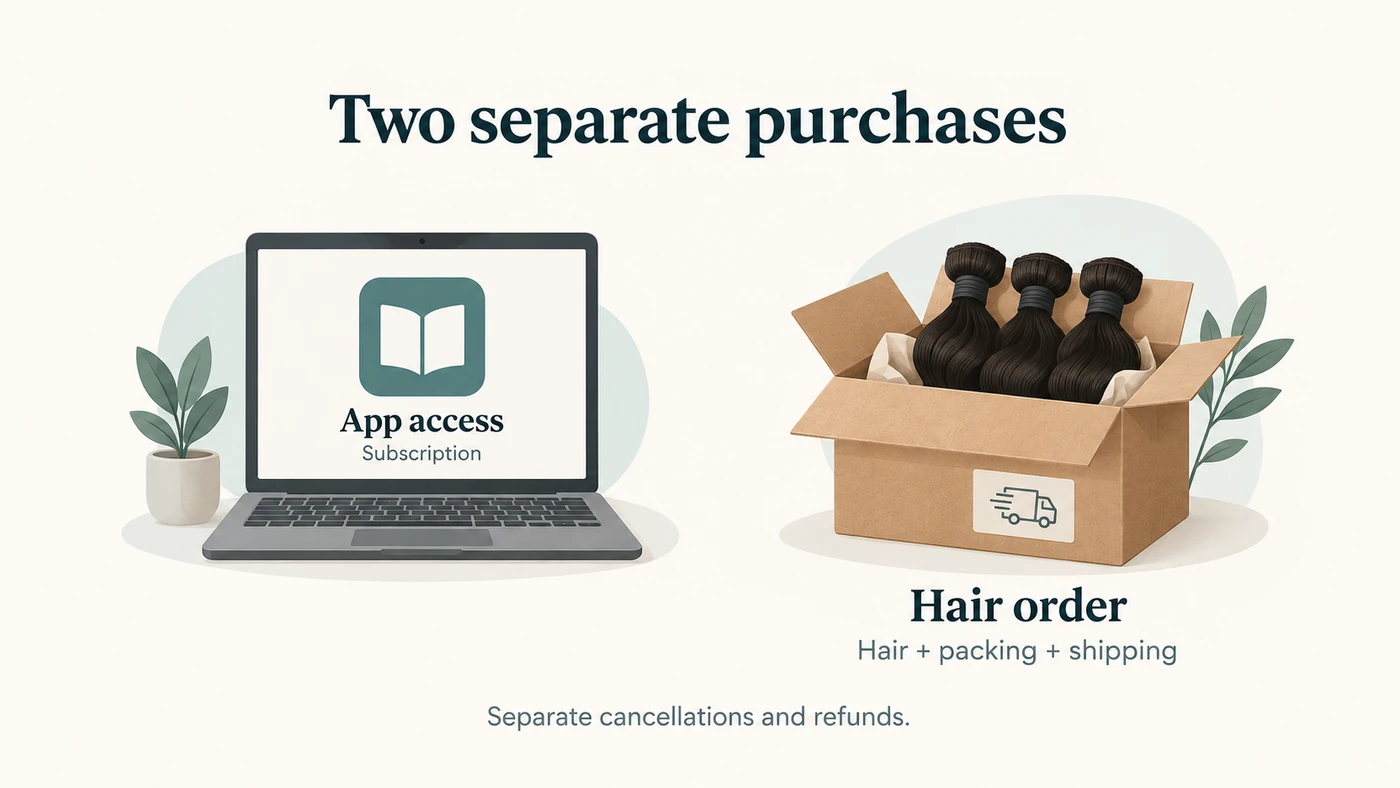
App access is separate from buying hair and sending it to customers. Budget the hair, packing, shipping, store subscription, payment charges, advertising and returns. Ask which charges appear on the Shopify bill and which supplier invoices or other charges you pay separately. Canceling app access is a different action from canceling or refunding a physical hair order.
Work through one complete order
This fictional USD example uses a $165 three-bundle sale. It is not a quote for the proposed specification from any named vendor.
- Customer revenue, excluding collected sales tax: $165
- Three hair bundles: −$75
- Packing: −$3
- Customer shipping: −$9
- Payment processing: −$5
- Advertising attributed to the order: −$24
- Contribution after these variable costs: $49
The app bill is separate from order contribution
That $49 is the amount left from one order before the app, store costs, refunds and other expenses. The $19.99 app subscription is owed even in a month with no sales. Use your expected number of orders to decide whether the app saves enough manual work to earn its fee; this example does not forecast demand or profit.
Use the actual app plan and store charges you pay, including a ready-made-store cost if you choose that route. Add applicable duties, tax, product review, insurance, other apps and customer remedies. Do not treat collected sales tax as revenue available to spend.
Ten orders need $870 before payout
The supplier-side hair, packing and delivery in this example total $87. Ten orders need $870 for those bills if supplier payment falls due before your customer-payment payout. Advertising and overhead can require more cash during that gap. Keep additional accessible funds for refunds; an anticipated supplier credit is not cash already received.
04
Follow the paid order through dispatch
Your order instructions should identify the product code, texture, color, length, number of units, any closure or other included part, and the customer’s address. Keep the accepted supplier order and payment reference connected to the store order.
Check the quantity unit before paying
For the hypothetical offer above, a customer buys one set containing three black straight 18-inch weft bundles, with no closure. Your store’s “quantity 1” and the supplier’s “quantity 1” can mean different things.
If the supplier sells one bundle
Map the set to three units of the approved bundle code. Confirm the same length, color and texture on all three; do not place one bundle order just because the customer selected one set.
If the supplier sells a three-bundle set
One supplier unit is appropriate only when that exact set contains the three agreed bundles. Read its contents: a mixed-length set or an offer with a closure is a different product.
Before payment, compare the supplier basket with the store’s promised contents. After acceptance, check that the accepted order still identifies all three bundles and the correct address. Ask about a missing unit before claiming the order is ready. This proposed check has not been performed in a vendor account.
Confirm stock before promising an appointment deadline. If the required length is unavailable, a shorter bundle is not an equivalent substitute. Hold the order and explain the available choice or changed timing to the customer.
The shipping threshold uses the supplier basket
Private Label describes orders placed before noon Eastern Time as typically processed the same business day, Monday through Friday. Its public offer also states free US shipping above a $99 threshold. Confirm which supplier basket and service qualify; a $165 retail sale in your store does not automatically establish the supplier’s qualifying order value.
Processing and transit are separate waits
JazzWigs describes stock processing of 0–2 business days after payment review, standard custom work of 1–3, some unavailable textures/colors/special lengths of 2–5, and bulk custom work of 5–15. It separately estimates transit at about 2–4 business days, depending on the route. These are provider terms and estimates, not a guarantee that a custom wig arrives for a particular event. Confirm who pays any import duties.
Keep the sequence visible:
- Confirm the exact variant and current stock or custom specification.
- Confirm supplier acceptance and payment.
- Record the production/processing period separately from carrier transit.
- Check carrier acceptance after the label is created.
- Give the customer tracking and act on delays, missing scans or delivery problems.
For US customers, the FTC merchandise-order rule requires a reasonable basis for the stated shipping time, or generally shipment within 30 days when none is stated. The default concerns shipment, not arrival. When shipment will be delayed, follow the required consent or refund procedure; the supplier’s delay does not transfer your responsibility to the customer.
05
Handle wrong hair, returns and customer concerns
Compare the delivered hair with the order
Ask buyers to compare the color, texture, length and contents before cutting, washing, coloring or installing the hair. Sealed bags, tags and ties can matter to a supplier’s ordinary return process. Give those instructions before sale, with accurate photographs and understandable care information.
When a customer reports a problem, check the actual order and product version. A wrong color sent by the supplier, a buyer changing their mind and a defect discovered after use need different handling. Do not dismiss a possible defect solely because the hair was worn.
Use the policy that governs the actual order
The inspected vendor pages give different ordinary-return routes. Check the terms attached to your exact order before publishing a store promise:
| Vendor page | Ordinary return terms shown | Confirm before sale |
|---|---|---|
| Private Label | Eligible unused, sealed, regular-price hair; a 30-day period. Worn, washed or altered hair and some sale goods are excluded. | Its wording conflicts on whether the clock starts at purchase or delivery; obtain the governing clock and authorization process. |
| JazzWigs | Its August 26, 2026 policy describes seven days from carrier-recorded delivery, intact ties/seals and an 8% restocking fee for eligible non-quality returns. | Return destination, postage, applicable exceptions and rights. |
| Dropship Beauty’s older support page | Its August 2024 help material describes a purchase-based period and other physical-product exclusions. | Use the current supplier agreement; do not let an old help page override it. |
On a phone, swipe the table sideways to compare every column.
Canceling an app subscription, refunding an app fee and returning physical hair are different transactions.
Vendor limits do not settle the buyer’s remedy
Your customer’s applicable legal rights and the store’s sale terms still matter. A supplier refusing reimbursement does not automatically justify refusing a customer remedy. Obtain return authorization where needed and record the address, deadline, condition requirements and who pays which charges.
Keep the customer remedy separate from vendor recovery
In our fictional $165 order, sending another $87 hair/packing/shipping parcel reduces the original $49 contribution to a $38 loss if no other costs change. A full $165 refund instead produces a $116 loss when all original costs are spent and unrecoverable. Those are two alternative outcomes; the original costs are counted once in each.
A $75 claim is not recovered money
If the store asks the supplier to credit the $75 hair cost, that claim remains separate from the customer’s replacement or refund. It is not $75 already recovered. Preserve the order references, variant, photos, return authorization and correspondence, then record any actual reimbursement when it occurs.
Respond to wear concerns without making medical promises
The American Academy of Dermatology explains that tightly pulling extensions and weaves can cause traction-related hair loss. Pain or irritation should prompt removal or a change to the tight style; persistent hair loss warrants a dermatologist’s assessment.
Do not advertise a hair unit as a medical treatment or guaranteed safe for every scalp. Help the customer stop the problematic use, provide the actual product and care information, and handle the reported problem under the appropriate responsibilities. A hair vendor’s beauty catalog does not establish a medical claim.
06
Ask for a quote you can actually use
A usable vendor discussion starts with the hair unit, contents, length-measuring method, texture, color, weight, packing and destination. Add the expected single-order route, stock/custom lead time and customer remedy arrangements. You can then compare offers that supply the same product and service.
If you want to explore China-side sourcing, AIDrop’s product-sourcing service can help coordinate vendor options, the agreed hair specification, sample review, packaging and shipment arrangements. Send the product link and brief, including the hair type, lengths, colors, grams, included units, destination and current sourcing problem. Confirm the actual operating scope; material claims, installation advice, customer rights and any medical or safety conclusion are separate matters.
Frequently asked questions
Do I need a Shopify hair app to start?
Not necessarily. A vendor may accept manual individual orders, subject to its actual eligibility and destination terms. An app can help move listings or orders, but it cannot establish the hair’s composition, stock or care instructions. Choose the vendor route first, then pay for software that supports it.
Does a 10A label identify the best hair vendor?
No. It is not a universal grading standard. Ask what the vendor means by its stated fiber, processing and care descriptions for the exact item. Compare the actual sample with those claims; do not rank unrelated products by a supplier’s grade label.
Are three bundles enough for every customer?
No. Our example defines three bundles, not a guaranteed full-head result. Length, net hair weight, attachment method, desired style and the customer’s requirements affect the purchase. State the contents and help the buyer obtain suitable professional guidance where needed.
Can I reject every complaint after the hair is installed?
No. Ordinary unused-return conditions and a report of wrong or defective hair are different matters. Check the actual item, sale terms, supplier agreement and customer rights. Keep the buyer’s remedy separate from whether the vendor will reimburse your store.

Beauty Products Dropshipping: Claims, Ingredients and Supplier Records
Choose an explainable beauty range with actual supplier examples, product and label questions, a worked bottle-cost example,

Supplement Dropshipping: Choose a Supplier and Check What You Can Sell
Choose an exact supplement offer and supplier route, match the formula and label, calculate a complete paid
