
You do not need a special “dropshipping bank account.” You need an account the provider permits for your actual business, that your payment processor can pay into, and that lets you pay suppliers in the required way. Its job is to keep store money usable and separate from personal spending.
Use the actual legal holder
Apply under the real legal holder. A company or LLC uses its entity name and records. A sole proprietor applies as the owner under the account’s sole-proprietor terms and supplies any required trading-name records. Do not assume a personal account permits business transactions. Opening the business account still does not activate card checkout or approve an overseas supplier transfer; those are separate steps.
01
Follow the money before comparing accounts
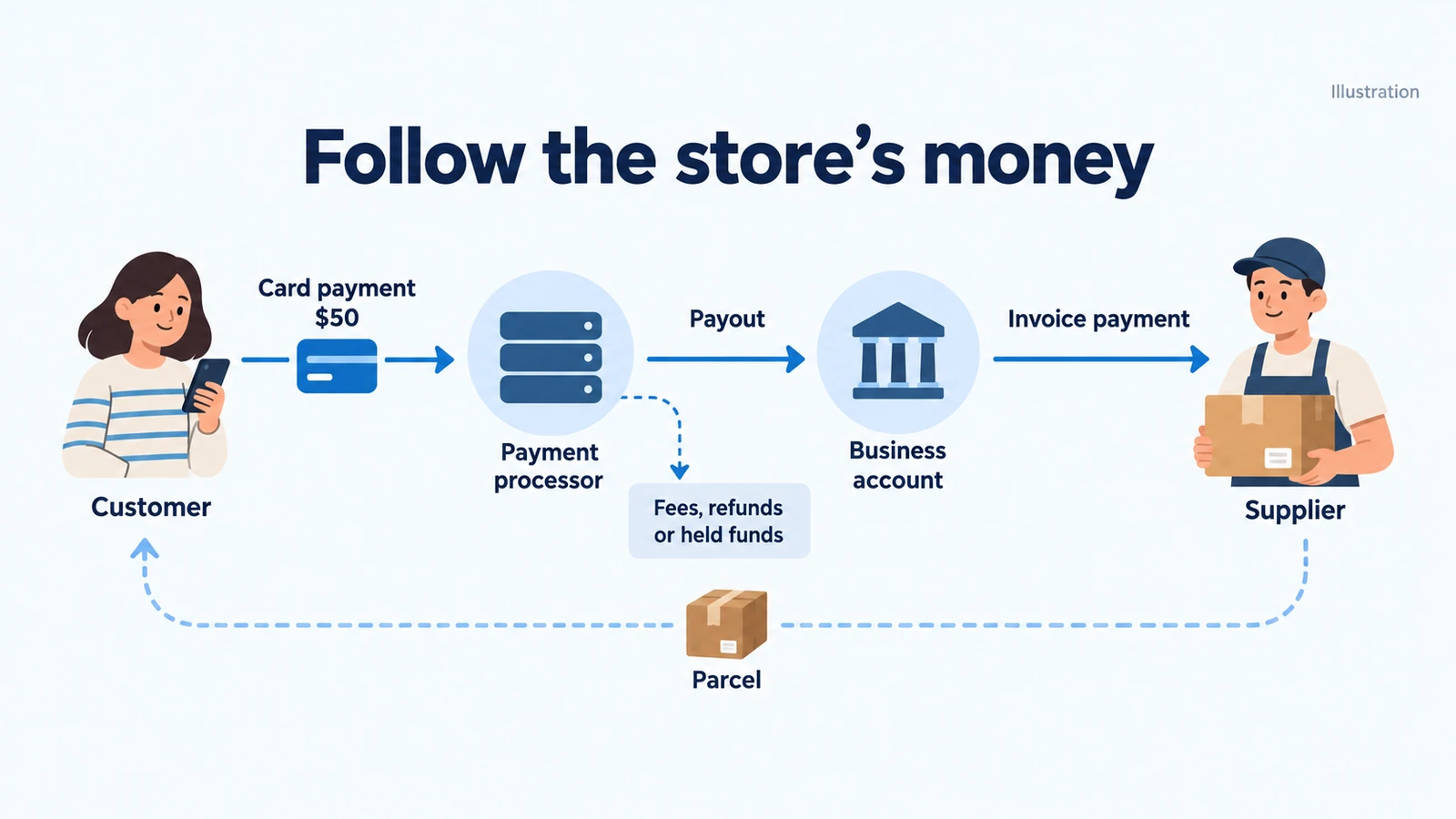
Imagine a customer pays $50 by card. A payment processor handles that card payment. It may deduct fees, issue refunds or hold some funds before sending a payout. Your business account receives the payout, which may combine several orders. You then pay product and shipping invoices, advertising and other bills.
A checking or current account receives and spends the store’s money. A processor handles customer checkout; a cross-border payment service may convert currency or send a supplier transfer. The SBA’s business account guidance describes ordinary checking and merchant-service roles. Even if one provider offers several features, confirm each one for your actual business and currency.
02
Fill in the account requirements before applying
Start with five answers. They keep you from opening an attractive account that cannot receive your store payouts or pay the next supplier invoice.
- Legal holder, entity type and registration country: The application and account name must match the real person or company
- Actual operating address and each owner’s residence/identity: Providers verify both the business and people who control it
- Checkout provider and country of the merchant account: That provider sets the payout-account rules
- Payout currency and transfer method: A dollar balance or receiving detail may not be compatible with the required bank rail
- Supplier’s legal recipient, invoice currency and accepted payment route: The supplier must receive the correct amount on time
Check both currency jobs
For example, a store paid in US dollars and invoiced by a supplier in Chinese yuan needs both a supported payout destination and a priced yuan transfer to the supplier’s legal recipient. One generic “international account” label answers neither question. A local business bank may be the simpler starting point if it meets both jobs; forming a US LLC just because an online list favors US accounts is a separate decision. The LLC guide covers that structure.
Write the provider’s actual eligibility and payout conditions beside these five fields. When a rule depends on where owners live or where the store operates, the registration country alone cannot decide it.
03
Prepare a truthful application folder
A company application commonly needs formation records, its tax identifier, the real operating address, people who own or control it and their identity documents. A sole proprietor may instead need the owner’s tax number, trading-name record and any applicable license. Check the specific provider and entity type before uploading files.
An application is not an issued EIN record
For a US company, Mercury’s document guide asks for state-filed formation records, an IRS-issued EIN document and identification for owners holding at least 25%, plus an operating-control person. A filled-out SS-4 application is not an IRS-issued confirmation. A beneficial owner is the actual person behind ownership, including ownership through another company.
An EIN is a US federal tax identifier, issued by the IRS without a fee. The IRS online route has domestic principal-place and responsible-party identification conditions; a business with its principal place abroad uses the applicable phone, fax or mail route. Form the entity first where that route requires it. An EIN is not bank or processor approval.
Then complete the provider’s application in this order:
- Enter the real legal holder, business activity, actual operating and owner addresses, expected payments and source of funds.
- Identify everyone the provider requires as an owner or controller, including people it asks to verify separately.
- Upload readable formation, tax, identity and address records through the provider’s secure process.
- Explain what the store sells, where it operates, where suppliers ship, who buys and how initial orders are funded. Give real store/product and supplier records if requested.
- Respond to review questions; if the provider cannot support the real arrangement, return to a provider that can.
Use the real place of operation
Do not substitute a registered-agent or forwarding address for the place you actually operate or invent a US operation to pass a form. The account may later be unable to process the very payouts you opened it to receive.
04
Compare provider options only after those five answers
These named routes were checked against provider documentation, not opened or tested by us. Eligibility, approval and payout compatibility remain separate.
| Example option | Situation worth checking | First condition to verify |
|---|---|---|
| Mercury | US-registered company, including some with nonresident founders | Real US or international principal address, existing/planned US operations, each owner’s residence and full review |
| Relay | US-registered operating business | Actual address and owner-document rules; its passport/SSN instructions conflict |
| Wise Business | Supported business needing available currency receipts or overseas payments | Registration and physical trading country, entity and the exact feature sought |
| Starling company account | Qualifying UK limited company or LLP | UK-resident controlling people and directors/partners with access |
| Shopify Balance | Qualifying Shopify merchant in the US/Puerto Rico | Residence, business address, identity, active Shopify Payments and USD/US transfer scope |
On a phone, swipe the table sideways to compare every column.
The table is a shortlist. These conditions decide whether one of its options works for you:
Mercury’s eligibility, Relay’s two identity guides and Shopify’s US bank requirements were rechecked October 11, 2026. Relay’s SSN/passport instructions still conflict. The other provider examples retain their original qualified scope; no account or transfer was tested.
- Mercury — address and operations: Mercury’s eligibility page allows some nonresident founders of eligible US companies to apply, but asks for actual or planned US operations and a real principal address, not a registered agent, PO box or UPS Store. It collects owners with at least 25% ownership; country restrictions depend on residence. Applying does not guarantee approval.
- Relay — check contradictory documents: its entity guide says an owner can provide an SSN or passport number, while its opening guide says each needs an SSN. Ask Relay about your actual owners before relying on this route. Its country restrictions consider citizenship or residence, unlike Mercury’s residence list.
- Wise, Starling and Balance — feature fit: Wise separates registered and physical trading addresses; its guidance rejects a virtual office or mail-forwarding service as the trading address. Starling has UK company and resident-controller conditions; Shopify Balance has US/PR merchant conditions. Neither Starling nor Balance is a universal shortcut for a foreign founder or a yuan supplier invoice.
- Protection of funds: Mercury provides banking through named partner banks; it is not itself an FDIC-insured bank. Wise Payments Ltd’s UK safeguarding concerns e-money, not an FSCS bank deposit. Check the specific provider entity and product before treating either as a bank deposit.
05
Test supplier payment and processor payout separately
An account that pays your supplier may not be eligible to receive your store’s checkout payouts.
To pay the supplier:
- Compare the total you fund for the same amount received. If a supplier must receive $250, an invented route costing you $255 beats one costing $258 by $3, provided timing and other needs match. For a yuan invoice, compare dollars spent for the same yuan receipt, including conversion and transfer charges. These are example quotes, not provider prices.
- Confirm the recipient’s legal name and payment details against the invoice through a trusted channel. A Wise business transfer must be funded from a business account with the same registered business name. A personal sender profile is no shortcut for a company invoice.
To receive checkout payouts:
- Check the account type before applying. Shopify Payments in the US requires a full US checking account in USD that accepts ACH transfers. Wire-only and savings accounts and some transfer services do not qualify. A Wise currency detail or US LLC alone does not establish eligibility.
- Once the merchant is verified, go to Settings → Payments and follow Shopify’s bank-connection steps. The manual US route asks for the account owner’s name, routing and account numbers, plus bank debit authorization. The routing number identifies the bank, not your individual account.
- Trace the first real payout from processor record to bank entry: reference, date, amount, deductions and any held funds. If it fails, check the platform’s reason, holder name, currency, account type and transfer details before trying again. We have not opened these accounts or tested a payout.
06
Explain a payout with ten ordinary orders
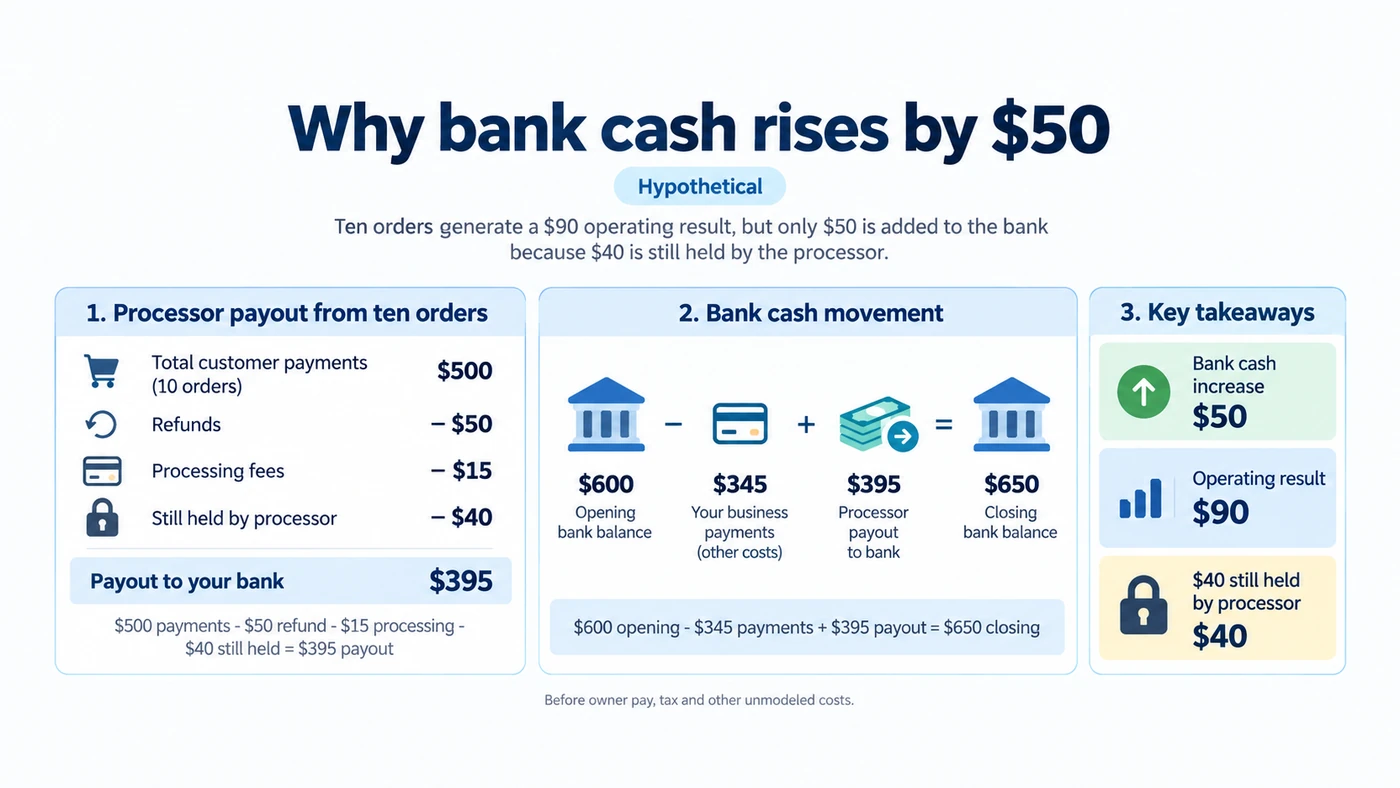
Suppose ten customers each pay $50, for $500 collected. One order is fully refunded after fulfillment. Assume the processor retains $15 in fees and temporarily holds $40 as a reserve. Every number here is hypothetical.
- Ten customer payments: $500
- One customer refund: −$50
- Processing fees, assumed not returned: −$15
- Funds still held by processor: −$40
- Bank deposit: $395
The $395 deposit is not $500 of new sales or the store’s profit. After the refund, sales are $450.
Suppose the product, packing and shipping for all ten orders, including the refunded one, cost $250. Add a $5 supplier-transfer fee, $80 advertising and an illustrative $10 account charge.
Separate profit from the deposit
That leaves $90 before owner pay, tax or omitted bills: $450 − $250 − $15 − $5 − $80 − $10. No supplier reimbursement is assumed. The unit-economics guide covers a fuller cost view.
Can the store pay before the payout?
Now follow the bank cash. Starting with $600, paying the supplier and transfer fee takes $255. Advertising and the monthly charge take another $90. The bank has $255 before the payout arrives, so those orders can be funded under the assumptions.
The missing $40 is still held
When the $395 payout arrives, the bank balance becomes $650: an increase of $50 from the opening $600. The operating result was $90; the other $40 is still held by the processor. If that $40 is later released, it increases available bank cash without creating another $40 sale.
Match the $395 entry to the ten order IDs, refund, fees and reserve. The held $40 is not an expense, and the same customer payment must not be recorded again when the deposit arrives. This is why a workable account needs usable transaction exports, not just a balance screenshot.
Reconcile the payout before calling it missing profit
Use three records for the ten-order example. All amounts here are teaching figures, not an actual account statement. Replace the labels with the references from your processor, bank and supplier.
Processor statement → expected payout
Ten order receipts total $500. Link the $50 fulfilled-order refund, $15 retained fees and $40 held reserve to the actual statement period. Expected payout: $395. Save the processor’s real payout reference and the order IDs behind it.
Bank entry → received money
Find the actual $395 deposit and match its reference and receipt date. In this example, opening cash $600 less $255 supplier/transfer and $90 advertising/account charge leaves $255; the deposit brings it to $650. A pending payout is not yet that bank entry.
Invoices → operating result
Keep the supplier invoice for all ten orders, including the refunded item: $250, plus the separate $5 transfer fee. With $80 ads, $10 account charge and $15 processing fees, $450 net sales leave $90 before omitted costs and tax. The remaining $40 is still held, which explains the smaller $50 bank increase.
If your actual deposit differs, first look for another refund, fee, currency conversion or reserve adjustment in the matching statement. Record a later reserve release as released proceeds, not a second sale. Until the references and amounts match, mark the difference unresolved rather than guessing at a new expense.
07
Keep the payment trail usable
For each payout, save the processor reference and its order IDs, refunds, fees and held balance. For each supplier payment, keep the invoice, legal recipient, currency, funded amount, transfer fee and confirmation. Download bank and processor statements so the figures can be matched again when the store has more orders. The dropshipping accounting guide covers the wider period-end records.
Your own transfer into the business account funds the store; it is not customer revenue. A transfer between your own business accounts is not a second sale either. Keep owner funding, customer receipts and supplier expense categories distinct.
Secure the account and actual payee details
Update the provider when the business’s entity, address or ownership changes. Use two-step authentication, limit helper access and independently confirm changed supplier payment details. A second account is a fallback only after its provider and payment platform actually approve and connect it; writing another brand on a list is not a working backup.
The first useful outcome is concrete: one qualified account, a real application folder, a supported payout connection, a full supplier-payment quote and a first deposit you can explain. If China-side product and shipping quotes are the missing input, AIDrop’s product-sourcing service can review the physical-product and operating questions. Send the item or supplier link, destination and the exact quote or packing question through contact. That inquiry does not open or approve a bank account.
Questions before choosing the account
Can a non-US owner apply for a US business account?
Some providers accept certain US entities with nonresident owners, subject to real operations, address, identity and country conditions. Check the particular provider. A US registration or EIN does not guarantee a bank account or payment-processor approval.
Does opening the account let my store accept cards?
No. The payment provider must separately support and approve the business. Its payout requirements must also match the account’s holder, country, currency and rail. Confirm both before depending on the account for store receipts.
Is a held processor reserve a business expense?
The held amount in the example is proceeds not yet available, not a new expense. Keep it in the reconciliation and match its later release. Actual fees, refunds or deductions change the calculation separately; a balance screenshot cannot identify them.
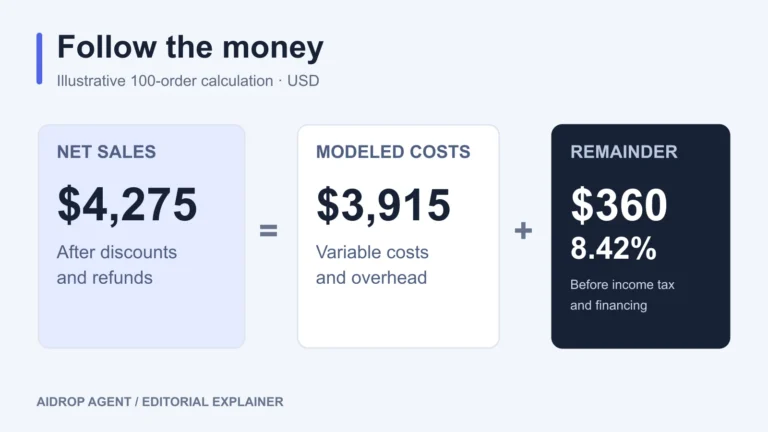
Dropshipping Profit Margin: Calculate What You Keep
Calculate dropshipping gross, contribution, and net margins. See how discounts, refunds, and ad costs change profit in

How to Price Dropshipping Products From Landed Cost and Risk
Calculate a retail price from the delivered cost of one variant, selling fees and required contribution, then
Dropshipping Cash Flow: Supplier Payments, Payouts and Refund Buffers
Plan dropshipping cash flow by date. Separate pending payments from usable cash, fund supplier bills, and test
