
You can often run an Indian dropshipping store as a sole proprietor. You still need the applicable business identity, GST registration and customer protections. The supplier shipping the parcel does not remove your responsibility for the sale.
Check the sales route first
GST depends on your state, turnover, goods and sales route. The conditional ₹40 lakh goods exemption does not let every small shop sell taxable goods across states without registering.
This guide covers an India-based seller serving Indian customers. A fictional organizer shop shows the registration steps, two invoices and first-order funding. Still choosing a market? Use the country selection guide.
01
When do you need GST registration?
Start with three facts: the state where your business is based, your annual aggregate turnover and where your customers receive goods. Aggregate turnover combines the relevant supplies across businesses under the same PAN throughout India; GST and compensation cess themselves are excluded. It is not the profit left after supplier bills. One lakh is ₹100,000.
| Your sales situation | What it means for registration |
|---|---|
| You sell goods only within your state through your own store | Apply that state’s turnover rules and other compulsory-registration conditions. The general threshold is ₹20 lakh, with ₹10 lakh in specified special-category states. Eligible businesses supplying only goods may use the conditional ₹40 lakh exemption. |
| You make ordinary taxable interstate sales of goods | Section 24 generally requires registration even below the turnover threshold, unless a notified exception applies to your actual supplies. |
| You sell goods through an e-commerce operator required to collect tax | Do not assume every marketplace seller must register, or that every small seller is exempt. The narrow unregistered-seller arrangement below may apply. |
| You have already registered voluntarily | Registration brings invoicing, returns and other GST duties; being below a threshold does not make those duties disappear. |
On a phone, swipe the table sideways to compare every column.
The CGST registration provisions and Notification 10/2019 explain these branches. The ₹40 lakh goods exemption excludes compulsory-registration cases and specified goods.
These states need a different threshold check
The ₹40 lakh exemption also excludes Arunachal Pradesh, Manipur, Meghalaya, Mizoram, Nagaland, Puducherry, Sikkim, Telangana, Tripura and Uttarakhand.
For goods businesses in those places, the turnover threshold is ₹10 lakh in Manipur, Mizoram, Nagaland and Tripura; it is ₹20 lakh in Arunachal Pradesh, Meghalaya, Puducherry, Sikkim, Telangana and Uttarakhand. The government-hosted registration handbook sets out this split. Compulsory-registration and other relevant conditions still apply.
The small marketplace-seller exception
Notification 34/2023 permits a limited arrangement for eligible goods sellers using these operators. The seller must meet all the conditions, including:
- Turnover in both the previous and current financial year stays within the applicable registration limit.
- The seller has a PAN and obtains the required portal enrolment number before supplying through the operator.
- Sales through the arrangement remain within one state or union territory, with no interstate supplies.
Notification 37/2023 sets the operator’s procedure. This exception does not authorise an unregistered own-store seller to ship taxable goods throughout India.
For our hypothetical Maharashtra shop, selling an organizer to a Karnataka customer is an interstate retail sale. A small starting turnover alone does not settle the registration question. Choose the applicable branch before taking that order. Regular GST and the composition scheme also have different eligibility and trading restrictions; composition is not a shortcut for every online seller.
02
Register the business that actually sells
GST registration identifies a taxpayer; it does not incorporate a company or approve every product. A sole proprietor uses the individual’s legal identity and PAN. A company uses its own legal identity. The bank account and payment application must match the business that receives customers’ money.
Here is a fictional application example, not a filed registration:
- Legal name: Priya Sharma, matching her PAN
- Trade name: DeskRoom, the shop name customers see
- Constitution: Proprietorship
- State and principal place of business: Maharashtra and her actual business premises, supported by the relevant ownership, lease or consent documents
- Contact and authorised signatory: The real applicant’s email/mobile and applicable signatory details
- Business dates and reason for registration: Actual commencement/liability dates and the applicable reason
- Goods: The goods sold and their correct HSN classification, not a guessed rate copied from another shop
Her supplier’s Gujarat warehouse is not automatically her principal place of business. Additional business premises belong in the application when the facts require them.
From application to GSTIN
An ordinary taxpayer liable under section 22 or 24 must apply within 30 days of becoming liable, under section 25(1). Special cases differ: a casual or non-resident taxable person applies at least five days before starting business, and an SEZ unit/developer needs the prescribed separate registration. Use the applicable dates rather than waiting for the first payout.
Follow the GST portal’s registration instructions:
- Open Services → Registration → New Registration. In Part A, enter the state, PAN-based legal name and required contact details; complete the OTP steps.
- Use the TRN, or Temporary Reference Number, to open the application and complete Part B: business, people/signatory, premises, goods and required state-specific information and documents.
- Complete the applicable verification and authentication. Aadhaar or biometric/document verification, where required, can affect when the application is considered complete and an ARN is generated.
- Use the ARN, or Application Reference Number, to follow the application’s status and respond to any request for clarification.
- Once approved, obtain the GSTIN, the taxpayer identification number, and registration certificate. Use the actual effective date when setting up invoices and returns.
A TRN saves an application; an ARN tracks it. Neither is permission to announce that GST registration has been approved.
Set the filing calendar after approval
An issued GSTIN starts ongoing work. For a regular taxpayer, Form GSTR-1 reports outward supplies; Form GSTR-3B summarizes the relevant liability and tax payment. Keep a filing calendar for the frequency actually assigned or chosen in your account.
Sales and purchase records
Keep the store’s retail invoices, supplier invoices and applicable adjustments separately. Match eligible purchase credits to the required records; possession of an invoice alone does not grant every credit.
Quarterly is not no monthly work
The official QRMP FAQ describes eligible taxpayers up to ₹5 crore aggregate PAN-level turnover opting for quarterly GSTR-1 and GSTR-3B, with monthly tax-payment arrangements. Check the eligibility, selected profile and actual due dates instead of copying another store’s calendar.
Give the responsible person the return period, invoices, purchase-credit records and payment deadline. A month without customer orders does not automatically end registration duties; check which return and, where appropriate, nil-return conditions apply. The portal provides separate GSTR-1 and nil GSTR-3B instructions.
GST does not settle every registration
Local premises and activity rules, product requirements and applicable resident nodal-contact duties need their own checks. The qualified 2021 consumer-rule amendment does not require every small dropshipper to form a private limited company.
03
One parcel can have two sales
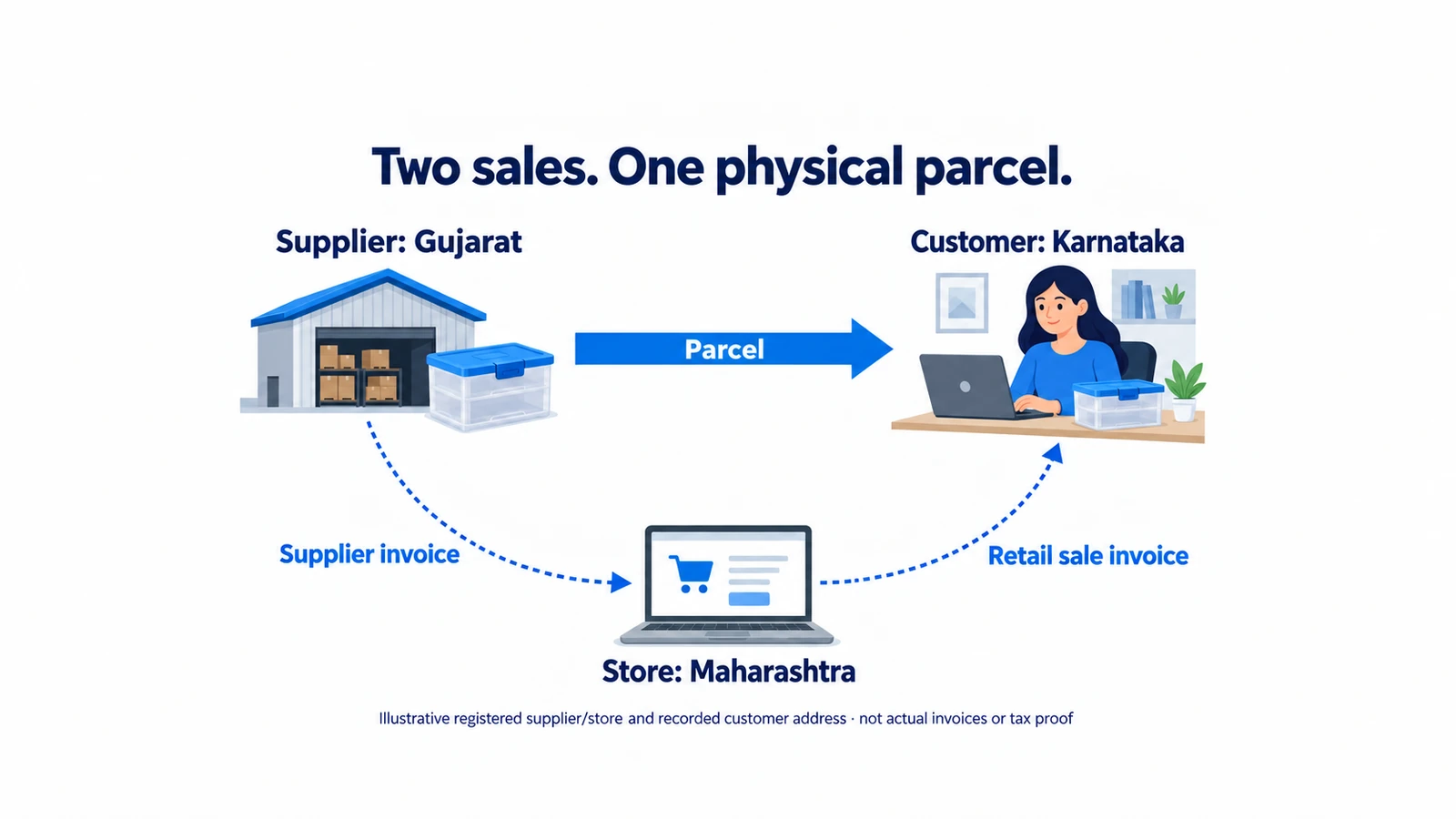
Direct shipping can involve two sales even though the parcel travels only once. Your supplier sells to your store; your store sells to the customer. Each sale needs its own invoice and tax treatment.
In this hypothetical registered-supplier/store example, a registered Gujarat supplier bills a registered Maharashtra store. At the store’s instruction, it ships to an unregistered Karnataka customer whose address is recorded on the retail invoice.
| Transaction | Invoice and place-of-supply result in this example |
|---|---|
| Gujarat supplier → Maharashtra store | The supplier invoice names the store. Under the bill-to/ship-to rule in IGST section 10(1)(b), the directing third person’s principal place of business determines the place of supply. Gujarat → Maharashtra is interstate. |
| Maharashtra store → Karnataka customer | The store issues its own retail invoice. For this unregistered customer, section 10(1)(ca) uses the address recorded on the invoice. Maharashtra → Karnataka is interstate. |
| Physical parcel | It travels Gujarat → Karnataka. That journey does not merge the two sales or make the supplier’s wholesale price the store’s taxable retail price. |
On a phone, swipe the table sideways to compare every column.
These results rely on the stated parties and addresses; other facts can produce another result. The IGST provisions explain the place rules. Give the supplier your correct billing details and the separate delivery address, then prepare the customer invoice from your own sale.
A supplier tax invoice does not automatically establish an input-tax credit. Credit means eligible GST paid on business purchases can offset GST due on sales. Section 16 has conditions, including the required invoice, receipt and communicated tax details, along with its other requirements. Direct delivery to another person at your instruction can satisfy the deemed-receipt provision; it does not waive the rest.
04
Make the product page and supplier order agree
For an organizer, the useful starting information is concrete: outside dimensions, drawer size, material, colour and everything included in the box. Obtain permission for the photographs. A sample can reveal a sticky drawer or a missing divider; it does not prove that every later batch meets every applicable standard.
Send the supplier a request like this, adapted to your actual product:
Please quote one [exact organizer model/colour] delivered to PIN [code]. Include the product price and GST, dispatch location, preparation time, delivery charge, courier, invoice in our business details and return address. Who pays for a wrong item, missing part, damaged parcel or refused COD delivery?
The answers become the product page and ordering instructions. “Stock in India” tells you where goods are held, not where they were made. BIS’s compulsory-certification list applies to specified products and orders; it is not a certificate required for every organizer. Where your category is covered, obtain information for the actual model and applicable requirement before listing it.
Product origin is not warehouse location
Packaged goods also have applicable package and online declarations. The Legal Metrology amendment effective July 1, 2026 requires the country-of-origin filter for imported-product listings, making them searchable and sortable by origin. A warehouse address is not a substitute for the product’s origin or applicable manufacturer/importer information.
Buying from an Indian wholesaler and importing goods yourself are different jobs. If you import, the IEC, customs, importer and relevant product requirements need their own arrangement. A domestic supplier saying “we handle shipping” does not explain who takes those responsibilities.
If you choose China-side sourcing, AIDrop can discuss the physical shipping arrangement, packing and handoff information for that route. Send the product link, quantity and destination PIN through contact. GST registration, importer responsibilities and legal decisions remain with your business and the relevant professionals or authorities.
05
Set up payment and fund the order
India is not on Shopify Payments’ supported-country list. Choose a provider supported for your actual Indian business and platform. Razorpay’s setup instructions distinguish test use from live activation, which requires the relevant business and bank verification. An installed app does not mean live card or UPI payments are approved.
Use the provider’s supported test method to try a successful payment and a decline. A declined payment must not send a purchase to your supplier. Before accepting real money, complete live activation and understand the platform/provider charges, payout timing and refund treatment.
What a ₹1,180 sale leaves
This is a hypothetical registered-store calculation using an illustrative 18% GST rate. It does not establish the organizer’s actual HSN rate. The ₹1,180 customer price contains ₹180 GST, leaving ₹1,000 net sale revenue.
| Item | Illustrative amount |
|---|---|
| Revenue excluding GST | ₹1,000 |
| Product | −₹450 |
| Delivery | −₹90 |
| Payment fee | −₹24 |
| Advertising | −₹180 |
| Allowance for order problems | −₹60 |
| Remaining before overhead and income tax | ₹196 |
On a phone, swipe the table sideways to compare every column.
These costs are net of eligible GST credits where applicable. Tax that cannot be credited becomes a cost. Use the real product rate and actual supplier/provider bills in your own calculation.
Money left on paper is different from money available today. The supplier may want the ₹540 product-and-delivery payment before your bank payout. GST on its invoice can add to that immediate cash requirement even if a credit is available later. Advertising, refunds and replacements need funding too.
COD collection comes later
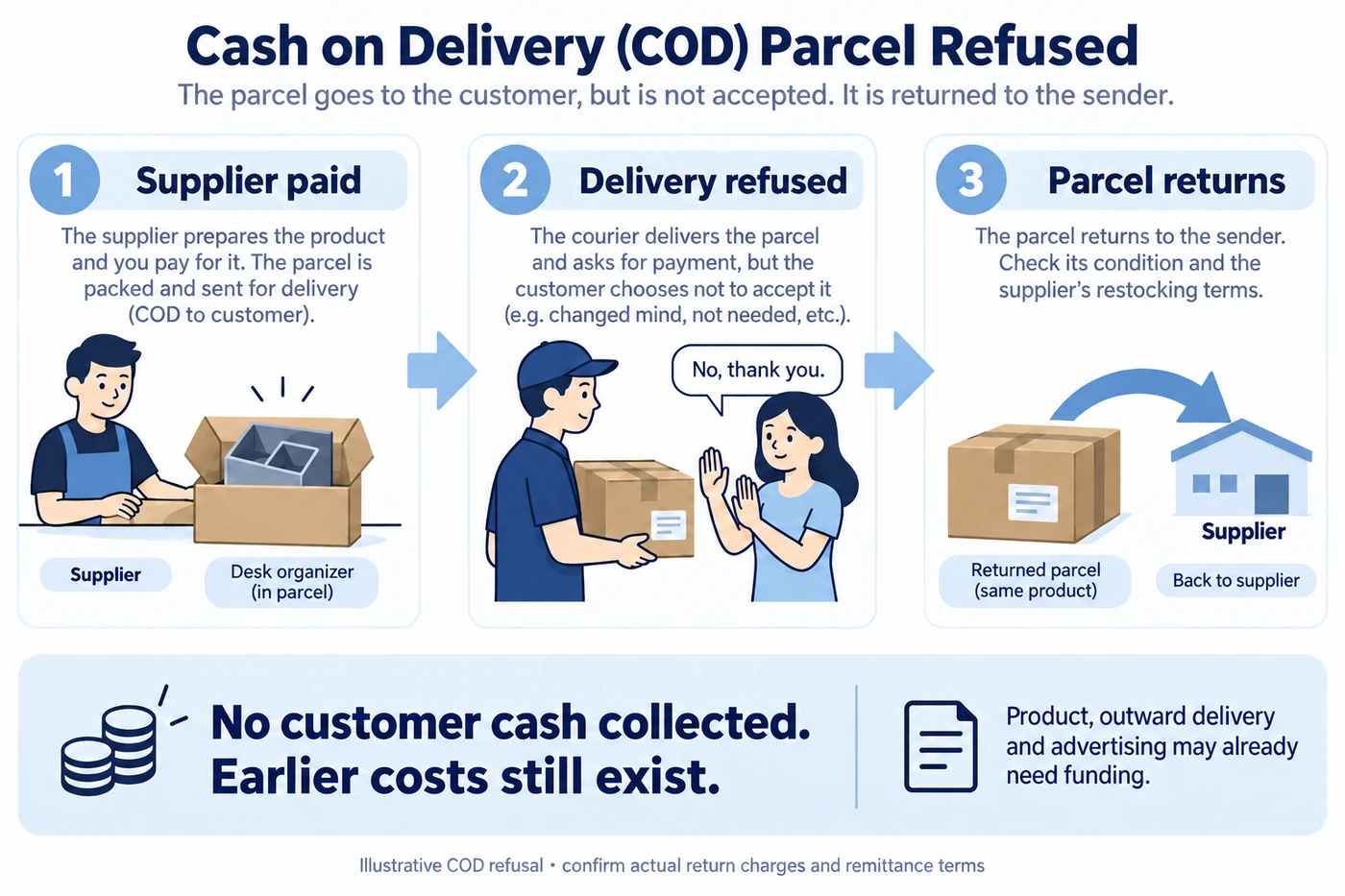
Cash on delivery (COD) moves payment collection to delivery. You can still owe the supplier before the customer pays. If the buyer refuses the parcel, no customer cash is collected, while product, advertising and applicable delivery/return charges may already have been incurred.
Shiprocket’s FAQ illustrates why the actual PIN-code service, COD collection fee, remittance timing and return charge matter. Put those terms in your price calculation before offering COD. A supplier-specific fee waiver does not recover all your product or advertising costs.
Failed delivery and return are different stages
A non-delivery report (NDR) means a delivery attempt failed. Contact the customer about the address or availability and request the permitted next attempt; Qikink’s NDR process is one provider’s workflow, not every courier’s rule.
Agree what happens to the returned parcel
A return to origin (RTO) means the parcel goes back to the sender. Agree who receives it, assesses its condition and charges for the return. Do not assume every returned product can be resold, or that a return automatically generates a supplier refund.
06
Give customers a usable remedy
Customers should be able to identify the seller, understand the offer and reach someone when a parcel goes wrong. Under the applicable Consumer Protection (E-Commerce) Rules, the store needs relevant disclosures such as:
- Seller identity, address, contact information and grievance contact.
- Accurate product information, applicable origin/manufacturer/importer details and warranty information.
- Total price and charge breakdown, payment methods and realistic delivery terms.
- Return, refund and exchange terms, including who pays return shipping in the relevant situation.
The rules require acknowledgement of consumer grievances within 48 hours and redress within one month. The 2021 amendment also sets the qualified resident nodal-contact requirement for the specified entities. These contacts are practical routes for a buyer to get an answer, not decorative footer labels.
For a wrong organizer colour or missing divider, first establish what the customer received and arrange the appropriate return, replacement or refund. You can request useful photos or order details without making the buyer negotiate with your wholesaler. Your customer obligation and your supplier reimbursement are separate.
The rules address goods that are defective, deficient, misdescribed or delivered late against the stated schedule, with the specified force-majeure exception for late delivery. They do not create an unlimited change-of-mind return for every product. Write any additional voluntary return policy clearly, and process accepted refunds within the applicable reasonable period.
A useful customer message is specific:
We sent the wrong colour for order [number]. We can arrange the matching replacement or the applicable refund. Please send a photo of the item and package so we can organise the return or correction. You do not need to contact our supplier.
For a delayed parcel, tell the buyer what happened and give the available next step. “The courier is responsible” does not resolve the store’s sale.
07
Run one complete order before adding traffic
For the hypothetical shop, a first order should connect all the pieces above:
- Use the supported payment test to select the exact organizer, enter a serviceable PIN code and confirm the displayed total. Try a decline as well; it should not reach the supplier.
- After required registrations and live payment activation, accept a permitted real order with the correct payment status, variant, quantity and customer address. Turn off test mode before live sales.
- Issue the store’s appropriate retail invoice. Send the supplier the separate billing and shipping details once, and obtain its invoice and order acceptance.
- Follow the carrier’s acceptance and tracking, then address a failed delivery or customer problem through the agreed process. A label alone is not proof that the parcel has been collected.
- Match the customer receipt, supplier bill, courier charges, bank payout and any refund. Use what actually happened to revise the price, delivery promise or available PIN codes.
You now have more than a published product page: an applicable registration decision, a matching application or approved registration, two correctly separated sales and enough cash to fulfil the order. The broader dropshipping launch guide covers the platform and marketing work around that foundation.
Questions before opening an Indian store
Does turnover below ₹40 lakh mean I can ship anywhere without GST?
No. That exemption has goods, state and compulsory-registration conditions. Ordinary taxable interstate goods sales generally trigger registration even below the threshold, unless the actual supply falls within a notified exception. Use the sales-route table before accepting an out-of-state order.
Must I form a private limited company?
Not for every store. A sole proprietor can often trade using the individual’s real legal identity and PAN. GST, local premises/activity rules, product requirements and account verification remain separate tasks. The qualified resident nodal-contact rule is not a blanket company-formation requirement.
Can I send the customer only my supplier’s invoice?
The example has two sales. The supplier bills your business for its purchase, while your store prepares the appropriate retail invoice for its sale to the buyer. The single parcel does not merge those prices, parties or tax treatments.
Can I ignore GST filing in a month with no orders?
Do not assume so. Confirm the duties of the active registration, the actual filing profile and whether the conditions for the relevant nil return are met. No customer orders alone does not prove that every purchase, credit, adjustment or tax line is nil.
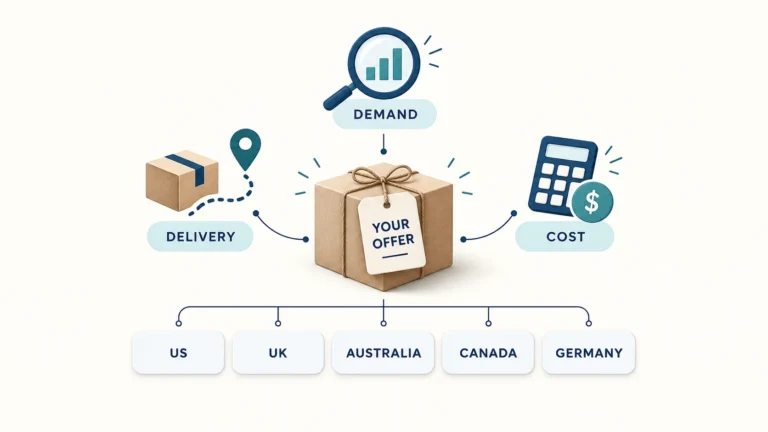
How to Choose Countries for Dropshipping: Demand, Delivery and Operating Constraints
Compare the US, UK, Australia, Canada and Germany by demand, delivery, current import rules, payment access and
What Is Dropshipping? How to Build and Run the Business
Learn how dropshipping works, earns money and handles risk, from product research and supplier checks to shipping,
How to Start a Dropshipping Business: From Offer to First Delivery
Start a dropshipping business with a clear offer, verified supplier, workable pricing, tested checkout, and a plan
