
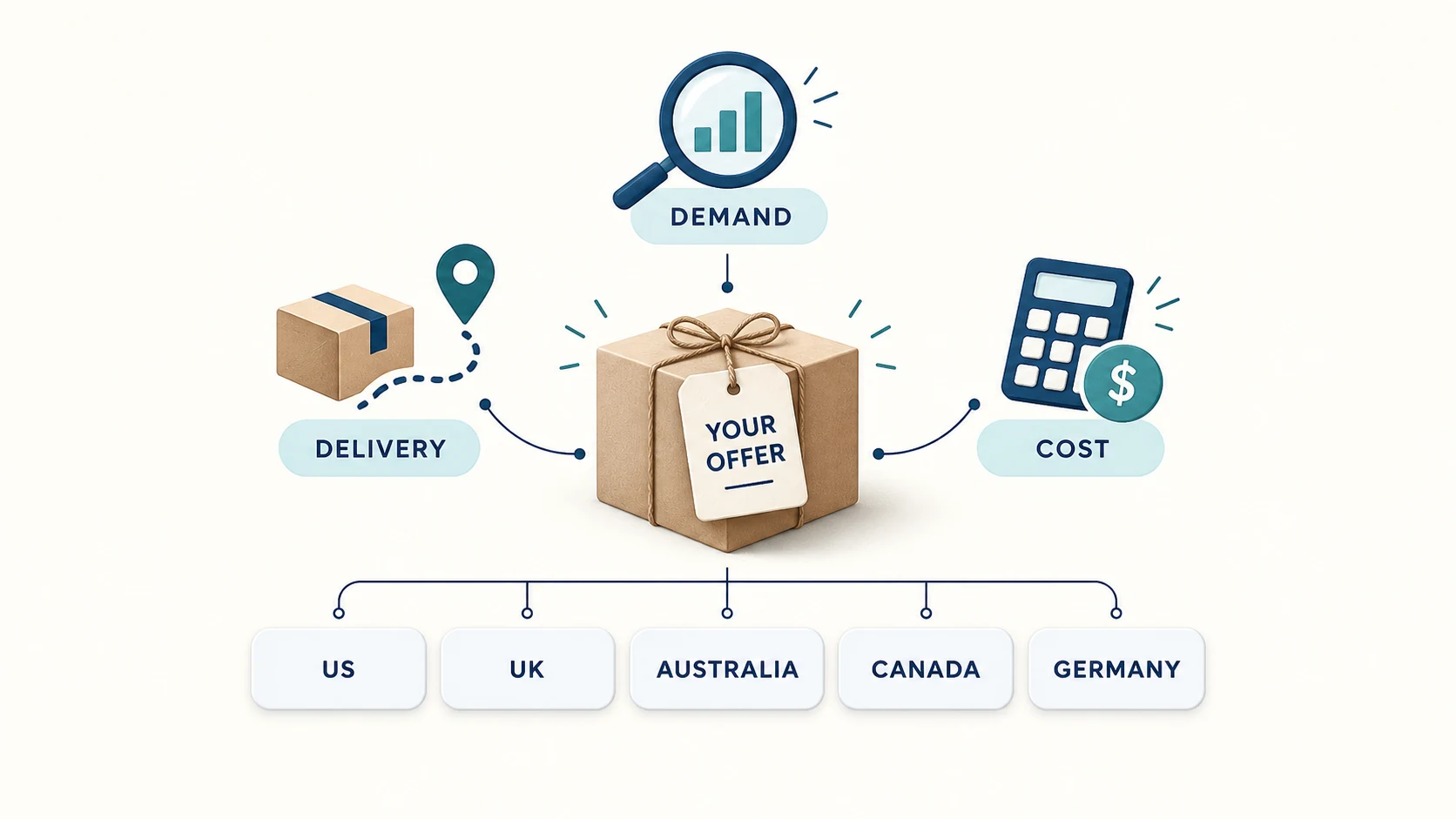
The best country for dropshipping is the customer market where your specific offer can attract demand, arrive as promised and leave enough money after delivery, selling and service costs. The United States, United Kingdom, Australia, Canada and Germany are useful candidates to compare, but none is a universal winner, and an English-language market is not automatically easy to operate in.
Choose the destination using a product-level comparison. A lightweight, non-fragile item with a credible local offer faces different constraints from a bulky product, a regulated item or a bundle that frequently needs returns. Country popularity does not settle those differences.
The market and policy discussion below was checked on September 11, 2026. It is a practical shortlist, not a data-backed league table. Import treatment changes: obtain a current route-specific quote and verify obligations before switching on sales.
01
Choose a customer destination, not just a country name
Separate four locations: where your business is established, where the product originates, where it is stocked and where the customer receives it. They affect different parts of the decision.
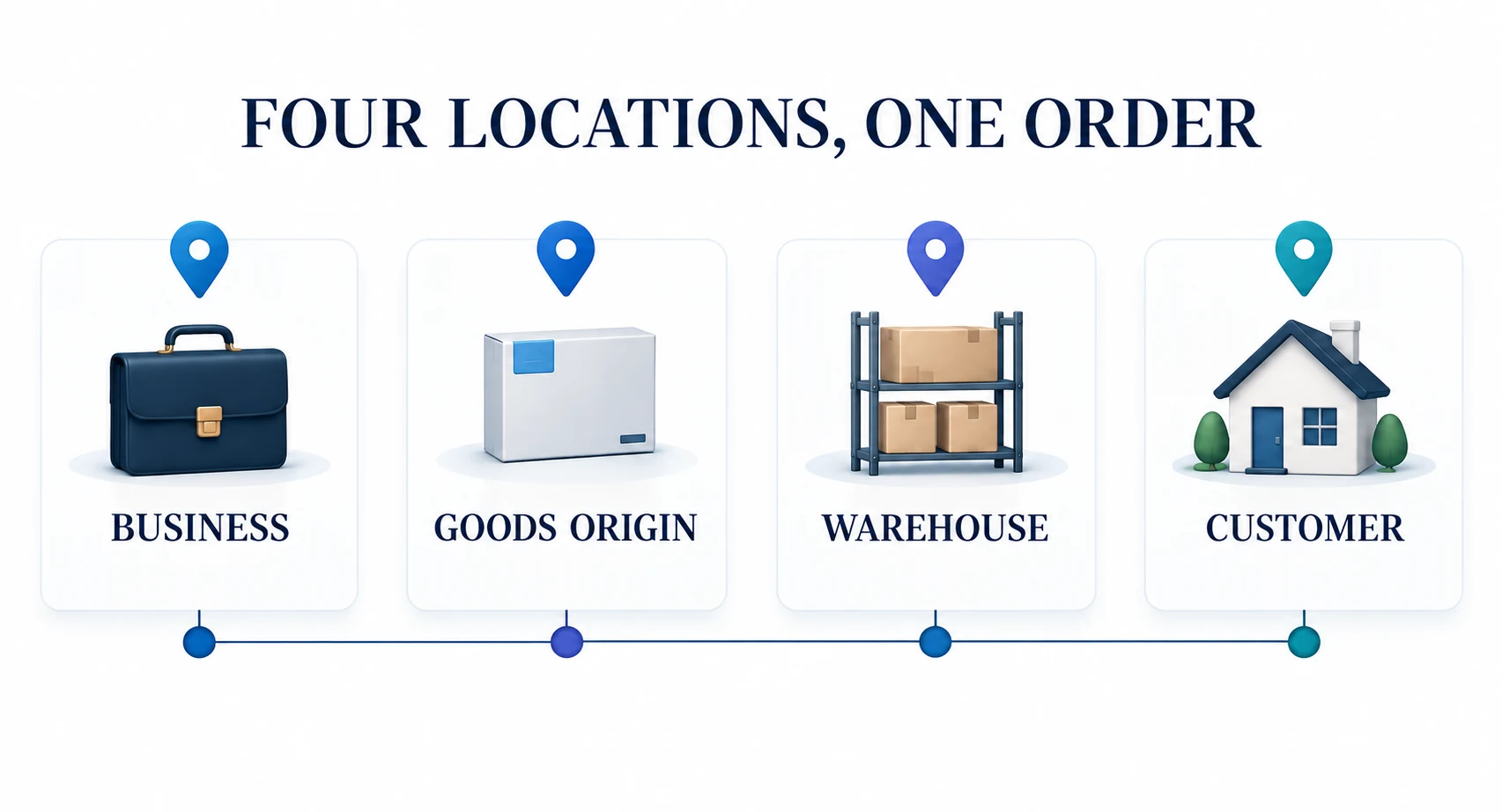
For example, an India-based merchant could sell a China-origin product from a U.K. warehouse to a U.K. customer. That arrangement differs from sending each order directly from China, even though the customer market is the same. Payment onboarding, import responsibility and delivery planning cannot be inferred from the destination alone.
Define the proposed arrangement in one sentence before comparing countries. Include the product, customer, warehouse, shipping service and intended return destination. If one of those is unknown, label it as unresolved instead of filling the gap with a country average.
02
United States: evaluate the offer with current import costs
The United States is a reasonable candidate for an English-language offer when the seller has an eligible payment arrangement, a serviceable delivery route and a product that can compete against what customers already buy. It should not be the default merely because an old guide describes low-value parcels as duty-free.
The decision-changing constraint
CBP’s mail duty-waiver guidance states that duty-free de minimis treatment for low-value shipments from all countries was suspended effective August 29, 2025. Do not build today’s economics around the former assumption that an order below $800 automatically enters duty-free.
Request the current treatment for the actual goods, origin and shipping mode, including who declares and pays the applicable charges. A supplier’s old “tax-free line” label is not a sufficient quote. Do not replace it with an invented universal tariff percentage either.
When to shortlist it
Shortlist the U.S. when you can demonstrate product-level interest, obtain a complete delivered-cost estimate and support the destinations you intend to advertise to. Compare a direct route with local stock where both are available. Local stock may improve one part of delivery while introducing an inventory commitment.
Test the actual address coverage. A quoted service to one metropolitan address does not prove the same price or timing for every state, territory or remote location. Restrict checkout and advertising to the verified service area while resolving exclusions.
03
United Kingdom: define the VAT and delivery arrangement
The U.K. is a useful candidate for an English-language store with an appropriate payment setup and a clear customer proposition. A seller still needs to identify how the order is taxed, which destinations are served and how a customer can return an item.
The decision-changing constraint
HMRC’s guidance for overseas goods sold directly to U.K. customers distinguishes treatment by consignment value and selling arrangement. For relevant direct sales to customers in Great Britain of goods outside the U.K. in consignments not exceeding £135, VAT generally needs to be accounted for at the point of sale. Northern Ireland, marketplace sales and other circumstances can have different treatment.
Check the consignment rather than the price of one item in isolation. A multi-item basket can change the relevant calculation. Do not use the same checkout assumption for direct sales, marketplace sales and goods already stocked locally without verifying the rules.
When to shortlist it
Shortlist the U.K. when the operator can price the offer with the appropriate tax treatment and has a workable delivery and return route. Confirm whether the shipping quote covers the intended U.K. destinations and whether Northern Ireland requires a different treatment for your arrangement.
Review competitors’ complete customer offers: delivered price, availability, product identity and return conditions. A supplier’s unit price may look attractive while the locally available offer already includes a service you cannot yet match.
04
Australia: test the full route and support coverage
Australia can suit an English-language offer when the product, route and customer-service hours fit the business. It is not automatically equivalent to selling in the U.K. simply because the same copy can be read in both places.
The decision-changing constraint
Australia’s low-value imported goods GST framework can place collection responsibilities on overseas suppliers, electronic distribution platforms or redeliverers, depending on the arrangement. The official Board of Taxation review describes registration, collection and remittance for relevant businesses with Australian GST turnover of A$75,000 or more. Verify the applicable turnover and supply rules for your business rather than using total worldwide revenue as a substitute calculation.
Ask who is collecting tax on the transaction and how the shipping documentation reflects it. Do not assume a marketplace collecting GST on one type of sale handles your separate direct-store sales as well.
When to shortlist it
Shortlist Australia when the quoted shipping service covers your likely customers at a workable delivered price. Test representative addresses, including any regional destinations you plan to include. Check customer-support coverage across the time zones you will serve.
Match seasonal merchandising to the customer’s location. Do not transfer a northern-hemisphere seasonal campaign unchanged and then interpret poor response as proof that the product lacks demand. Compare the offer and timing together.
05
Canada: distinguish origin, transport and customer charges
Canada is a candidate when the product has a credible local offer and your business can support the intended provinces, languages and delivery areas. It deserves its own route calculation, even when you already sell to U.S. customers.
The decision-changing constraint
CBSA’s Courier Imports Remission guidance distinguishes courier shipments imported from the U.S. or Mexico from those imported from other countries. The stated remission thresholds differ; the higher U.S./Mexico courier thresholds are not a blanket exemption for a direct shipment from China.
Use the actual shipment route and applicable conditions when obtaining a quote. Confirm duties, taxes and any clearance or handling charges, plus whether the customer will be asked to pay on delivery. A lower advertised product price can become a poor offer if the customer receives an unexpected bill.
When to shortlist it
Shortlist Canada when you can support the specific customer region, service coverage and return process. Verify the language and product-information requirements applicable to the province and category rather than assuming an English-only store is sufficient everywhere.
Check the difference between the supplier’s nearest-city estimate and the addresses you intend to serve. If remote-area costs change the economics, disclose and configure the service limitation before acquiring customers there.
06
Germany: localize the offer and resolve EU obligations
Germany is worth comparing when you have credible German-language merchandising and support, a product suitable for the market and a team able to handle the associated compliance work. Treat those capabilities as launch requirements, not a translation task to finish after sales begin.
Import costs have changed
The EU Council’s small-parcel customs announcement describes the interim €3 duty, applicable from July 1, 2026, by item category identified through tariff subheadings within qualifying low-value parcels. It is not simply a universal €3 charge for every complete order, regardless of contents or import procedure.
Obtain a current classification-based quote for the actual parcel. Keep customs duty separate from VAT and from any handling fee. Collecting VAT through an applicable IOSS arrangement should not be interpreted as proving that customs duty is zero.
Packaging responsibility also needs current review
Germany’s ZSVR online-retailer guidance now addresses the PPWR framework applying from August 12, 2026. It distinguishes packaging manufacturer and producer responsibilities and discusses registration, recycling-finance and documentation obligations.
Identify who carries the relevant responsibilities in your exact chain. Do not assume the supplier’s general statement that packaging is “registered” settles your own obligations. Obtain product- and packaging-specific advice where the arrangement is unclear, using the current authority guidance rather than an older checklist.
When to shortlist it
Shortlist Germany when language, checkout, delivery, returns and the applicable product and packaging requirements are ready together. If translation and responsibility assignment remain unresolved, an apparently attractive advertising result is not a sufficient launch decision.
An EU warehouse may change the transport and inventory arrangement, but it does not automatically remove all tax, product or packaging responsibilities. Evaluate that route on its own terms instead of treating “EU stock” as a complete compliance answer.
07
Compare demand for the offer customers can actually buy
Build a small comparison using the same product definition across candidate countries. Include the local search terms, relevant alternatives, delivered selling prices, availability and common customer objections. Record the date and source of each observation.
Use search interest to investigate demand, not as a direct estimate of orders. A popular broad term can contain research intent or refer to a different product. A low-volume term can still describe a specific buying need; investigate the actual results and offers before dismissing it.
Compare equivalent offers
Match the variant, quantity, accessories and delivery terms. A two-pack sold locally should not be compared directly with your supplier’s one-unit cost. Convert currencies consistently and separate tax-inclusive from tax-exclusive amounts before drawing a price conclusion.
Record what your offer improves: a useful feature, clearer information, a suitable bundle, availability or another defensible customer benefit. If its only advantage disappears after shipping and returns, the country is not yet a strong market for that offer.
Test one uncertainty at a time
If the product has a clear use but the price is uncertain, test the offer and price within the chosen market. If the route is unverified, resolve delivery before increasing demand. Running a broad campaign across five countries can obscure which assumption failed.
The product-validation guide connects market signals to a bounded launch decision. Do not count interest alone as proof that the complete order economics work.
08
Validate delivery by route and parcel
Request quotes using the actual packed dimensions, weight, product characteristics, origin and customer destinations. Include surcharges and the point at which any quoted delivery estimate begins. Supplier preparation time can sit outside the carrier’s transit estimate.
Ask for the ordinary route and the exception process. Confirm how tracking is supplied, when the carrier accepts the parcel and who investigates a delivery failure. The shipping-times guide explains why a single transit number can conceal several handoffs.
Order legitimate test shipments where practical and record what they establish. One delivered sample demonstrates that journey; it does not prove a country-wide on-time rate. Use additional observations and provider evidence when the risk justifies them.
If a route is expensive or unreliable for a region, narrow the service area or compare a different stock location. Avoid advertising nationwide coverage while relying on a quotation for one easy destination.
09
Compare contribution after delivery and acquisition
Use a consistent calculation across markets: revenue retained after applicable sales tax treatment, less goods, shipping, selling/payment costs, modeled exception costs and customer-acquisition cost. Include duties and other import charges in the correct cost line for your arrangement. Do not count the same tax or freight twice.
Consider two hypothetical markets with $40 of net revenue per order in the same comparison currency. Market A costs $14 for goods, $8 for shipping, $3 for selling/payment charges, $3 in modeled exceptions and $9 in acquisition. The remainder is $3 before fixed overhead, financing and income tax.
Market B has the same $14 goods cost, but $5 shipping, $3 selling/payment charges, $2 modeled exceptions and $11 acquisition. It leaves $5 before those other costs. Although acquisition is $2 more expensive, the combined delivery and exception costs are $4 lower, leaving $2 more contribution.
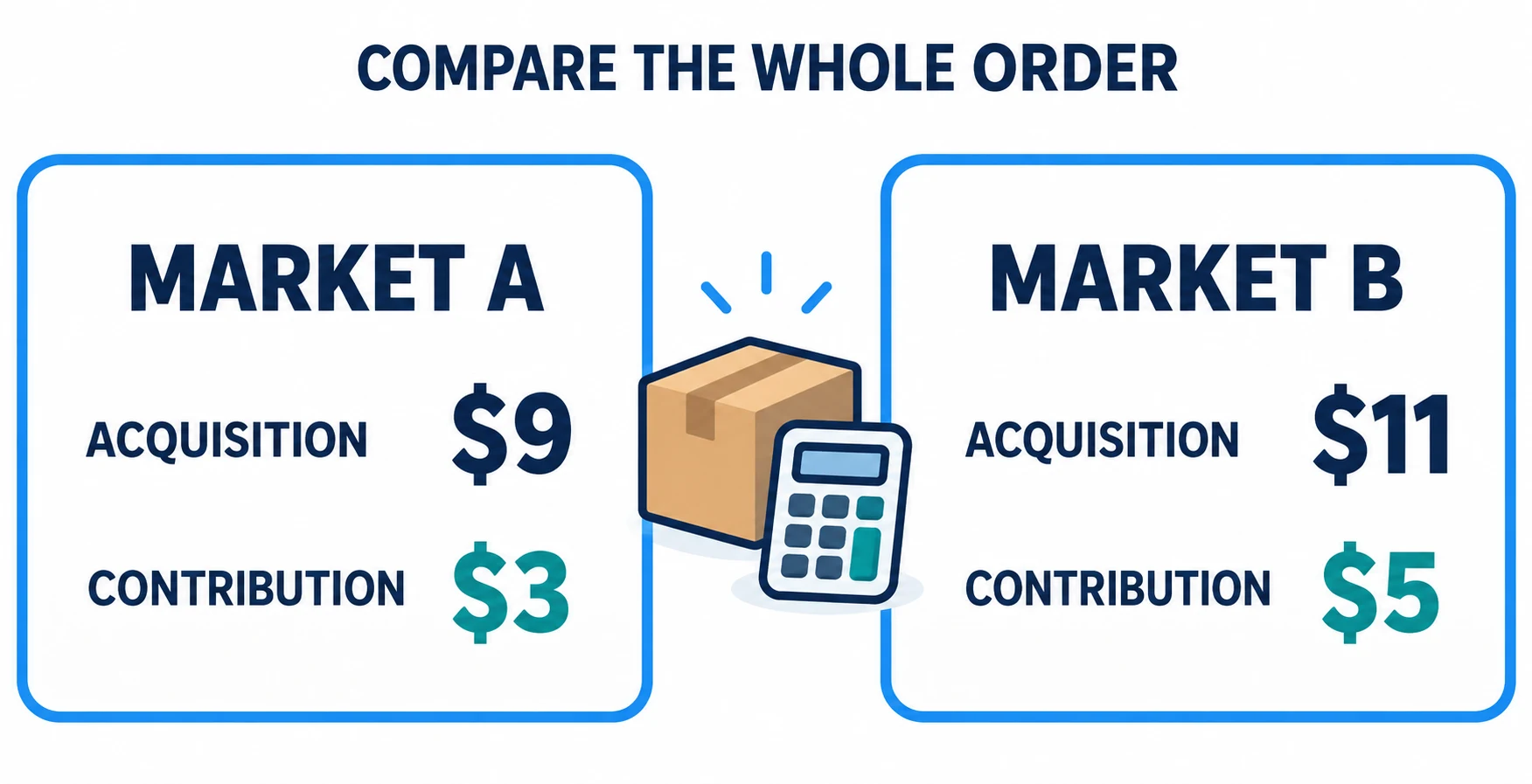
These are invented planning inputs, not country averages or predicted returns. Their purpose is to prevent selecting a market by advertising cost alone. Use actual quotations and observed results as they become available; keep uncertain assumptions visible.
Check the downside and the cash dates
Recalculate with a plausible higher shipping cost, a weaker conversion result or a delayed payout. Decide how much loss the test can absorb and what signal will stop further spending. A positive base case with no room for ordinary variation needs more work before expansion.
Map supplier payments and customer refunds against available cash. Revenue booked in a report is not necessarily money available for fulfillment. The unit-economics guide provides the broader cost framework; the country comparison should use the same definitions.
10
Resolve payments, support and returns before opening checkout
Check whether the payment provider can onboard your actual business, support the transaction type and settle to your bank arrangement. Customer-country availability and merchant-country eligibility are different questions. A local-currency price display does not settle either one.
Translate more than the product headline. Review size or measurement terms, instructions, delivery explanations, support messages and return directions. Use someone competent in the target language when a poor translation could change the meaning of the offer or a required notice.
Plan a usable customer remedy
Name the accepted return destination and receiver. Check whether returning a low-value product across borders is economically sensible and what alternatives are permitted under your policy and applicable consumer rules. Do not assume a supplier will receive customer parcels without agreement.
Estimate the operational workload of questions, damaged items and delivery disputes. A time-zone difference may be manageable with assigned coverage; it becomes a problem when nobody owns the next response. Connect the customer-facing remedy to the supplier recovery process without making the customer wait indefinitely for reimbursement between businesses.
Keep rules attached to the actual market
Document the product, tax, customs, consumer and packaging questions that apply to the destination. Resolve material gaps before accepting orders. A market comparison identifies these gates; it cannot provide a universal legal checklist for every product and seller arrangement.
11
Select a bounded launch and a reason to stop
Choose one market where the mandatory conditions pass and the offer has a credible advantage. State the supported product variants, service area, tested route, spending limit and person responsible for exceptions. Keep other destinations disabled until their requirements are ready.
Review the full order result, not only clicks or checkout conversion. Track actual shipping cost, delivered condition, questions, refunds and the timing of cash commitments. Compare those observations with the assumptions that justified the test.
Pause or narrow the market if the product cannot be delivered as promised, payment access is unresolved, a required obligation is unmet or the economics fail at a reasonable selling price. Revise the failed assumption before repeating the same campaign.
Expand after the operation is reproducible. A second country requires its own route and customer-service checks, even when the product and website are similar. The dropshipping fundamentals section connects market selection to the wider business model.
12
Frequently asked questions
Which country is best for dropshipping beginners?
Start with a market whose language, customer needs and delivery arrangements you can support. The U.S., U.K., Australia and Canada are candidates for an English-language operation, but each has distinct import and service constraints. Choose from verified fit rather than a generic ranking.
Should I target several countries at launch?
Only if the payment, delivery, tax and support arrangements are ready for each one. A single-market launch often makes it easier to identify why an offer succeeds or fails. Broader coverage should follow evidence and operating capacity.
Does a local warehouse make a country the best choice?
It can improve a particular route while adding stock commitments and other responsibilities. Compare the complete arrangement, including inventory, receiving, delivery and returns. Local stock alone does not establish demand or profitability.
Can I use old low-value import thresholds in my margin estimate?
Recheck them. U.S. de minimis treatment and EU small-parcel duty rules changed before this guide’s research date. Use a current quotation and official guidance for the actual product, route and selling arrangement.
Should I choose the country with the cheapest advertising?
No single cost decides the market. Compare acquisition alongside delivered cost, conversion, customer service and exceptions. A market with more expensive acquisition can still leave a better contribution if the rest of the order works more efficiently.