
Buying an item on Amazon after an eBay sale and having Amazon ship it straight to your buyer is not allowed under eBay’s dropshipping policy. A fast delivery, plain box or automation app does not change that rule.
That does not mean every business involving Amazon and eBay works the same way. You might have a separate agreement with a wholesaler, or you might own stock that a warehouse ships for you. Those setups need different checks.
Before paying for software, write down who sells you the item, when you buy it and who sends it to the customer. Those three answers tell you which business you are actually building. For the wider setup, supplier and order-management questions, see the eBay dropshipping guide.
01
What does Amazon-to-eBay dropshipping mean?
The usual idea sounds simple: someone buys from your eBay listing, you buy the matching item through Amazon’s retail checkout, and Amazon delivers it to the eBay buyer. You hope the difference between your selling price and the Amazon price will cover fees and leave a profit.
The problem appears before that profit calculation. eBay’s official dropshipping policy allows direct fulfillment by a wholesale supplier. It does not allow you to buy from another retailer or marketplace after the sale and have that business deliver to your customer.
Retail checkout is not a wholesale agreement
A wholesaler is a business supplying you under a wholesale arrangement. Having a business account at retail checkout does not, by itself, create that relationship. The terms behind the purchase matter more than the label on the account.
Even with an allowed wholesale setup, you remain responsible to the eBay buyer for delivery and their experience. Your supplier’s mistake still lands in your store’s inbox.
Why a successful tutorial is not enough
A video might show an order arriving, or a tool might display a completed sale. That proves the example order moved through a system. It does not establish that the source meets eBay’s rules, or tell you how eBay will handle your account.
The policy provides for consequences such as listing restrictions or account suspension. There is no reliable timetable here for when enforcement will happen, so “it has worked so far” is a poor basis for choosing a source.
Also keep platform rules and law separate. A purchase can breach eBay’s policy without settling every legal question about that purchase. Product rights, taxes and consumer obligations need their own checks; calling a method “legal” does not make it acceptable to eBay.
02
Three ways Amazon can be involved
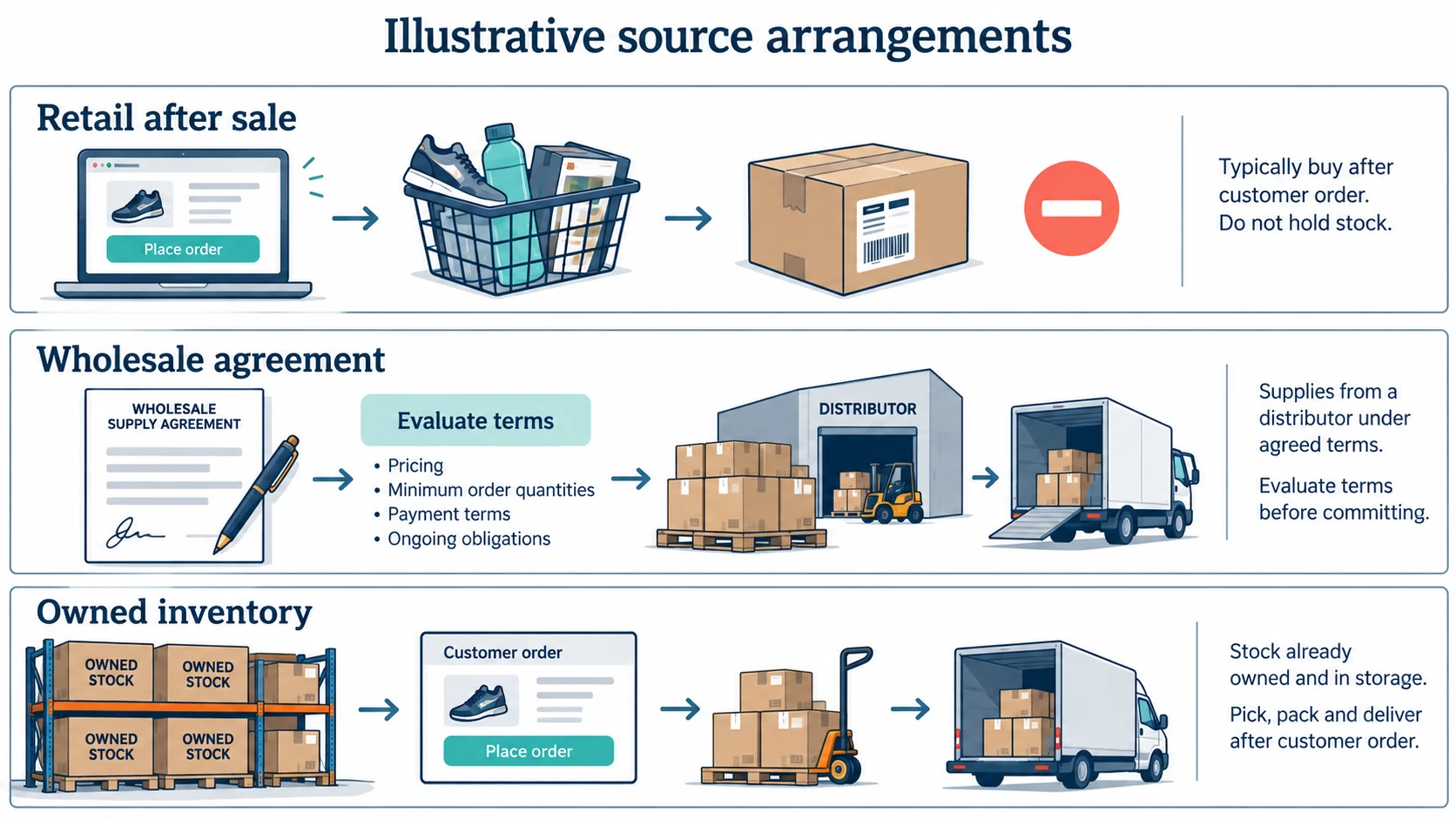
Imagine three sellers describing their business as “Amazon to eBay.” These illustrative arrangements look similar from a distance, but the purchase behind each order is different.
| Arrangement | What happens behind the sale | What to decide |
|---|---|---|
| Amazon retail purchase after an eBay sale | You use retail checkout and enter the eBay buyer’s address | Reject this source setup: it is the route eBay does not allow |
| Direct wholesale agreement with a supplier that also sells on Amazon | Your purchase is under a separate wholesale relationship with that supplier | Check the agreement, products and fulfillment terms; its Amazon storefront does not establish permission |
| Stock you own, stored with a fulfillment provider | You buy inventory in advance; the provider ships your stock when orders arrive | Check inventory, warehouse and eBay requirements, and budget for stock that may not sell |
On a phone, swipe the table sideways to compare every column.
eBay’s seller handbook explains the distinction between stock owned before listing and a wholesale agreement. A marketplace user agreement does not substitute for an agreement with a wholesaler.
A separate wholesale service needs separate terms
For the second arrangement, ask who you are contracting with and how purchases are made. A distributor may have an Amazon storefront and also offer a separate wholesale service. You need evidence of that separate service, rather than assuming the storefront makes its retail checkout suitable.
Where Amazon MCF fits
Amazon Multi-Channel Fulfillment, or MCF, ships inventory that you send into Amazon’s fulfillment network. Think of it as storage and order fulfillment for your stock. It is different from selecting an Amazon retail listing after receiving an eBay order.
An Amazon product number is not proof that you hold stock ready for MCF. You must arrange the inventory, prepare it for the network and understand inbound delivery and storage costs before customers order it.
You also need to check how that service fits the selling channel: carrier and tracking information, parcel requirements, handling time and returns. Having your stock in a warehouse does not automatically satisfy every eBay requirement.
This route changes the financial risk, too. You pay for inventory before knowing how much will sell, and slow-moving stock keeps your money tied up. These distinctions come from official service information; they are not an account-specific approval or a tested MCF recommendation.
03
Find out what the supplier is actually offering
A supplier’s answer should let you describe the item and the order accurately. Start with the contracting business and the product: the exact SKU or product code, variant, pack quantity and condition. For branded goods, establish the rights to sell the goods and use any supplied photos or descriptions.
Then check stock and dispatch. Does “available” mean units are reserved for your orders, or simply that the supplier expects to obtain them? What happens if you receive a paid order and the supplier has no stock? A stock feed is useful only when you understand what its number represents.
The order handoff needs equally clear answers. Where does the parcel ship from? How long does preparation take? Which tracking details can your buyer use? Who handles a wrong item, damage or a return, and which charges fall to you?
Here is a short request you can adapt:
Please confirm your direct wholesale supply terms for these products and whether I may sell them on eBay. For each SKU and variant, send the invoice details, stock and reservation rules, dispatch time, ship-from location, carrier/tracking options and return address. Please also explain who pays for defects, return postage and any restocking charge.
An Amazon link is not the supply agreement
A reply containing only an Amazon product link and instructions to use retail checkout has not answered the wholesale question. A genuine agreement with no clear delivery or return terms also leaves work to do. Keep the listing on hold while those gaps are resolved, and retain the terms you actually rely on.
If you have a product idea but no clear supplier brief, AIDrop’s product sourcing service can help define the specification, variants, sample checks, packaging and destination requirements so supplier options can be compared.
Send AIDrop a product link, destination and eBay selling plan, along with the sourcing decision you need to make.
This helps clarify the proposed supply arrangement; it does not grant eBay approval or make an Amazon retail purchase an allowed source.
04
Choose software after you have a source
Once the supplier relationship is sound, software can reduce the work of updating listings, checking stock, passing orders to the supplier and returning genuine tracking details. These are useful jobs, especially when you handle more than a few products.
A software label does not change the source
Claims such as “non-API,” “safe automation” or “seller of record” need careful reading. Non-API describes how a tool connects or operates. Seller of record concerns the selling role and its responsibilities. Neither label changes where you bought the product or removes eBay’s retail-sourcing restriction.
For an allowed arrangement, follow one SKU through a normal order before expanding. Check that the variant matches, the stock figure means what you expect, the supplier receives and accepts the order, and tracking reaches the correct eBay order. Ask what prevents a second submission if the first request is retried.
Also check an order that needs to be held. A stock mismatch or incomplete address should produce a clear stop and a person responsible for fixing it. A tool that keeps passing unsuitable orders creates more work as sales grow.
Keep a ready order and a held order distinct
Use this fictional record only after you establish an allowed source. BAG-B means the supplier’s blue option; it is not a real catalog code or an order we placed.
A ready blue order
Record the eBay order reference, BAG-B, quantity one, address and paid shipping service. Match those fields to the supplier’s acceptance and keep its order reference. A label alone does not establish carrier possession.
A held blue order
Suppose the exact blue option is unavailable. Keep that order on hold while confirming a supported next step. Available red stock is not permission to substitute red. Ask the buyer before an alternative and follow the applicable cancellation or refund process if needed.
After resolving a hold, verify that the original order was accepted at most once and that any shipment matches the agreed color and address. If an app timed out, look up the existing supplier reference before resubmitting. Keep the buyer informed from the actual status, not the app’s optimistic label.
Check acceptance and carrier possession separately
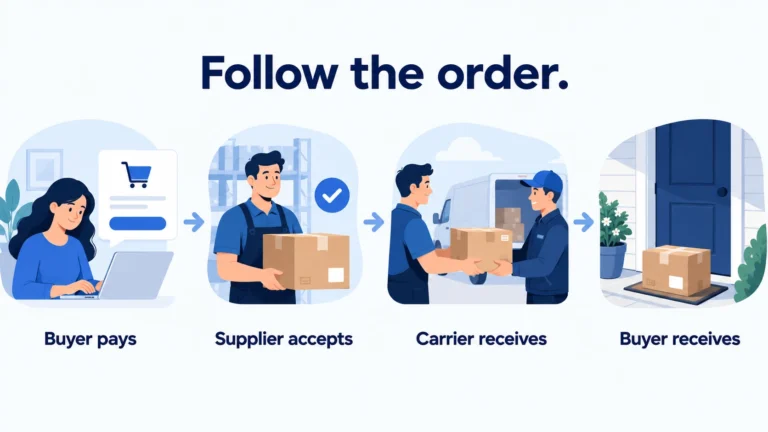
Look beyond a green “fulfilled” status on a screen. The supplier might not have accepted the order, or a label might exist while the parcel is still in the warehouse. Order acceptance and carrier possession are separate events.
Do not use fabricated tracking, conceal the purchase source or open another account to evade restrictions. The useful goal is a truthful, traceable order from a source eBay allows. No software has been tested or endorsed in this guide.
05
Promise a delivery date you can support
Customers buy from your eBay listing. They expect the delivery date shown in that listing, whoever prepares the parcel. Build that promise from the supplier’s actual handling time and the shipping route, rather than copying an Amazon retail estimate.
Two days of handling come before transit
Handling time is the time spent preparing and handing over the order. Transit time starts after that handoff. For an illustrative example, suppose a wholesaler dispatches within two business days and the carrier then takes four to six business days. If preparation takes the full two days, the combined time is six to eight business days, before allowing for the relevant cutoff, weekends or other route conditions. It is not two-day delivery.

Ask when the clock starts and which days count. An order placed after a dispatch cutoff may wait until the next working day. A route that works for one destination might have different coverage or timing elsewhere.
Tracking needs the same care. A created label is not proof that a carrier has the parcel, and an internal order number is not necessarily tracking the buyer can use. Confirm which real carrier events you will receive and who investigates when updates stop.
Sort out returns before the first problem
Get the return address, defect process and charges in writing. Check who pays return postage, whether there is a restocking charge and what happens to opened or used goods. A supplier’s policy may leave you with costs that your obligations to the buyer do not let you pass on.
Budget the buyer’s remedy before supplier credit
You may need to refund the buyer before the supplier repays you. Know who will receive the returned item and how you will obtain the evidence needed for a supplier or carrier claim. A promise to “handle returns” is too vague to price or rely on.
Check what is left from the sale
Suppose, again as an illustration, you sell an item for $40, pay $22 for the goods and $5 for supplier delivery. That leaves $13 before eBay fees, advertising, refunds and running costs. It is not $13 of profit.
Use the actual supplier quote, packed product and destination to check the order cost. Then include platform fees and a realistic allowance for problems. The dropshipping profit margin guide explains how to separate the sale, its costs and the money left for the business.
06
Already using Amazon retail purchases?
Pause new sales on affected listings while you review the source. Continuing to take orders adds to the problem you need to resolve. Pausing a listing, however, does not remove your responsibilities for customers who have already paid.
Make a short list of open orders and record what has actually happened: not yet placed with a supplier, accepted, shipped or delivered. Use order records and real tracking to distinguish them. Do not mark an order dispatched just to clear it from the queue.
For each buyer, follow the relevant eBay process to resolve delivery, cancellation or a refund truthfully. A parcel already in transit requires a different response from an order that has never been placed. Keep the buyer informed using facts you can support; do not abandon existing orders while looking for a new business model.
Before relisting, check the replacement product’s specification, variant, pack quantity and condition. Confirm its price, stock, dispatch location, handling time and return terms. Two suppliers’ photos can look alike while their products or delivery arrangements differ.
If eBay has sent a restriction notice, address what that notice requests using accurate records. A new supplier or tool is not a promised route to reinstatement, and creating another account to evade the restriction is not a repair.
07
Quick answers before you start
Is an Amazon Business account enough?
No. It does not automatically turn retail checkout into a direct wholesale agreement. Read the actual supply terms and apply eBay’s sourcing rule to the purchase you plan to make.
Can I sell products on both Amazon and eBay?
Selling through two channels is a different question from buying at Amazon retail after an eBay sale. Each channel has its own requirements. Identify the source and fulfillment arrangement for the goods sold on each one.
Does owning stock solve every problem?
Owning inventory changes the source question, but delivery, tracking, product rights and buyer obligations still need checking. It also requires money for stock and storage before all the units sell.
Should I buy software first?
Start with the supplier and the order terms. Then assess a tool against that real setup. You will have a clearer list of jobs for it to do—and will avoid paying to automate a source arrangement eBay does not allow.
eBay Dropshipping: How the Business Works and What It Costs
Understand eBay dropshipping, supplier relationships, order costs, cash needs, fulfillment and returns before expanding your product range.
Amazon Dropshipping: Policy, Supplier Control and Order Operations
Check Amazon dropshipping policy, supplier controls, listing identity, fulfillment, returns, fees and cash needs before launching merchant-fulfilled
Amazon Dropshipping Policy: Rules, Examples and Pre-Listing Checks
Understand Amazon dropshipping rules for seller identity, packaging, sourcing records, returns and shipping, with practical examples and
