

Stripe can support some dropshipping businesses, but the seller, product, account country and payment route must be eligible. Its dropshipping guide describes payment support; the current restricted-business rules and your own account review determine whether your actual offer can proceed.
Start with one real product and seller. A successful checkout alone does not approve the business or make the customer’s payment available for the supplier today.
For a useful policy check, describe who takes the buyer’s payment, the exact SKU, the seller’s account country, where the supplier dispatches from and what delivery and return service the buyer receives. “Do you allow dropshipping?” leaves most of that decision unanswered.
Explore the broader topic: Dropshipping Unit Economics and True Order Cost.
01
Start with the seller's country and the actual product
Check the merchant’s country, not the visitor’s
The buyer’s country and the merchant account’s country are different facts. A US customer can visit a store run by a business registered elsewhere; that does not turn the seller into a US Stripe merchant. Check Stripe’s current global availability list for the business’s location, then read the policy and account requirements for that location. If you intend to open an account in a country other than your main business country, Stripe lists separate cross-country account requirements, including a legal entity and a real operating presence in that account country. A borrowed address is not a solution to an unsupported market.
Check the actual SKU against the applicable prohibited and restricted business rules, updated September 22, 2026. “Home goods” is too broad: a non-electrical organizer and a battery product raise different questions.
Read both the product category and the account-country/payment-method conditions. Restricted categories need additional review; the list is not exhaustive. Absence of the word “dropshipping” is not account approval.
Legal seller and account market
Write down for this store: Registered entity and where it actually operates
Decision it changes: Which Stripe availability and jurisdiction rules apply.
Product
Write down for this store: Exact SKU and category, not a broad niche
Decision it changes: Whether the goods or sales practice appears in prohibited/restricted rules.
Payment route
Write down for this store: Stripe product or local payment method the customer will use
Decision it changes: Extra method-specific conditions may apply.
Order model
Write down for this store: Store sells to buyer; named supplier packs and ships
Decision it changes: The account and website must accurately describe the real business.
An India account changes the export decision
There is a clear example of why the account market matters. Stripe’s India help page for accepting international payments says it does not support dropshipping exports in that context. That is an India-account, international-payment restriction. It should not be copied into a claim that all Stripe accounts worldwide reject physical-goods dropshipping. Conversely, Stripe’s broad marketing guide cannot override that specific rule.
If a policy term appears to describe your business but its application is unclear, ask Stripe about the actual seller, account market, item and flow before accepting live payments. “Dropshipping” alone is too little information for a useful answer.
02
Tell the truth about who charges the buyer and who ships
In ordinary dropshipping, the customer buys from your store. Your supplier sends the parcel, but your business sets the offer and remains the seller the customer contacts about delays and refunds. Stripe describes that sequence in its own model guide: the store collects payment and pays the supplier, which ships the goods.
Describe the real seller and supplier
Keep the store, the account application and the actual parcel workflow consistent. Stripe’s prohibited-uses rules disallow false or misleading details about the business and undisclosed processing on behalf of another merchant. Do not describe your store as keeping its own warehouse if it does not. Do not put a supplier’s sales through an account that identifies a different, undisclosed seller. If your setup really is a marketplace or payment platform, seek the appropriate Stripe product and review rather than relabeling it as a single retail store.
Give buyers a delivery and refund promise you can meet
The customer-facing version of this honesty is simple. A product page should describe the item they will receive. The checkout should not promise a dispatch date your supplier cannot meet. The store should make shipping, refund and contact information easy to find. Stripe’s reserve guidance recommends clear shipping and refund terms, receipts, proof of shipment and an accessible customer contact path as ways to manage risk. Those pages also help a real buyer decide whether to order.
You do not need to publish your private supplier contract to customers. You do need to know what the supplier will do, and avoid making a public promise that depends on a route you have not checked.
03
Build one truthful offer sheet before connecting live checkout
Here is a hypothetical store. It is a completed example of the questions to answer, not a Stripe-approved merchant or a claim about AIDrop inventory.
- Seller of record: A US-registered retail company that owns the customer offer and takes payment in its own name.
- Item: One non-electrical desk organizer, with materials and dimensions shown on the product page.
- Supplier: A separate supplier in China; it holds stock, then picks and packs after the store pays its order.
- Shipment: The supplier passes the parcel to a named carrier; the store can obtain tracking and a destination delivery event.
- Customer promise: A delivery window based on a current route quote, plus a clear response if dispatch is delayed.
- Returns and support: A published refund/return path and a working customer-support inbox owned by the store.
- Money: Supplier invoice is due before dispatch; the store can pay it without assuming a same-day Stripe bank payout.
Use the offer sheet to choose the applicable rules
The first line decides which country rules to read. The product line is specific enough to compare with restricted categories; it does not prove the item is permitted. The supplier and shipping lines show how the store would meet the promise and document a real order. The money line prevents a successful card charge from being mistaken for spendable supplier funds.
One offer sheet can lead to different decisions
For this illustrative US business, the next action is to check the current US/account terms and disclose the actual model in the account, then resolve any Stripe review request. The sheet does not let an article pronounce the business approved. For an India account taking international payments on exported dropshipped goods, the specific Stripe help-page restriction changes the first decision: do not proceed on the strength of a general “Stripe supports dropshippers” article.
Make the same sheet for your own first SKU. If you cannot fill the supplier’s actual ship-from location, route or refund owner, that gap is worth resolving before you ask customers to pay.
If the official list or account prompt leaves an open question, send Stripe a short, concrete description rather than asking only, “Do you allow dropshipping?” For example:
“Our legal seller is [registered business and account country]. We sell [exact physical SKU] on [store URL]. Customers pay our store; [supplier type and country] holds stock and ships each order from [ship-from country] to [customer markets]. We own customer support and refunds. The product page shows [dispatch/delivery window], and our return and contact pages are [URLs]. We plan to use [Stripe product/payment method]. Does this described business and payment route require additional review or fall under a restriction for our account?”
Keep Stripe’s answer tied to that offer
This message is not a way to negotiate around a prohibition. It gives Stripe the facts needed to answer a real question. Keep the response attached to the specific offer and account; if you later change the SKU, market or seller-of-record arrangement, revisit the answer instead of assuming it covers the new model.
04
A successful charge is not a supplier payment
A working payment button can coexist with late dispatch
Account suitability is also an ongoing question about the offer customers actually receive. Consider the hypothetical desk organizer in the offer sheet: if the page promises five-day delivery but the supplier repeatedly accepts orders only after a two-week delay, refund requests and disputes can rise even while each charge succeeds.
The charge proves a payment attempt worked; it does not validate the advertised delivery route, guarantee future processing or tell you when money is available to pay the supplier. Keep the promised date, supplier acceptance, carrier movement and refund response in the same order record so you can correct the offer before the gap repeats.
If your real product, market or fulfillment pattern falls into a restricted category, use Stripe’s current policy and account-specific guidance before live checkout. Do not hide the supplier arrangement or interpret a processed test payment as approval of a changed business. If a supplier delay makes the published promise untenable, change or close that SKU while you resolve the route.
Charge, balance, bank receipt and supplier invoice differ
Even after a store is accepted, four events remain separate: the customer charge succeeds; Stripe records funds in a pending or available balance; Stripe sends a bank payout under the account’s schedule; and the supplier invoices or charges the seller. Stripe’s payout documentation says it pays from the available balance and that the first payout and subsequent payout timing depend on account and settlement conditions. A product listing that says “payment received” does not make the supplier invoice disappear.
Read the actual reserve notice
The business may also receive a reserve notice. Stripe’s reserve overview says a reserve holds a portion of funds under account-specific terms for possible refunds and disputes; the provider communicates the amount and duration. There is no responsible universal “Stripe holds X% for dropshipping” figure to put into a new store budget. Use the actual notice and balance, then compare the expected bank receipt with the supplier’s due date.
Check the payout’s expected deposit date in your actual Stripe Dashboard and confirm the bank receipt. Stripe’s payout guide distinguishes the first payout from subsequent settlement and payout schedules; bank availability can add time.
If the supplier is due on Monday and the bank receipt is later, pay from other usable cash or agree different terms before promising Monday dispatch. Compare fees and alternative providers in our payment-gateway guide.
Work out the cash needed for one dispatch
Illustrative organizer order: the buyer pays $42; none of this payment has reached your usable bank cash yet. The supplier needs $28 today, and you keep a separate $6 service buffer.
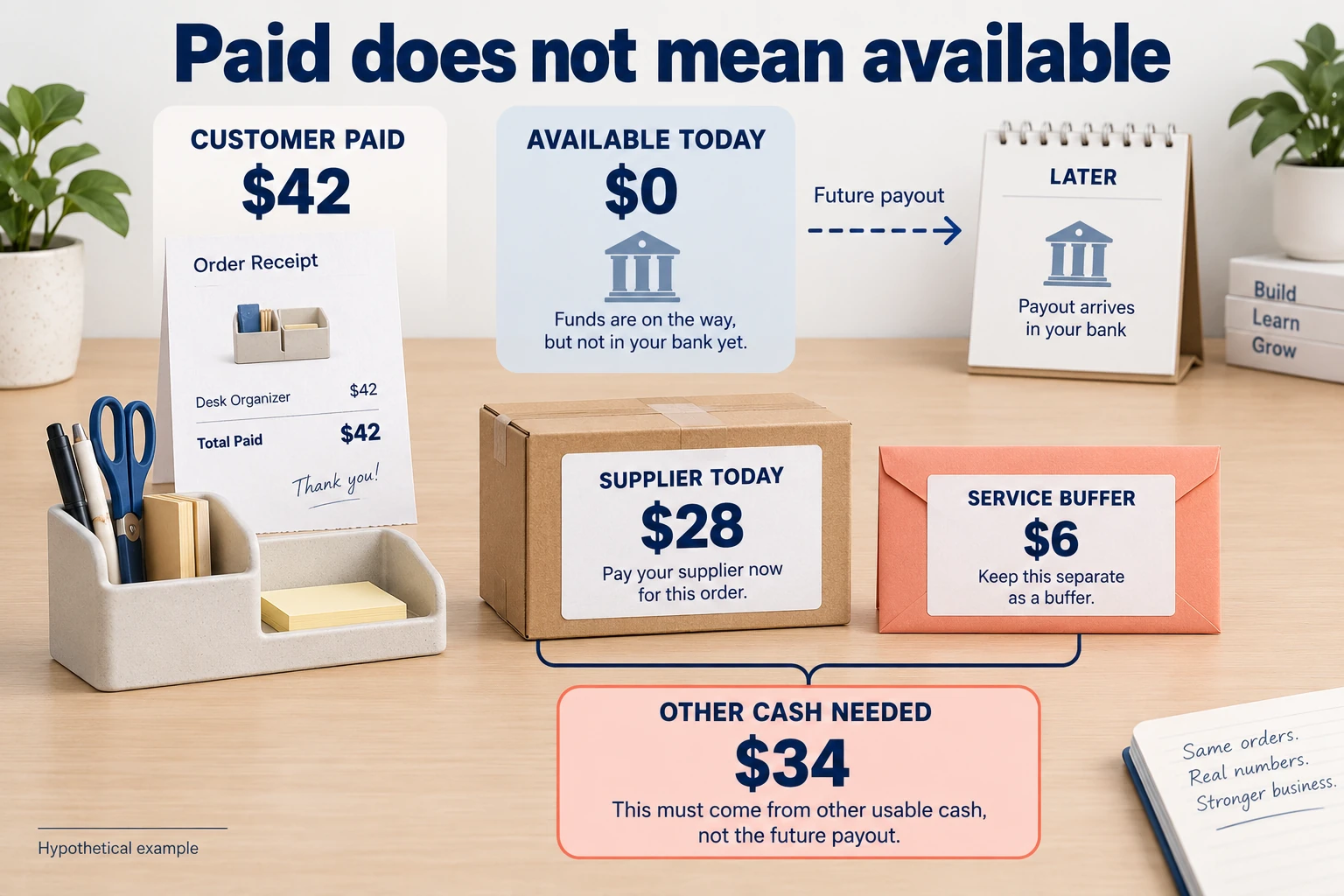
Today’s requirement
$28 supplier payment + $6 buffer = $34 from other usable cash. Ten orders under the same assumptions need $340, before additional real outflows. Future payout proceeds cannot be counted twice as today’s cash.
What to check next
Record the actual Stripe payment/balance, expected deposit and bank receipt separately from the supplier invoice, payment and acceptance. If the account shows a reserve or review notice, follow its specific terms rather than predicting release from this example.
The $42, $28 and $6 figures are invented teaching inputs, not Stripe fees, a reserve percentage or an AIDrop quote. This calculation funds dispatch and a buffer; it is not the order’s net profit.
05
Choose a next step for this store, then test one real order
Your one-SKU sheet should end with one of three outcomes, with the source date beside it:
Proceed to account review and a controlled test
What it means: Account market appears supported; the actual item/model is not identified as excluded, and your site and supplier records are truthful.
Next step: Complete Stripe’s required verification, read any account notice, then place a small real order only after the account is ready.
Ask Stripe about this exact use
What it means: A category is restricted, a country/payment-method rule is unclear, or the account asks for more information.
Next step: Send the legal seller, site, product, fulfillment route and customer promise; wait for case-specific guidance.
Stop this Stripe route
What it means: An applicable current rule excludes the merchant’s described use or the seller cannot meet account requirements.
Next step: Change the business/offer legitimately or evaluate another allowed provider; do not conceal the use or move it through an unrelated account.
Keep Stripe’s account response and policy link with the offer sheet. The two test stages below check different parts of the same order.
Test the checkout and the shipment as separate stages
Use the provider’s supported testing method before a permitted small live order. Do not send test-mode orders to a supplier as paid customer purchases.
Payment rehearsal
Verify the correct organizer, address, currency, receipt and failed-payment behavior in the intended integration. Test mode checks the integration; it does not demonstrate a live payout or prove account eligibility.
Approved live order
After the account is ready, inspect the actual payment, fund the supplier, record acceptance and follow the real carrier handoff. Check the promised delivery/support path and the bank payout. A successful charge with no supplier acceptance is an unresolved order.
Resolve the failed stage before taking more similar orders. One observed success supports those steps once; it does not override Stripe’s ongoing review or approve a changed product or business model.
AIDrop Agent can help clarify the China-side handoff behind that offer sheet—supplier readiness, picking/packaging, available parcel routes and the tracking events a route returns. Send the SKU and destination scenario for a scoped operating review. Stripe alone decides Stripe-account suitability; we do not approve or process merchant payments.
06
Frequently asked questions
Does Stripe prohibit all dropshipping?
No universal answer follows from the model name. Stripe publishes a guide describing support for dropshippers, while its current policy can exclude particular products, practices, countries or account setups. The India international-payment restriction above shows why the specific merchant and route matter.
If my store is on Shopify, is Stripe automatically available?
No. The ecommerce platform and payment account are separate eligibility questions. Shopify’s available payment providers depend on the store’s market and setup; our Shopify dropshipping payment-methods guide covers that implementation decision. Do not assume a standalone Stripe account can be selected in every Shopify store.
Can I hide my supplier so Stripe sees a normal retail store?
You are a retailer when you sell to the customer and remain responsible for that sale, even if a supplier ships it. Accurately describe who the legal seller is and how the order is fulfilled. Stripe’s policy forbids misleading information about the business and undisclosed processing for another merchant. Hiding a real operating relationship is not an eligibility strategy.
Does an accepted Stripe payment mean the supplier can be paid today?
No. The charge, Stripe balance, bank payout and supplier invoice move on different schedules. Check the account’s actual payout and reserve notices, and make sure the supplier can be paid by its deadline without assuming immediate bank cash.
Dropshipping Profit Margin: Calculate What You Keep
Calculate dropshipping gross, contribution, and net margins. See how discounts, refunds, and ad costs change profit in

How to Price Dropshipping Products From Landed Cost and Risk
Calculate a retail price from the delivered cost of one variant, selling fees and required contribution, then
Dropshipping Cash Flow: Supplier Payments, Payouts and Refund Buffers
Plan dropshipping cash flow by date. Separate pending payments from usable cash, fund supplier bills, and test
