
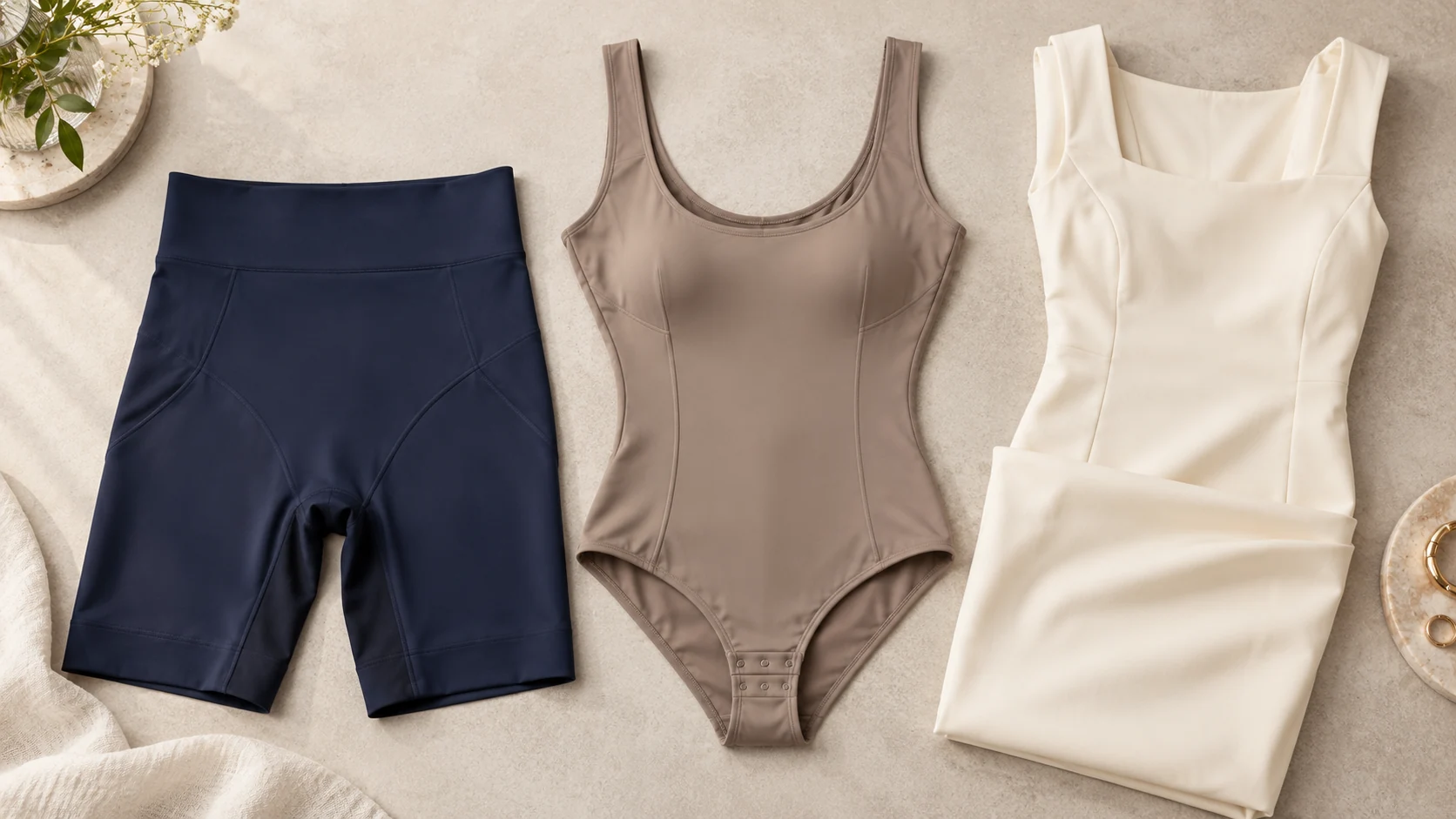
Shapewear dropshipping lets you sell body shapers, shaping shorts and similar garments while a supplier holds and dispatches the stock. It can work for a focused adult clothing store, provided you can explain the fit, fulfill the exact size and afford the customer remedies your supplier may not reimburse.
Before importing a large catalogue, choose one style for one outfit problem. Check its supplier programme, size chart, sample and complete order cost. A promise of a dramatically smaller waist will not fix a garment that rolls, pulls at the shoulders or arrives in the wrong size.
01
Start with the outfit problem, not the strongest compression
A shopper wearing a close-fitting dress may want a smooth line without a visible leg opening. Another needs a bodysuit with a usable closure, while a third wants shaping shorts that stay below the dress hem. Those are different products, even if every supplier calls them “tummy control.”
Use the garment’s construction to narrow the choice:
- Shaping briefs or shorts: check waist height, leg length, edge finish and the area covered.
- Bodysuits: add torso length, bust arrangement, straps and access at the gusset to the size discussion.
- Waist-focused styles: explain where support begins and ends; they do not provide the same coverage as a full body shaper.
Choose ordinary adult fashion shapewear for this evaluation. Post-operative compression and products sold for a medical purpose need a different product and claims review. A fashion supplier’s “firm control” description is not a measured medical compression specification.
02
Choose a supplier that actually takes customer orders
A manufacturer that sells in bulk is not automatically a dropshipping provider. Start with a documented programme, then confirm the style and variant you want to sell.
| Supplier lead | Route and qualification |
|---|---|
| Be Wicked shapewear | Its collection is offered through its dropship programme. Account approval, paid access, price rules and per-order charges apply. |
| Feelingirldress | Describes taking paid merchant orders and sending products to the customer’s address. Confirm current variant stock, origin, packing and claim terms. |
| Shapewear Wholesale | Its FAQ explicitly says it does not offer dropshipping. Treat it as a wholesale/manufacturing lead if you are willing to buy and fulfill stock separately. |
These are documented arrangements, not an independent ranking of product quality. Ask whether the exact colour and size are eligible, whether backorders are allowed and whether your sales channel is permitted.
For Be Wicked, the programme instructions separate the dropship account from a regular wholesale login: apply, receive approval, then activate the annual subscription. Its minimum-advertised-price rules also matter when planning promotions. Our lingerie guide covers that account distinction in more detail.
Confirm the parcel and paperwork
Get written terms for the parcel and paperwork as well. Do not assume “dropship” means your own branded packaging. Be Wicked describes its own packaging with the retailer’s packing slip. For imported orders, require accurate commercial information; do not copy a supplier’s suggested gift or undervaluation workaround. CBP’s invoice-value guidance is a starting point for US entries.
03
Check US fulfillment at the variant level
For a US-focused store, ask where this order will leave from, rather than whether the supplier has an American address.
Be Wicked’s programme describes dispatch from Commerce, California. Feelingirldress has a separate US warehouse page describing a selected stocked range. Neither fact proves every size and colour you might import is currently ready for domestic dispatch.
Before advertising a US route, record:
- The supplier style code and exact size/colour variant.
- The warehouse holding that variant and its current availability.
- The customer’s supported postal address and actual shipping method.
- Processing time separately from transit, plus the policy if stock runs out.
- The address and authorization process for any eligible return or claim.
US-fulfilled is also different from US-made. Do not change the country-of-origin statement because a parcel leaves a US warehouse. If the supplier switches to an overseas route, reconsider the quote and delivery promise before accepting that change for the buyer.
04
Use body measurements to solve the size question
The customer’s body measurements and the garment’s relaxed measurements answer different questions. A stretchy garment can be smaller at rest than the body it is designed to fit. Clothing designers call this negative ease. It does not give a merchant a formula for choosing an arbitrarily smaller size or promising a particular pressure.
Use the exact style’s current body-size chart and measurement instructions. Triumph’s fitting guidance warns against sizing down for more control; shaping is designed into the garment. Do not turn that into a claim that any supplier’s medium fits the same person.
When the waist and hips point to different rows
Be Wicked’s general chart currently lists these approximate body ranges in inches:
| Size | Waist / hips |
|---|---|
| M | Waist 28–29 in; hips 38–40 in |
| L | Waist 30–31 in; hips 40–42 in |
Now imagine a buyer with a 29-inch waist and 41-inch hips. Their waist matches M while their hips match L. Choosing M because it matches the waist ignores the hips; choosing L does not make its waist range an exact match.
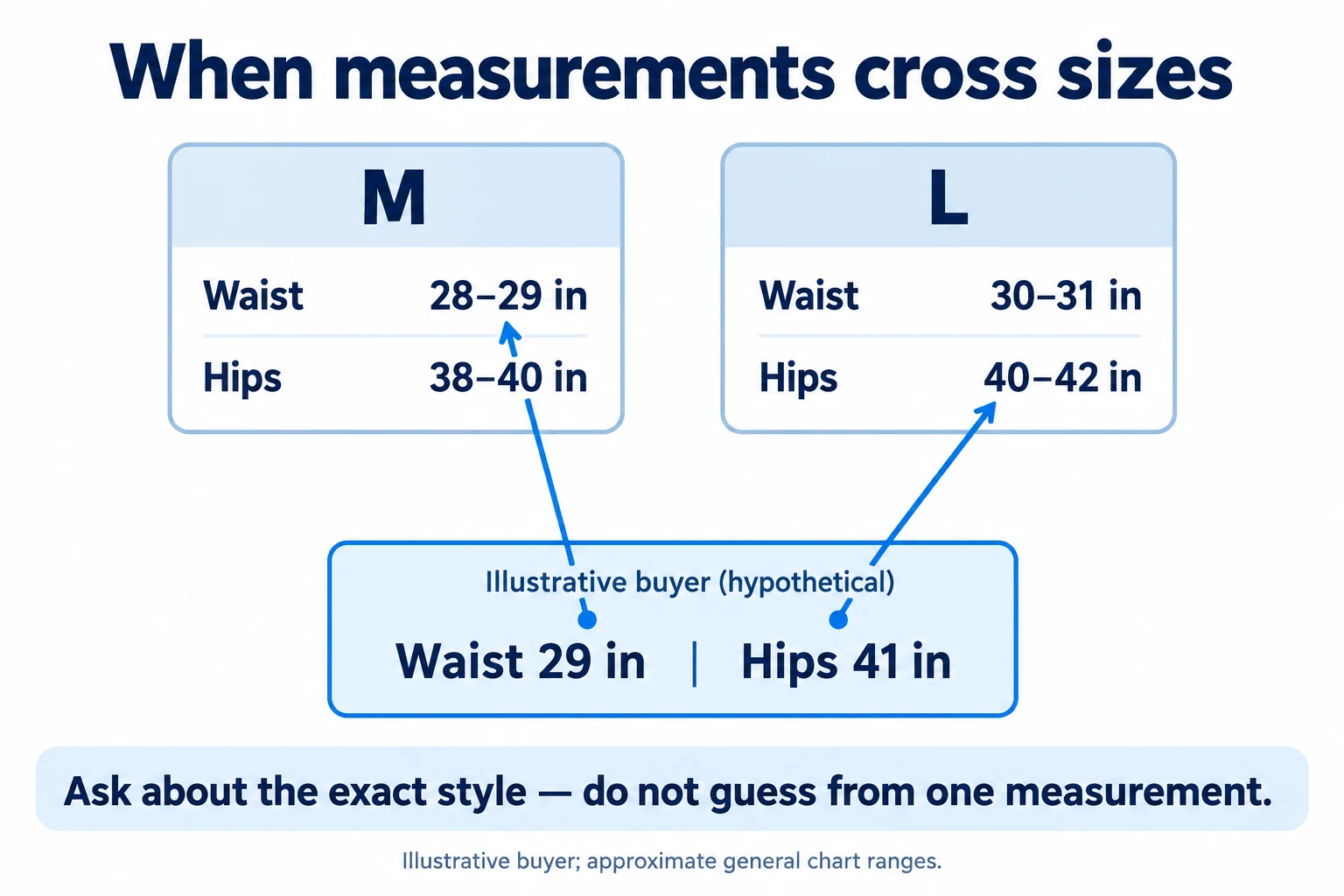
Ask the supplier about that specific style and both measurements. A different cut may be more suitable. For a bodysuit, include bust and torso information where the style requires it. This hypothetical buyer is an explanation of a chart conflict, not a fitting recommendation or a new universal size chart.
Keep units visible. If you convert a chart, use 1 inch = 2.54 cm and preserve its ranges; do not independently round the endpoints into a different fit promise. Recheck the chart when changing supplier or style.
05
Order samples that reveal rolling, coverage and closures
A folded garment can look tidy while hiding an awkward leg edge or a bodysuit that is too short for its intended wearer. Order the actual style, colour and size you plan to describe.
Check the construction first
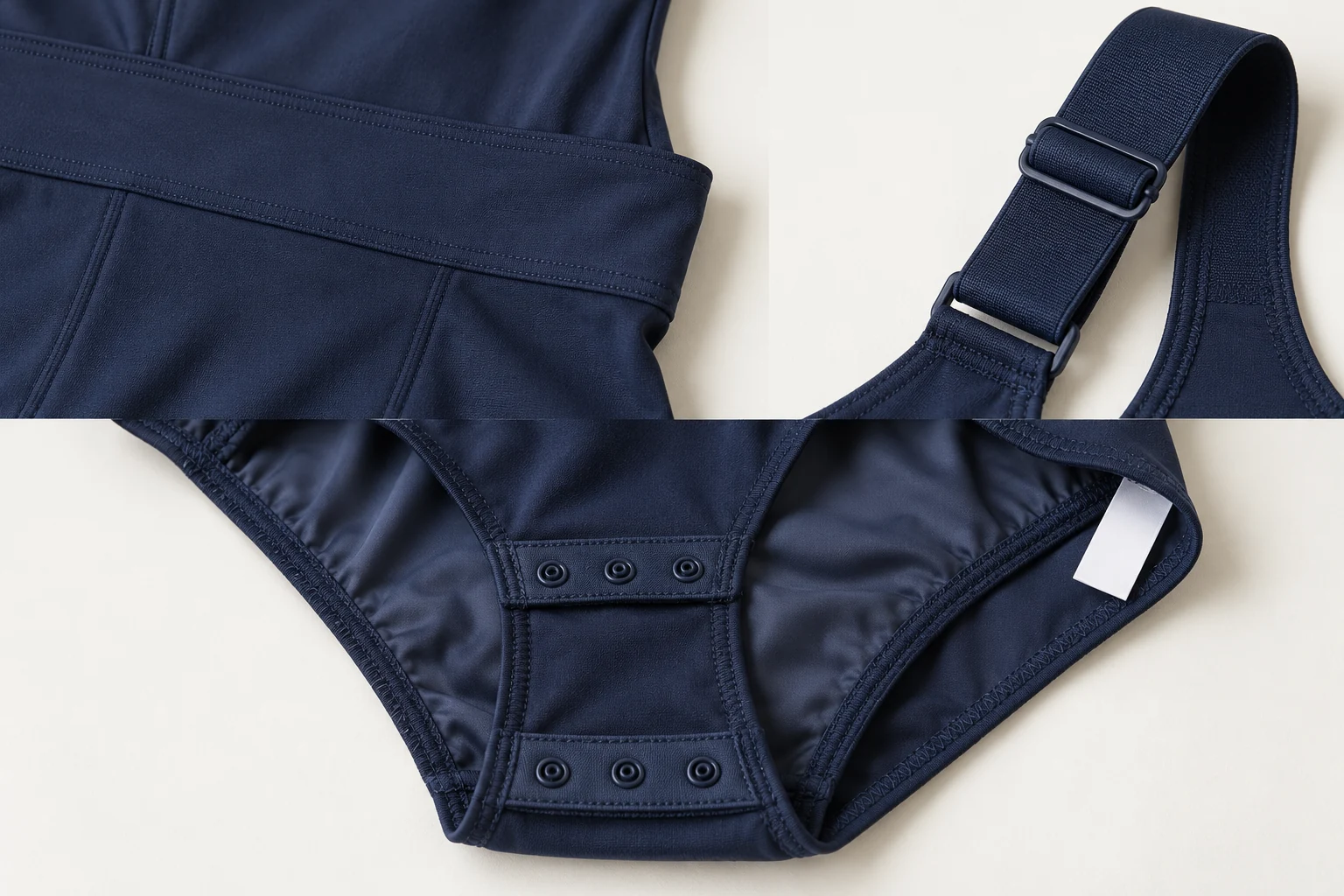
Record fabric composition and the care label. Inspect seams, joined panels, waistband edges, adjustable straps, fastening and any grip material. Check that the item and its tags match the supplier code and size you ordered.
If the listing promises a hook closure, show and check that closure. If it has an open gusset, do not describe it as a snap fastening. Photograph the relevant features clearly, using your own images or images you are authorized to publish.
Then check the intended wear
Where appropriate, collect feedback from a consenting adult who matches the style’s intended fit range. Ask about putting it on, sitting, bending, waistband movement, leg edges, shoulder tension and visibility under the intended outfit. Do not ask someone to continue wearing an uncomfortable garment just to complete a test.
Save the style, size, body-measurement context and observations without publishing personal measurements or images without permission. A single sample does not prove all-day comfort, every-size fit or a clinical effect.
For a care trial, follow the actual label and record changes in shape, stitching or grip. These are proposed merchant checks, not wear or wash tests we performed. The wider clothing guide explains sample and range planning.
06
Write a listing about the garment, not a body transformation
A useful description helps the shopper choose a garment. It should explain coverage, the supplier’s stated control level, construction, fit guidance, material and closure.
For example, after confirming the actual features: “High-waisted shaping shorts with mid-thigh coverage and a pull-on waist. Check this style’s waist and hip chart; contact us if your measurements fall across two sizes.” Add the verified fabric, care, leg length and return information. This is sample wording, not a description of every product in the supplier table.
Smoothing while a garment is worn is different from permanent weight loss. The FTC’s shapewear claims guidance discusses enforcement against unsupported slimming and cellulite claims. Do not import claims such as fat burning, permanent inch loss or post-surgery recovery from a supplier’s description without the required basis and product review.
Avoid misleading before-and-after images, fabricated reviews and compression numbers that the supplier cannot substantiate. Do not turn “light,” “medium” or “firm” control into a standardized pressure rating across brands.
For covered US textiles, check fibre, origin and responsible-business information against the FTC’s labeling guidance. Your store title, photos, product record and delivered label should describe the same garment.
07
Price the order and the size change you may have to fund
Use the complete parcel cost before deciding that a style has an attractive margin. Be Wicked’s current shapewear programme guide lists a $100 annual subscription and a $6.95 handling charge per order, plus shipping. Its programme page currently lists $5.50 USPS Ground Advantage and $12.50 Priority Mail for domestic shipping, within its package limits. Reconfirm the applicable service and order quote.
See what remains before advertising and remedies
For an illustrative order, assume a $55 customer payment, a $22 garment, $6.95 handling and $5.50 shipping:
$55 − $22 − $6.95 − $5.50 = $20.55
That $20.55 still needs to cover payment/platform fees, advertising, customer remedies, access costs and overhead. If an unreimbursed fit remedy costs an additional $8, only $12.55 remains before those other expenses. Neither figure is net profit.
If you expect 100 orders in a year, allocating a $100 annual subscription across them gives $1 per order for planning. At 20 orders it would be $5 per order. The subscription is still an upfront annual payment, and neither volume is a sales forecast.
The supplier’s final-sale rule is a cost input
Be Wicked’s returns page says it does not accept dropship returns. It separately discusses damaged, incorrect or short shipments, prompt reporting and authorization. Confirm how those claims apply to your dropship account; do not promise that a routine size exchange will be refunded by the supplier.
Write your customer-facing policy for the market you serve. State eligible conditions, deadlines, hygiene condition, evidence, return costs and how to contact you. A supplier’s final-sale statement does not automatically remove the buyer’s applicable rights or make a wrong-item claim a change of mind.
Agree separate procedures before launch:
- Selected size delivered, poor fit: identify the customer remedy and who funds it when the supplier will not reimburse a size change.
- Wrong size delivered: compare the order and garment codes; pursue the supplier’s incorrect-item claim rather than treating it as a sizing preference.
- Defective seam: keep clear issue photos and seek the applicable defect remedy promptly.
The underwear guide covers related pack and intimate-item description issues.
08
Verify the exact order before scaling the range
Keep one product record linking the store variant to the supplier. For example, a fictional internal record could read: SHAPE-01 / black / L / supplier style and variant IDs / approved chart version / confirmed warehouse. Those are your recording fields, not a supplier’s actual codes or a claim that L fits every customer.
Use that record for a deliberately budgeted sample order:
- Check that the store shows the right size chart, colour, contents, price and supported shipping option.
- Match the paid store order to the supplier’s accepted order, including the exact variant, address and service.
- Follow the original order through dispatch and tracking. Check for backorders before creating a replacement order.
- Inspect the received code, size, garment, packing slip and outside packaging against what you promised.
A catalogue feed is not proof that automatic ordering is configured. Check the actual ordering method for your account. An inventory update also does not reserve that unit for a customer whose supplier order has not been accepted.
Start with a small, verified range. Log size questions and remedies by style and reason—too short in the torso, waistband rolling, wrong variant, damaged seam—so you can fix the chart, change the cut or remove the style. One overall return number hides those different problems.
09
Questions before selling shapewear
Is shapewear still a profitable dropshipping niche?
A category’s popularity cannot establish your profit. Check actual demand for your offer, the complete cost and what customers need explained before buying. The example above shows how handling, freight and one fit remedy can consume much of the apparent markup.
Can I advertise plus sizes if the supplier lists them?
Check real stock and the actual chart for each listed variant. Ask about coverage and torso grading rather than assuming an enlarged letter size preserves the same fit. Do not show a size as available solely because it appears in an old catalogue.
Can I put my own label on dropshipped shapewear?
Only if that programme and garment support it on agreed terms. Ordinary dropshipping and private-label manufacturing are separate arrangements. Confirm quantity, labeling, packaging, stock ownership and fulfillment before advertising it as your own manufactured range.
Should I recommend a smaller size for stronger shaping?
Do not use that shortcut. Use the current style’s body-size chart and supplier fit advice. If waist, hips, bust or torso point to different options, resolve the mismatch rather than guessing from one measurement.
Can I market a fashion shaper for recovery after surgery?
Do not add a medical purpose to an ordinary fashion listing. That requires a separate product, evidence and regulatory review. This guide does not approve a garment for surgery recovery or prescribe compression or wearing time.
Where can I compare other sourcing arrangements?
Use the clothing supplier comparison for broader apparel routes. If your plan requires China-side sourcing, sample coordination, packaging or fulfillment, send AIDrop the style specification, size range, destination and expected volume. We can review that scope; supplier selection does not replace fit testing or approval of product claims.
Sources and scope
Sources checked October 19, 2026. Supplier prices, programmes and size charts are public information subject to current account and product terms. The buyer measurements, order code, cost scenarios and sample checks are illustrative. No paid order, wear test, wash test, medical evaluation or independent supplier-quality ranking was performed for this guide.

Clothing Dropshipping: Sizes, Variants, Samples and Returns
Verify apparel sizes, variants, samples, labels and returns before launch. Build a clothing dropshipping offer around accurate
Clothing Dropshipping Suppliers: 5 Options for Different Stores
Compare Trendsi, Printful, Printify, Apliiq and BrandsGateway by clothing model, fit information, stock, shipping and return costs.
Shoe Dropshipping: Sizing Evidence, Variants and Return Exposure
A shoe listing needs model-specific fit evidence, exact size-color stock and a workable exchange route. Compare one
