

Reverse dropshipping usually means sourcing goods from markets such as the US or Europe for customers in markets such as China. The supplier can still send each parcel directly after the retailer receives the customer’s order. It reverses the direction of a familiar China-to-Western-market dropshipping example.
Shopify uses that direction to explain the term. Some providers use it more broadly for bringing a hard-to-obtain product into another market. In either usage, the opportunity depends on a specific buyer and product: a country label does not prove demand, quality or profit.
01
How the order works
The basic supplier-direct sequence remains straightforward:
- The customer buys from your store. You present the product, collect payment and provide customer service.
- You purchase the agreed item from the supplier. Send the correct variant and recipient information through the agreed order process.
- The supplier dispatches to the buyer. The actual export, import and carrier arrangements determine how the parcel reaches the destination.
Imagine a retailer selling a mechanical pencil to an individual buyer in China. Its supplier is a US business, the pencil was manufactured in Japan and the parcel starts at a US warehouse. These are hypothetical roles, not an approved supplier or shipment; the retailer’s own location is unspecified.
Keep the four places separate:
- Supplier business: US, where the retailer buys.
- Manufacture: Japan, the assumed origin of this pencil.
- Dispatch: US warehouse, where this parcel begins.
- Buyer: China, where the individual receives and uses it.
Dispatch address does not establish origin
A US warehouse does not make a product US-made. Likewise, importing stock into China before customer orders changes the inventory, delivery and cash commitments; it is different from foreign-supplier dispatch after every sale.
Who this model suits
- Worth investigating: you can obtain a particular product buyers want, support their language and payment needs, and preserve a useful delivered-price or service advantage after cross-border costs.
- Poor starting fit: your plan relies only on “premium Western goods,” the same item is readily available on better local terms, or you cannot fund and manage the import and customer-service work.
02
Choose a product the buyer cannot easily replace
Begin with one buyer group and one destination. Look for a particular model, assortment or buying service that local offers do not already provide on comparable terms. These are illustrative research directions, not verified demand or cleared import products:
| Candidate offer | Buying reason to investigate |
|---|---|
| A particular mechanical pencil and compatible refills | The buyer wants that model or refill system, rather than any inexpensive pencil. |
| A specialist craft tool from an authorized supplier | The tool performs a specific task that available substitutes handle poorly. |
| A fabric accessory in a particular material or size | The buyer needs that construction or fit and can see accurate specifications before purchase. |
On a phone, swipe the table sideways to compare every column.
Search the exact model and close substitutes on the channels the intended buyer uses. Compare delivered price, availability, authenticity information, included parts, arrival estimate and returns. A foreign catalogue price alone cannot tell you whether the offer is competitive.
Identify a specific buying reason
Ask prospective buyers what they need and why they would choose your listing. For the pencil, the answer might concern a grip or compatible refill that is hard to obtain locally. That is a question to test; we have not measured demand for this hypothetical product.
Use the comparison to make a choice:
- If the same model is already available locally for less with easier returns, identify a real additional benefit or drop the offer.
- If buyers cannot tell what makes it useful, obtain the exact specifications and an appropriate sample before creating the demonstration.
- If demand exists but the supplier cannot authorize resale or serve the route, choose another supplier or product before advertising.
Food, skincare, electronics and other products often suggested as “premium” ideas add product-specific duties. Their category popularity does not answer whether the exact item, intended use and destination arrangement are permitted. Build the first offer around a product you can properly identify, supply and support.
03
Get a supplier quote and a workable checkout
Confirm the supplier will serve this route
A directory listing or domestic retail page does not establish that a supplier will resell and dispatch to your intended market. Send the proposed transaction, not just “Do you offer dropshipping?”
You can adapt this request:
We plan to sell [exact model and variant] to individual buyers in [destination]. Please confirm:
- Permission to resell that item in the territory, and any applicable brand or export restrictions.
- One-unit purchase terms, manufacture/origin information, dispatch warehouse, packed weight and dimensions.
- Item price, packaging, destination shipping quote, processing time, tracking and any excluded charges.
- Stock updates, substitution approval, customer-visible paperwork and inserts.
- Damage or wrong-item claims, cancellation before dispatch, return address and reimbursement terms.
Resolve export and paperwork responsibilities with the supplier and route operator:
- US export controls can depend on the item, destination, end user and end use. This does not mean every pencil needs a license; the actual transaction needs the appropriate screening.
- The commercial invoice and packing list describe the sale/value and shipment. A pro forma quotation is not a completed-sale invoice. Use accurate product, origin and value information and identify who supplies the required documents.
Choose a selling arrangement you can actually use
Trade.gov’s China ecommerce guide describes different entry routes. Their account and operating requirements are not interchangeable:
| Selling arrangement | What must be resolved |
|---|---|
| Qualifying cross-border marketplace | Merchant onboarding, product acceptance, payment and supported import/fulfillment arrangement. |
| Foreign store with a qualifying import service | Your account and payment access, required transaction data and the actual service handling imports. |
| Local distributor or stocked local operation | Commercial import and domestic selling responsibilities, plus inventory and storage funding. |
On a phone, swipe the table sideways to compare every column.
Test a payment arrangement you can use
For the chosen route, confirm supported customer payment methods, settlement currency, bank payouts and refunds. Complete a destination checkout test through the eligible merchant arrangement. A familiar payment button does not prove your business can use it for that transaction.
The product page should explain the exact model and included parts, total payable price, dispatch and expected delivery, customer-service contact and return arrangements in language the buyer understands. Show who pays import-related charges. Match the store, payment provider and import operator’s information flow before taking orders.
04
Choose the actual import route
These China arrangements illustrate why a foreign dispatch address alone cannot settle the import question. Other destinations require their own route and product rules.
| Arrangement | What happens |
|---|---|
| Qualifying retail direct purchase, 9610 | Goods enter from abroad for the individual consumer order. |
| Qualifying bonded retail import, 1210 | Inventory enters a customs-bonded warehouse before customer orders. |
| General trade and local distribution | An importer brings goods in under the applicable commercial-sale arrangement. |
| Ordinary foreign parcel | The carrier uses its actual declaration route; the label alone does not qualify it as retail cross-border ecommerce. |
On a phone, swipe the table sideways to compare every column.
For qualifying retail imports, the official No.486 framework requires more than an overseas store:
- Eligible personal-use goods. Identify the exact classification and permitted-list entry. Consumers cannot resell these imports.
- Responsible businesses. A foreign-registered seller owns the goods and appoints a China-registered company that registers with customs and takes responsibility for accurate declarations.
- Matching transaction information. Customs-connected platforms transmit order, payment and logistics records. The alternative carrier/postal branch must undertake its required reporting and legal responsibilities.
- The applicable tax arrangement. The consumer is the taxpayer; the prescribed platform, logistics or declaration party handles collection and remittance.
China’s published tax notice, No.49 of 2018, effective January 1, 2019, sets these retail-import transaction limits:
| Published limit | RMB |
|---|---|
| Single transaction | 5,000 |
| Annual transaction total | 26,000 |
On a phone, swipe the table sideways to compare every column.
One expensive item has a different tax branch
An order containing only one item with a taxable value above RMB5,000 but below RMB26,000 may still use the retail channel, with full goods-rate tariffs and applicable import VAT and consumption tax. It counts toward the annual total; exceeding that annual limit requires general-trade treatment.
Use the full taxable-value inputs
Customs’ published guide defines the taxable value as the actual transaction price, including the retail price, freight and insurance. Use those inputs, rather than the supplier’s wholesale cost alone.
Before quoting the buyer, have the operator confirm the applicable product/list entry, the buyer’s remaining annual allowance, actual route, tax calculation and data requirements. This hypothetical pencil has not been checked against the list; the 2022 list-amendment announcement alone does not clear it.
Keep the order, payment and parcel linked
For a fictional pencil order P1001, prepare these matching records with the actual route operator. This is a worksheet, not a customs submission format or an approved import.
Order
P1001; exact pencil model and variant; quantity; buyer/recipient details; actual retail amount and currency. Keep the same product and buyer across the records.
Payment
The actual payment transaction reference, payer and amount/currency, linked to P1001. Leave a blank until the payment exists; a copied order total is not proof it was paid.
Logistics
The actual dispatch and waybill reference linked to P1001, with the parcel contents and recipient. A printed label does not prove carrier acceptance or customs release.
Taxable value
Ask the operator to confirm the actual retail price, freight and insurance inputs and applicable treatment. The later 520 selling-price example includes assumed costs; it is not automatically the customs-declaration value.
Compare model, quantity, buyer, currencies and references before submitting through the supported arrangement. If they disagree, resolve the real record or route issue with the responsible party. Do not invent an order or payment to make the three records appear consistent.
Product information and customer responsibility
-
Buyer information: The qualifying retail branch requires a buyer-confirmed risk notice, including possible absence of physical Chinese labels and available Chinese electronic information. Its specified first-import filing relaxations retain safety and prohibition exceptions; they are not blanket product approval. General-trade product requirements need separate treatment.
-
Customer relief: The Ministry of Commerce clarification says the consumer first seeks relief from the foreign seller. If that seller fails to perform, the entrusted domestic company may bear the corresponding joint responsibility. That company is more than a convenient return address.
-
Category duties: Some categories add duties. A January 7, 2026 food announcement requires covered retail-import food sellers to entrust a domestic food operator with recall work and addresses stopping sales, reporting and platform action. This food-specific rule does not apply to every pencil.
05
Price the complete order and fund it before payout
Convert the quote into one currency so you can compare the complete delivered offer. This pencil example uses hypothetical RMB planning amounts, not an exchange rate, tax calculation or actual shipment quote.
| Order item | RMB |
|---|---|
| Customer price | 520 |
| Supplier’s product | −180 |
| International freight | −80 |
| Payment and currency costs | −25 |
| Handling and local delivery | −30 |
| Provisional import-tax budget | −35 |
| Advertising to acquire the buyer | −70 |
| Planned returns and other problems | −20 |
| Contribution before recurring bills | 80 |
On a phone, swipe the table sideways to compare every column.
Product markup is not the complete profit
The 340 difference between price and product cost is not profit. The other listed costs total 260, leaving 80 for recurring bills, owner pay and any further business taxes or expenses. An expensive return can reduce that amount further.
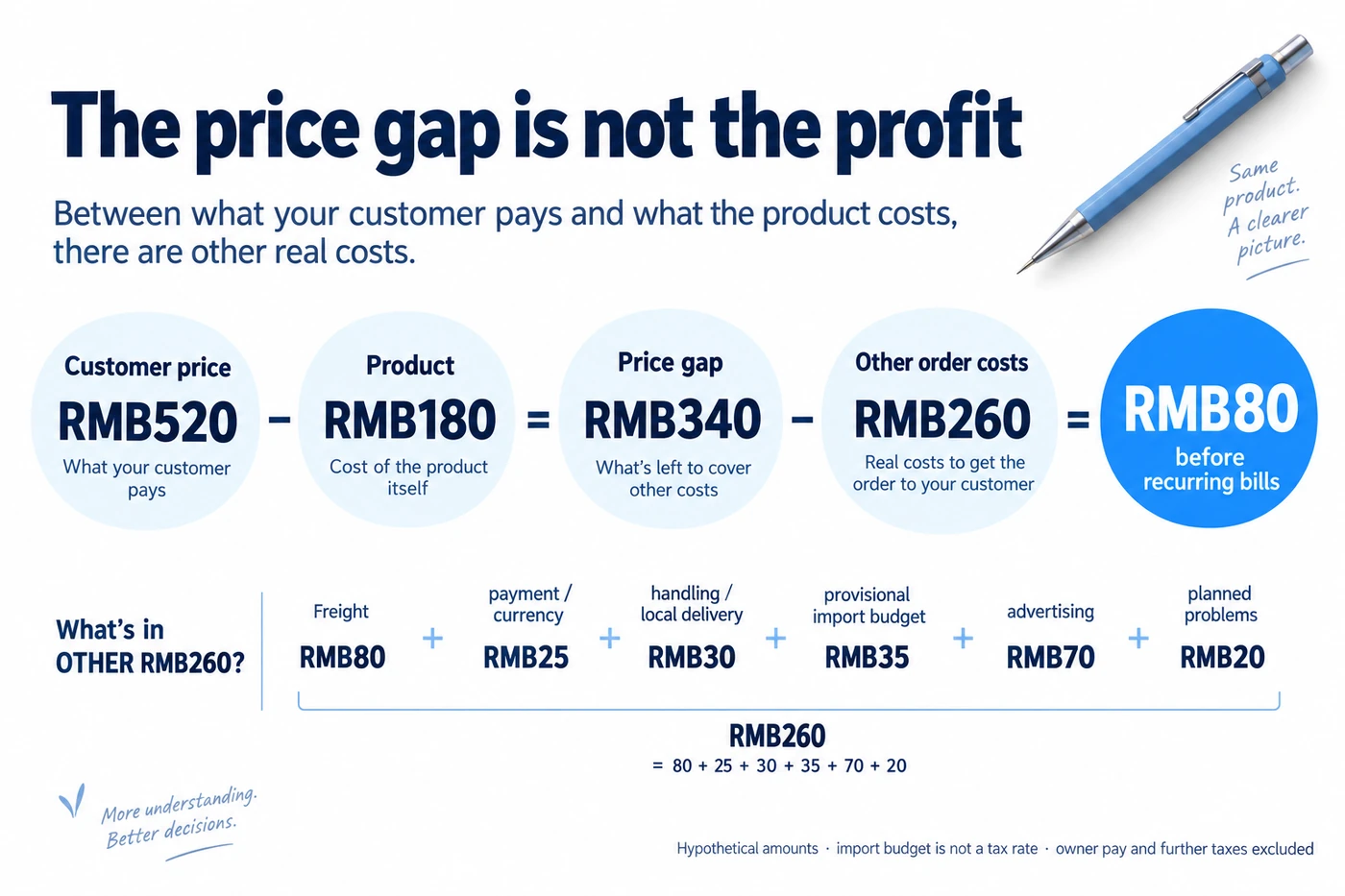
Replace the planning assumptions before giving a customer a firm price:
- Import cost: the 35 is a provisional budget, not a current tax rate or exemption. Obtain the actual product/route calculation and identify the collection or payment party.
- Transport: confirm whether the 80 freight and 30 handling assumptions cover the real carrier, customs handling and local delivery, including excluded charges.
- Customer remedies: price the actual return, replacement or refund exposure rather than assuming every problem costs 20.
If the full delivered price removes the buyer’s reason to choose you, change the product, supplier or market. A premium description cannot recover a cost disadvantage by itself. Our unit economics guide explains the broader order-cost calculation.
Fund the supplier before customer proceeds arrive
Pay the supplier before payout
If product and freight are prepaid, those two lines require 180 + 80 = 260 per order, or 2,600 for ten orders. Advertising, handling and refunds can require additional cash. Match these payment dates with when your merchant account actually makes customer proceeds available.
A 1210 bonded-stock arrangement adds advance inventory and storage commitments. Choose the number of first orders you can fund under the actual route, with room for remedies; projected contribution is not money already available in the bank.
06
Complete one first order before expanding
Once the offer’s permissions and route are resolved, use a limited first order to understand the real product, payments and parcel journey. It does not replace product eligibility or merchant onboarding.
- Match the supplier and import answers. Use the exact model, origin, packed dimensions, destination and individual-order request. Obtain the actual route, participants, required transaction information and complete quote.
- Inspect an appropriate sample. Compare the item, included parts and packaging with your proposed page. Correct discrepancies before offering that version. We have not performed a sample inspection for this example.
- Finish the page and payment journey. Explain the buyer’s total price, charges, shipment and arrival information, support and returns. Complete the supported destination checkout and establish how a refund reaches the buyer.
- Fund and submit the supplier order. Confirm stock, variant, recipient information and payments due. Send the same product and order information required by the actual carrier/import arrangement, with accurate paperwork.
- Follow the parcel and buyer’s experience. Track dispatch, customs handling and delivery. Compare actual charges and times with the quote; answer the buyer’s questions through the named support contact.
- Decide whether the next orders make sense. Continue only if the delivered offer remains attractive, customer obligations can be met and the next orders are funded. Repair the specific discrepancy before increasing volume.
Keep a launch note with the product/origin, supplier/warehouse, customer market, selling/payment arrangement, import operator/route, complete price, cash due and support owner.
The pencil’s four locations are assumed. Fill in the real supplier permission, classification, domestic company and quote before selling. The illustration is a starting plan, not import clearance.
Handle a wrong item or return
- Resolve the buyer’s problem: confirm the ordered and received model, then provide the applicable refund or replacement. Explain the return address and who pays the actual freight.
- Seek supplier or carrier credit separately: use the agreed order evidence and claim terms. Their reimbursement process does not settle the customer’s remedy automatically.
- Update the offer and budget: correct the mapping or packing error, and include currency, processing and return effects in the cost calculation. Stop affected orders while an unresolved problem makes the promise unreliable.
For the wider model, see what dropshipping involves. If the actual route needs China-side picking, product checks, packing or carrier handoff, discuss the scope through AIDrop’s auto-fulfillment service. Send an inquiry with the product, manufacture and dispatch locations, destination and the specific China-side work. Confirm service fit and costs; this does not establish Western-brand supply rights or a complete China retail-import arrangement.
07
Frequently asked questions
Is reverse dropshipping just another name for importing?
It is a type of cross-border fulfillment, usually described as a supplier in a developed market sending an order to a consumer in another market. Importing stock into your own warehouse and later selling it is a different arrangement. First name the supplier, dispatch location, destination and stock owner; the label does not choose an import route for you.
Does shipping from the US mean the product was made there?
No. The mechanical pencil above could be made in Japan and held in a US warehouse. Its dispatch country would be the US, while its manufacturing origin would be Japan. Keep those facts separate when checking documents and writing the product page.
Can I use China’s cross-border retail-import route to buy goods for resale?
The rules cited above treat those purchases as final goods for the consumer’s personal use and prohibit domestic resale. Do not use that route as a shortcut for acquiring wholesale stock. The product, operator and transaction still need to qualify for the chosen route; a low parcel value alone does not establish eligibility.
What Is Dropshipping? How to Build and Run the Business
Learn how dropshipping works, earns money and handles risk, from product research and supplier checks to shipping,
How to Start a Dropshipping Business: From Offer to First Delivery
Start a dropshipping business with a clear offer, verified supplier, workable pricing, tested checkout, and a plan
Dropshipping for Beginners: Learn the Model and Test Your First Order
Learn dropshipping basics, choose a focused offer, budget for supplier payments and rehearse checkout, shipping and support
