
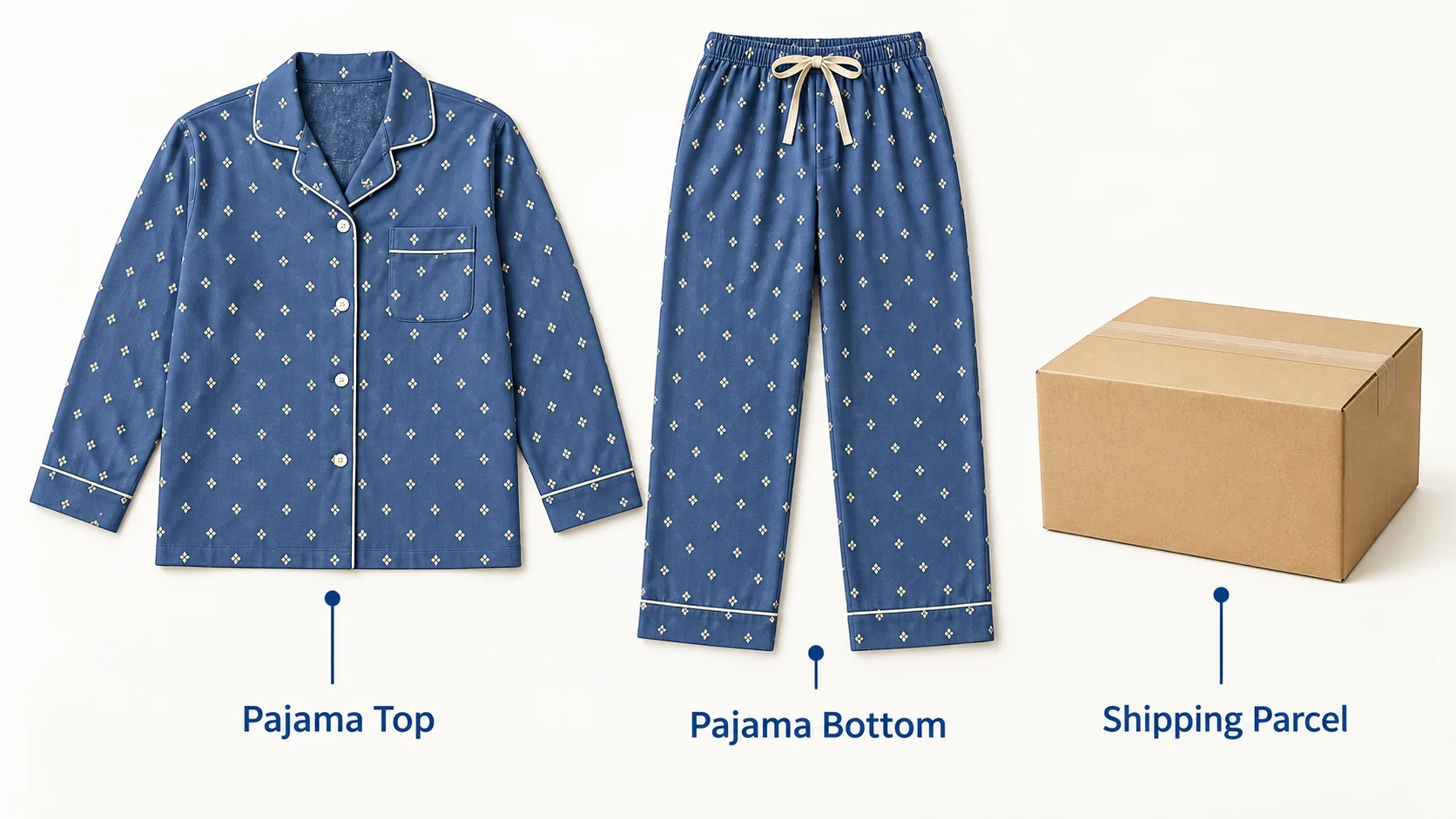
Pajama dropshipping can use ready-made sleepwear or print-on-demand products with your own artwork. Choose the route according to the offer: an everyday garment with a verified fit, or an original design on a specific blank. For a two-piece set, confirm that the top and bottom are sold, priced and fulfilled together before calling it a set.
That last detail is easy to miss. Two attractive catalog products may have different sizes, production locations or parcels. A customer expects a complete outfit; your setup needs to deliver one. This guide follows the fabric, fit, artwork and order-cost decisions that make that promise credible.
The provider pages were checked on October 13, 2026. This article addresses ordinary adult sleepwear. The examples are hypothetical, and no wash or fulfillment test was performed for this review.
01
Choose ready-made or print-on-demand pajamas
Use ready-made stock when the main value is cut, comfort or a defined everyday fit. Use print-on-demand when the original pattern or personalization is a meaningful reason to choose the product. POD does not remove the need to approve the garment itself.
| Route | Useful when | Main question before launch |
|---|---|---|
| Ready-made catalog or sourced set | Fabric, fit and value lead the offer | Are both pieces available in the promised size and origin? |
| Print-on-demand set | Your artwork is the differentiator | Does the chosen SKU include both pieces, and where is it produced? |
| Separate POD top and bottom | You deliberately offer a configurable outfit | How are sizes, parcels and combined costs explained? |
The current Printify pajama page contains different product arrangements. Its listed men’s all-over-print pants are US-fulfilled polyester; a women’s short pajama set is listed as polyester with China fulfillment. Other products have their own details. Inspect the selected SKU and print provider instead of assuming all pajamas on the platform share one material or origin.
For a ready-made route, request exact specifications from a clothing supplier or sourcing partner. The broader clothing dropshipping guide explains how to compare those arrangements. Do not use a children’s catalog as proof of adult product availability.
02
Know whether one order contains a complete set
A set SKU and a store bundle are different constructions. A set may contain both pieces as one supplier product. A bundle combines two products at the store level; fulfillment may still treat them separately.
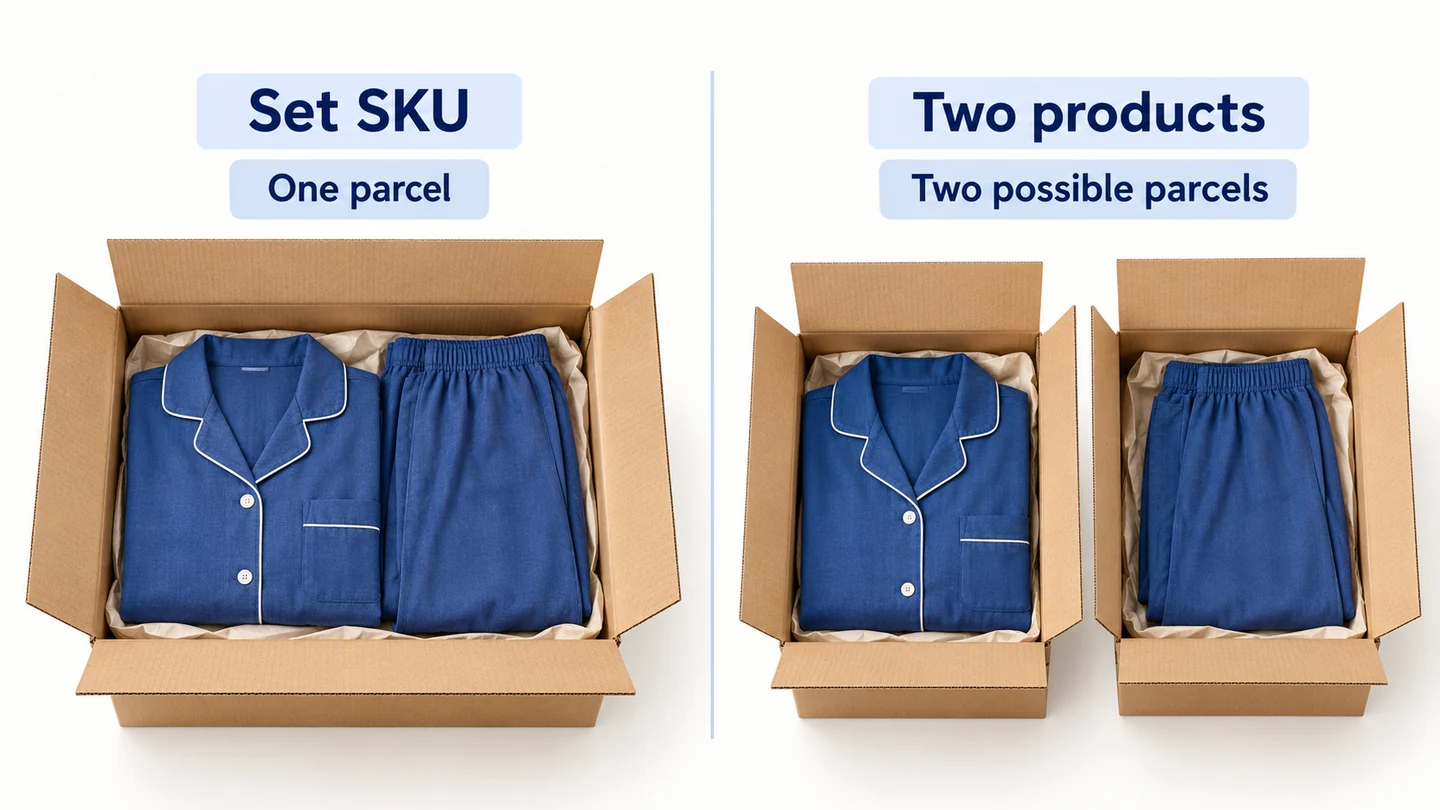
Before publishing, record the supplier identifiers for every piece, the quantity included and whether one selected size controls both pieces. Ask whether a top in medium and a bottom in large can be ordered together if that choice is part of your offer.
Try the purchase on your live product page. When the shopper changes the size, confirm the resulting order contains the intended pieces and variants. For a store bundle, inspect the separate supplier lines rather than assuming the single retail title proves both items were ordered.
If separate parcels are possible, say so before checkout and show both tracking records when they ship. A bottom arriving first should not leave the buyer thinking that half the order was forgotten. Do not label a single pair of pants “pajama set” merely because a styled photo includes a top.
03
Check the top and bottom fit separately
For the top, look at chest room, shoulder shape, sleeve length and body length. For the bottom, check waistband measurement, rise, hip room and inseam. A person can need different sizes in the two pieces.
Ask whether each chart contains body measurements or finished garment measurements. If the waistband is elastic, obtain the provider’s stated method for its relaxed and stretched measurements. Do not invent a safe stretch range from a photograph.
Use a sample to compare the chart with the actual garment under the same measuring method. Record the exact size and SKU. If you intend to sell the items only as a fixed-size set, explain that limitation so the shopper can judge both pieces before buying.
| Buyer question | Information that helps |
|---|---|
| Will the top feel tight? | Applicable chest chart and construction |
| Will the trousers be long enough? | Inseam and how it is measured |
| Can I mix sizes? | The actual product or bundle configuration |
| Will the waistband adjust? | Verified construction and stated measurements |
Keep the actual cut visible in photos: cuffs, pockets, drawstring and closure if present. Mention them only when included on the selected product, not as generic sleepwear benefits.
04
Approve the fabric and wash result
Read the exact composition before describing comfort. Cotton, polyester and mixed fabrics can produce different experiences; “satin” describes a fabric construction and does not automatically mean silk. A product page should identify what is actually supplied.
Follow the stated care method on a sample, then repeat the same measurements after it is dry. A hypothetical trouser length changing from 100 cm to 97 cm is a 3% reduction: (100 − 97) ÷ 100. That calculation explains the observation; one sample would not establish an average shrinkage rate for a production run.
Also inspect seam twist, surface feel, print appearance and color change under ordinary light. Record the wash conditions with the result. “It shrank” is less useful than knowing which measurement changed under which care method.
Do not promise cooling, skin-health or flame-resistance benefits without appropriate product evidence. Children’s sleepwear introduces additional requirements and is outside this adult-product guide. Keep that category separate rather than repurposing the adult setup unchanged.
05
Prepare artwork for the actual panels
A repeating pattern can look good on a flat screen and fail at a seam or waistband. Download the selected product’s current template and inspect which panels are printed. Keep important lettering and small motifs away from trim or seam areas according to that template.
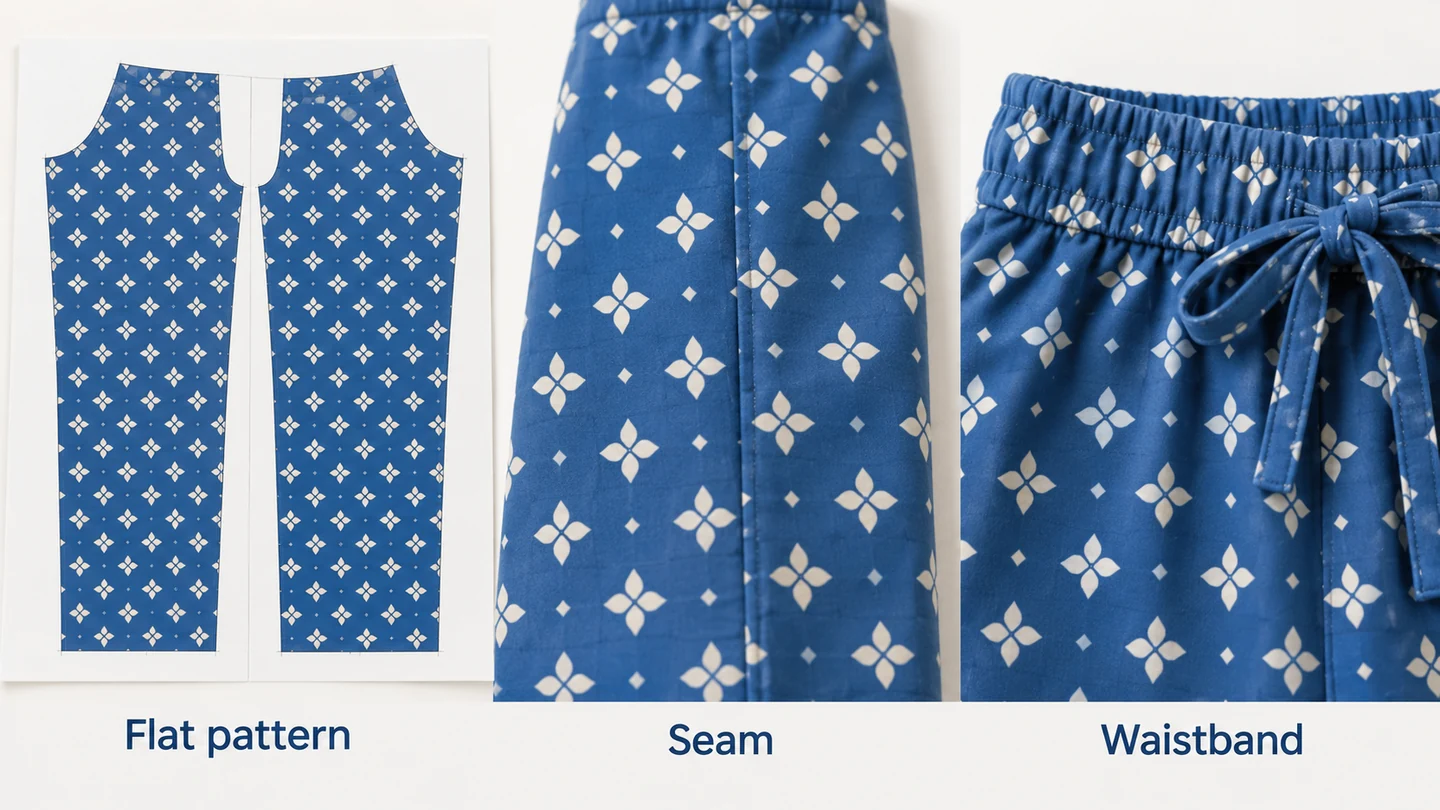
If you create separate top and bottom products, verify the scale and color of the pattern on both. The same uploaded image can be resized differently on each product. A matching mockup is a proposal; the received garments show how the combination looks physically.
For a simple trial, use a repeat with forgiving edges rather than a design that requires two panels to align perfectly. Inspect the front, back, side seams and waistband on the sample. Then photograph the actual set for the product page when you have it.
Avoid licensed characters or logos unless you have the rights. Your own artwork gives you more control over the offer and keeps the sample approval focused on the garment and printing.
06
Price both pieces and every parcel
Here is an illustrative $49 outfit made from two separately fulfilled items. These are teaching figures, not provider prices:
| Item | Separate-parcel example |
|---|---|
| Top | $12.00 |
| Bottom | $16.00 |
| Top shipping | $5.00 |
| Bottom shipping | $6.00 |
| Store payment fee | $1.80 |
| Planning allowance for problems | $2.00 |
| Remaining from $49 before ads and overhead | $6.20 |
If a confirmed combined shipment instead costs $7, with the other assumptions unchanged, the remainder becomes $10.20. You have saved $4 in parcel charges. That benefit exists only when the provider actually combines the items at that price.
Request quotes for the exact destination and quantity. Include personalization, production or other actual charges if they apply. Then compare a one-set offer with a two-set offer without assuming the second set ships free.
Also price a partial failure. If the top is correct and the bottom is missing or the wrong size, you may need to reship one piece, refund part of the sale or replace the whole set. Ask what the supplier can do before writing your store’s remedy.
Our order-cost guide helps separate the customer payment from the actual contribution left after fulfillment.
07
Handle a missing half or wrong size with a matched record
Start with the reported problem, then check the matching record:
| Reported problem | What to check first | What the result tells you |
|---|---|---|
| One piece is missing | Supplier order lines and each tracking record | The second piece may have its own documented parcel; do not call it lost without checking. |
| A wrong item arrived | Ordered variant, received item label and parcel contents | A mismatch points to the order mapping or fulfillment. |
| The set does not fit | Sent variant, ordered size and the measurements shown on the page | Separate product accuracy from a missing or misleading fit explanation. |
The Printify remedy policy provides a damage or manufacturing-error route with photo evidence within 30 days of delivery; it does not cover a buyer choosing the wrong size or color. Verify the selected provider’s applicable terms and your store’s own obligations.
Improve the relevant part of the offer after the case. If customers cannot tell that sizes are fixed as a set, say that beside the size selector. If one inseam repeatedly causes confusion, show its measurement plainly.
For a ready-made set with defined fabric, sizing and packaging, ask AIDrop for a sourcing and sample review. Send specifications for both pieces and the destination. We can discuss that scope without claiming control over a POD provider’s printing or refund decisions.
08
Questions about adult pajama dropshipping
Can I advertise polyester satin as silk?
Use the verified fiber composition. A satin appearance or weave does not establish silk content. Tell the buyer what the selected garment is actually made from.
Are two imported products automatically a set?
No. Check the supplier order lines, quantities and fulfillment. If you create a store bundle, explain any separate size choices or parcels before purchase.
Should I order a printed sample before publishing?
Yes, if the offer depends on the artwork, fit or fabric experience. Check both pieces together. A sample of only the top cannot approve the bottom or the complete pattern combination.
Can I use the same process for children’s sleepwear?
Treat it as a separate product and compliance task. This guide addresses adult sleepwear and does not establish the requirements for children’s products.

Clothing Dropshipping: Sizes, Variants, Samples and Returns
Verify apparel sizes, variants, samples, labels and returns before launch. Build a clothing dropshipping offer around accurate
Clothing Dropshipping Suppliers: 5 Options for Different Stores
Compare Trendsi, Printful, Printify, Apliiq and BrandsGateway by clothing model, fit information, stock, shipping and return costs.
Shoe Dropshipping: Sizing Evidence, Variants and Return Exposure
A shoe listing needs model-specific fit evidence, exact size-color stock and a workable exchange route. Compare one
