
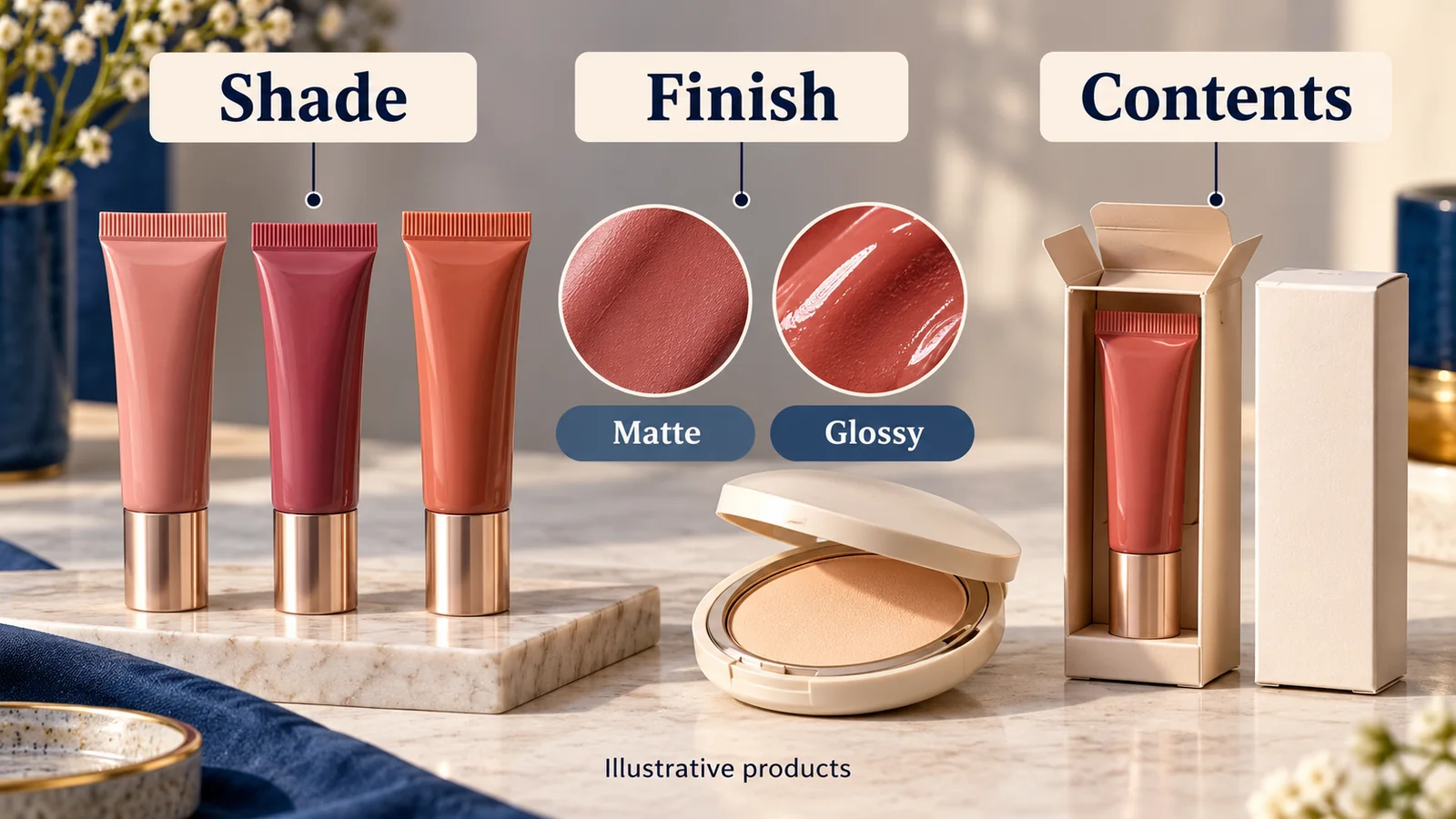
Makeup dropshipping means a supplier sends cosmetics directly to the people who buy from your store. Your job is to make that purchase understandable: the buyer must be able to choose the right shade, know the finish and receive the exact product described. Start with a range you can identify and support, rather than importing every attractive color in a catalog.
Imagine a shopper choosing a soft rose lip color. “Rose” alone does not tell her whether it is sheer or opaque, glossy or matte. It may not even tell your supplier which tube to pack. A useful makeup store connects the customer description, supplier code and physical label.
The product examples below are illustrative. The regulatory references concern US cosmetic sales and were checked on October 17, 2026. The broader beauty products guide covers the wider category and business responsibilities.
01
Choose a makeup routine you can describe clearly
A small range can still offer a meaningful choice. Choose the routine first: an everyday lip look, complexion matching or a particular eye look. Each asks you to explain something different.
| Starting range | What the buyer needs to choose | What the store must verify |
|---|---|---|
| Lip color | Shade, finish, coverage and quantity | Exact shade code, intended lip use and accurate product information |
| Complexion makeup | Depth, undertone, coverage and finish | A usable shade system and information that does not overpromise a match |
| Eye makeup | Color, finish, application area and contents | Intended use, relevant ingredient documentation and clear directions |
None is automatically easy or guaranteed to sell. A foundation range can become difficult if the supplier has many shades but cannot provide consistent descriptions or authorized photographs. A small lip range can still be unsuitable if its identity, formulation or labeling is unclear.
Look at the customer’s complete choice. Does a kit include the applicator shown? Are three tubes sold together or pictured together to show options? Does “nude” mean the same thing across the range? Explain these points before the buyer reaches checkout.
You can add products later. First, choose enough items to serve a clear purpose and learn which questions customers actually ask. Adding more shades before you can describe the first ones multiplies uncertainty rather than solving it.
02
Choose how you will source and brand it
There are two common routes to investigate. You can resell documented existing products with appropriate permission, or use a service that offers cosmetics under your brand. Private labeling changes more than the appearance of the tube: responsibilities, artwork, minimums, setup charges and replacement arrangements need checking.
For examples of services to research, Blanka‘s Shopify App Store listing describes branded beauty products and fulfillment. DR.HC’s YOURS private-label program describes another branded cosmetics route. These are providers’ own descriptions, not our testing or a ranking of their products.
Before choosing either kind of service, request information for the actual items you intend to sell:
- Current product and shade references, with ingredients and intended uses.
- The countries served for those products and the warehouse used.
- The labeling arrangement and the business responsible for the product information.
- Samples, branding charges, recurring subscriptions and any minimum purchase.
- Current packing, delivery and claim procedures for damaged or incorrect items.
Do not assume a provider’s general “no minimum” or fast-delivery message applies to every customization and destination. Obtain the current terms for your range. A plain stock tube and a custom printed carton may involve different commitments.
Keep the response with the product record. If a supplier changes the formula, shade system or packaging, you need to know which listing and orders the change affects. The supplier’s brand presentation does not replace your own understanding of the item.
03
Make shade, finish and product code agree
Color names help people shop; exact codes help systems and people choose the same item. Keep both. A hypothetical three-shade range might look like this:

| Your store option | Supplier pick code | Description to verify |
|---|---|---|
| Rose 01 | LC-R01 | Rose tone; agreed finish and coverage |
| Berry 02 | LC-B02 | Berry tone; agreed finish and coverage |
| Peach 03 | LC-P03 | Peach tone; agreed finish and coverage |
Those codes and shades are fictional examples. For a real range, use the actual supplier references and confirm the description against the product documentation and samples. Do not reuse an image simply because its filename resembles the color name.
Show the color honestly
Use authorized, relevant photographs. Explain what they show: the tube, a swatch, packaging or the result of a particular application. Screen settings, lighting and the surface underneath can change the apparent color. A photograph helps a customer choose; it cannot guarantee how a product will look on every person.
Avoid generated swatches as evidence of a real cosmetic shade. An illustration can explain the difference between two kinds of finish, but it should not impersonate a photograph of the actual formula. Ask for real product imagery or commission accurate photography of the approved sample.
Map each store variant to its exact supplier pick code. In a controlled test, select a neighboring shade as well as the first option. If every variant points to the first imported item, a beautiful shade selector merely makes the error easier to purchase. The SKU mapping guide explains that connection in more detail.
04
Read the label before writing the promise
Obtain the product’s actual ingredient and label information before publishing claims. FDA’s US labeling summary explains identity, quantity, ingredient and business-information requirements. A supplier’s short marketing description is not a substitute for that information.
Match the claim to the evidence
Read the words you plan to put on the product page. These three examples need different support:
| Proposed wording | What needs to be established |
|---|---|
| “For lips and eyes” | Check the color additives for both uses. Permission for one area does not automatically cover the other. FDA use rules. |
| “FDA approved” | Registration is not proof of product approval. Establish what the supplier’s document actually covers. FDA overview. |
| “Matte finish” or “Treats eczema” | The first describes appearance; the second makes a disease-treatment claim. That can bring drug rules into play. Check the exact claim before publishing. |
The same care applies to allergy or universal-suitability claims. Keep the copy within what is supported for the actual product and intended use.
If your brand will appear on the label, establish your role and applicable responsibilities before launch, including current MoCRA requirements where relevant. This section is a starting point for checking a US offer, not a complete regulatory approval process. Use the linked beauty guide and appropriate specialist review for the actual product and market.
05
Price the delivered order and a wrong-shade shipment
A low tube price can hide an expensive parcel. Count the customer shipping charge as money received and the carrier charge as a cost. They are not necessarily equal.
Here is an illustrative USD order, unrelated to a provider’s quote:
| Order amount | Example |
|---|---|
| Makeup price paid by customer | $24.00 |
| Shipping paid by customer | $4.00 |
| Total received before any applicable tax treatment | $28.00 |
| Product cost | $7.00 |
| Carrier charge | $6.00 |
| Packing | $0.60 |
| Assumed payment fee | $1.14 |
| Left before advertising, fixed costs and remedies | $13.26 |
Now suppose the warehouse sends Rose 01 instead of the ordered Berry 02. Sending the correct item costs another $7 in product, $6 in shipping and $0.60 in packing: $13.60 extra. The affected order now leaves minus $0.34 before the other costs, unless an actual supplier reimbursement changes that result.
That calculation does not predict a failure rate. It shows why picking accuracy and responsibility for wrong items matter. Adding a guessed “returns reserve” and then counting that same replacement twice would distort the example.
A correctly supplied shade that the customer dislikes is a different situation from an incorrect item. Describe your applicable return arrangements clearly, while respecting the customer’s rights. A supplier’s claim policy and your customer-facing obligations do not automatically match.
06
Test the customer choice through to the parcel
Once you have a documented candidate, test the same path the buyer will use. This is a proposed assessment, not a product test we have conducted.
- Select a named shade on a phone and inspect the matching image, price and contents.
- Place the properly authorized sample order and retain the store confirmation.
- Match the selected variant to the supplier request and pick code.
- On arrival, compare the tube, carton, shade code, quantity and label with the approved record.
- Inspect the condition and seal, and record any difference before expanding the range.
Visual inspection cannot establish cosmetic safety. It can reveal an incorrect item, unreadable label, damaged pack or mismatch between what was offered and what arrived. The sample guide helps organize checks against a defined reference.
If Berry 02 arrives as Rose 01
Help the customer and investigate the mapping. Keep the store order, selected option, supplier request and useful photographs together. Hold further orders for the affected variant while you determine whether the problem is in the listing, system mapping or physical picking.

Before placing a corrective order, confirm whether one has already been created. Fixing the original mapping is necessary for future buyers, but it does not itself send the current buyer the right item. Verify both results separately.
For a China-side sourcing or packing comparison, send AIDrop Agent the exact product and shade references, label requirements and destinations. Ask what documentation and handling the proposed range requires before requesting a price. A generic “lipstick dropshipping” inquiry leaves too much unspecified.
07
Help the customer without hiding behind hygiene language
A wrong item, a broken tube, a suspected reaction and a change of preference require different responses. Start with what happened and identify the actual product and, where relevant, batch. Ask only for evidence that helps resolve that issue.
Do not respond to every problem with “cosmetics cannot be returned.” A hygiene policy does not erase applicable rights for incorrect or defective goods. The returns guide explains how to separate the customer remedy from a supplier reimbursement request.
If a customer reports a possible health or safety issue, avoid giving a diagnosis or reassuring them without evidence. Advise them to stop using the item, seek appropriate medical help where needed and provide a clear way to report the product details. Investigate the affected product and follow applicable safety-reporting obligations.
Keep product corrections visible to the team. An updated shade description should reach the storefront, support answers and packing reference. Otherwise, the next customer can run into the same confusion even after the first complaint is closed.
08
Makeup dropshipping questions
Can I start without my own makeup brand?
Yes, if you have an appropriate arrangement to resell the products. Confirm sourcing, permission to use brand assets, product information and fulfillment. A private-label service is another route, not a requirement for every store.
Do I need a large shade range?
You need enough choice to serve the intended customer honestly. A large range is difficult to sell well if its shades are poorly described or inconsistently mapped. Start with a range you can document, then expand for a real customer need.
Can I use supplier photographs?
Only when you have permission and they accurately represent the item. Confirm the shade and version. Do not use an attractive generic swatch to stand in for an undocumented product.
Does a supplier’s registration mean every product is FDA approved?
No. Registration, product information and the legal status of ingredients or uses are different matters. Use the FDA references above and establish the responsibilities for the actual US offer.
Are private-label minimums always high?
They vary by provider, product and customization. Obtain current minimums and charges for the actual label, tube and carton, rather than assuming a general service headline applies to the whole pack.
Can customers return an unopened product?
That depends on applicable rights and the stated sale terms. Give a clear contact route and assess the reason for return. Do not copy a supplier’s business policy into your consumer policy without checking the difference.

Beauty Products Dropshipping: Claims, Ingredients and Supplier Records
Choose an explainable beauty range with actual supplier examples, product and label questions, a worked bottle-cost example,

Supplement Dropshipping: Choose a Supplier and Check What You Can Sell
Choose an exact supplement offer and supplier route, match the formula and label, calculate a complete paid

Hair Extension Dropshipping: Choose the Length, Texture and Order Route
Compare actual hair vendor routes, fill a precise bundle or wig request, budget app access and a
