
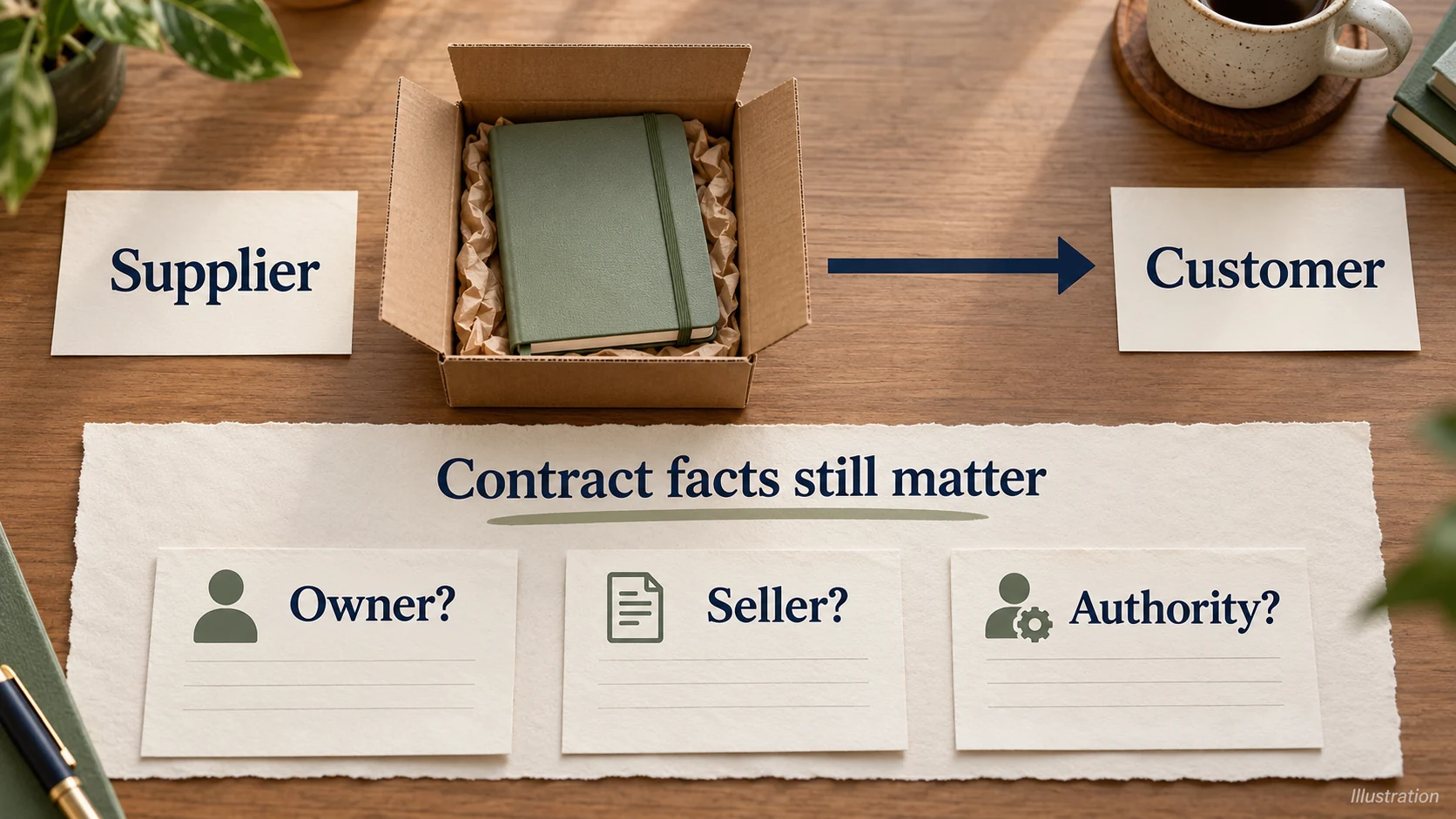
Some dropshipping arrangements are accepted by the scholars cited below, while other arrangements are not. The contract and the order of events matter: selling as an owner, acting as an authorized agent and making a qualified advance sale are different transactions. The fact that a supplier sends the parcel does not tell you which one your store is using.
You may have found one answer saying dropshipping is prohibited and another saying it is permissible. Before assuming one of them settles your store, compare what is actually being sold, who owns it, whose behalf you act on and when payment and the binding sale occur.
This article explains the cited views and a way to describe your transaction for review. It does not issue a personal religious ruling or certify a store, app or supplier arrangement.
01
Why the answers you find differ
Dropshipping describes a delivery method in ordinary ecommerce. It does not describe every contractual right between the buyer, website operator and supplier. Two sites can send a parcel along the same route while making different agreements.
The primary answers show why the details matter:
| Primary source | Position and condition to retain |
|---|---|
| Jordan’s Iftaa Department, ruling 3754, March 2023 | Distinguishes several forms, including prior-authorized agency, referral commission, a prohibited unowned-sale scenario and a qualified Salam arrangement |
| Egypt’s Dar al-Ifta, fatwa 6464, February 2022 | Permits the described online transaction subject to removing harmful uncertainty and harm, with applicable rules observed |
| Islam Question & Answer, answer 334744 | Emphasizes ownership and possession concerns and discusses ways of structuring the transaction differently |
| SeekersGuidance, Shaykh Muhammad Carr, March 2025 | Accepts a Salam structure in the Shafi‘i school when the conditions of its separate stages are met |
The linked answers address particular questions and should be read in their own context. The table is not a vote count or a claim that all schools have agreed on every form.
The Egyptian ruling, for example, discusses a described product, an agreed overall price and the removal of uncertainty that can cause harm or dispute. A restrictive answer about selling an unowned item may be assessing a different sequence or using a different interpretation. Neither headline should be turned into permission to ignore the actual conditions.
02
Ownership and possession are separate questions
Ownership asks whose goods you are selling. Possession asks whether the relevant delivery or control has been established under the view applied to the transaction. A product photograph, an imported listing and permission to use an app do not answer either question by themselves.
Islam Q&A distinguishes selling something not owned from reselling something bought but not yet possessed. That is why “I can order it after the customer pays” may not answer the concern raised in that ruling.
Not touching the parcel is an incomplete test
It is also too simple to decide every case by whether a parcel passes through your home. Darul Ifta Birmingham’s discussion cites actual and constructive possession. The relevant question is what rights and control have actually been established, not merely whether you personally carried a box.
For goods held elsewhere, collect the supplier or warehouse terms: which goods are yours, what has been allocated, who may release them, and what obligations you bear. Those facts can be reviewed under the appropriate view. Do not treat an invoice, a stock reservation or a supplier’s use of the word ownership as an automatic religious determination.
The timing matters too. If your intended structure requires ownership and possession before your binding sale, purchasing later does not move those events backward. Establish when the customer contract is actually made; do not infer it from a convenient label on the checkout button.
03
Agency changes what you agree to do
In an agency arrangement, you act for another party under authority they have given you. The Arabic term wakalah refers to agency. That is a different role from selling goods on your own account and keeping a retail margin.
Jordan’s ruling describes prior authorization from a supplier to sell specified goods for agreed compensation while the supplier dispatches them. Islam Q&A also distinguishes acting for the original seller from acting for a customer who appoints you to buy.
A commission needs an actual agreement
Suppose, purely as an illustration, a supplier appoints an operator to sell its notebook and agrees a fee for that work. Identify the supplier as the principal, the task the operator may perform, how compensation is determined and what obligations remain with each party. The agreement—not the website’s description of itself as an agent—establishes the proposed role.
Darul Iftaa Chicago’s September 2026 answer likewise distinguishes a prior agreement to market and sell on a company’s behalf from an operator first making its own sale and then purchasing elsewhere. Its discussion also considers who bears the refund responsibility under that arrangement.
Do not turn every difference between supplier cost and customer price into a commission by renaming it. The authority, task, compensation and responsibilities have to match the actual arrangement. Different fee or leftover-profit terms can raise further questions; the agency label alone does not approve every way of paying the operator.
04
Salam is a specific advance-sale contract
Salam is an advance-sale arrangement for goods described by agreed specifications and supplied later, subject to its conditions. It is not simply another name for collecting money before buying something.
The cited Jordan answer describes advance payment and an agreed supply period. Islam Q&A’s discussion emphasizes receipt of the full price under the relevant conditions, including a concern where money remains with an online intermediary. The actual payment facts therefore matter.
Record what your provider does: authorization, capture, availability of funds and payout may be separate events in its records. Present those records for review rather than assuming that a screen saying paid settles what counts as receipt for the intended contract.
Specifications and delivery remain your commitment
SeekersGuidance’s January 2022 answer stresses accurate descriptions and delivery dates, and the seller’s responsibility to provide the item by the stipulated date if the first supplier cannot supply it. The arrangement does not make the buyer’s entitlement depend only on whichever supplier happens to answer.
An exact description and an agreed delivery term are more useful than “something like the photo” or “whenever the supplier ships.” Product eligibility, payment and other conditions still require review for the specific arrangement. Do not assume a general Salam answer covers every product in a catalog.
There are differences in how the cited answers discuss disclosure. Carr’s 2025 answer does not require the disclosure asked about in that Salam question; the Birmingham answer instructs the seller to explain that the item will be purchased after payment. Keep that difference visible instead of inventing one universal checkout sentence. Neither answer removes separate consumer or platform requirements.
05
Map one proposed order before asking for a ruling
Use a concrete record so the scholar can assess an actual transaction rather than the word dropshipping. The following notebook example is fictional and is not an approved agency or Salam contract.
| Part of the proposed order | Fictional record to assess |
|---|---|
| Product | One new green A5 notebook with 192 lined pages and 90 g/m² paper; an invented specification, not a supplier SKU |
| Your role | The store presents itself as the seller; no prior agency authorization is documented in this example |
| Customer contract | Assume the store’s sale confirmation is binding and occurs before its supplier purchase |
| Payment | A card authorization is recorded; the provider’s collection and availability terms have not been supplied for review |
| Supplier purchase and control | The supplier holds unallocated stock when the store confirms the sale; a purchase request follows, and prior control is not documented |
| Delivery and problems | The buyer looks to the store for delivery; the supplier-failure arrangement has not yet been agreed |
Follow the sequence, not just the parcel
Imagine the store accepts the customer order first and only then orders the notebook from a supplier. Write those events in that order. Do not fill in “already owned” because you expect to buy the notebook a few minutes later.
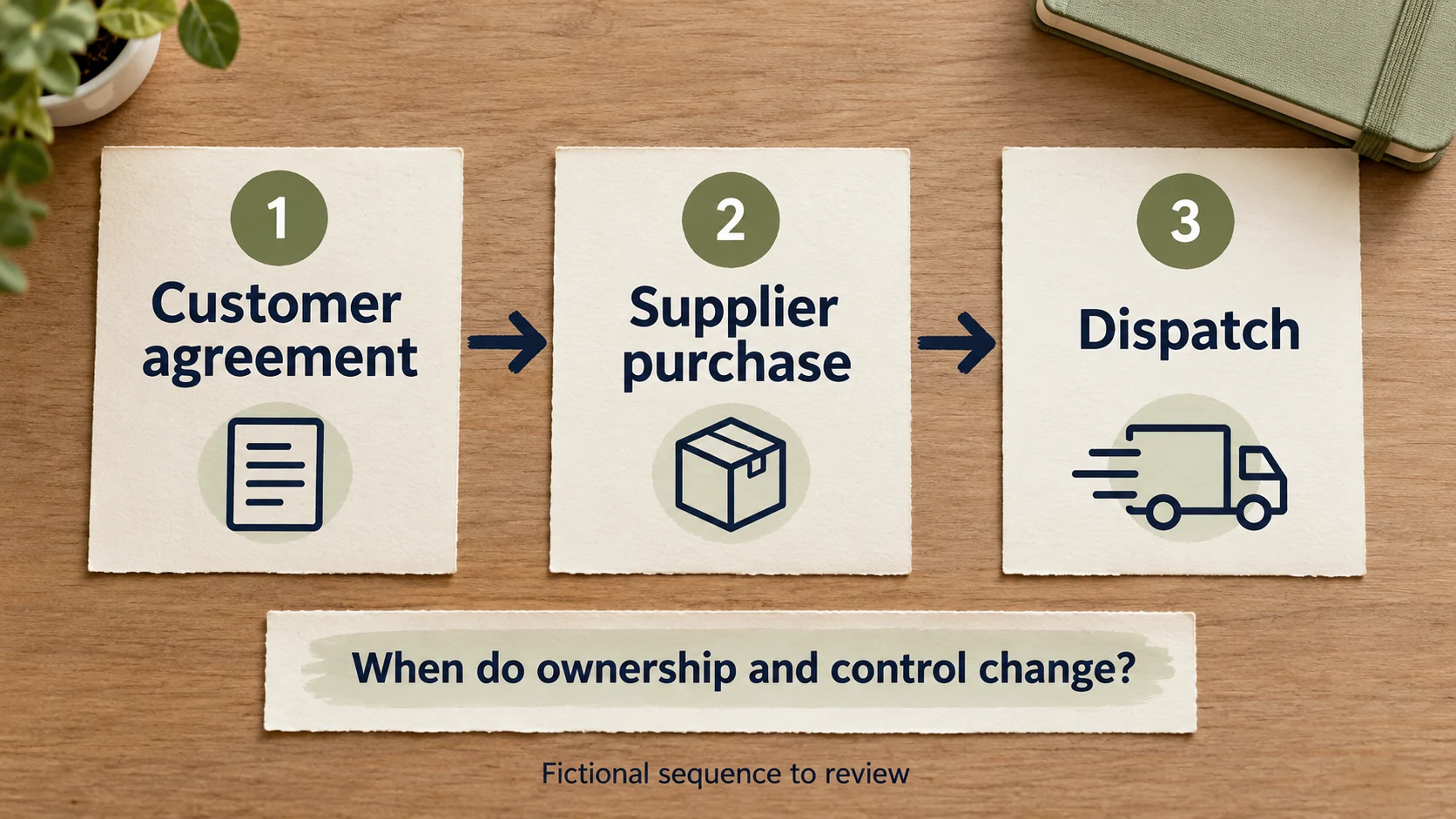
If you propose agency instead, attach the principal’s authorization and the agreed task and compensation. If you propose Salam, attach its intended terms and the actual payment arrangement. Those are different sets of facts; you cannot borrow one feature from each and assume the mixture is approved.
Bring the checkout wording, store terms, supplier agreement, payment-provider information and a proposed failed-order response together. A screenshot of the product page alone leaves the central questions unanswered.
The example has not established ownership or control before the assumed binding sale, prior agency authority or the relevant receipt of price. Those gaps explain what still needs resolving. The answer depends on the arrangement being assessed; the table does not silently approve the transaction as one of the alternatives.
The useful result is a clear description of your arrangement and the specific changes a qualified reviewer requires. This example demonstrates preparation; no scholar has approved the fictional notebook transaction shown here.
06
Changing the wording does not change the transaction
A supplier agreement and the store’s behavior have to follow the arrangement you adopt. Adding “we are an agent” to terms while continuing to make a different transaction does not establish the missing authority. Calling a charge an advance sale does not establish all its conditions.
The same applies to fulfillment companies. A business called a dropshipping agent may provide sourcing, packing or shipment services. Its name does not show whom it is authorized to act for in your sale, when ownership changes or how possession is established.
If you want help describing China-side sourcing or fulfillment facts, contact AIDrop Agent with the product, stock location and proposed handoff. We can discuss the physical process. The agreement and its religious assessment should be reviewed by an appropriately qualified scholar; we do not provide a halal certification for the transaction.
After making changes, compare the records for one permitted order with the arrangement reviewed: who had authority, when the sale became binding, what happened to the payment and when the supplier purchase occurred. A contradiction in those records identifies a remaining problem more clearly than rereading a new policy paragraph alone.
07
Frequently asked questions
Must I personally store every item?
Personal handling is not a complete test for all the arrangements discussed. Agency, ownership and possession raise different questions. If goods remain with a supplier or warehouse, describe the actual authority and control rather than treating the address alone as the answer.
Is taking customer payment first always prohibited?
The cited sources discuss qualified advance-sale arrangements, so timing alone does not produce a universal answer. The particular contract, receipt of price, goods and delivery conditions matter. A normal checkout should not be called Salam without reviewing those facts.
Does a Shopify app or supplier agreement make the store halal?
An app can transmit orders; an agreement can describe commercial terms. Neither name certifies the whole transaction. The actual role, authority, sequence and obligations need to match the arrangement assessed.
What about the products and financing used by the store?
They need attention separately. A potentially acceptable delivery arrangement does not establish that every product or payment/financing term is permissible. The cited answers also identify product and transaction conditions; include the real details when requesting advice.
Does a religious opinion also approve the store under civil law?
No. Product, consumer, tax and selling-platform requirements remain separate. Our dropshipping legal guide covers that different task, while the returns guide explains operational customer remedies. Do not use a religious answer to promise an exemption it does not discuss.
Sources and scope
Sources checked October 26, 2026: the linked original institutional and named-scholar answers. Their dates, conditions and differences are retained; mirror sites were used for discovery rather than substituted for accessible originals. This is an explanatory comparison, not a personal fatwa or a claim of scholarly consensus. The notebook and transaction record are illustrative; no contract, payment or store was certified or tested for this article.
Is Dropshipping Legal? What Your Store Is Responsible For
Learn the US responsibilities behind dropshipping: product safety, licenses, taxes, shipping promises, intellectual property, imports and customer

Dropshipping Taxes: The Records and Questions to Prepare
Income tax, sales tax and import charges follow different rules. Use a US operating baseline to separate

Dropshipping Copyright and Trademarks: Check Products, Images and Store Claims
Check dropshipping products, images and store claims separately. Review supplier permissions, intended uses, launch decisions and infringement
