
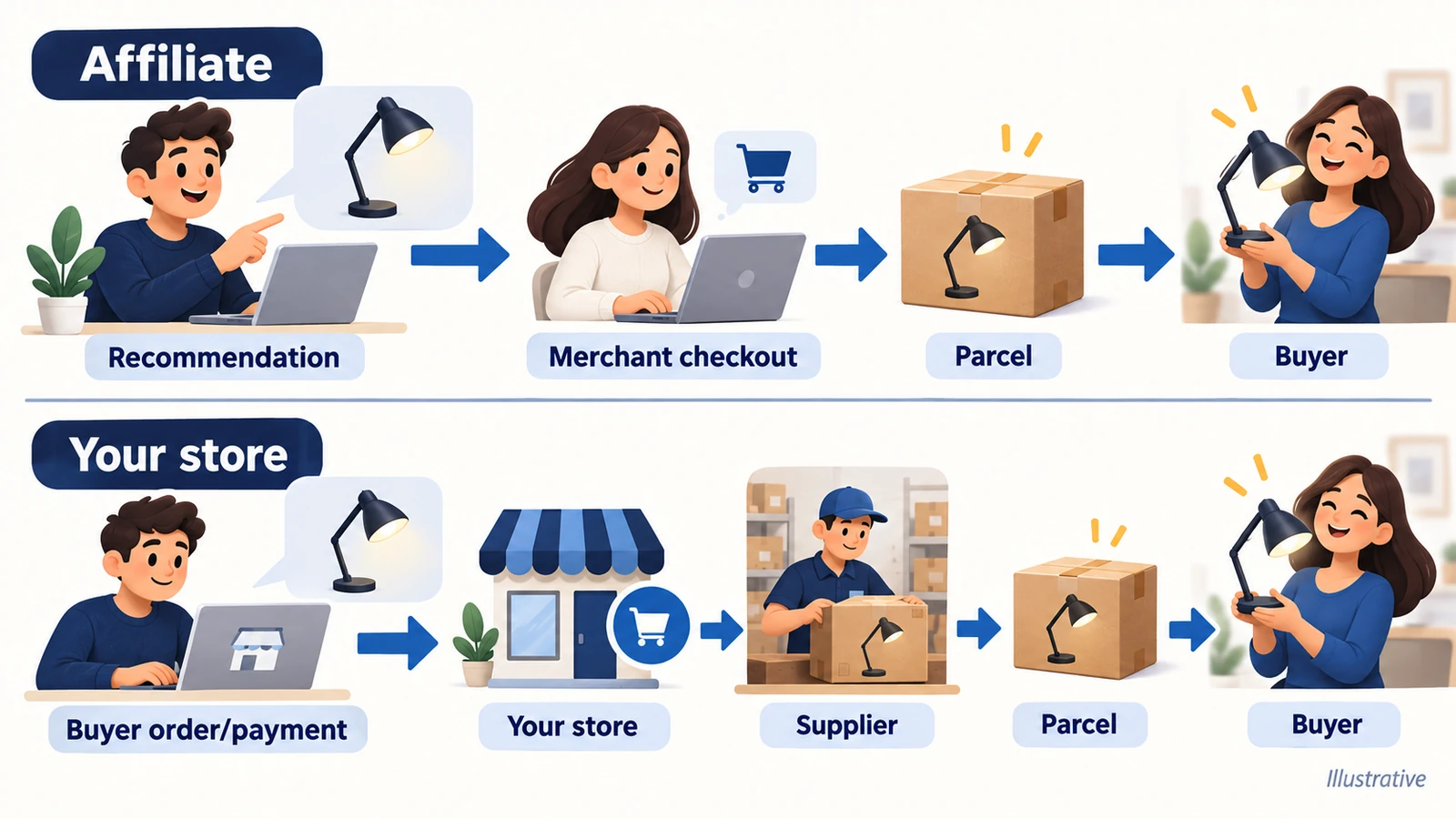
Choose affiliate marketing if you want to help people choose another merchant’s products. Choose dropshipping if you want to run the retail offer and can fund suppliers, refunds and customer support. An affiliate earns a commission for an eligible referral; a dropshipping seller receives the sale price and pays the costs of completing the order.
Affiliate marketing avoids the need to buy each customer’s product from a supplier. Dropshipping gives you more control over pricing and the offer. Both still need a reason for people to listen, click and buy.
01
Who takes payment and who serves the order?
Imagine someone choosing a $50 desk lamp. An affiliate explains the choices and links to a merchant. The buyer pays that merchant, which handles the product order. A dropshipping seller lists the lamp in their own store, takes the payment, pays a supplier to ship it and remains the buyer’s point of contact.
| What changes | Affiliate marketing | Dropshipping |
|---|---|---|
| Where the buyer checks out | The merchant’s site | Your store |
| Who sets the retail offer | The merchant | You, within your supplier and platform arrangements |
| Your income | Commission on an eligible referral | Sale revenue; your earnings depend on the costs |
| Your main daily work | Useful content, audience growth, links and program performance | Product pages, marketing, ordering, stock, delivery and buyer support |
| Cash for goods | You do not fund the buyer’s order | You may pay the supplier before your store payout arrives |
| Refund and parcel problems | The merchant serves the buyer; your commission may be reversed | You serve the buyer and separately pursue any supplier remedy |
| Main dependency | Program access, terms, attribution and merchant offer | Product demand, supplier performance and order economics |
On a phone, swipe the table sideways to compare every column.
Choose it for useful buying advice
Affiliate marketing suits a person who can answer a buying question well: which lamp fits a small desk, how two features compare, or which option suits a particular task. An existing relevant audience helps, but you can also build one. The ongoing job is producing useful recommendations and keeping them accurate when products or terms change.
Choose it for running the retail offer
Dropshipping suits a person who wants to design and price an offer, improve its packaging or assortment, and keep serving customers after checkout. Supplier shipment does not remove the retailer’s responsibilities. Shopify’s dropshipping legal guidance covers that relationship; the dropshipping introduction explains the wider model.
If you enjoy publishing but do not want to manage parcels and refunds, affiliate marketing is the clearer first direction. If you want a retail business and can fund its orders and remedies, consider dropshipping. Neither choice removes the work of attracting buyers.
02
Compare the money left, not the sale price
Use one hypothetical calculation: twenty $50 purchases, two full refunds and $100 in marketing costs for either model. The affiliate commission is an assumed 5%, not an Amazon lamp rate. For the store, assume all twenty orders shipped, each costing $20 for the product and $6 for delivery.
| Money in or out | Affiliate example | Dropshipping example |
|---|---|---|
| Income after the two refunds | 18 × $50 × 5% = $45 commission | $1,000 − $100 = $900 net sales |
| Goods for twenty shipped orders | Paid by the merchant | $400 |
| Shipping for twenty orders | Paid by the merchant | $120 |
| Payment processing | Outside this affiliate calculation | $36: assumed 3% + $0.30 on each original payment, retained after refunds |
| Marketing | $100 | $100 |
| Store subscription | Outside this affiliate calculation | $40 |
| Amount remaining | −$55 | $204 |
On a phone, swipe the table sideways to compare every column.
The affiliate calculation is $45 − $100 = −$55. The store calculation is $900 − $400 − $120 − $36 − $100 − $40 = $204. Both exclude content labor, samples, extra tools and tax; the store also excludes additional returns, replacement freight or disputes. These are different business costs, not measured results showing that one model always earns more.
The affiliate example can afford $2.25 per purchase
The example explains a useful limit. Affiliate commission averages $45 ÷ 20 = $2.25 per initial purchase after the assumed refunds. Paying more than that to generate each purchase loses money even before other content or website costs. A larger commission or lower marketing cost changes the result. At an assumed 10% commission, the same affiliate example leaves $90 − $100 = −$10.
The store has more room in this calculation, but its costs can change quickly. Shipping at $10 instead of $6 adds $80 across twenty parcels and reduces the remainder from $204 to $124. Price the actual destination before choosing the offer.
Cash you need before payouts arrive
The twenty store orders require $520 for goods and shipping if the supplier bills before your payment processor releases the money. Add the assumed $100 marketing budget and $40 store bill, then hold $100 for two possible refunds: $760 of available funding, plus the unpriced sample and other setup costs in this example.
That refund reserve is cash kept available, not another cost to subtract from the $204 calculation. Actual refunds already reduced revenue in the table. A payment dashboard showing sales does not mean all of the money is available; payout schedules and possible holds matter. Shopify explains payout timing and reserves for its payment service.
An affiliate does not fund the $520 supplier bill, but still needs enough money and time to create and promote the content before commissions become payable.
03
Understand when a commission becomes payable
A referral click is not income. An affiliate program defines the action that qualifies, how it must be attributed to your link, what can reverse the commission and when money can be paid. Read those terms before choosing an offer or buying promotion.
Two current examples, checked again on October 11, 2026, show the difference:
- Amazon Associates US: its program policy covers qualifying purchases and excludes canceled, returned or refunded orders. The ordinary referral session can end before 24 hours, including when the customer places a non-digital product order or clicks another affiliate’s link. Category rates and the full policy determine the actual commission.
- Shopify Affiliates: this is a software-plan referral, rather than a commission on a physical lamp. The earnings page lists $150 USD for eligible US merchant referrals to Basic, Grow or Advanced after the required full-price payment. Trials alone do not qualify. Refunded or fraudulent referrals can be reversed, and other merchant locations can have different amounts.
Payment also takes time. Amazon’s US payment help says approximately 60 days after the earning month’s end, with a $10 threshold for bank transfer or gift certificate and $100 for checks. Its payout guidance also requires tax information.
Impact payment and bank withdrawal differ
Shopify’s published timeline locks the previous month’s eligible actions on the 21st and sends payment to the Impact balance the following day; that is separate from withdrawing money to your bank.
For the program you intend to use, answer five questions:
- Am I eligible, and is my website or channel accepted?
- What purchase or action earns commission, at what current rate?
- How long does attribution last, and what disqualifies an action?
- Is my planned advertising or traffic source allowed?
- When can approved earnings reach my available payment balance?
These answers decide whether your content and budget fit the offer. For example, Amazon restricts certain paid-search placements involving its trademarks; a marketing plan that depends on them cannot simply be applied to its affiliate links.
04
What happens when the buyer needs a refund?
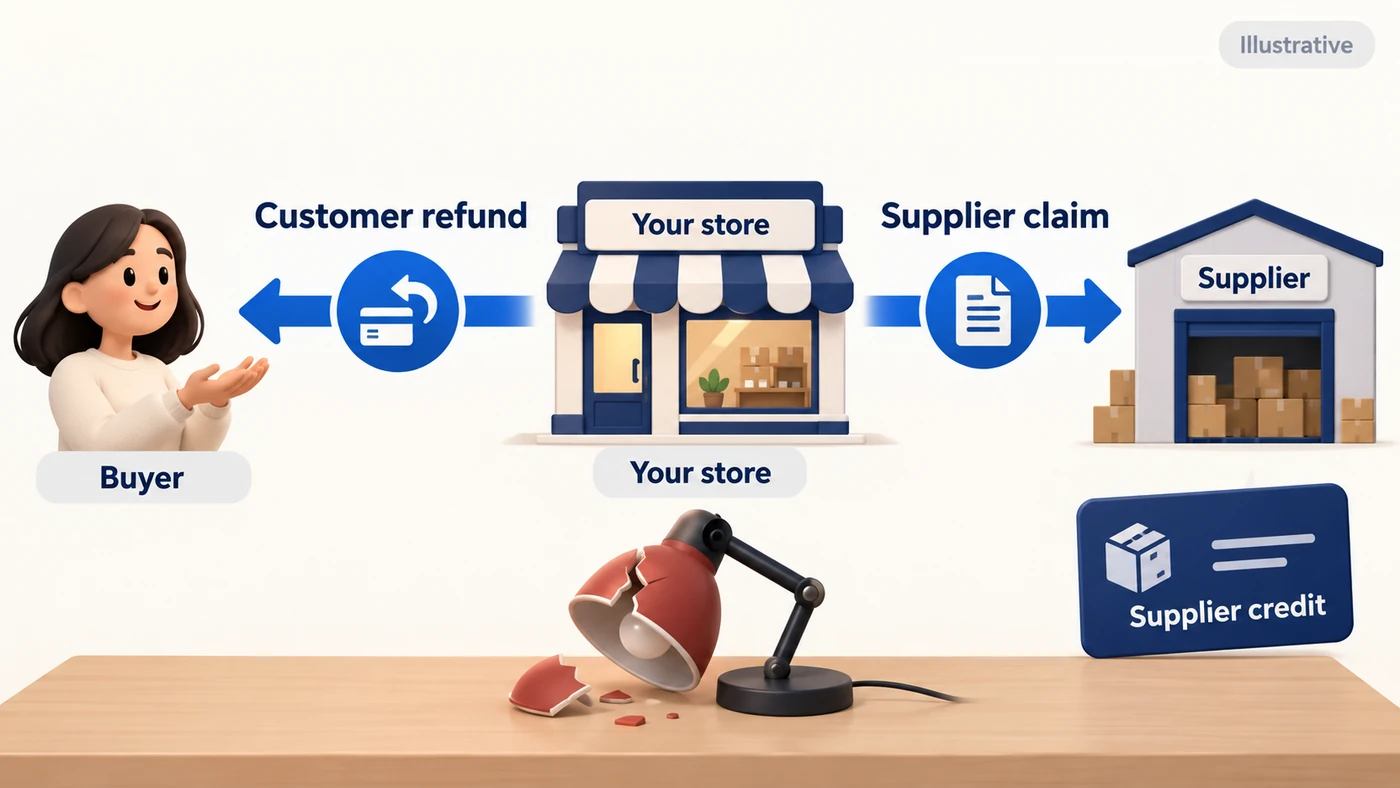
If the lamp arrives broken, an affiliate’s reader takes the order problem to the merchant. The affiliate may lose the commission after a refund, and repeated complaints are a reason to reconsider the recommendation.
If the buyer purchased from your dropshipping store, you respond. Ask for the order details and evidence needed to understand the fault, then provide the applicable remedy under your terms and the relevant customer rules. At the same time, send the supplier the information required for its defect claim.
A supplier credit cannot fund today’s refund
Those two conversations can have different outcomes. The customer may receive a refund while the supplier reviews photographs or offers a credit toward a later order. A promised supplier credit is not cash you can use to refund the buyer today.
Refunding the buyer and recovering money from the supplier are separate actions. Agree on the supplier’s evidence requirements, return address, replacement charges and claim deadline before taking paid orders. Those arrangements help you plan the remedy; they do not transfer your buyer’s complaint to the supplier.
For US merchandise orders, the FTC shipment rule also applies to the retail seller’s shipment promises and required delay remedies. Pausing an advertisement or ending a product listing does not close the orders already accepted.
05
Choose a first test you can afford
Pick one customer question and one route. Trying to build a full store, an affiliate website and several social accounts at once makes it harder to learn which offer is earning its place.
An affiliate test: one useful buying comparison
- Choose a topic and program. Pick a subject you can explain accurately, such as lamps for a small desk. Apply to an appropriate program and establish that your intended channel is accepted.
- Write the comparison and disclose the commission. Answer the buyer’s questions about footprint, power requirements, useful features, delivered price and order support. Use verified information, identify claims from specifications, and describe your own testing only if you performed it.
Place a clear disclosure near the recommendation and links. For US audiences, the FTC’s guidance explains why “affiliate link” alone may be unclear. For example: “I earn a commission if you buy through these links.” Follow the program’s additional wording and placement requirements.
- Publish and cap spending. Use a permitted channel where the intended buyer can find the comparison. Unpaid distribution still takes content time. For permitted paid promotion, set the cap first; the earlier $100 is hypothetical, with content and website costs separate.
- Decide from approved earnings. Continue when approved commissions and the cost of reaching buyers make another test worthwhile. Pending clicks cannot fund more ads. Use the results below to choose what to change.
| What you see | What to do next |
|---|---|
| No outbound clicks | Reconsider the topic, audience or recommendation. |
| Clicks without eligible actions | Review the offer, link setup and program conditions. |
| Eligible actions later reversed | Exclude them from earnings before deciding whether to continue. |
On a phone, swipe the table sideways to compare every column.
A dropshipping test: one complete retail offer
- Get the sample and quote. Order a sample, obtain the actual destination quote, and agree on how faults and returns will be handled.
- Connect the offer. Build a product page with confirmed specifications, package contents, price and delivery information. Configure payment, test checkout, and establish how a paid order reaches the supplier and tracking reaches the buyer.
- Prepare cash before promotion. Keep supplier and refund funds available. The twenty-order example’s $760 funding allowance differs from the $204 remaining after costs. Even a smaller test needs sample costs, order funding and money for remedies before the payout clears.
- Cap the test and act on results. Evaluate customer acquisition costs and delivered orders. If acquisition consumes the margin, change price, source or marketing before buying more traffic. If wrong items or repeated delays consume it, fix fulfillment first. Several completed orders at repeatable costs support another small test; one sale is a starting observation.
For a physical offer needing China-side sourcing, send AIDrop the exact product, sample requirements, destination and expected order pattern through the contact page. Request the product, packing and shipping costs separately. Affiliate-only content does not require this supplier service.
06
Questions about choosing a model
Can I start either model for free?
You can publish some content through a free channel, but samples, websites, promotion and your time still have costs. Dropshipping also needs funds for accepted supplier orders and customer remedies. Use the costs of your intended test rather than a “free business” label.
Can I combine affiliate marketing with a dropshipping store?
Yes. Make it clear which products customers buy from your store and which links lead to another merchant. Disclose commission relationships where needed, follow each program’s terms, and keep the two income calculations separate.
What Is Dropshipping? How to Build and Run the Business
Learn how dropshipping works, earns money and handles risk, from product research and supplier checks to shipping,

Dropshipping Marketing: A Plan from First Visit to Repeat Order
Plan dropshipping acquisition, product-page conversion and repeat sales around realistic margins. Compare channels and measure costs and

Dropshipping SEO: Build Search Pages Customers Can Trust
A practical SEO plan for dropshipping stores: map searches to the right pages, verify supplier claims, link
