
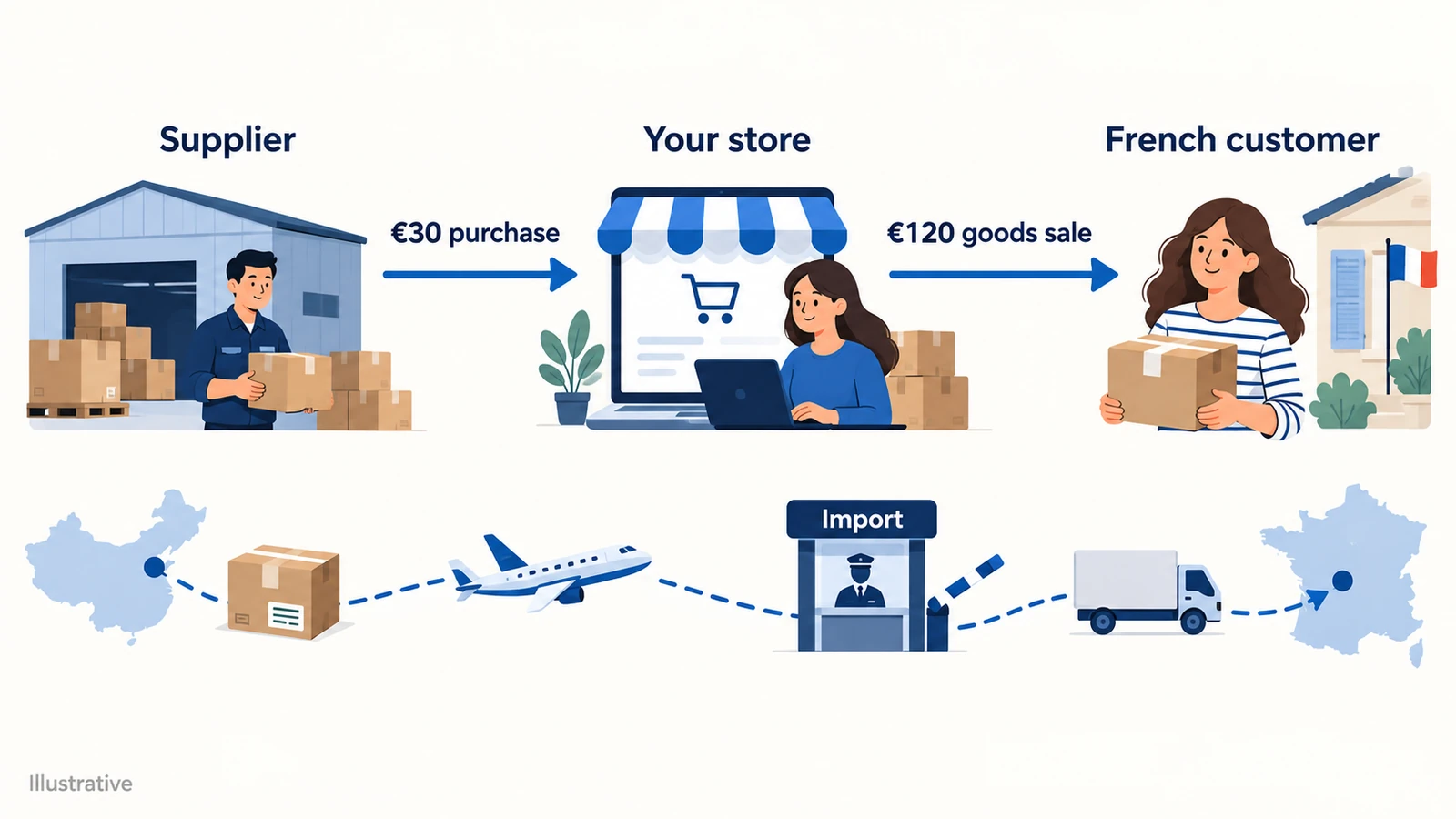
EU dropshipping normally creates VAT obligations even when the supplier sends the parcel. Eligible goods imported directly from outside the EU can use IOSS, an optional way to collect VAT at checkout and report it monthly. Eligible consumer sales moving between EU countries can use Union OSS. Other imports, ordinary domestic sales and some supplier-direct chains need the appropriate local VAT treatment.
Choose the route from the actual sale and movement of goods, rather than your supplier’s promise that tax is “handled.” This guide covers physical goods sold to consumers in EU VAT territory, with rules checked on September 29, 2026. UK sales, business-to-business sales, excise goods and special territories can follow different rules.
01
Choose the route from where the goods start
Imagine your store buying a lamp from a Chinese supplier for €30 and selling it to a French consumer for €120 before delivery and VAT. These are hypothetical amounts. The supplier’s invoice covers its sale to you; your invoice covers your sale to the customer. The parcel entering the EU creates a separate import event.
| Where the goods are and what happens | Route to consider | What the route does not automatically cover |
|---|---|---|
| Outside the EU when sold; eligible non-excise consignment worth no more than €150 | IOSS for the imported consumer sale | Higher-value consignments, goods already stored in the EU or every customs charge |
| In the EU; an eligible consumer distance sale moves goods to another EU country | Union OSS for that cross-border sale | Importing stock, ordinary domestic sales or every supplier-direct chain |
| Imported without IOSS, worth more than €150, sold domestically or outside the scheme’s conditions | Normal import and applicable local VAT treatment | A universal rule that the customer or carrier handles every merchant duty |
On a phone, swipe the table sideways to compare every column.
VAT is a consumption tax. The scheme is a way to report covered sales; it is not permission to ignore other VAT obligations. The Commission’s OSS guidance explains the different scopes. First identify the goods’ location at sale, dispatch country, destination, seller and importer. Then use the relevant branch below.
02
Use IOSS for an eligible direct import
IOSS means Import One Stop Shop. For an eligible consumer distance sale, the goods must:
- Be outside the EU when sold.
- Be non-excise goods.
- Enter in a consignment with an intrinsic goods value no higher than €150.
Intrinsic value is the relevant goods value, explained in the calculation below. Goods already stored in an EU warehouse do not belong in IOSS.
With a valid IOSS arrangement, your order follows three steps:
- Collect the applicable destination VAT when the customer pays.
- Report the covered sale in the monthly IOSS return.
- Pass the correct IOSS details securely to the customs declarant.
Correct use allows the import-VAT exemption for that covered shipment. Customs duties and other fees can still apply. See the Irish Revenue IOSS guide.
Who registers?
| Seller’s situation | Registration route |
|---|---|
| Established in the EU | Direct registration under the scheme’s conditions |
| Established outside the EU | Generally appoint an EU-established IOSS intermediary to fulfill the scheme’s obligations on your behalf |
| Within a qualifying mutual-assistance-country exception | Use the exception only when its conditions are met; the Commission’s Norway example requires the qualifying goods to be dispatched from Norway |
On a phone, swipe the table sideways to compare every column.
The Norway exception also depends on dispatch
A Norwegian seller sending these goods from China does not get that exception merely from its home address. The Commission registration guidance explains the routes.
If your offer does not qualify or you do not use IOSS, choose the non-IOSS import branch before taking orders. A supplier giving you an IOSS number does not establish that it is valid for your own consumer sale.
What if a marketplace collects?
A platform can be treated as the supplier for VAT purposes in two cases:
- Qualifying imports not exceeding €150, regardless of the underlying seller’s establishment.
- Qualifying EU-located goods sold to consumers when the underlying seller is established outside the EU.
The Revenue deemed-supplier guidance gives those conditions.
Use the marketplace arrangement for its actual sale
Use the platform’s tax report and shipment instructions for that actual customer order. Buying the lamp through a marketplace and reselling it through your own website does not automatically put your website sale under the platform’s collection. Stock imports, other channels and other VAT returns may remain your responsibility.
03
Use Union OSS for eligible EU stock sales
Union OSS can report eligible consumer distance sales of goods moving from one EU country to another. For example, goods you hold in a Dutch warehouse and sell to a French consumer may belong in this route. A non-EU seller can also use Union OSS for qualifying goods sales; the word “Union” does not require every seller to be EU-established.
Importing that stock and selling it are separate events. Ordinary sales where goods stay within one country generally need domestic VAT treatment, rather than Union OSS. Particular deemed-supplier marketplace rules can change the domestic-sale case.
A supplier shipping from the EU is not enough
In a chain of sales, VAT rules must identify which sale the transport belongs to. Follow the example in the Commission’s filing guidance:
- Retailer A is in one EU country and buys from supplier B in a third EU country.
- B sends the goods to A’s customer in a second country.
- A has no stock, establishment or VAT registration in B’s country.
The example’s retailer sale does not qualify for Union OSS
In that stated case, A’s sale is a sale without transport and cannot be reported as an intra-EU distance sale through Union OSS.
So distinguish goods you sell from your own EU stock from a supplier-direct chain with different contracts and parties. The example does not decide every chain, but it shows why the dispatch address alone cannot make your sale OSS-eligible.
The €10,000 rule is about where VAT is due
The limited €10,000 threshold can let an eligible seller apply its home-country VAT treatment to covered cross-border sales below the threshold. The limits include:
- Establishment in only one EU country.
- Goods dispatched from that country to another EU country.
- Count the combined covered goods sales and relevant telecommunications, broadcasting and electronic services, excluding VAT, in both the current and preceding calendar year.
Once the relevant threshold is exceeded, destination treatment applies; an eligible seller can also opt into destination treatment below it under the applicable conditions. The Commission OSS explanation sets out those limits. This is not a general VAT-free allowance for a small shop, a non-EU seller or China-to-EU imports. Any separate small-business exemption has its own conditions.
04
Calculate VAT from the customer’s price
Use the retail goods value for the €150 test
For the €150 IOSS test, use the eligible consignment’s intrinsic goods value. Here that means the customer goods price excluding VAT and separately identified freight or insurance. Freight bundled into the goods price without being separately shown is treated differently.
Combine the relevant goods in the consignment. The supplier’s €30 invoice does not turn a €180 retail goods sale into an eligible €30 sale.
Splitting one purchase above €150 into several parcels does not make that purchase IOSS-eligible. The Commission’s ecommerce explanatory notes explain that limit. Use those notes for the VAT concepts, rather than their superseded description of customs-duty relief.
Return to the hypothetical lamp. Assume an ordinary item subject to France’s standard 20% rate and a valid IOSS arrangement. The customer goods price is €120 before VAT, with €12 delivery shown separately. Rates vary by product and destination; the official EU rate reference identifies France’s standard rate.
| Amount | Calculation | Meaning |
|---|---|---|
| €120 | Customer goods price before VAT | Intrinsic goods value for this IOSS test |
| €132 | €120 goods + €12 delivery | VAT taxable amount in this example |
| €26.40 | €132 × 20% | VAT collected on the sale |
| €158.40 | €132 + €26.40 | Customer total, excluding any separate duty or carrier fees |
On a phone, swipe the table sideways to compare every column.
The IOSS goods value is €120, not €158.40
The €158.40 checkout total is above €150, but the example’s separately stated goods value is €120. Eligibility value and the amount used to calculate VAT answer different questions.
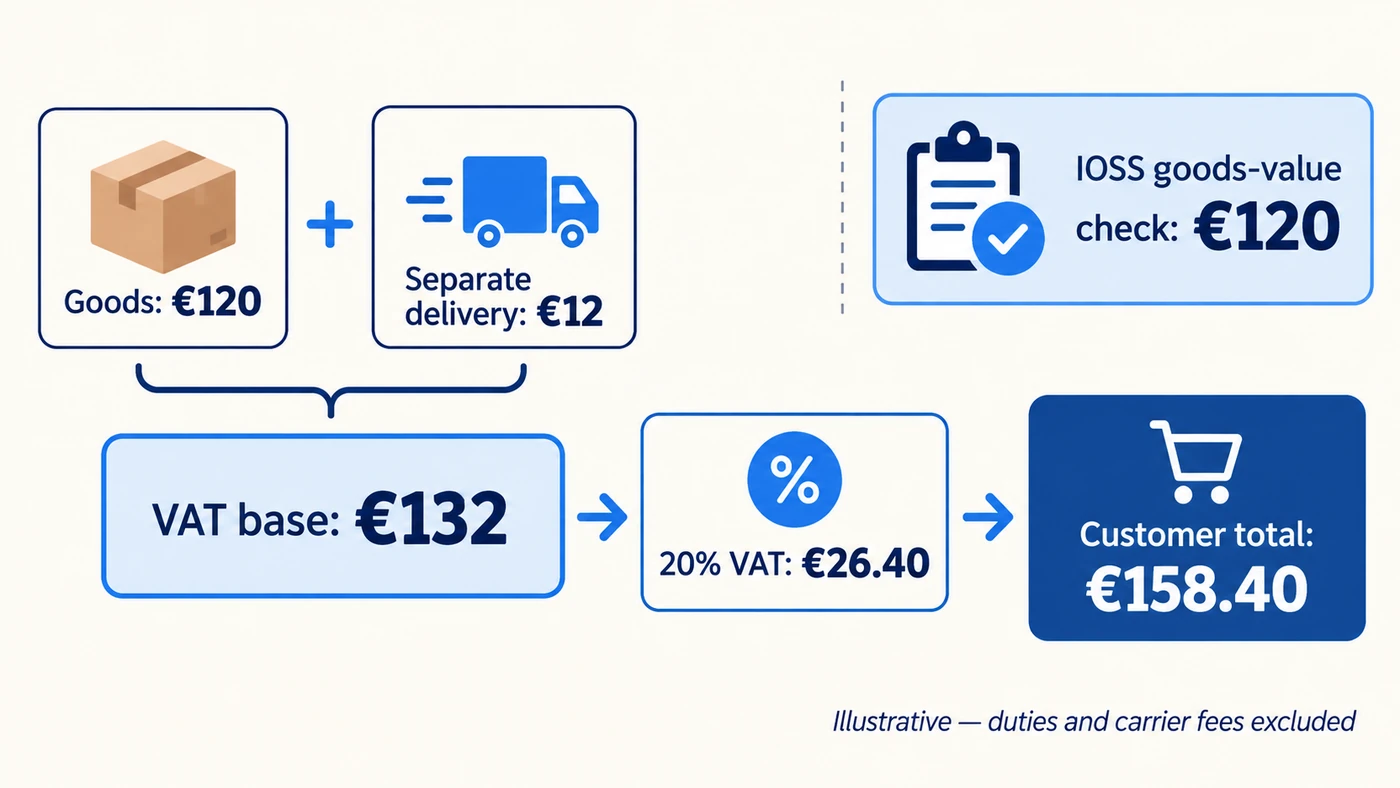
If €158.40 is already your VAT-inclusive selling total, divide it by 1.20: the amount before VAT is €132 and VAT is €26.40. Adding another 20% would charge VAT twice. Keep the €30 supplier purchase out of this customer-tax calculation.
05
Handle imports that do not use IOSS
Without IOSS, import VAT is normally dealt with through the import arrangement. Goods above €150 also fall outside IOSS. Before promising an all-inclusive delivery price, establish:
- Who is the importer?
- Who makes the customs declaration?
- Who pays each charge?
Import VAT does not settle every merchant obligation
A carrier collecting import VAT from the buyer does not prove that every merchant VAT obligation is finished. Likewise, a delivery-duty-paid quote needs an explanation of the actual parties, tax treatment and documents; the label alone does not establish that your retail sale has been reported.
France: who owes the VAT?
France’s March 4, 2026 ruling addresses own-site dropshipping without IOSS, outside its specified marketplace exception. For goods imported into and delivered in France, its section 2 distinguishes equal from differing import and retail taxable amounts.
All section 2.1 conditions are met
This includes equal import and retail taxable amounts. The final customer is liable for import VAT; the merchant is not liable for that imported distance sale.
Different taxable amounts under section 2.2
The merchant is liable for import VAT and French VAT on the customer sale. It needs the appropriate VAT registration details on the customs declaration and must report the retail sale.
For a merchant liable under that route, two further questions matter:
- Can import VAT be deducted? Normal deduction conditions require the correct taxpayer, documents and rights. Reporting both events does not mean unavoidable double tax.
- Is a French fiscal representative required? A liable non-EU seller may need one, subject to the ruling’s mutual-assistance-country exception. This role differs from an IOSS intermediary.
That is a French branch, not a rule for every EU destination. For your non-IOSS route, resolve the importer and local registration using the actual customer invoice, supplier invoice and declaration arrangement. Do not tell the customer to pay the carrier while leaving a merchant duty unresolved.
06
Price customs charges separately
IOSS concerns VAT. It does not make every parcel free of customs charges.
Since 1 July 2026, the EU’s temporary €3 customs duty has applied to eligible distance-sale imports with an intrinsic value not exceeding €150, including IOSS orders.
The duty is charged by tariff category. Five T-shirts in one category incur €3; a T-shirt and a watch in two categories incur €6. Count the categories, not simply the parcels or individual products.
The Commission describes an exception for eligible preferential or customs-union treatment on non-IOSS imports declared using the H1 procedure. See its current customs guidance.
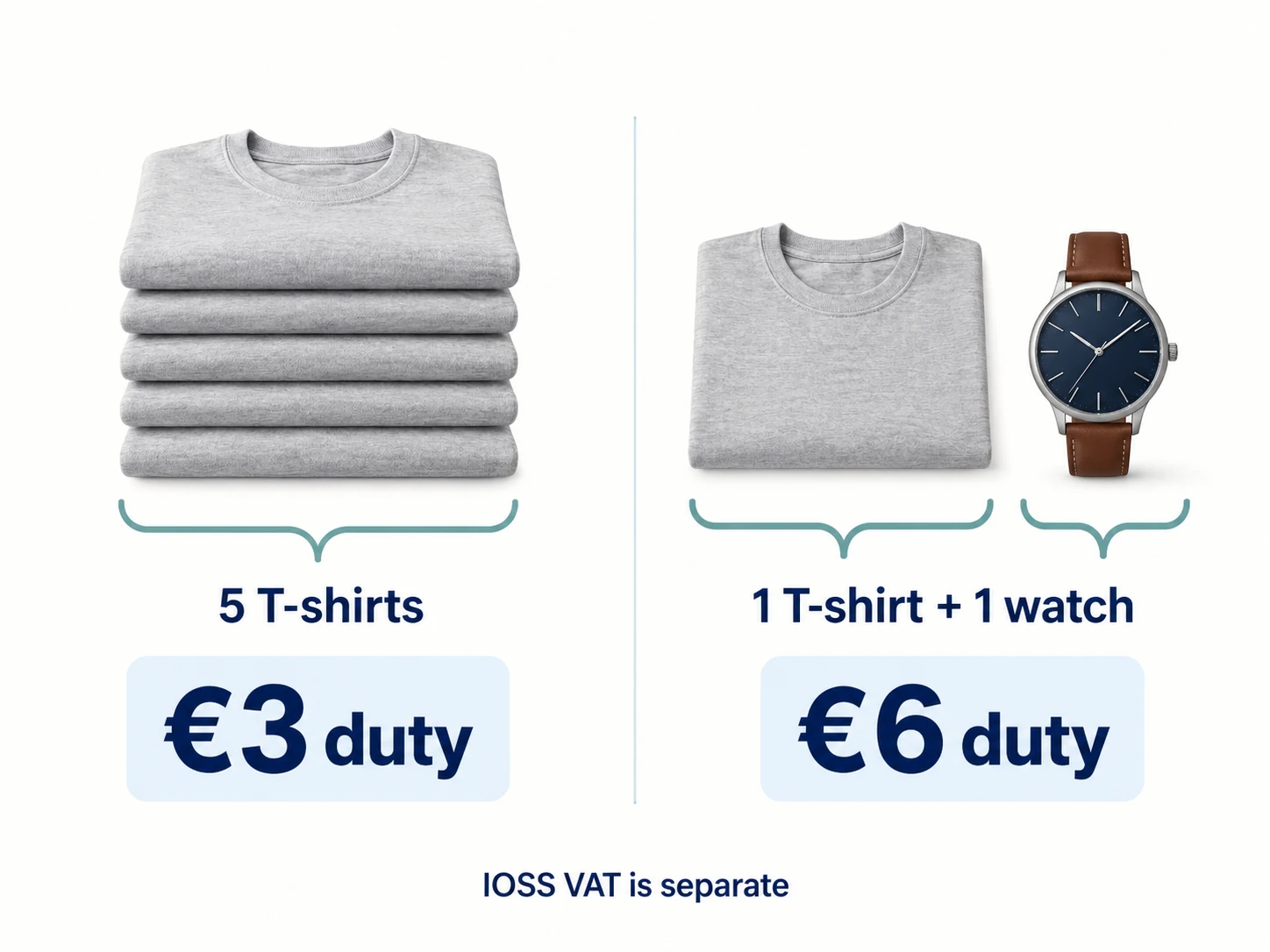
Irish Revenue’s current IOSS guidance says no VAT is charged on that €3 duty when IOSS is used. Carrier clearance or handling charges are separate, so ask the shipping provider for the applicable charge and payer rather than adding an invented flat fee to every order. Irish Revenue IOSS guide
Plan for the announced Dutch charge from November 1
There is also a dated change to plan for: the Netherlands announced a €2 charge per product group from 1 November 2026 for covered imports into the Netherlands. That announcement is not a current, EU-wide €2 charge. Keep it separate from the July customs duty when pricing a route. Dutch government announcement, 22 September 2026
07
Take the order through registration, filing and refunds
Once you have chosen the route, turn it into a working checkout and delivery arrangement:
- Arrange the registration. Apply through the relevant Member State’s tax authority, or appoint the required IOSS intermediary. Add local VAT registrations where the actual stock, import or domestic sale requires them. The Commission’s registration guide explains which country identifies the seller under each scheme.
- Set the customer price. Use the product’s applicable rate in the customer’s country for covered destination-taxed sales. Make the VAT-inclusive total clear. A platform’s ability to support OSS and IOSS together is a software question; its settings cannot expand your legal eligibility. Shopify EU tax reference
- Give the parcel the right information. Agree who declares the import, the correct goods value and who pays customs charges. Transmit a valid IOSS number securely to the parties that need it for clearance; do not publish it on the storefront or customer invoice. A customs EORI number identifies a customs operator and does not replace a VAT registration. Commission e-commerce explanatory notes, EORI guidance
- Assign the return and payment. IOSS returns are monthly; Union OSS returns are quarterly. Both are due by the end of the following month, including the required nil returns when no covered sales occurred. September IOSS and third-quarter Union OSS returns are therefore due on 31 October. Other local VAT returns can still be required. Commission filing guide
Here is the completed note for our hypothetical September order: your own store sells a lamp dispatched from China to a French consumer; eligible goods value €120; separately charged delivery €12; valid merchant IOSS arrangement; taxable amount €132; illustrative VAT €26.40; customer payment €158.40. The merchant accounts for that sale in the September IOSS return due 31 October.
The supplier’s €30 invoice remains a separate purchase, and the declarant receives the correct retail-value and IOSS information for the parcel.
Keep the scheme’s sales records electronically available for ten years from the end of the transaction year. The order, destination, taxable amount, rate, VAT, payment and later corrections should connect to one another. Purchase VAT is not deducted inside an OSS return; use the appropriate ordinary VAT return or refund procedure where its conditions are met. OSS record rules, OSS return rules
If you fully refund that sale, €158.40 means returning €132 of price and delivery plus €26.40 of VAT. Correct the original sale through the applicable scheme process; do not base the customer refund on your €30 supplier cost.
Investigate the entry before seeking duplicate-tax correction
If the carrier also collected import VAT on a parcel that should have used IOSS, obtain the import entry and payment receipt so the declarant can establish whether the number was transmitted and which correction or repayment route applies. A checkout receipt alone does not automatically secure a border-tax refund.
08
Frequently asked questions
Can the checkout total exceed €150 and still qualify for IOSS?
Yes, in the stated lamp example: €120 goods plus separately stated €12 delivery and €26.40 VAT gives €158.40 paid. The intrinsic goods value used for that example’s IOSS test is €120. Bundled freight, extra goods and other eligibility conditions still matter.
Can I use IOSS for goods already in an EU warehouse?
No. IOSS covers qualifying distance sales of goods imported from outside the EU. EU stock needs the appropriate intra-EU or domestic treatment; eligible cross-border consumer sales may fit Union OSS.
Can I use the IOSS number from my supplier purchase?
Do not assume it covers your store’s retail sale. Confirm whose sale the arrangement reports and how the actual retail value and valid number reach the declarant securely. A platform collecting on your purchase is not necessarily collecting on your own-site customer sale.
Does IOSS remove the €3 customs duty?
No. IOSS concerns VAT. Eligible low-value imports can still carry the separate temporary customs duty. Irish Revenue’s current IOSS guidance says no VAT is charged on that €3 duty when IOSS is used; clearance fees are another separate charge.
Get the supplier and parcel details clear
For the wider store setup, the dropshipping legality guide covers responsibilities beyond this VAT route.
Need the physical dispatch and parcel details before deciding the VAT route? AIDrop’s fulfillment service can coordinate China-side picking, product checks, packing, labeling and carrier handoff.
Send the product link, destination, sales channel and proposed dispatch point. Confirm available records and connections during onboarding. Your authority, adviser or appointed intermediary handles VAT registration and scheme obligations.

Is Dropshipping Legal? What Your Store Is Responsible For
Learn the US responsibilities behind dropshipping: product safety, licenses, taxes, shipping promises, intellectual property, imports and customer

Dropshipping Taxes: The Records and Questions to Prepare
Income tax, sales tax and import charges follow different rules. Use a US operating baseline to separate

Dropshipping Copyright and Trademarks: Check Products, Images and Store Claims
Check dropshipping products, images and store claims separately. Review supplier permissions, intended uses, launch decisions and infringement
