
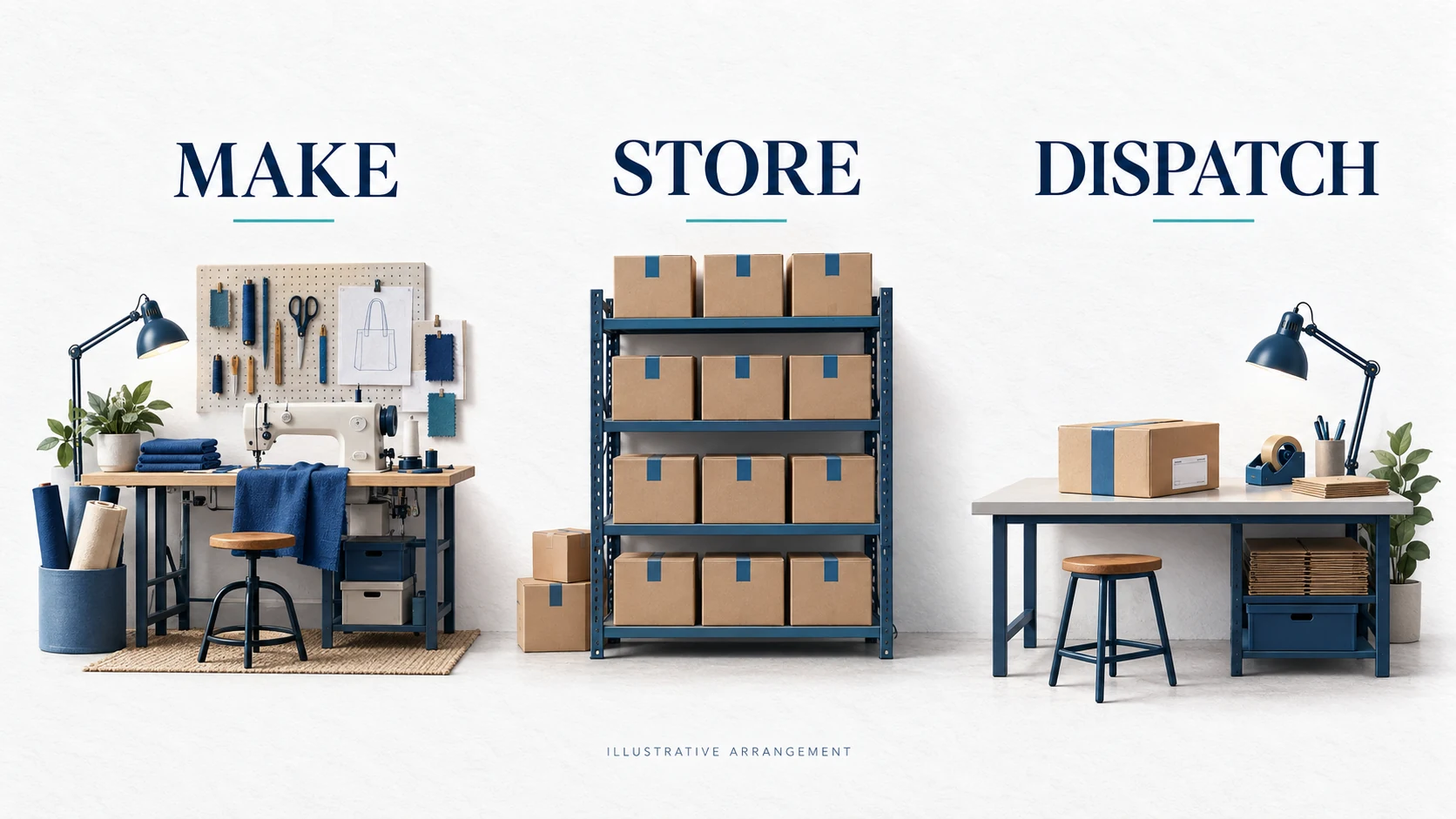
A manufacturer can dropship when it can pick, pack and dispatch individual customer orders, or when its production is connected to a separate fulfillment partner. The useful question is whether the arrangement can repeatedly deliver your approved product to your customer at an acceptable total cost. A factory address and a low unit quote do not answer that question.
Start with stocked-product manufacturers if you want to resell an existing item. Consider an on-demand producer when your offer depends on printing or customization after purchase. For a custom production run, expect to discuss inventory ownership and batch quantities even if customer orders leave the warehouse one at a time.
This guide covers the factory relationship. For the broader choice among manufacturers, distributors and sourcing partners, see the dropshipping supplier guide.
01
What counts as a dropshipping manufacturer?
A manufacturer makes or assembles a product. Dropshipping describes how a customer order is fulfilled. A business can perform both functions, but production capability does not automatically include consumer parcel fulfillment.
A factory that ships cartons to wholesalers may have no process for importing hundreds of individual addresses, checking one-piece orders or handling replacement requests. Conversely, a distributor can operate an effective dropshipping service while outsourcing all manufacturing. Evaluate each business for the work it actually performs.
Ask who manufactures the item, who owns the stock and who dispatches the parcel. These may be three different parties. Keep their legal names, locations and responsibilities in the supplier record so that a production issue reaches the maker and an address problem reaches the fulfillment operator.
Direct factory fulfillment
The manufacturer holds finished stock or produces to order, then ships to customers. This can reduce handoffs, but only when the factory has the necessary order, packing and shipping processes. Confirm that the quoted service includes retail parcels rather than merely dispatching bulk cartons to your freight forwarder.
Factory plus fulfillment partner
The manufacturer sends approved stock to a warehouse or agent, which releases customer parcels. This separates production from order handling. It also creates a receiving handoff: someone must count arrivals, identify damaged units and reconcile the stock that becomes available to sell.
On-demand production
An on-demand provider makes or decorates an item after an order. Printful, for example, describes printing, packing and shipping custom products without an order minimum. That is a named route for decorated goods, not evidence that any custom manufacturing process accepts a one-unit production run. Printful’s service description explains its model.
02
Choose the arrangement before searching for factories
For a first test of an existing product, ask for the stocked variant, its available quantity, replenishment lead time and one-order fulfillment price.
You need enough information to make a modest customer promise without committing to a custom production run prematurely.
- For private labeling, separate changes to the product from changes to the packaging. A printed insert, custom carton, embroidered logo and new mold can create different purchase commitments.
- Ask for the minimum quantity, setup charge and replenishment time for each component.
- Do not treat a sample with your logo as evidence that every future order can be customized individually.
For a product already selling consistently, a batch may be workable. Forecast the variants separately, assess the cash commitment and decide where the goods should be held. A factory arrangement is useful only if its production cycle fits the replenishment cycle your store needs.
If the factory makes the right product but cannot handle customer parcels, request a quote for delivery to a fulfillment partner. CJ, for example, describes a service for receiving goods from an external supplier and fulfilling orders from that stock. It is one possible arrangement to investigate; its availability does not establish a particular factory’s suitability. CJ’s fulfillment service describes that division of work.
03
Where to find manufacturing candidates
Alibaba is a starting point for factory discovery, not a substitute for confirming the fulfillment agreement. Its supplier directory distinguishes manufacturers, trading companies and businesses performing both roles. It also describes third-party assessments under its Verified Supplier program. Read the actual assessment scope and date instead of treating a badge as a guarantee of the SKU you plan to sell. Alibaba’s supplier directory explains these distinctions.
Search by a specific product and manufacturing process. A request for a sewn organizer with defined dimensions is easier to evaluate than a request for “winning dropshipping products.” Compare a small shortlist whose catalogs, equipment and stated production focus match the item.
Be careful with search pages labeled “no minimum order.” Alibaba’s no-minimum supplier results include both product offers and logistics services, with quantities expressed in pieces, packs or kilograms. Read the individual offer: a one-kilogram freight minimum does not tell you the minimum purchase quantity for the product.
Two more specialized candidates illustrate what to ask.
- Dropleather describes ready-to-brand leather goods without a minimum, while separately advertising custom development from 30 pieces.
- MCDFL’s FAQ describes factory-direct print-on-demand and one-piece orders.
These are provider-owned descriptions, not independently verified factory endorsements. Check the current contract, product evidence and sample before accepting their broader service claims.
Other useful routes include a brand’s official wholesale contact, industry exhibitor directories and introductions from a fulfillment partner already handling the relevant product category. Each route produces a candidate, not an approval. Check whether the business allows resale through your chosen channel and whether it has authority to supply any branded goods it offers.
An on-demand producer is a more direct search route for original printed designs. Printful and providers accessible through Printify are examples of that model. Do not describe every provider on a print network as the manufacturer of the undecorated blank; clarify which production and decoration operations it performs.
The supplier discovery workflow goes further into building and contacting a shortlist. Here, the essential filter is whether a candidate can support your specified production and dispatch arrangement.
04
Verify the business and the product separately
Ask for the contracting business name, operating address, payment beneficiary and the facility that will handle your goods. Resolve unexplained differences before payment. A legitimate trading business need not pretend to be a factory; its role should simply be clear.
A video call can help connect people, products and facilities, but it does not establish every fact in a sales presentation. Ask to see the process relevant to your item, and use a qualified independent inspection when the commitment or product risk warrants it. Match any assessment or report to the named business, location, product and date.
Fix the product reference
Record the model, material, dimensions, color, included parts and packing method. Where variation matters, agree the acceptable range and the method used to measure it. A phrase such as “good quality” cannot resolve a later disagreement about a zipper, finish or missing accessory.
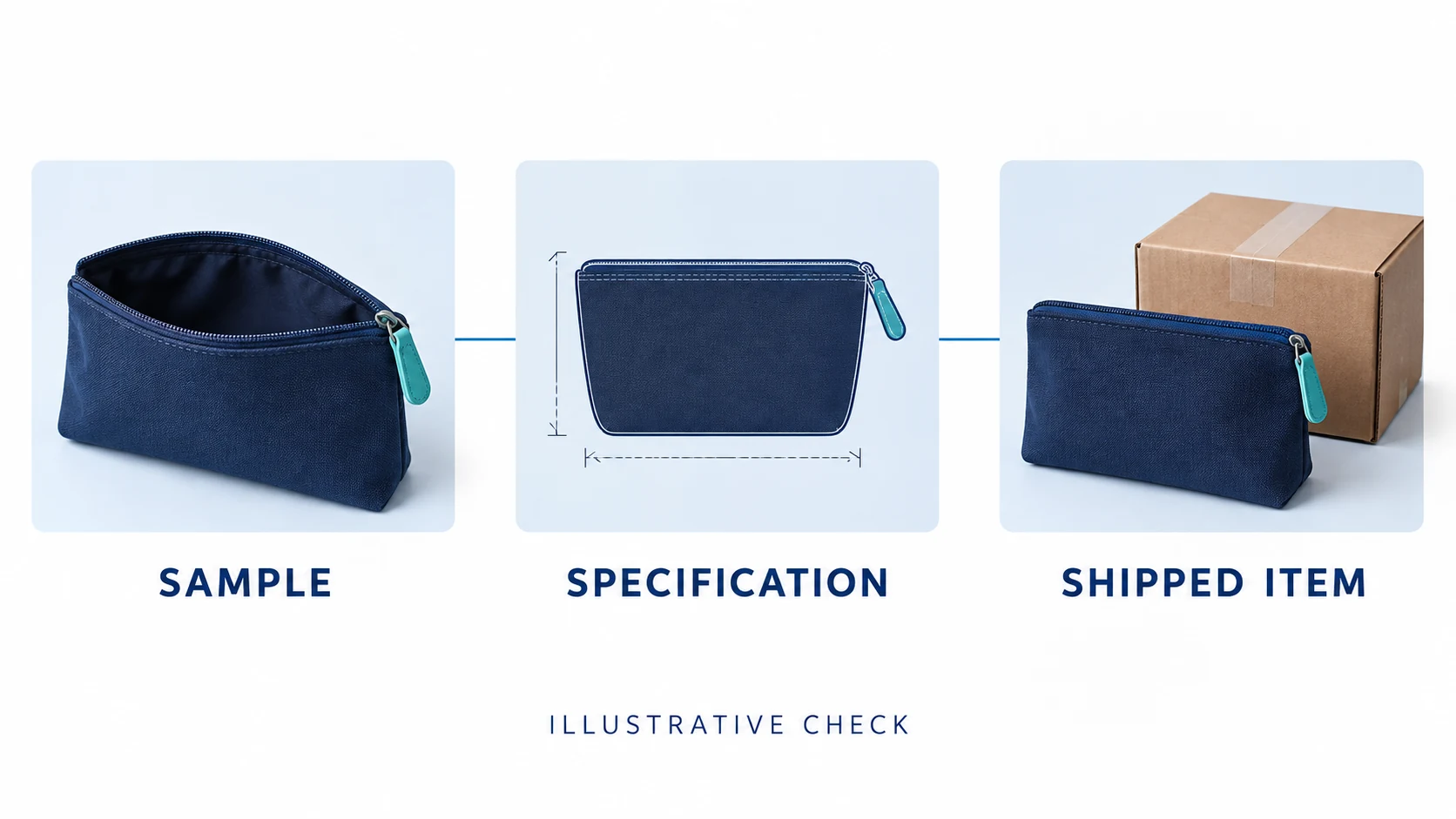
Order a physical sample through the proposed fulfillment route. Check the item and the arrival experience: the variant received, parcel protection, labels, tracking history and any unwanted promotional material. Keep photos and measurements tied to the sample identity.
Check the evidence behind claims
A supplier statement about a material or performance characteristic is a claim to verify. Ask for evidence that covers the actual product and intended market. A report for a similar-looking model or an older material formulation may not support your listing.
The sample shows what arrived in that sample order. It does not prove all production units conform. Agree the appropriate quality-control checks for later batches and the circumstances that trigger another review, such as a component, factory or packaging change.
05
Separate production quantity from dispatch quantity
One-piece dispatch does not necessarily mean one-piece purchasing. A factory might manufacture 300 units for your account, store them and ship one unit whenever an order arrives. You still committed to the batch.
In a hypothetical arrangement, 300 units at $6 each require $1,800 for the goods. Sending those units to 300 separate customers later does not remove the initial inventory exposure. Add any deposits for packaging, storage charges and replenishment cash when comparing the arrangement with buying stocked goods per order.
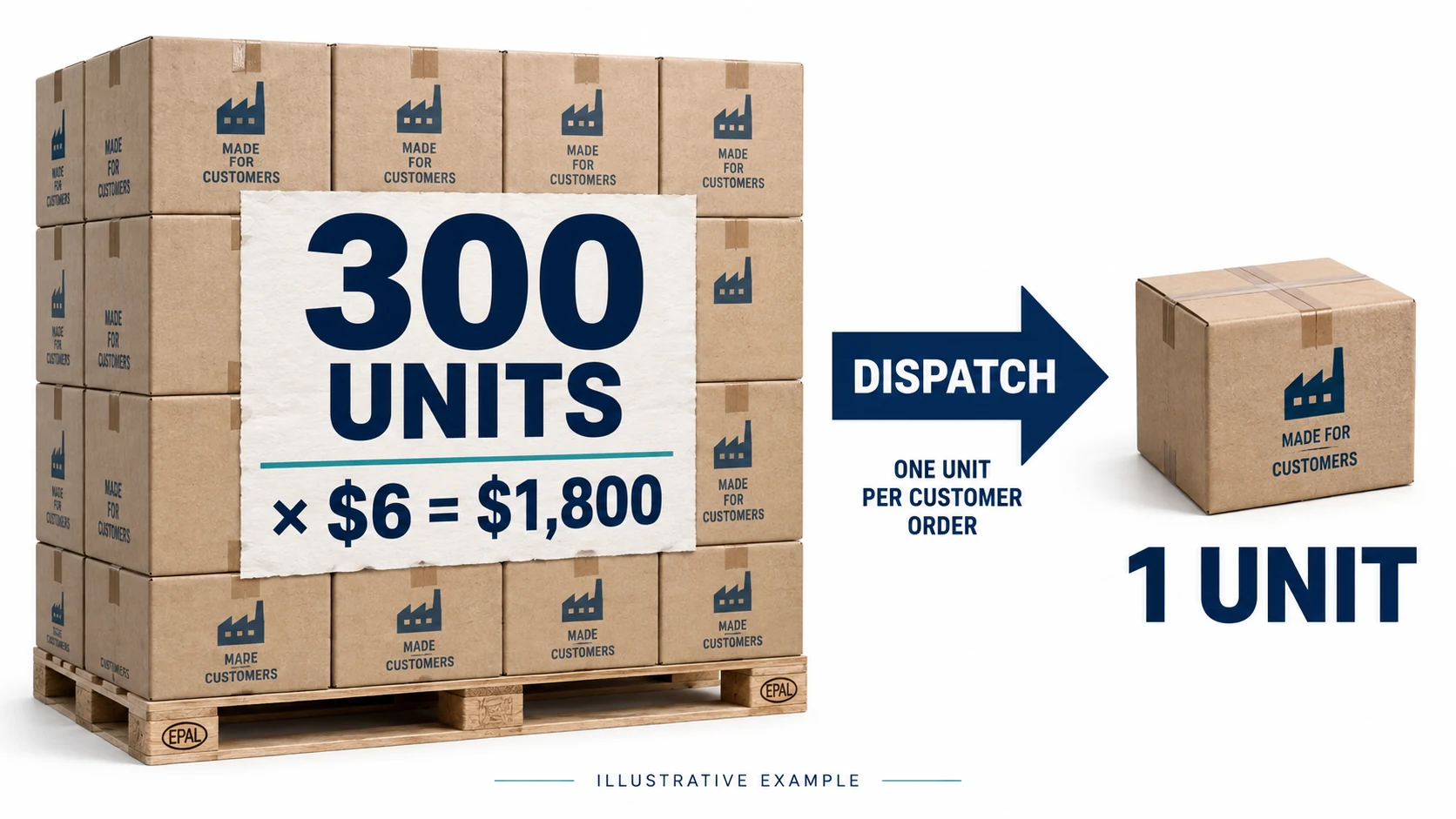
Ask three separate questions: how many units must be produced, how many must you buy and how many can leave in one customer parcel?
Obtain the answer for each variant and customization option. A minimum of 300 across a style is materially different from 300 in each color.
Negotiate the right constraint. You may be able to use a standard material, remove a custom component, buy an existing color or postpone printed cartons. Reducing complexity can change the quote more realistically than asking for a lower minimum without changing the production request. The MOQ guide explains these commitments in more detail.
Also agree what happens to unsold stock. Who owns it, how long can it remain, what are storage charges and how can it be transferred?
A fulfillment partner holding your inventory should be able to reconcile receipts, shipments, damaged units and remaining units.
- For custom development, also record who owns the artwork, tooling and approved specification files, and whether they can be transferred if the relationship ends.
- Ask which materials or components can change without a new approval.
A commercially usable exit requires more than permission to collect the remaining cartons.
06
Compare the complete quote
A hypothetical $4.80 factory price might become $11.10 before the parcel reaches your customer: $4.80 for the product, $0.40 allocated inbound freight, $0.60 packaging, $0.80 pick and pack, and $4.50 outbound freight. These are illustrative inputs, not a market quote. Destination duties, taxes, payment fees and your store costs are additional where applicable.
Use the same product, packed dimensions, destination and service level when comparing suppliers. A lightweight sample sent to one city does not establish the cost of the finished retail package to every customer region.
Request the following quote details together:
- Exact SKU and included accessories, with the quoted quantity and currency.
- Stocked or made-to-order status, and when the production or processing clock starts.
- Packaging and handling charges, including any minimum purchase of materials.
- Packed weight and dimensions, destination coverage and shipping service.
- Who pays applicable import charges, plus remote-area or other stated surcharges.
- Replacement, defect, cancellation and storage terms.
Record whether the quote includes delivery to a consumer address, a local warehouse or a port. Those are different services. Ask how long the quote is valid and what changes allow repricing. Use the resulting delivered cost in your order economics, not the factory headline price.
07
Agree how orders and exceptions will be handled
- Give each approved variant a stable SKU mapping.
- The order sent to the supplier should identify the correct item, quantity, address and relevant customization.
- Decide when an order is accepted and when payment or stock allocation is complete.
If an import or integration gives an uncertain result, check whether the supplier already received the order before sending it again. Preserve the supplier order reference so a retry does not create a second parcel. A simple manual process can work at low volume if it retains those records reliably.
Define the cancellation point. Before picking, a change may be possible; after customization or carrier handoff, the available remedy can be different. Your customer-facing policy and support process need to reflect the arrangement you can actually operate.
For unavailable stock, damaged goods or a changed component, require an exception message and a decision. Do not permit an unapproved substitute simply to keep the dispatch clock moving. Agree who can approve the change, what evidence they need and when the customer must be contacted.
Returns need their own instruction. Establish the return address, authorization process and treatment of defects, wrong items and buyer preference separately. A supplier credit and your customer’s refund are related transactions, but one may be due before the other has been resolved.
08
Pilot the full arrangement before increasing volume
Start with a limited set of approved variants. Place orders through the actual process and inspect the resulting records and parcels. Include a normal order and, where practical, a controlled cancellation or address-change request before the agreed cutoff. Do not create misleading customer orders or manufacture a defect to test support.
- Record acceptance time, dispatch evidence, carrier acceptance, delivery and any exceptions.
- Separate processing delays from transit delays so you can ask the right party to correct the problem.
One successful delivery establishes only that this order worked under those conditions.
Increase volume when the item, cost, stock records and order handling remain consistent. Pause the affected SKU when there is an unresolved identity change, repeated missing stock or a serious quality issue. Fix the cause and repeat the relevant check before using the same customer promise again.
For a factory-plus-warehouse arrangement, reconcile the first receipt before releasing orders. Compare what the factory shipped with what the warehouse accepted. That check prevents a quantity discrepancy or damaged carton from becoming a series of customer shortages.
09
Frequently asked questions
Can I dropship directly from a factory?
Yes, if the factory agrees to individual customer fulfillment and can perform it reliably. Confirm stock, order acceptance, packing, shipping, tracking and exceptions. Otherwise, use a separate fulfillment partner and budget for any inventory commitment.
Are manufacturers always cheaper than wholesalers?
No. A lower product price can be offset by minimum quantities, setup charges, storage, handling or freight. Compare the complete arrangement at your expected volume, including unsold inventory and cash requirements.
Does a one-piece MOQ mean there is no inventory risk?
It may mean you can buy one stocked unit, but it does not describe every customization or future replenishment requirement. Ask whether any stock or packaging must be purchased in advance and who owns unsold goods.
Can a verified factory still be unsuitable?
Yes. Business assessment, product conformity and customer fulfillment are separate questions. A factory can be capable in bulk production while lacking the process or commercial terms your dropshipping store requires.
What should I send in the first inquiry?
Send the product reference, variants, target destination, expected initial order range, customization request and required fulfillment arrangement. Ask for a sample quote and complete cost breakdown rather than an unsupported promise of high future volume.