
A dropshipping business plan should explain who will buy, why they will choose your offer, who will ship the order and how you will pay for it. Include the work after checkout, too: answering customers, handling delays and issuing refunds.
For a first store, start with a short working plan. Add detailed management, funding and financial projections if a lender or investor needs them. The SBA’s planning guidance distinguishes lean and traditional formats; the useful format is the one that makes your decisions and assumptions clear.
01
Your plan on one page
Copy these fields into a document. Replace the brackets with specific answers, amounts and dates.
Who buys and why
Customer and market: We sell to [customer] in [country/region], who needs [specific job done]. Our evidence is [interviews, competing offers or paid orders].
Offer and competition: We sell [product and exact variant] for [delivered price]. Buyers choose it over [named alternative] because [supported difference].
How the order runs
Supplier and delivery: [Supplier] ships from [warehouse] to [destination]. The quote includes [product, packing and freight]. Dispatch, tracking and return arrangements are [terms].
Store and payments: We sell through [store/channel], accept [payment method] and receive payouts into [eligible account]. Local business and product requirements are [resolved items or outstanding work].
How buyers arrive and get help
First customers: We reach buyers through [one channel], spend up to [amount] and judge the test by [paid orders and cost per buyer].
Daily operations: [Person] handles order release, inventory changes, tracking and customer messages at [times]. A wrong or delayed order is handled by [procedure].
Profit and available cash
Budget: Startup spending is [amount], monthly bills are [amount] and each order leaves [amount] after its variable costs.
Cash: Starting bank cash is [amount]. We can fund [number] orders before payouts while retaining [refund buffer].
What happens next
First actions: By [date], complete [sample/quote/page/payment test]. By [review date], decide [continue, repair or stop] using [actual results].
A filled organizer-shop example
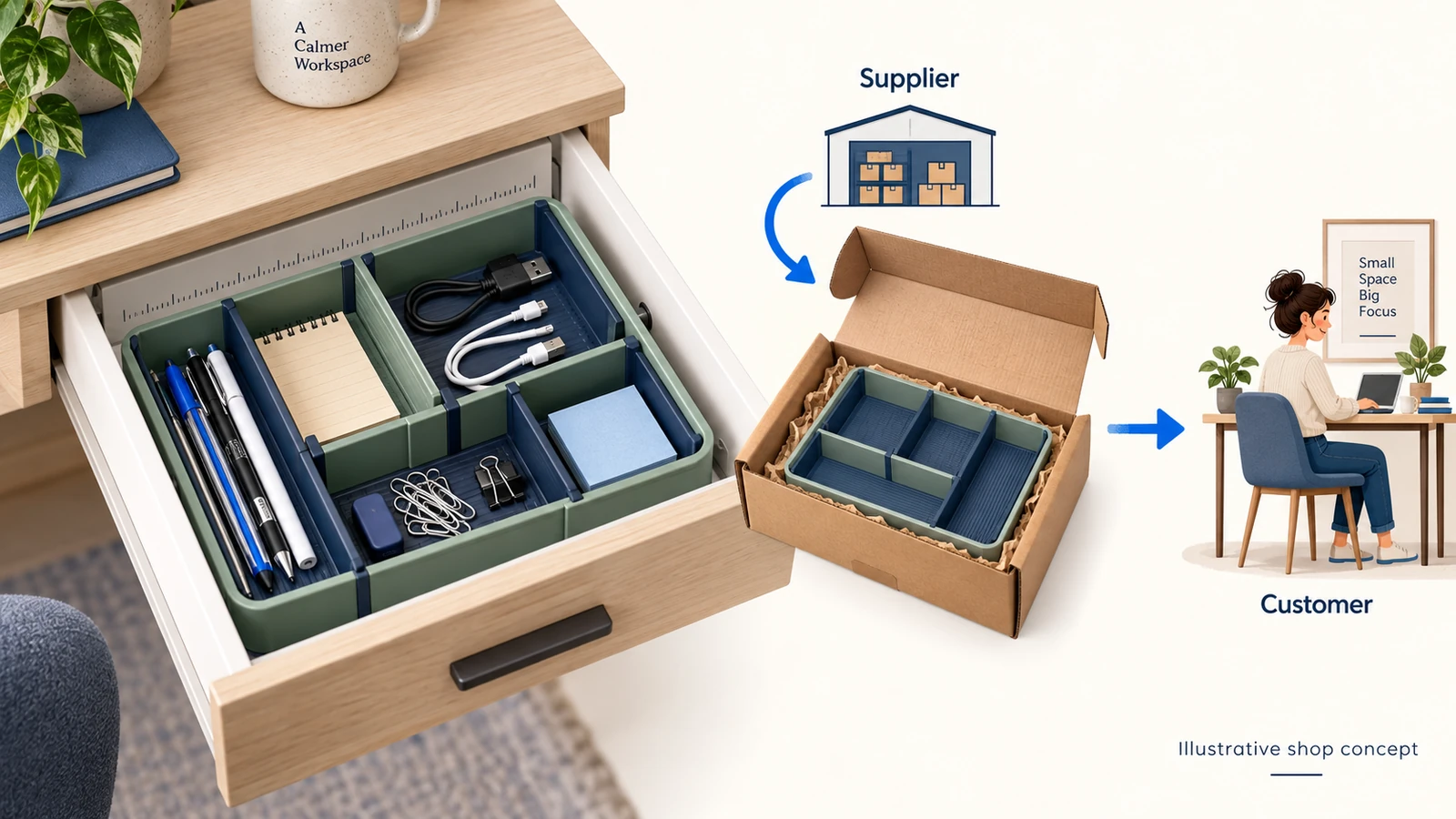
Imagine a US shop selling one adjustable, non-electrical desk-drawer organizer to people working from small home desks. The offer helps buyers choose an insert that fits their drawer, rather than guessing from a supplier photo.
| Plan field | Hypothetical answer |
|---|---|
| Customer | US home workers with a cluttered desk drawer |
| Product and price | One organizer, $39 with shipping included |
| Supply | One supplier dispatching individual orders from a US warehouse |
| First sales channel | Short product demonstrations leading to the product page |
| Month-one goal | 40 orders at an assumed $8 advertising cost per buyer |
| Owner’s work | Daily order checks, tracking follow-up and customer support |
| Starting funds | $1,500; fund the first ten orders and hold $200 for problems |
On a phone, swipe the table sideways to compare every column.
All amounts below are hypothetical USD assumptions. This is a completed planning example, not a real shop, supplier quote or demand test. The US warehouse assumption describes dispatch location; it does not establish where the organizer was manufactured.
02
Explain who buys and why
“People who like home products” is too broad to guide the page or the advertising. The organizer shop has a more useful customer: someone with a shallow desk drawer who wants pens and cables separated without losing space.
The plan needs an answer to a harder question: why would that person pay $39 here? A nearby shop may sell an insert for less, and a marketplace may deliver one sooner. Compare the exact size, delivered price, stock, materials and returns before claiming an advantage.
For this offer, the proposed difference is help with fit. That requires real information:
- Obtain the organizer’s minimum and maximum dimensions and the usable compartment sizes.
- Buy a sample and photograph it beside a ruler and inside a measured drawer.
- Explain the clearance needed to close the drawer and show what is included in the purchase.
- Ask prospective buyers which fit questions remain unanswered. Fix the page before spending more to bring people to it.
Measurements support fit, not a demand forecast
A sample can support those photos and measurements; it does not prove every shipment will be identical. A few conversations can reveal confusing copy, but they cannot establish a market-wide demand estimate.
Write the market section using the evidence you have. For example: “We will initially serve US home-office buyers through drawer-fit demonstrations. We have identified competing inserts, but paid demand for our $39 offer is still untested.” That is a usable starting position.
The first marketing plan should describe how the next buyer reaches checkout:
- Film a drawer-fit demonstration and a separate explanation of compartment use.
- Link each video to the matching page with the measurements, included items and delivered price.
- Compare actual advertising spend with paid buyers. Replace the assumed $8 acquisition cost when results arrive.
Forty orders is a planning goal. Repeated fit questions point to missing measurements or photos; an uncompetitive delivered price requires an offer or cost change. Posting the same supplier clip repeatedly does not resolve either problem.
03
Decide who does the work after checkout
The supplier arrangement must support the offer you just described. Ask for the exact organizer variant, available stock, packing charge, destination shipping cost, dispatch timetable, tracking method and return address. In the example, $10 for the item, $1 for packing and $5 for shipping produce a $16 supplier bill.
Shipping included in the customer’s $39 price still costs the shop money. Shopify’s dropshipping shipping guidance explains this distinction and the extra complications of orders split between suppliers.
Complete these arrangements before opening paid checkout:
- Place the sample order through the intended process. Confirm the variant, packaging, tracking and condition on arrival. Obtain a separate commercial quote for customer orders.
- Agree on changes and problems. Decide how the supplier reports stock changes, when an address can be corrected and what evidence it needs for a wrong or damaged item. No substitute product should be sent without an agreed customer response.
- Prepare a backup. Identify an alternative with compatible specifications and obtain its quote. If it changes the dimensions or price, revise the offer before using it.
- Connect the shop and payment account. Build the product page, shipping and return information, contact route and checkout. Use an eligible payment provider and account; confirm the actual payout arrangements. Test an order before inviting customers.
Assign a named person and daily time to these jobs:
- Release valid paid orders and remove unavailable variants.
- Follow up missing tracking and answer customer questions.
- Give the appropriate store replacement or refund for a wrong organizer.
- Request supplier credit separately; pending reimbursement is not bank cash.
Assign someone to the customer’s problem
An app connection does not answer a customer’s missing-parcel message. The customer should not have to chase your supplier.
For covered US orders, the FTC merchandise rule requires a reasonable basis for the stated shipment time; the relevant default is 30 days when no shipment time is stated. If you cannot ship on time, obtain the required delay consent or promptly refund unshipped goods. Shipment and arrival are different, and silence is not consent in every delay situation.
Add the actual local registration, tax, product and insurance work to the plan. The SBA’s launch guidance ties requirements and fees to location and activity. The example’s provisional registration budget below is an assumption to replace, not a published legal fee.
04
Put the costs beside the selling price
Your finance section needs three separate amounts: what opening the shop costs, what keeping it open costs and what fulfilling one sale costs. Mixing them makes an attractive markup look more useful than it is.
Startup and monthly spending
The example allocates $300 before launch:
- $70 for samples.
- $50 for basic product photography.
- $40 for domain and setup work.
- $30 for initial tools.
- $110 provisionally for locally required registration or help, to replace with actual requirements and fees.
Monthly bills total $230: $80 for the store and operating tools, plus $150 for administration and support. These are recurring business expenses. They do not include the owner’s pay or income tax, which need their own entries in a real plan.
What one order leaves
Contribution is the money a sale leaves after its variable costs, available to pay monthly bills. For the hypothetical organizer:
| One order | USD |
|---|---|
| Customer pays, including shipping | $39.00 |
| Item, packing and supplier shipping | −$16.00 |
| Payment processing | −$1.50 |
| Advertising per buyer | −$8.00 |
| Estimated cost of refunds and replacements | −$2.00 |
| Contribution before monthly bills | $11.50 |
On a phone, swipe the table sideways to compare every column.
Problem allowance and held cash differ
The $2 is an estimated average problem cost across orders, not a fee charged on each purchase. Compare that estimate with actual refunds, lost product costs and replacement freight as orders arrive. A separately held bank buffer funds those payments when needed.
Forty orders are still a planning assumption
Forty orders produce $1,560 in sales and $460 in contribution. Subtract the $230 monthly bills: projected operating profit is $230 before owner pay, income tax and recovery of startup spending.
Under this price and cost mix, monthly break-even is $230 ÷ $11.50 = 20 orders. That covers the stated monthly bills; it does not pay the founder or recover the initial $300.
Put the price and costs in a working sheet
If you want to change the figures yourself, enter these USD inputs in column B of a sheet: B2 price 39; B3 supplier bill 16; B4 payment fee 1.50; B5 advertising per buyer 8; B6 expected problem cost 2; B7 monthly bills 230; B8 planned orders 40.
Contribution per order
In B9, enter =B2-SUM(B3:B6). The example returns $11.50. Replace the cost inputs with actual quotes and results; avoid deducting a shipping line again if B3 already includes it.
Orders to cover monthly bills
In B10, enter =IF(B9>0,ROUNDUP(B7/B9,0),"No positive contribution"). The example returns 20. Zero or negative contribution does not have a profitable order count under this cost mix.
Monthly operating result
In B11, enter =B8*B9-B7. Forty orders return $230 before the stated owner-pay, tax and startup-recovery exclusions. With advertising at $16, B9 falls to $3.50, B10 rises to 66 and B11 becomes −$90.
This is a formula layout to enter, not an attached spreadsheet or a forecast validated by sales. The separate cash section below still decides whether orders can be paid for before payout; a positive B11 does not make unpaid proceeds available.
What changes the decision
Replace the example inputs one at a time with a real supplier quote or campaign result:
| Changed input | Effect on the plan |
|---|---|
| Delivered supplier cost rises from $16 to $18 | Contribution falls to $9.50; price, sourcing or another cost must absorb the difference. |
| Advertising costs $16 instead of $8 per buyer | Contribution falls to $3.50; 40 orders leave $140, producing a $90 monthly loss after bills. |
| Sales volume falls below 20 at the original costs | The stated monthly bills are not covered. |
On a phone, swipe the table sideways to compare every column.
This tells you what to fix. A cheaper supplier is useful only if the product and service still support the offer. Doubling ad spending cannot solve a price that leaves too little after acquisition costs. If the new price would exceed comparable delivered offers, choose a different product or buying reason before launching.
05
Fund orders before the payout arrives
The customer can pay your shop today while you still need your own money to pay the supplier. Add a cash forecast showing the payments due before sales proceeds reach the bank.
For the example, start with $1,500 and assume no customer payout has arrived yet. Pay $300 in startup costs and the month’s $230 bills. Funding ten orders then costs $160 for the supplier and $80 for advertising, leaving $730 in the bank. Holding $200 of that balance for problems leaves $530 uncommitted.
The bank cannot preserve the buffer at this pace
Funding all 40 orders before any payout would be different: the supplier needs $640 and advertising uses $320. The same starting funds would leave only $10, so the shop could not preserve its $200 buffer.
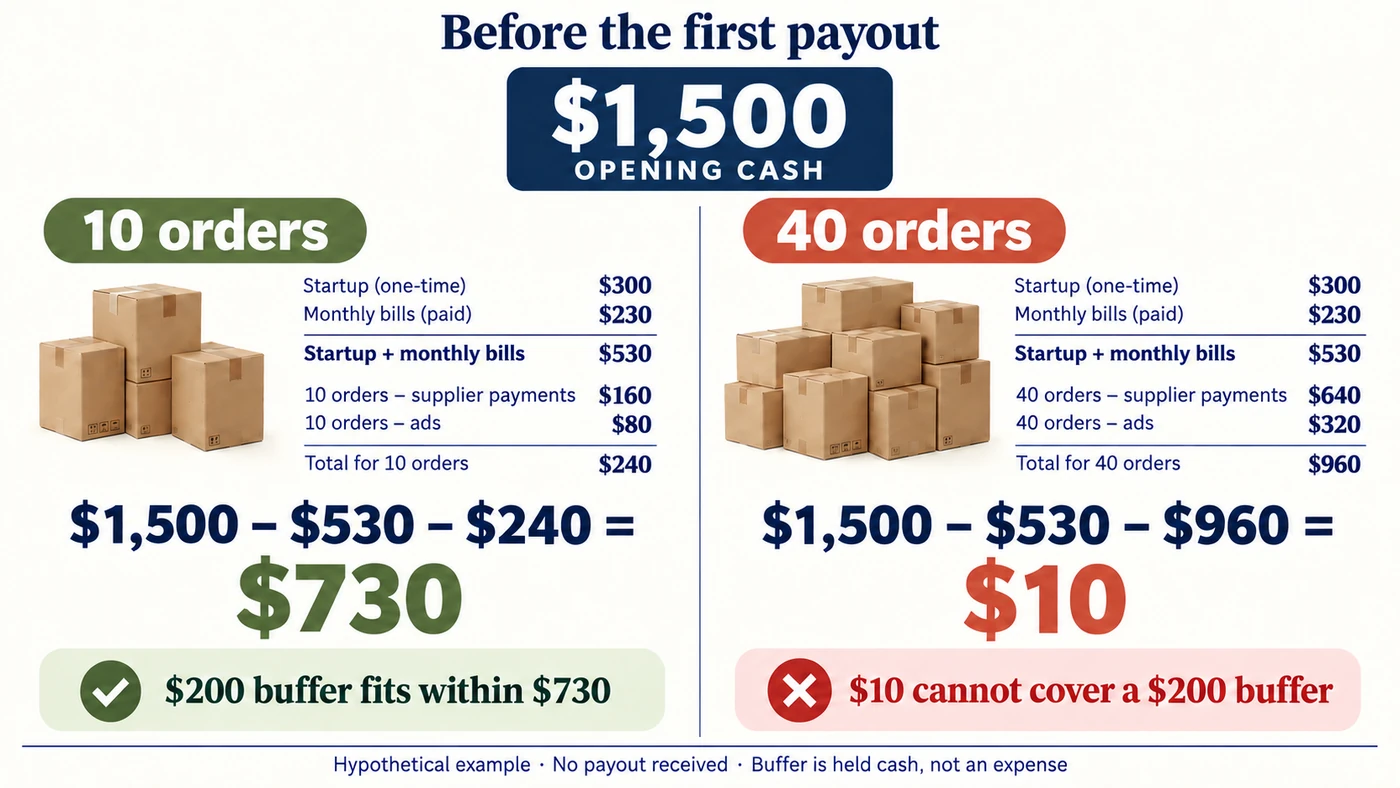
| Before any payout | First 10 orders | All 40 orders |
|---|---|---|
| Starting cash | $1,500 | $1,500 |
| Startup costs and month’s bills paid | −$530 | −$530 |
| Supplier and advertising paid | −$240 | −$960 |
| Bank cash remaining | $730 | $10 |
| $200 buffer can be held? | Yes; $530 remains uncommitted | No |
On a phone, swipe the table sideways to compare every column.
Holding cash does not spend it again
The buffer stays inside the bank balance. Holding $200 does not spend another $200. A refund or replacement spends cash when it actually happens; the per-order allowance in the profit forecast estimates that cost in advance.
Use your actual payout dates
Shopify distinguishes settlement, payout schedules and bank arrival. Timing varies by region, risk and payment method, and refunds or chargebacks can reduce payouts. A payment confirmation is not proof that the cash is available.
For your forecast:
- Use the account’s expected payout date, then allow for the stated bank processing time.
- List supplier payments, advertising and bills due before that date.
- Subtract those payments from available bank cash and protect the chosen buffer.
- Limit new order commitments or advertising if the resulting balance cannot fund them. Follow up any payout alerts instead of assuming the next sale solves the shortage.
Reconcile the month when money arrives
Suppose all 40 customers’ payments have been paid out and actual problem costs total the planned $80:
- Calculate net receipts: $1,560 sales minus $60 processing fees leaves $1,500.
- Pay the month’s actual costs: $640 supplier, $320 advertising, $230 bills, $300 startup and $80 problems total $1,570.
- Find closing bank cash: $1,500 opening funds + $1,500 net receipts − $1,570 payments = $1,430. Hold $200 within that balance, leaving $1,230 uncommitted.
Closing cash differs from the $230 monthly operating profit because it includes opening funds and startup spending. Update the forecast when actual payouts, refunds or costs differ.
When someone else will rely on the plan
If a lender, investor or partner asks for a formal plan, ask for their required format and period first. The SBA distinguishes detailed traditional plans from lean working plans. Your one-page draft is a useful starting summary; it does not supply evidence that you have not gathered.
Explain the business and evidence
Add the real entity, owners, responsibilities and intended market. Attach the actual competing-offer comparison, supplier quote and relevant sample observations; label untested demand and estimates clearly.
Explain the money requested
State the amount, what it buys and the timing. Provide the requested financial projections with price, volume, acquisition cost, supplier/payout terms and downside assumptions. Include actual debt-payment terms where financing applies, rather than inventing an interest rate or approval.
Make each material figure traceable to a quote, receipt or stated assumption. Keep the forecast dates and its exclusions visible. A professional-looking template cannot establish that forty buyers will arrive or that a lender will accept the proposal.
06
Turn the plan into the first month's work
Give each action a date and a person responsible. The organizer shop’s first month could follow this sequence; move the dates if a sample, payment account or supplier arrangement is not ready.
- Week one: establish the offer. Compare competing delivered offers, obtain the complete supplier quote and order the sample. Finish the fit explanation, product page and return arrangements. The output is an offer the owner can actually explain and supply.
- Week two: launch a funded test. Complete checkout and tracking tests, publish the demonstrations and accept only orders the bank can fund. For this example, the first ten orders fit the stated cash plan. Ten is a funding choice, not a statistically conclusive test size.
- Week three: fix the observed problem. Compare ad spend with paid buyers and follow the actual parcels. Repair missing product information, payment failures or delayed dispatch where they occur. If stock or cash becomes insufficient, reduce new commitments while resolving it.
- Week four: replace the assumptions. Calculate actual contribution, monthly costs and closing cash. Compare them with the $8 acquisition cost, $2 problem allowance and 40-order goal. Choose the next month’s spending and order capacity from the revised figures.
Keep sales receipts, supplier invoices, ad charges, payment fees and customer remedies together. They allow you to reconcile the forecast and prepare the records your business needs; the IRS recordkeeping guidance explains the US income-and-expense purpose.
The next decision follows the result:
- Buyers pay and costs fit: continue within funded order capacity, replacing forecasts with actual supplier and payout information.
- Visitors arrive but do not buy: investigate the offer, fit information, delivered price and checkout before increasing traffic.
- Orders arrive but lose money: change the price, acquisition approach or product economics. More volume can enlarge that loss.
- Contribution is positive but cash is short: adjust the order pace and payment timing; do not treat unpaid sales as available bank funds.
Use the dropshipping startup guide for the wider launch sequence. If the plan needs China-side sourcing, AIDrop’s product-sourcing service can help define the physical supplier work. Send your product specification, destination and expected order volume so the relevant sourcing and fulfillment scope can be reviewed. Those operating inputs belong in the plan; this US-warehouse example is not an AIDrop quote or a promise of its availability.
Questions when filling in the plan
How long should the plan be?
For your own first offer, use the one-page fields and the supporting numbers and tasks you need to make decisions. A lender or investor may request a detailed traditional plan. Use that recipient’s requirements; no page count guarantees a useful or accepted plan.
Can I copy the example’s costs and forty-order target?
Use them to understand the calculations, then replace them with your actual supplier quote, account fees, supported acquisition test and available funds. Forty orders are a goal in this fictional example, not evidence of demand or a minimum needed for every store.
Why can the plan fund ten orders but still aim for forty?
The ten-order case limits commitments before any payout arrives. Forty is the month’s assumed sales goal. Actual payouts may later fund more orders, but their timing and remaining obligations need checking. A profitable month on paper does not authorize purchases the current bank balance cannot cover.
How to Start a Dropshipping Business: From Offer to First Delivery
Start a dropshipping business with a clear offer, verified supplier, workable pricing, tested checkout, and a plan
What Is Dropshipping? How to Build and Run the Business
Learn how dropshipping works, earns money and handles risk, from product research and supplier checks to shipping,
Dropshipping for Beginners: Learn the Model and Test Your First Order
Learn dropshipping basics, choose a focused offer, budget for supplier payments and rehearse checkout, shipping and support
