
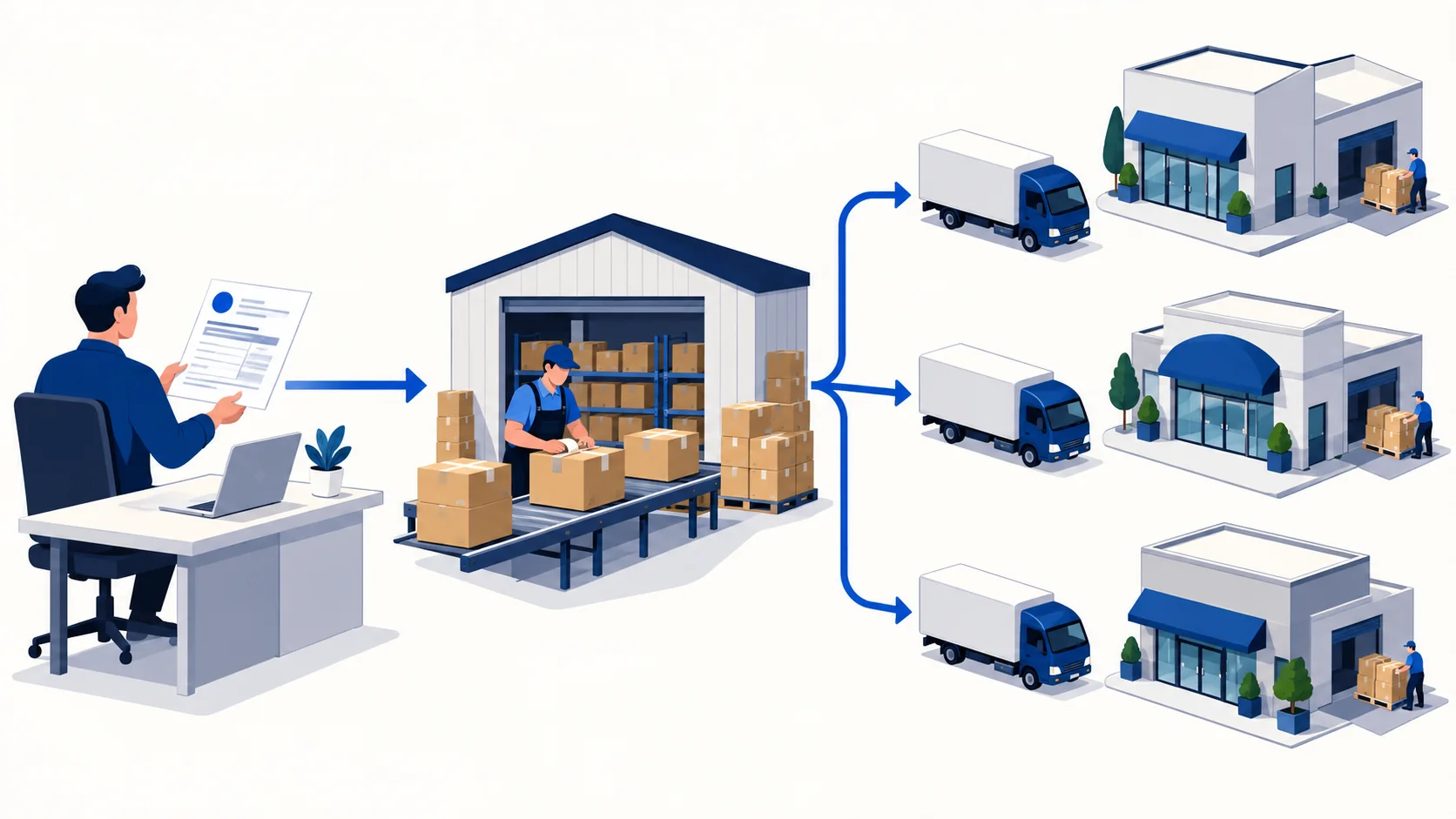
Yes, B2B dropshipping can work. You sell to a business buyer, then an upstream supplier sends the goods directly to that buyer’s business address. You do not receive and reship the stock. The challenge is that a business order is rarely just a name and a delivery ZIP: it may have a purchasing contact, a purchase order, several branches, case packs, a negotiated price and payment terms.
Picture a small chain asking you for supplies at three locations. The buyer sends one purchase order. Your supplier says it can ship direct. Before accepting, you still need to know whether the supplier will send three separate parcels or freight consignments, what each location receives, and how each shipment appears on the buyer’s invoice. That is the practical meaning of B2B dropshipping for this article.
Explore the broader topic: Dropshipping Suppliers: Compare Channels, Costs, and Fit.
01
Put the three businesses in the right roles
In this setup, you are the seller to a company. The company is your buyer, and its employee or purchasing manager is the order contact. An upstream manufacturer, wholesaler or distributor is your supplier. It holds or produces the goods and ships them to the buyer’s named location under an agreed arrangement. The supplier’s price to you and your price to the buyer are different records.
Shopify’s B2B terminology guide describes transactions between businesses and distinguishes the parent company, buying contact and company locations. Those are useful concepts even if you use another storefront or a spreadsheet; Shopify settings are not automatic features of your business.
Who is the buyer?
“B2B” is sometimes used in the opposite direction: you buy from a B2B wholesaler and then sell single items to consumers. That may be ordinary consumer dropshipping. Here the buyer is a business. If you are instead a manufacturer recruiting stores to resell your line, your account and pricing design is a supplier-side project.
| Party | What it controls | What must travel with the order |
|---|---|---|
| Business buyer | Purchase approval, receiving location and PO reference | Company, authorized contact, ship-to, case quantity and required delivery window. |
| Your store | Buyer quote, invoice and customer support | Accepted terms and matching order record. |
| Upstream supplier | Available stock, case pack, dispatch and carrier | Exact product code, quantity per location, address, labeling and tracking. |
On a phone, swipe the table sideways to compare every column.
If the upstream company will only send pallets to your warehouse, it is a wholesale purchase, not this supplier-direct arrangement. Confirm the direct ship-to address before you advertise a B2B dropship offer.
02
Create one buyer account, then specify each receiving location
Business buyers can have several sites under one company name. The purchasing manager’s email is not the delivery address. Ask who is authorized to place orders, which branch is buying, and whether the PO applies to the head office or to each site. The platform terminology guide treats company locations as potentially having different catalogs, payment terms and shipping addresses. In your own system, the same separation can be a simple table.
Ask the purchasing contact for the company name, billing details and PO number, then collect a separate receiving record for each site: address, contact/phone, opening hours and any dock or appointment rule.
A warehouse that accepts cartons only from 9 to 3 needs a different delivery plan from a staffed shop counter. Confirm who signs, whether partial deliveries are allowed and who may approve an address change. Keep those answers beside the branch allocation.
Approve the receiving address
Do not assume a one-time address is authorized just because the buyer types it into a note. Have the purchasing contact confirm that site and the receiving name. Otherwise the supplier may send to the company headquarters by default while the buyer expected a branch.
03
Translate the PO into cases and shipments
Suppose a fictional buyer requests two cases of 24 units for each of three locations. The product total is 2 × 24 × 3 = 144 units. But fulfillment is not one 144-unit parcel. It is three address-level allocations of 48 units each—unless the supplier’s system requires six separate case orders or another arrangement.

| Buyer location | Cases | Units at 24 per case | Receiving record |
|---|---|---|---|
| Branch A | 2 | 48 | Address, dock/contact, tracking. |
| Branch B | 2 | 48 | Address, dock/contact, tracking. |
| Branch C | 2 | 48 | Address, dock/contact, tracking. |
| PO total | 6 | 144 | Three site-level deliveries to reconcile. |
On a phone, swipe the table sideways to compare every column.
This is illustrative arithmetic, not a supplier quote. “Case of 24” has to mean the actual sellable unit for that product. If the supplier’s minimum is four cases per location, the buyer’s two-case branch request fails even though six cases appear on the overall PO. If freight is charged per destination, one blended shipping fee may also be wrong.
Write the PO as three address-level lines
For fictional PO-301, use product CASE-24: one case contains 24 sellable units. The following is a worksheet example, not an API request or accepted supplier order.
Branch A
PO-301 / A; 2 cases × 24 = 48 units; authorized ship-to and receiving hours ___; supplier purchase ___; carrier/tracking ___; received cases ___.
Branch B
PO-301 / B; 2 cases × 24 = 48 units; its own ship-to/contact ___; supplier purchase ___; carrier/tracking ___; received cases ___.
Branch C
PO-301 / C; 2 cases × 24 = 48 units; its own ship-to/contact ___; supplier purchase ___; carrier/tracking ___; received cases ___.
Before release, the three lines must total six cases and 144 units. After delivery, if A and C received two cases each but B received one, only five cases—120 units—are confirmed received. Investigate B’s remaining 24 units; do not let the total supplier invoice hide that shortage.
Ask the supplier to accept an itemized record with product code, case pack, quantity, every ship-to and the buyer’s PO reference. B2B Wave’s published order API illustrates why these fields are distinct: it has a customer ID or email, an address or address-book entry, a customer order reference, product code and quantity; it can mark an address as a dropship address. That software documentation is a useful field model, not evidence that your supplier uses B2B Wave or that AIDrop has that integration.
04
Make the supplier accept the business order as written
A supplier account may show wholesale prices but still reject direct-to-buyer dispatch or a multi-address PO. Get written acceptance of the exact product, case minimum, each branch’s quantity, ship-from origin, parcel/freight method, packing slip identity and whether the buyer will see the upstream supplier’s price.
Ask how this supplier accepts direct delivery
Some suppliers need a special order note. For example, Yedoo’s published B2B terms tell buyers to enter “dropshipping” and the end-customer address in the order note. That is one vendor’s process, not a standard all suppliers follow. The lesson is that direct delivery should be an accepted order instruction, not something you hope the warehouse infers from a different address.
Check what happens when one site cannot be served. May the supplier ship the other two and backorder the third? Will it issue three tracking numbers and identify the delayed site? Can your buyer accept a split invoice? These details decide whether one supplier can actually handle the PO you quoted.
Approval of a relationship does not reserve today’s stock
Also separate the standing relationship from this order. A master agreement might say the supplier permits dropshipping and prints neutral slips, but the next PO still needs an accepted product code, site list, quantity, price and dispatch window. A successful order to Branch A last month does not reserve six cases for three branches today.
Let the authorized buyer approve substitutes
If the supplier proposes a substitute—another color, pack size or comparable item—route it back to the authorized buyer contact. A buyer may have an internal approved-product list; “equivalent” on the supplier’s side may fail the buyer’s specification. Record who approved the change, the new price and the revised delivery record. Without that approval, hold the affected line rather than quietly filling it with something else.
05
Agree on price, payment and tax documents before release
Business buyers may expect trade prices, volume breaks, deposits or payment after delivery. None is automatic. Start with a quote that states product code, unit of sale, quantity, each destination’s freight, taxes where applicable, and the payment event that releases the order. A supplier that charges you immediately while the buyer pays you 30 days later creates a cash gap you must choose to fund. Do not offer “net 30” merely because the buyer asks; credit terms need a deliberate agreement.
Separate the product and three delivery charges
For a simple fictional quote, assume six cases cost you $70 each and three address-level freight charges are $18 each. Upstream cost is 6 × $70 + 3 × $18 = $474 before taxes or service recovery. If you quote six cases at $105 each plus $18 freight for each site, the buyer’s stated total is 6 × $105 + 3 × $18 = $684. The $210 difference still has to cover your processing, payment cost, claims, sales expense and overhead. These are invented numbers to show the separate product and freight lines; actual buyer and supplier terms may differ.
Net 30 changes cash timing, not the supplier invoice
In the six-case example, the supplier wants $474 before release. If the buyer pays the $684 quote 30 days after delivery, that future receipt does not pay today’s supplier.
If you fund the interval
Have $474 usable cash plus your actual extra costs and recovery buffer by the supplier deadline. Confirm when the buyer’s 30-day clock starts and which receiving or invoice documents it needs.
If you cannot fund it
Agree a deposit, earlier buyer payment or supplier credit before accepting the PO. Record the changed terms and recheck dispatch. Do not accept net 30 and discover the cash gap after all three branches expect delivery.
The illustrative $210 difference is before the remaining costs. It does not prove a $210 profit or mean $210 is available today.
A business buyer is not automatically tax-exempt. Under the Texas resale-certificate rules, a qualifying resale purchase needs a properly completed certificate; a permit number alone is insufficient, and the seller must retain the certificate.
That distinction matters for branch supplies: goods bought for the buyer’s own use are not automatically goods bought for resale. The Texas authority says not to accept a resale certificate when you know or have reason to believe the goods are for other use. Check the actual jurisdiction and transaction before removing tax; one Texas example does not settle a multi-state PO.
Keep the buyer invoice and supplier bill reconciled by PO number, product code, branch and quantity. A mismatch is easier to fix before boxes depart than after a branch counts the wrong case size.
06
Tell the buyer how each branch will receive and report problems
Find the missing case by branch
The useful control is a three-way match, not a single “delivered” flag. Suppose the buyer’s PO says two cases for each of three branches, the supplier accepts six cases, but Branch B signs for only one. Keep the PO line, supplier order line, parcel count and receiving note together under the same reference. You can now tell whether the missing case was never packed, split into another shipment or lost after carrier collection. Do not invoice the buyer for six received cases merely because the supplier accepted six; resolve the disputed line under the agreed terms and give the buyer a dated correction or replacement plan.
One buyer PO can still become three supplier ship-to orders. The important link is the branch and case count on every line, so a short shipment to Branch B does not silently turn into an apparent overage at Branch C. Ask the buyer who may approve a substitution or extra freight before the supplier changes the order.
Direct shipping does not remove your customer-service role. Tell the purchasing contact when each site was dispatched, provide a tracking reference per site, and state who should inspect and report damage or shortages. If the supplier ships one branch today and two tomorrow, the status should say that plainly.
Carton count and product condition differ
Choose a receiving test that fits the product. A sealed carton count may establish that two cases arrived, but it might not prove all 48 units are intact. For fragile or expensive goods, agree whether the receiver photographs the outer carton, checks the case seal and opens the goods at delivery or within a specified claim window. The supplier’s policy should tell you which evidence it needs. Do not invent a universal 24-hour claim deadline.
For a buyer-supplied address error, agree who pays for rerouting in the sales terms and upstream agreement before quoting the order.
| Exception | First record to inspect | Decision for the buyer |
|---|---|---|
| Branch receives too few cases | PO allocation versus supplier pick record and carrier scan | Replace missing goods or correct the invoice under the agreed claim terms. |
| Wrong location gets the parcel | Authorized ship-to versus transmitted label | Identify who supplied/entered the wrong address and arrange a supported correction. |
| One site is late | Site-specific dispatch and tracking | Give that site’s revised date and let buyer decide on partial acceptance. |
On a phone, swipe the table sideways to compare every column.
07
Release or hold the three-location order
Release the three-site quote: If the supplier confirms two cases to each branch, an accepted carrier service for each address, three freight charges, one PO reference carried into its records, and a shortage/damage process, you have a concrete order to price and accept.
Hold or narrow the quote: If the supplier only says “we dropship B2B” but cannot confirm multi-address handling, hold the fictional six-case PO or quote one address at a time.
Version the approved PO, not an email thread
An order record the buyer and supplier can both read has: company and authorized contact; buyer PO; exact product and case pack; branch quantity and receiving address; accepted ship dates and carrier mode; price, freight, taxes and payment release; packing-slip identity; and claims. Keep version control on changes. If Branch C changes from two cases to three after approval, issue a revised quantity and quote rather than relying on an email buried in a thread.
If you are assessing a specific supplier-to-business-buyer route, send AIDrop Agent the product code, case pack, buyer locations, order volume and required handoff and ask whether a custom sourcing or fulfillment scope can be assessed. Any capability and price must be confirmed for that scope before you sell it.
Questions about B2B dropshipping
Is buying from a wholesaler always B2B dropshipping?
No. Here your customer is a business and the upstream supplier dispatches to that business. Buying wholesale and selling individual items to consumers is a different buyer model.
Do I need Shopify B2B or an API?
No software is required merely to understand the arrangement. A clear PO and branch worksheet can work for an agreed manual process. Software helps only when its actual account, product units and address mapping fit the supplier’s accepted process.
Can six cases satisfy a four-case minimum?
Not if the supplier requires four cases per destination and each of three branches wants only two. Ask whether the minimum applies per PO, SKU, case or ship-to before quoting.
Does a business buyer qualify for tax-free purchasing?
Not automatically. Resale eligibility and documents depend on the transaction and jurisdiction; goods consumed by the buyer are different from goods acquired for resale. The Texas example above is limited to Texas rules.
Should I offer net 30 to win the order?
Only after agreeing the credit terms and funding the supplier’s earlier due date. In the fictional order, $474 must be funded today even though the buyer will pay $684 later. Include actual extra costs and remedies before choosing your credit limit.
What Is Dropshipping? How to Build and Run the Business
Learn how dropshipping works, earns money and handles risk, from product research and supplier checks to shipping,
How to Start a Dropshipping Business: From Offer to First Delivery
Start a dropshipping business with a clear offer, verified supplier, workable pricing, tested checkout, and a plan
Dropshipping for Beginners: Learn the Model and Test Your First Order
Learn dropshipping basics, choose a focused offer, budget for supplier payments and rehearse checkout, shipping and support
