
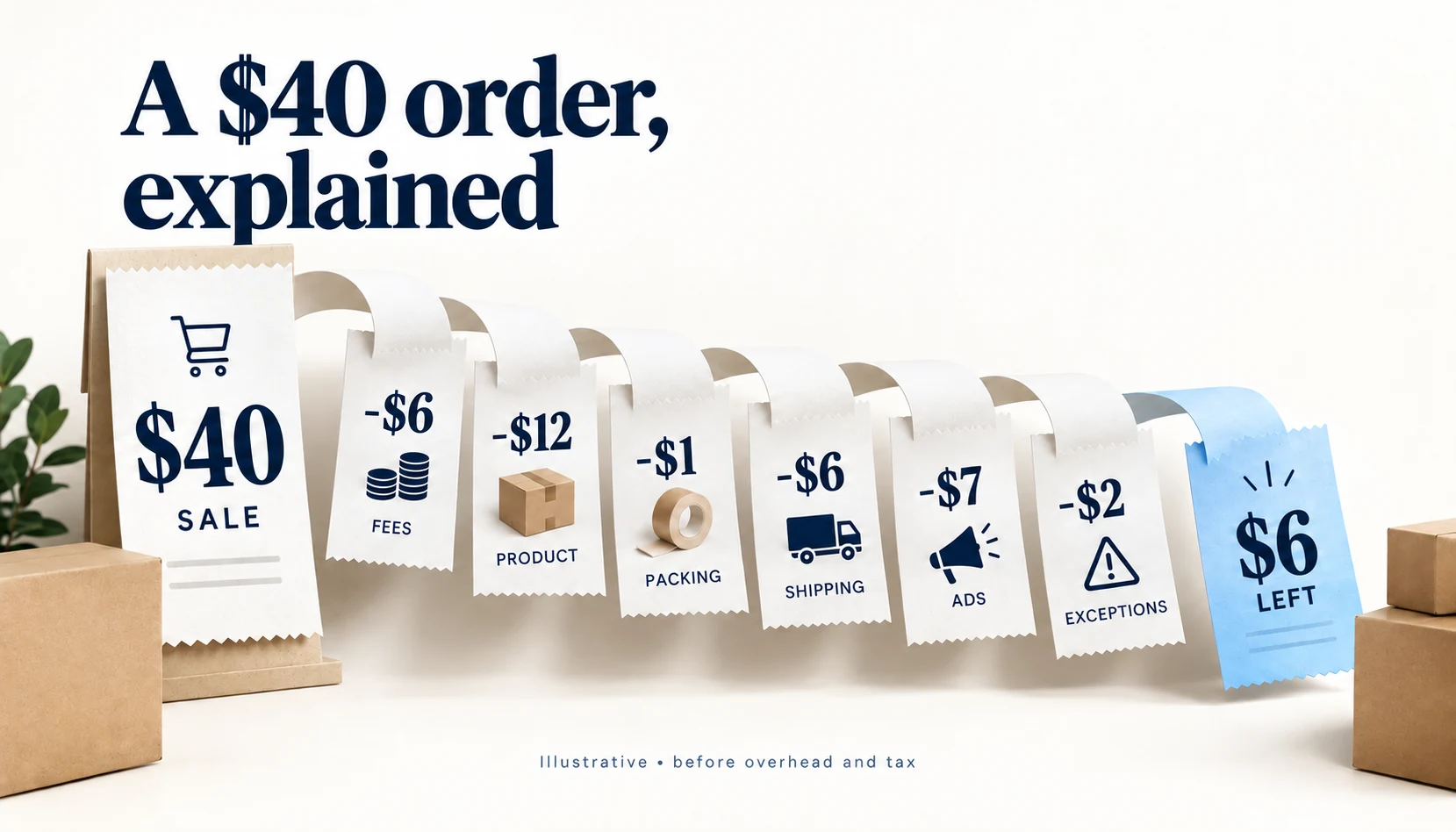
Amazon dropshipping costs include the selling plan, referral fees, the supplier’s product and fulfillment charges, advertising where used, refunds and business overhead. Amazon does not charge a separate fee simply because an order is dropshipped. Your profit is the amount left after the costs of the actual order, including what happens after delivery.
A $40 order in the example below contributes $6 before monthly overhead and tax. A combined price reduction and shipping increase turns the same order into a $0.10 loss. Those are illustrative results from stated assumptions, not typical seller earnings or an AIDrop quotation.
This article uses Amazon’s US store and merchant-fulfilled orders. Published platform charges were checked September 19, 2026. For the operating model and sourcing conditions, see the Amazon dropshipping guide.
01
Start with the Amazon fees that actually apply
The US selling-plan page lists Individual at $0.99 per item sold and Professional at $39.99 per month, plus selling fees. The plans provide different tools and program access, so volume is not the only reason to choose one.
For plan charges alone, 40 Individual sales cost $39.60 and 41 cost $40.59. Professional’s monthly fee is $39.99. That comparison does not include referral fees or establish that both plans meet your operational needs.
Referral fees depend on the product’s fee category. They can include percentage tiers and a minimum amount. The fee base includes the item price, customer shipping charge and gift wrapping where applicable; separating $5 of shipping from a $35 item does not necessarily reduce the referral fee compared with a $40 delivered offer.
Do not apply 15% to everything. Amazon currently lists Home and Kitchen at 15%, while Clothing and Accessories uses different rates at different price levels. Also check the actual fee category, which Amazon notes may differ from the category customers see in the store. Use the current rate table and product calculation instead of a remembered percentage.
Amazon’s dropshipping explanation confirms that there is no dropshipping-specific Amazon charge. Optional programs and services can add costs. Your supplier may also charge sourcing, handling or account fees independently of Amazon.
Keep FBA charges out of an ordinary supplier-direct order
If your supplier sends the parcel to the customer, use your merchant-fulfilled shipping and handling costs. Do not subtract an FBA fulfillment fee or FBA storage charge just because a third-party calculator has those fields filled by default.
If you also keep stock in FBA, calculate that offer separately, including its applicable inbound, storage and fulfillment charges. You can compare the models, but combining both fulfillment bills for a single shipment creates a false result. Amazon’s merchant-fulfilled guide describes the separate shipping tools and operating arrangement.
02
Build one merchant-fulfilled order from the quote
The following example uses a $40 delivered sale in a category with a 15% referral fee. All other amounts are hypothetical. It excludes sales tax collected for remittance and assumes one item per order.
| One completed order | Amount |
|---|---|
| Customer revenue after discount | $40.00 |
| Referral fee: 15% × $40 | −$6.00 |
| Supplier product cost | −$12.00 |
| Pick, pack and packaging | −$1.00 |
| Outward shipping | −$6.00 |
| Advertising allocated to the order | −$7.00 |
| Expected net return/replacement impact | −$2.00 |
| Contribution before fixed overhead and tax | $6.00 |
The order has a 15% contribution margin: $6 divided by $40. It has not produced $6 of take-home profit because the monthly plan, other fixed expenses and tax remain outside the calculation.
Obtain the supplier’s quote for the packed item, actual variation, destination and service. Establish whether handling and packaging are included in the product or shipping line. If they are, split the total for clarity without charging yourself twice. Include currency conversion, payment transfer, import or brokerage costs when the arrangement makes them your expense.
Use a route-specific quote for difficult destinations rather than a blended shipping average. A product can work for one destination and fail for another. If the supplier changes the warehouse or carrier service, update both the cost and the delivery promise.
The $2 exception allowance is a planning estimate of the net economic reduction caused by returns, replacements and similar events. It is not a second product purchase on every order. Once you have actual refunds and cost recoveries, replace the allowance with those actual results instead of deducting both.
03
Calculate margin and a defensible price floor
Three numbers answer different questions:
- Contribution per order: revenue less costs that vary with the order, including expected exceptions.
- Contribution margin: that contribution divided by revenue.
- Operating profit: total contribution less the period’s fixed operating expenses.
Markup uses a cost base, not revenue, so a markup percentage is not interchangeable with a margin. If you call every amount left after buying the item “profit,” shipping, selling fees and customer acquisition disappear from the decision.
In the $40 example, non-referral variable costs total $28: product $12, packing $1, shipping $6, ads $7 and expected exceptions $2. With a 15% referral rate, the zero-contribution price solves:
Price × 0.85 − $28 = $0, so price = $32.94, rounded to cents.
That floor covers the modeled variable costs only. To leave $5 per order toward overhead and profit, solve price × 0.85 − $28 = $5, giving about $38.82. At the assumed $40 price, the result is the $6 contribution shown above.
This shortcut only works while the referral rate and other costs remain constant. Recalculate when a price crosses a fee tier, a minimum fee applies, a coupon changes the charged amount or a promotion adds a separate charge. Do not hide tax collected for someone else inside the revenue available to cover your costs.
The same example leaves $13 before ads and fixed overhead: $40 minus $6 referral fee, $19 supplier fulfillment and $2 expected exceptions. Spending $13 to acquire an order leaves nothing for overhead. To retain the modeled $6 contribution, acquisition must average $7. A high advertised ROAS is useful only if its revenue, attribution and cost scope match the orders you are evaluating.
04
Work refunds through a complete order cohort
A reserve helps with a forecast. Actual profitability needs actual refund entries, recoveries and remaining costs. Use one group of orders so you do not subtract refunded revenue and then mistakenly subtract the entire refunded order value again as a loss.
Take 100 orders at $40. Assume three are fully refunded. All 100 were shipped; supplier product, packing and outward shipping cost $19 per order, and total ads were $700. For illustration, assume the transaction records show $14.40 in total Amazon fee credits after the refunds, $15 in reverse-shipping costs, and $24 of recovered product value. The credit and recovery amounts are assumptions, not a statement of the fee or reimbursement every return receives.
| Cohort result | Calculation | Amount |
|---|---|---|
| Gross customer revenue | 100 × $40 | $4,000.00 |
| Three full refunds | 3 × $40 | −$120.00 |
| Net revenue | $4,000 − $120 | $3,880.00 |
| Referral fees originally charged | 100 × $6 | −$600.00 |
| Fee credits recorded | Actual assumed credits | +$14.40 |
| Products, packing and outward shipping | 100 × $19 | −$1,900.00 |
| Advertising | Cohort total | −$700.00 |
| Reverse shipping | Assumed actual total | −$15.00 |
| Recovered product value | Assumed usable recovery | +$24.00 |
| Contribution before fixed overhead | Net revenue minus net costs | $703.40 |
Without those three returns, the same cohort would contribute $800 before fixed overhead. Their net impact is therefore $96.60, or $0.966 per original order. This is lower than the forecast allowance of $2 per order. It does not establish a future return rate or mean you should reduce the allowance after one small sample.
The table intentionally omits the forecast $200 exception allowance because it already contains the actual assumed refunds and related adjustments. Deducting the allowance again would count those risks twice. Equally, treating the three refunded units as if product and outward shipping had never been paid would overstate the result.
Recovered product value needs evidence. A returned item that could theoretically be resold is not the same as a supplier credit received. Inventory recovered for resale can have economic value without providing cash today. Separate those states when reconciling profit with your bank balance.
For your own cohort, record each refund, applicable fee adjustment, return label, supplier credit, replacement shipment and disposal charge. Use the transaction report’s actual treatment rather than assuming all Amazon fees reverse in full. Follow the current return rules; do not delay an owed customer remedy while waiting for a supplier credit.
05
Stress the selling price and shipping cost
Return to the normal-order forecast with its $2 expected exception allowance. The order contributes $6 at a $40 selling price. Now reduce the selling price by 10% to $36 and increase shipping from $6 to $8.70. Keep the other assumptions unchanged.
The referral fee falls to $5.40 under the assumed unchanged 15% rate. The new result is:
$36 − $5.40 − $12 − $1 − $8.70 − $7 − $2 = −$0.10.
The cheaper price and dearer shipping have consumed the entire contribution. Increasing order volume would increase the modeled loss before fixed overhead. A higher sales total would not repair it.
Run separate tests for price, shipping, acquisition cost, refund impact and exchange rate so you can see which input changes the decision. Then combine plausible adverse changes. Use quotes, actual performance or a clearly labeled planning assumption; an arbitrary optimistic percentage makes the spreadsheet look precise without making it useful.
If the price required for a viable contribution exceeds what customers will pay for an equivalent delivered offer, change something substantive: source cost, package dimensions, service, product mix or the value of the offer. A repricer should have a cost-informed floor, but a floor cannot create demand at an uncompetitive price.
06
Separate monthly overhead from order costs
Suppose the business pays the $39.99 Professional plan plus an assumed $60 of other monthly fixed expenses. Total fixed overhead is $99.99. At the forecast $6 contribution per order, it takes 17 orders to cover that overhead because $99.99 divided by $6 is 16.665.
That is an operating break-even calculation, not recovery of every dollar used to launch. If you spent $300 on samples and setup, recovering that investment requires additional contribution. Decide whether to show those costs as current expenses or allocate them for planning, and use the same treatment when comparing months.
At 100 normal orders under the forecast, contribution is $600 and the amount left after $99.99 overhead is $500.01 before tax and any excluded owner compensation or financing costs. Under the actual-return cohort above, $703.40 less the same overhead leaves $603.41. The forecasts differ because the actual assumed exception impact differs; neither should be presented as a typical monthly income.
List software, bookkeeping, insurance and professional services in the period when they apply. If an app charges per order, put that variable part into the order calculation. If you pay annually, track the immediate cash payment as well as the monthly amount used to compare operating performance.
Do not allocate a Professional fee per order and also subtract the whole monthly fee again. Use one treatment consistently. The same principle applies to fixed creative-production costs and advertising-management fees.
07
Fund orders before Amazon releases the money
Amazon sales and bank-available cash are different numbers. Its seller-payment guide explains scheduled settlement, reserves and deferred transactions. The date funds become usable depends on your account and the transactions, not simply the date the customer ordered.
For an illustrative planning gap of 21 days, five orders daily at $19 paid to the supplier require 5 × $19 × 21 = $1,995 in supplier payments before recycling the proceeds. At the modeled $7 advertising spend per order, another $735 is spent over those 105 orders. Together that is $2,730, before fixed bills, refunds or additional contingency.
Twenty-one days is a scenario, not a promised Amazon payout interval. Replace it with your account’s actual timing and a slower case. If you increase sales to ten orders daily with all other assumptions unchanged, this supplier-and-ad requirement doubles.
The referral fees are deducted from proceeds in this simplified cash example, so they have not been added again as an upfront supplier payment. If your account charges, reserves or other balances create different cash obligations, include their actual timing. A cash forecast should show both incoming settlements and payments due, not just an order margin multiplied by volume.
Do not count borrowed money as profit. Financing can bridge a timing gap, but fees and repayment dates can change the result. A product with negative contribution needs a different commercial answer, not a larger borrowing limit. The cash-flow guide covers the wider timing calculation.
08
Reconcile the forecast against actual transactions
After orders have had enough time to deliver and generate returns, match the Amazon order records with supplier invoices, shipping charges, advertising spend and payment adjustments. Keep unresolved orders visible rather than treating every recent sale as complete.
Check four differences first: the fee charged versus the estimated category fee; the shipping invoice versus the quote; customer refunds and supplier recoveries; and ad spend attributed to the actual group of orders. These differences often explain why a product looked attractive before launch but leaves little cash afterward.
If a supplier invoice combines several orders, allocate it using the real product and shipping amounts rather than dividing everything equally when parcels differ. Reconcile any multi-currency payments using the actual amount paid, including conversion charges. Keep taxes collected for remittance separate from revenue you retain.
Amazon’s calculator, linked from its pricing page, can compare fulfillment estimates. It does not replace your full business ledger. Enter your own fulfillment costs and confirm which expenses the displayed result includes before calling it net profit.
Use the result to decide whether to maintain, reprice or stop an offer. For definitions and a broader worked example, see dropshipping profit margin. The useful measure is the contribution and cash generated by delivered orders after their known adjustments, not the headline gap between a supplier price and a listing price.
09
Frequently asked questions
Is Amazon dropshipping profitable?
It can be, but there is no reliable universal profit percentage for every seller or product. Estimate the specific order, include expected customer remedies and overhead, then compare the forecast with completed-order results. Sales figures for all Amazon sellers do not establish dropshipping profit.
Does Amazon always take 15%?
No. Referral fees vary by category and can have price tiers and minimums. Selling-plan charges and optional services are separate. Confirm the product’s actual fee category and the current US rate table.
Should I include a payment-processing percentage as well?
Do not automatically add a standalone-store card-processing percentage to an Amazon sale. Use the actual Amazon charges and any separate payment, currency-conversion or supplier-transfer fees you incur. Adding an unrelated default can overstate costs.
Are returns already covered by the referral fee?
No. Customer refunds, outward shipping, reverse shipping, replacement products and any fee adjustments need their own treatment. Use actual records, and avoid subtracting an expected return allowance again after actual returns are included.
What is a good margin to target?
Choose a contribution that can cover your fixed costs, owner compensation, uncertainty and desired profit at a realistic sales volume. A margin that only works with perfect delivery, zero refunds or unusually cheap ads leaves little room for the business to operate.