
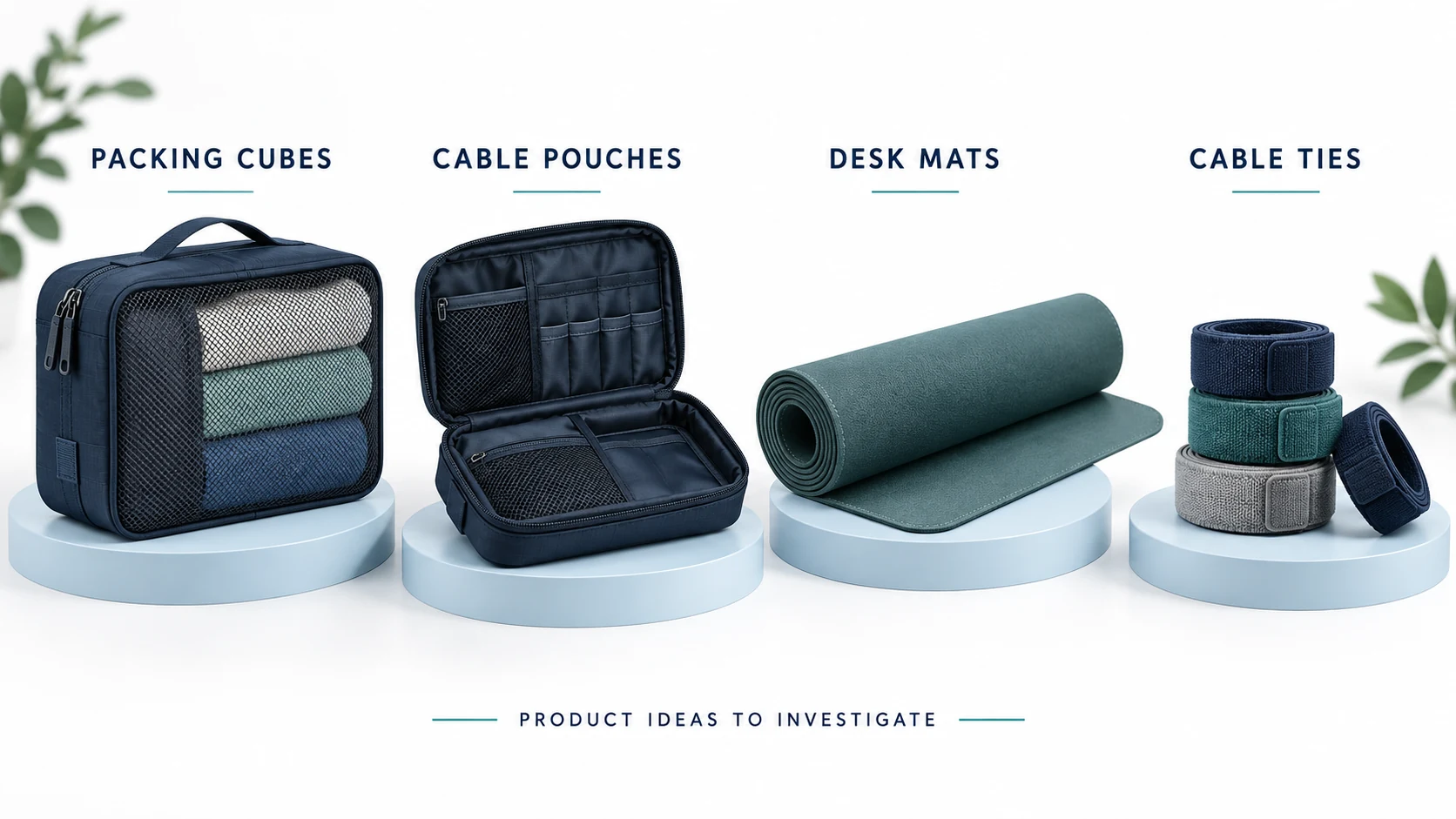
Packing cubes, cable pouches, desk mats, reusable cable ties, drawer dividers, fabric storage bags, plant ties, garden labels, craft organizers, adult pencil cases, printed tote bags and art prints are practical products to investigate. Each can be built around a recognizable customer need. The best choice is the one whose audience, delivered cost and quality you can validate before increasing spending.
These are conditional editorial picks, not a sales ranking or a claim that the products are currently trending. A particular supplier’s version may be poor, expensive to ship or indistinguishable from a cheaper local offer. Treat the list as a starting shortlist and test the exact item you intend to sell.
For a first range, we would favor a few related organization products over a collection of unrelated viral gadgets. Their use can often be explained with dimensions, compartments and an honest demonstration. That makes it easier to identify a specific buyer and discover whether the offer actually solves their problem.
01
How these products were selected
The selection favors concrete everyday uses, inspectable physical features and opportunities to explain a meaningful difference. It avoids relying on medical results, electrical performance or safety-critical functions to make the initial offer attractive. This does not exempt any product from applicable rules or quality checks.
Broad product-idea lists, including Shopify’s product guide, establish the range of categories sellers consider. Category popularity alone does not show that a particular item, price or shipping route will work for your store. The dropshipping products guide explains the broader selection process.
Each candidate below includes a buyer, a potential difference and the checks that can change the decision. The difference must be present in the supplied product; do not turn an attractive description into an unsupported feature claim.
02
Travel and desk organization
1. Packing cubes for a defined bag or trip
Packing cubes are worth investigating for travelers who want to separate clothing inside a suitcase or backpack. A useful offer could identify exactly how the set fits a particular bag size or packing routine, rather than simply promising “better travel.”
- Check every piece’s dimensions, zipper operation, seam finish and actual packed thickness.
- If the set uses compression zippers, show what they do using the physical sample and avoid unsupported claims about a universal percentage of space saved.
- Specify the number and sizes of pieces clearly.
The commercial risk is easy comparison. If the same set is readily available locally for less, a generic product page will struggle to justify slower delivery. Look for an audience-specific set or useful packing guidance that accompanies a genuinely suitable product.
2. Cable-organizer pouches
A cable pouch can suit commuters carrying a charger, adapters and small accessories. The opportunity is a clear fit demonstration: show which objects fit, which pockets hold them and how the pouch closes with those objects inside.
Measure internal space as well as external dimensions. Check the zipper, elastic retention and lining. A photograph of an empty pouch does not show whether a bulky charger fits. Keep electrical accessories out of the included-item list unless they are actually supplied and appropriately checked.
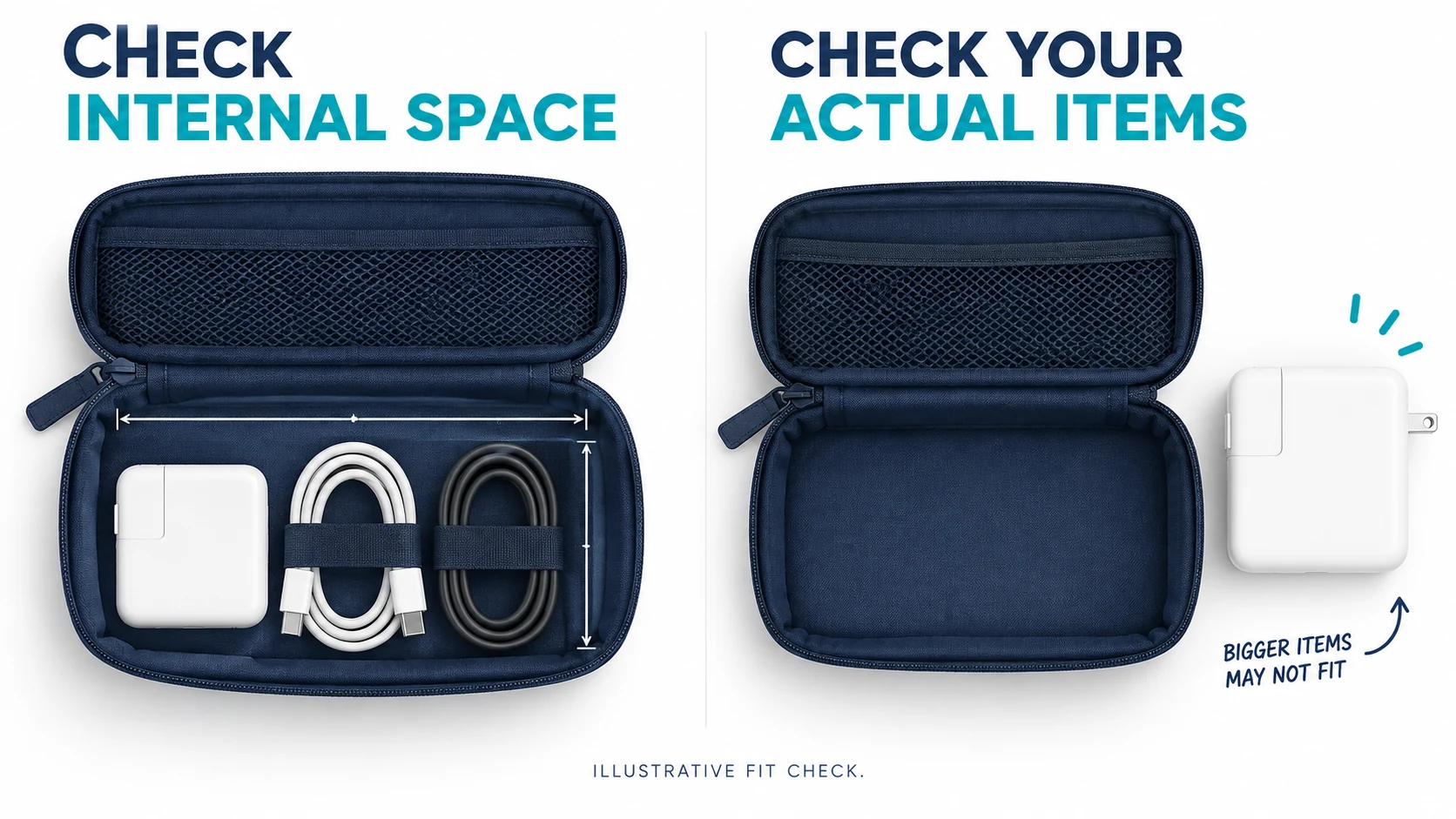
This is a stronger candidate when the store serves an identifiable user, such as a compact work-bag audience. A broad claim that it fits every charger creates avoidable returns.
3. Desk mats in specified sizes
A desk mat can appeal to customers arranging a small workspace or protecting a defined desk area. Size, surface feel, edge finish and visual design give the customer concrete points to compare.
- Inspect flatness after unpacking, backing grip, edge stitching and the surface with the intended mouse and writing use.
- If you describe it as waterproof or heat-resistant, obtain evidence for that claim and its conditions.
A simple cleaning demonstration should not become a promise of resistance to every spill or temperature.
Check the finished package. A rolled mat may require a longer parcel than its light weight suggests. Obtain the shipping quote for that packed shape before selecting it as a low-cost item.
4. Reusable cable ties
Reusable ties can complement a cable pouch or desk range. Their straightforward job is to keep cables grouped during storage or routine desk organization.
Verify length, width, closure behavior and the number included. Show the intended cable bundle rather than implying compatibility with every installation. Do not market an ordinary organizer as an electrical safety device or a load-bearing fastener.
The main commercial issue is a low standalone order value. They may make more sense as an accurately described multipack or a relevant add-on. Calculate whether the additional shipping and handling allow that bundle to improve contribution.
03
Home and hobby storage
5. Drawer dividers
Drawer dividers suit customers organizing a particular drawer depth and width. Clear measurement guidance is more useful than a broad image of an attractive room.
- Inspect the adjustment range, contact surfaces and stability in the intended setup.
- Show the minimum and maximum usable dimensions from the actual sample.
Do not imply that an adjustable product fits all furniture.
Packed length can make shipping expensive, and fit errors can generate returns. Favor a product whose dimensions and installation are easy to explain and whose delivered cost remains sensible against local alternatives.
6. Fabric storage bags
Fabric bags can suit people separating seasonal textiles or keeping a defined set of items together. The buying decision depends on usable capacity, closure and handles, not simply the volume number in a supplier listing.
- Measure the bag and demonstrate a realistic contents example.
- Inspect seams, zipper operation and handle attachment.
- If you state a carrying capacity, obtain appropriate supporting evidence. Do not infer a load rating from the appearance of a handle.
A compressible empty bag may ship efficiently, but verify the packed dimensions of a multipack. Clarify whether any frame, divider or pictured contents are included. The product is less attractive if its differentiation depends on claims the supplier cannot support.
7. Craft-supply organizers for adults
A compartment organizer can suit a specific hobby, such as storing sewing notions or adult art supplies. Match compartment size and closure behavior to the objects users need to carry.
- Check whether dividers are fixed or removable and whether small items migrate between compartments when the case moves.
- Inspect latches and edges.
A well-staged overhead photo should be accompanied by dimensions and an honest view of the closed case.
Avoid making this a universal children’s storage product without assessing the different intended use and applicable requirements. Keep the audience and included items explicit. Narrow use is often easier to explain than an organizer supposedly suited to every hobby.
8. Adult pencil cases and stationery pouches
A pencil case can work within an adult study, office or creative-tools range. A useful difference might be the opening style, length for particular tools or an arrangement that makes contents visible.
Test the tools you show in the product photography, inspect lining and seams, and check whether the case closes comfortably when filled as advertised. Give the internal length when fit is an important selling point.
Generic designs face direct price comparison. An original design, a specific use or a coherent bundle may improve the offer, but that remains a proposition to test. Avoid using protected characters or artwork without permission.
04
Gardening accessories
9. Reusable plant ties
Plant ties can suit hobby gardeners who need to attach plants to suitable supports. They are an option to investigate when the product has clear instructions and an appropriate use range.
Inspect the fastening mechanism, edges and adjustability. Demonstrate the intended placement without tightening a tie against a stem. Do not make broad claims about improved growth or suitability for every plant from a generic supplier description.
Seasonality and order value matter. Match the target region’s gardening season, and check whether a sensible pack size can support shipping costs. A cheap item still needs a workable delivered price.
10. Garden labels
Garden labels address a simple need: identifying plants or planted areas. Buyers may value a writable surface, suitable dimensions and a design that fits the setting.
- Test the exact writing method you recommend on the actual label.
- If you claim outdoor durability, support the claim for the relevant conditions rather than assuming it from material appearance.
- Identify whether a marker is included.
Labels are often a better fit for a focused gardening range than a standalone general store. Their visual simplicity also makes it important to show scale and pack quantity clearly; a small label photographed close up can create the wrong expectation.
05
Products built around original designs
11. Printed tote bags
A tote can suit a store with original artwork or a specific audience that values the design. Print-on-demand is one route to investigate when you want to avoid purchasing a batch of decorated stock before testing demand.
- Check the actual fabric, dimensions, handle construction and print result.
- Show the design on the correct bag rather than a generic mockup that suggests a different shape or texture.
- If the bag is intended to carry a stated load, verify that claim.
The challenge is the combination of production cost, shipping and audience demand. Original artwork does not automatically justify a premium. The print-on-demand workflow explains the production and order checks behind this option.
12. Art prints in a controlled size range
Art prints can work when the customer wants the artwork itself and you have rights to sell it. A small, coherent collection is easier to present than an unrelated catalog of generic graphics.
- Sample the print at the actual offered sizes and inspect color, detail, paper and packaging.
- State whether a frame is included.
- Show size context accurately, since room mockups can exaggerate the physical dimensions.
Check whether the print ships flat or rolled and how damage is handled. Large sizes and frames can change freight and breakage exposure considerably. Begin with the sizes and packaging you can validate rather than offering every catalog option immediately.
06
Validate demand for the exact offer
Choose a customer and a use before comparing search signals. “Cable pouch for a compact work bag” creates a more testable offer than “popular accessories.” Read competing listings and customer questions to identify requirements such as dimensions, closure behavior or included pieces.
Google Trends uses sampled search data and a normalized scale; its score is not a count of purchases. Use consistent geography and time settings, inspect seasonality and distinguish a broad category from the exact item. Google’s data explanation sets out those limits.
Look at what customers can already buy in your destination market. Compare the complete offer: product specification, included items, delivered price, delivery promise and returns. If yours is slower and more expensive, identify a real reason someone would choose it before paying to attract traffic.
A social video can suggest a useful demonstration or customer objection, but attention does not prove profitable demand. Treat it as an idea to investigate. The product research guide explains how to combine signals without treating any one source as a sales forecast.
07
Calculate contribution after delivery
A product can be attractive while its delivery route makes the offer unviable. Obtain an actual quote for the chosen variant, packed dimensions and destination, then connect that quote with the price you can realistically charge.
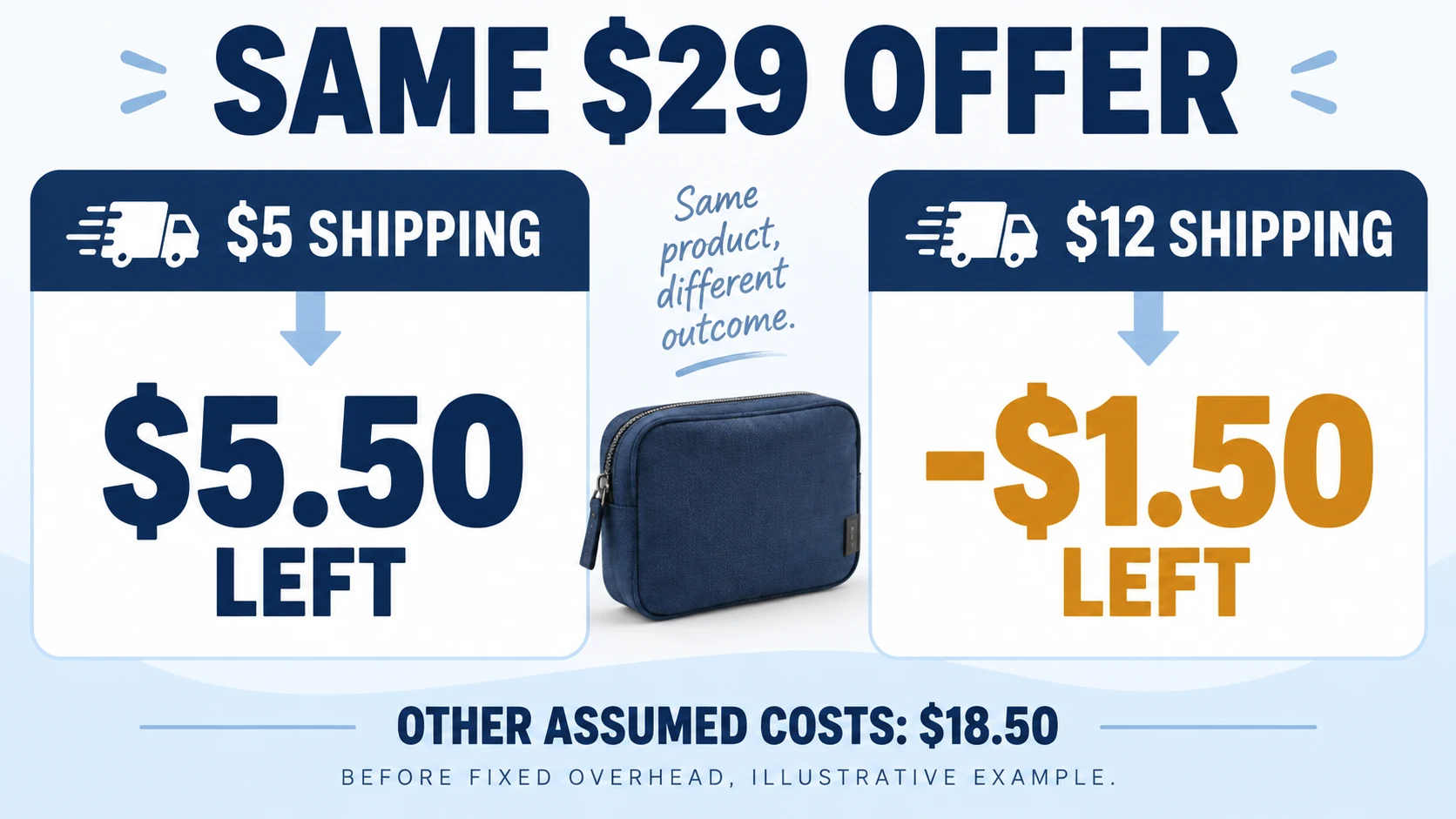
Consider a hypothetical organizer sold for $29. Subtract $8 for the goods, $5 for shipping, $1.20 for payment and other order fees, $2.30 as a modeled exception allowance, and $7 for acquisition. The result is $5.50 before fixed overhead and other applicable costs. These are planning inputs, not promised margins.
If shipping is $12 instead of $5, the same example loses $1.50 before overhead. A large package or an unsuitable destination route can reverse the decision even when the product price is unchanged.
Use conservative inputs where evidence is weak and label them as assumptions. Include applicable taxes or import charges according to the arrangement rather than silently omitting them. Separate the cash needed to pay suppliers from the margin calculation. The unit economics guide covers that distinction.
Bundling only helps when customers value the added items and the additional costs support it. Check whether two items leave in one parcel, whether handling increases and whether the bundle creates a new return issue. A higher order value alone does not establish a better result.
08
Eliminate avoidable product and listing risks
Check the product identity, intended use and rules for the destination before launch. In the United States, CPSC guidance states that selling recalled products is unlawful. Search the relevant recall records and investigate any match before offering the item. CPSC’s online selling guidance explains that responsibility.
Keep listing claims within the evidence you possess. FTC guidance requires truthful advertising and a reasonable basis for objective claims. Words such as waterproof, non-toxic or clinically proven create questions that an ordinary product photo cannot answer. The FTC’s small-business advertising guidance covers claim substantiation.
For a first range, avoid choosing an item whose appeal depends on health effects, protective performance or an unfamiliar regulated use unless you have the required expertise and evidence. A simpler product still needs checks, but fewer unsupported claims make the offer easier to assess honestly.
Order samples of the exact variants and keep the approved reference. Recheck meaningful supplier changes. Do not let a low quote override a mismatch between the photographed item and the product that will be shipped.
09
Test a narrow range and learn from completed orders
Choose a few related variants, prepare accurate product pages and set a spending limit you can afford to lose. Define what would cause you to pause: an incorrect item, unresolved product evidence, negative contribution at the observed acquisition cost or a delivery promise the route cannot support.
Review completed orders, not only clicks and purchases. Record actual shipping charges, support questions, refunds and the reason for any return. A customer who buys and later receives the wrong size of organizer has not validated the offer as presented.
Change the variable associated with the problem.
- If buyers misunderstand dimensions, repair the page and images.
- If the product is sound but freight destroys contribution, examine the route or package.
- If the supplier repeatedly changes the item, pause the SKU and review the relationship rather than spending more on advertising.
Expand only after the initial range gives you a credible basis for the next decision. Add products that serve the same audience and can meet compatible delivery expectations. That creates a more useful store than continually replacing one untested “winner” with another.
10
Frequently asked questions
What is the best product for a beginner to dropship?
A practical starting candidate is a simple, inspectable item for a specific audience, such as a cable pouch or packing-cube set. It still needs a sample, a complete delivered quote and a reason to buy from your store. No item is automatically profitable for beginners.
Are these the best-selling products right now?
No. This is an editorial shortlist based on practical product and fulfillment characteristics, not a live sales leaderboard. Validate current demand and competition in your target market before spending.
Should I choose a trending product or an evergreen product?
Choose the offer you can validate and fulfill. Trends can change quickly, while an everyday item can face intense local price competition. Check the specific audience, seasonality, delivered price and useful difference in either case.
Are lightweight products always cheaper to ship?
No. Packed dimensions, route and service also affect the quote. A long rolled mat or a bulky lightweight organizer may cost more than expected. Request shipping for the finished package rather than estimating from product weight alone.
How many products should I launch with?
Start with a small enough range that you can sample, describe and support every variant. The appropriate number depends on your resources and audience. A narrow approved range gives you clearer information than a large imported catalog with inconsistent terms.