
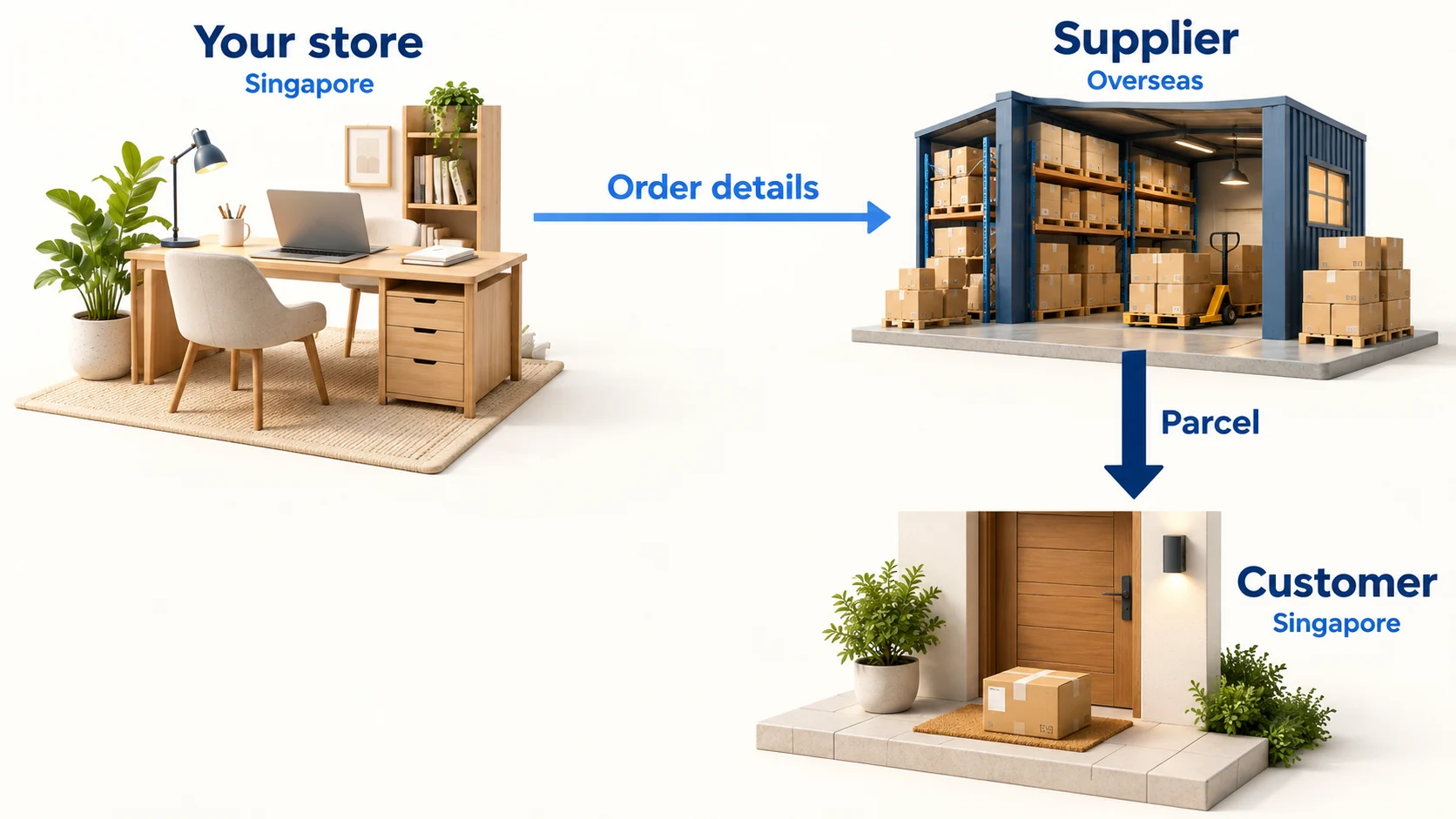
Dropshipping in Singapore works as a retail business: your store takes the order, and a supplier sends the goods to your customer. You can start without renting a warehouse. You still need a workable supply route, the right business and payment setup, and a clear decision about who collects GST.
Start by separating three addresses: where your business operates, where the stock sits, and where the customer receives it. Putting “Singapore” in the store settings does not move the goods or settle the tax question.
This guide focuses on a Singapore-based retailer selling ordinary physical goods to consumers in Singapore. There is a separate explanation for overseas sellers. The official requirements linked below were checked on October 19, 2026.
01
Choose the supply route before building the store
A supplier with a large catalogue is useful only if the order can reach your customer on terms you can sell. There are three practical routes to compare.
Stock already in Singapore
Ask a local wholesaler or distributor whether it accepts single-customer orders and will dispatch them for your store. A wholesale price list alone does not establish that service.
This route can make a local delivery or return arrangement easier to manage. The trade-off may be a smaller range, a higher purchase price or a handling charge. Ask about the exact product code (SKU), available stock, dispatch days and return recipient. “Singapore supplier” is not enough if that supplier also orders the item from overseas after receiving your payment.
An overseas supplier sends each parcel directly
This is the familiar cross-border model. You avoid buying a whole batch, but the customer order now depends on overseas stock, international transport and the import arrangements.
For a China-side source, request a quote for one specific product packed for one Singapore address. Include the quantity, packed dimensions, weight, dispatch time, tracking service and treatment of tax or clearance charges. The supplier selection guide explains the difference between a supplier, an app and a sourcing partner.
Bring in a small batch after the product proves useful
You can begin with direct fulfillment and later keep a limited quantity locally. That buys more control over dispatch, but it also commits cash before the customer pays and leaves you with unsold stock if demand changes.
The choice depends on the offer. A replacement part needed urgently has a different delivery problem from a distinctive decorative item bought well before an occasion. Choose the product and customer need first; then choose the stock arrangement that can support them.
Ask for a complete route: “Can you send one unit of SKU A to this Singapore postcode? Please quote the packed parcel, state where it ships from, explain tax collection and identify the return address.” This request is more useful than asking whether a supplier “supports Singapore.”
02
Register the actual business, then arrange its payments
For a business operating in Singapore, start with ACRA’s registration and eligibility rules. They specifically include online stores and dropshipping among regular activities for profit that require registration unless an exemption applies. The page also explains the full-name exemptions and rules for foreigners; “side income” is not a general exemption.
Business registration and incorporation are different choices. A sole proprietorship has one owner and no legal separation between that owner and the business. A company is a separate legal entity, with more administration. ACRA compares the structures by liability, cost and other requirements. Choose with those consequences in mind rather than assuming every small store needs a Pte Ltd immediately.
For the sole-proprietorship route, ACRA’s Bizfile registration instructions cover reserving a name, entering the business details and address, adding the owner, paying and receiving the registration outcome. Foreigners without Singpass must use a corporate service provider. That is a real eligibility condition, not something a store app fixes.
Match the payment account to that seller
The business named in checkout, customer emails and payment records should be the business actually making the sale. Before paying for a website package, establish which payment provider will consider your real arrangement.
For example, Shopify Payments Singapore has its own business, identity and bank-account requirements. Its guidance says individuals and sole proprietors must live in Singapore to qualify for that regional service. It also describes a qualifying Singapore bank account and verification documents. A Unique Entity Number (UEN) or company registration is one part of the application, not a promise of approval.
If you run an existing business abroad and want Singapore customers, begin with that actual business and payment arrangement. Selling to Singapore is not the same as operating a business there. Establishment, local stock and other activities can change the obligations, so do not buy a Singapore company merely because the customer’s delivery address is Singaporean.
03
Work out which GST question applies to your order
The first question is who is selling, followed by where the goods are and how they enter Singapore. “Under S$400” does not answer either question by itself.
A Singapore-based seller
IRAS explains that direct sales of qualifying imported low-value goods to non-GST-registered Singapore customers enter the local supplier’s GST rules. A GST-registered local supplier must account for GST on those sales. A non-registered local supplier includes them when assessing its taxable turnover and registration liability; the domestic annual taxable-turnover threshold is S$1 million.
Assess registration using the applicable timing and turnover rules, including the business’s other activities. Do not assume you can wait until year-end. If the store is not GST-registered, do not add a line called “GST” simply because the supplier mentioned tax.
An overseas seller supplying Singapore customers
The overseas vendor registration rules use a different test: annual global turnover above S$1 million and relevant business-to-consumer (B2C) supplies of remote services and/or low-value goods to Singapore above S$100,000 annually. Here, B2C concerns customers who are not GST-registered. The S$100,000 figure is not a replacement for the local business threshold.
Marketplace arrangements can also change which party is treated as the supplier. Keep a direct website sale and a marketplace sale separate when recording the transaction.
Item value and the amount taxed do different jobs
For the relevant low-value-goods treatment, IRAS describes goods located outside Singapore, delivered by air or post and with sales value no greater than S$400, subject to its other conditions. The consumer explanation distinguishes that item-value test from transport and insurance charges. Import relief also has its own conditions based on the consignment and its cost, insurance and freight (CIF) value. A sea shipment, a controlled item and an air parcel are not interchangeable examples.
Here is a hypothetical direct sale by a GST-registered local retailer of one qualifying ordinary item. The current GST rate is 9%.
| Order amount | Calculation |
|---|---|
| Item before GST | S$200.00 |
| Shipping before GST | S$12.00 |
| Amount used for this GST calculation | S$212.00 |
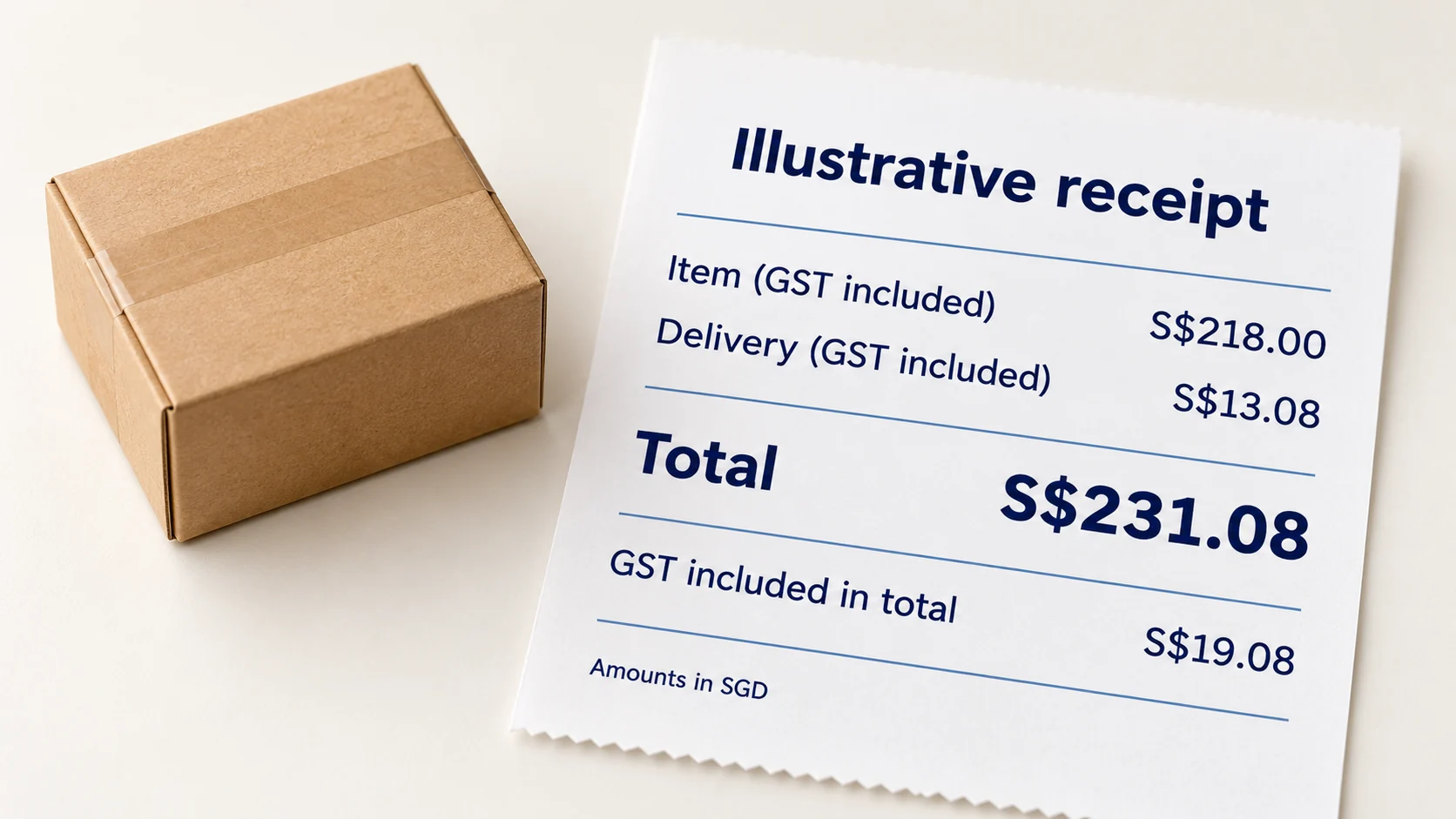
| GST | S$212 × 9% = S$19.08 |
| Customer total | S$231.08 |
The S$200 item value answers a different question from the S$212 used in the tax calculation. Neither amount is the store’s profit.
For public price display, a GST-registered retailer must follow the GST-inclusive price rules. In this example, the item is S$218 including GST and delivery is S$13.08 including GST. The table explains the breakdown; it is not a suggestion to advertise the item at S$200 and surprise the customer later.
Agree how the necessary tax information reaches the courier. If GST has already been collected but the shipment lacks the information needed to recognize that treatment, the customer can face another collection request. Keep the order invoice and carrier reference so you can investigate that specific parcel instead of telling the buyer that “shipping includes everything.”
04
Build a price that can pay for the whole order
Separate the cash the customer pays from the money available to run the business. The supplier’s item price is only the first expense.
Consider a different, explicitly non-GST-registered merchant example. This store collects S$48 for an order with delivery included. These figures are assumptions for learning, not supplier rates or an AIDrop quote; any unrecoverable tax is assumed to be included in the expense figures.
| Variable cost for this order | Assumed amount |
|---|---|
| Product | S$19 |
| Outbound delivery | S$7 |
| Packing or handling | S$2 |
| Payment processing | S$2 |
| Expected return/replacement cost allowance | S$3 |
| Customer acquisition | S$4 |
| Total variable cost | S$37 |
The order leaves S$11 before fixed costs and income tax. It does not produce S$29 of spendable profit just because S$48 minus the S$19 product price equals S$29.
Replace the assumptions with a sample order and written packed-parcel quote. For the return allowance, use the cost and frequency you can actually observe as orders accumulate. A reserve is an expected cost across orders, not a claim that every parcel incurs a S$3 return fee.
You also need cash between receiving an order and receiving an available payout. A supplier may require payment before dispatch. A refund can become due while an upstream claim is still being considered. Keep those cash needs beside recurring software, business administration and other fixed costs when deciding what you can afford to test.
05
Prove the delivery and return promise with one real route
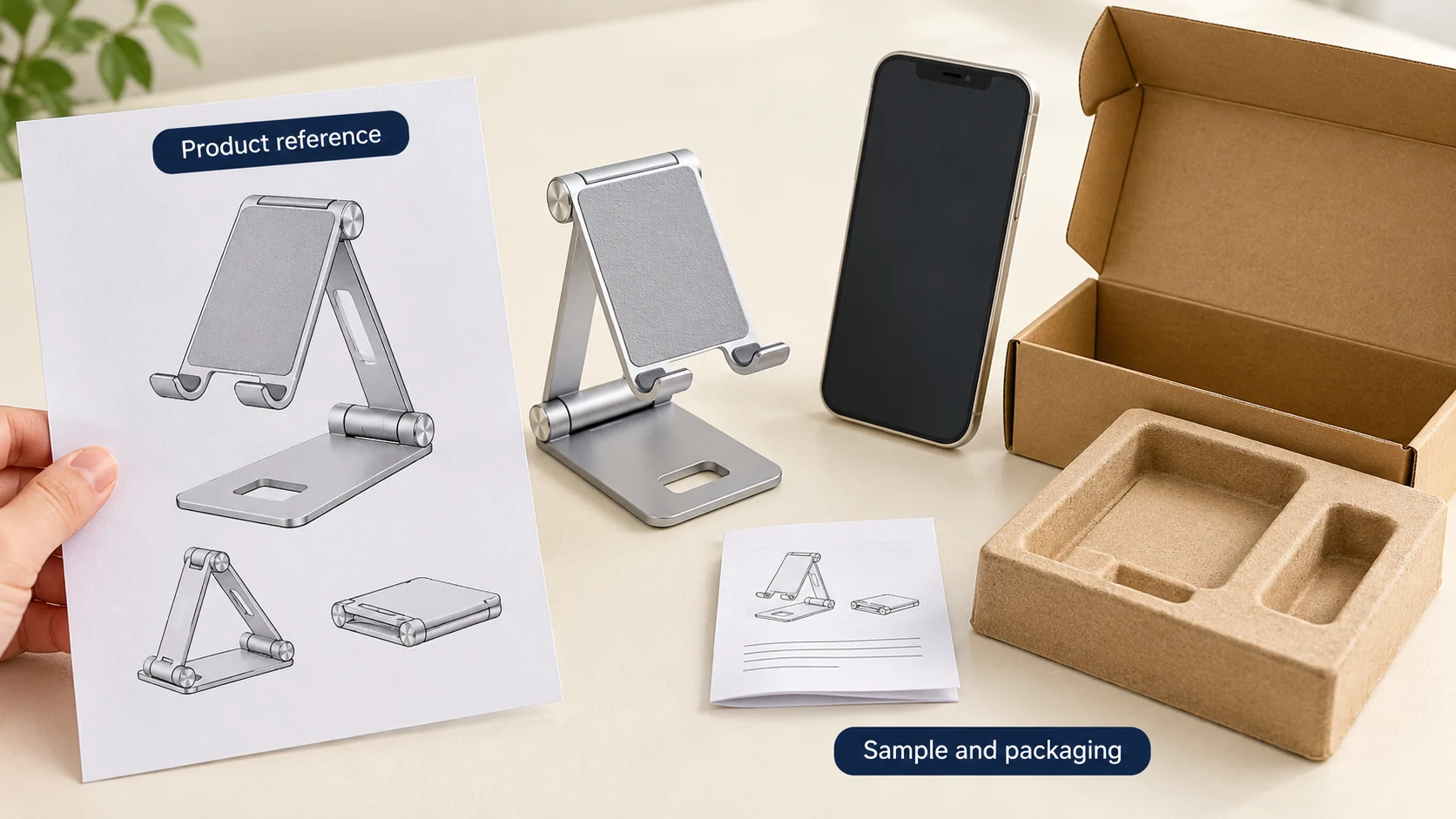
A sample only helps if it tests the product and delivery arrangement you intend to sell. A parcel sent through a special express service says little about a cheaper service used for ordinary customer orders.
Use one SKU, its actual packed parcel and a representative Singapore destination. The following is a proposed trial, not a test we have performed for your store.
- Place the customer-side order. Inspect the mobile product page, final price, delivery information and payment result. Save the order ID and receipt. A test-mode payment checks a different part of the system from a real paid shipment.
- Match the supplier order. Confirm the SKU, quantity and delivery address against the store order. Record supplier acceptance. An order appearing in an app does not yet show that someone will dispatch it.
- Follow the parcel and import information. Record dispatch, carrier acceptance, tracking and any tax or clearance request. Singapore Customs’ import overview explains the formal import requirements, including checks for controlled goods; do not assume every parcel requires the same declaration process.
- Inspect what arrives. Compare the product, package contents and paperwork with the listing. Record the delivery outcome and costs. One successful sample demonstrates that order, not a permanent delivery guarantee.
- Walk through a return request. Obtain the receiving address, authorization instructions, responsibility for transport and the point at which a refund is decided. You can review that process without inventing a defect or making a false claim.
If the store records payment but the supplier cannot find the order, investigate that link before importing more products. If the buyer is asked to pay GST again, reconcile the invoice and shipment information with the seller and carrier. If the item differs from the listing, correct the offer or source before spending on traffic. Each failure has a different owner.
Use the shipping-time guide for a deeper comparison of dispatch, carrier events and delivery estimates. A delivery promise should describe the route you have evidence for, including the time before dispatch.
06
Launch a small offer people can understand
There is no need to guess a list of “hot Singapore products” before you understand an order. Start with a defined customer problem and an item you can describe accurately: its useful dimensions, what is included, compatibility, limitations and delivered price.
A generic phone stand must compete with other easy-to-find stands. A well-explained stand that fits a particular desk arrangement still needs evidence of demand, but at least the customer can understand the reason for choosing it. The claim must come from the actual product, not an invented lifestyle benefit.
-
Product safety. Some categories add work that an ordinary accessory does not. The Consumer Product Safety Office explains supplier responsibilities and controlled-goods requirements. Check whether the exact product needs registration and a valid SAFETY Mark; do not treat a foreign certificate or plug adapter as a universal substitute.
-
Customer data. Customer information also travels with the order. Share only what fulfillment needs, explain the use of that information, and address protection and retention with the supplier. Singapore’s PDPA overseas-transfer provision sets conditions for comparable protection; a privacy-policy link alone does not implement those conditions.
Once the route works, test one acquisition channel with a budget you can lose. Track actual paid orders, acquisition cost, completed deliveries, complaints and refunds together. Clicks show attention; they do not show that the order leaves money or reaches the buyer as promised.
If the missing part is China-side sourcing, samples or packing, send AIDrop your product brief, Singapore destination and expected order pattern. That gives us something specific to review. Business registration, tax decisions and payment approval remain with the relevant professionals and providers.
07
Questions before starting a Singapore dropshipping store
Do I need my own warehouse?
No. A supplier can hold and dispatch the stock. You still need to know where it is, whether it is available for your orders, and where customers can send an authorized return. A registered business address is not automatically a receiving warehouse.
Do I have to form a Singapore company to sell to Singapore customers?
The customer’s location alone does not decide that. A Singapore operator should follow ACRA’s applicable registration rules. An overseas business must consider its own position and the Singapore activities, products and tax rules involved. Avoid changing the business identity in payment settings to match a market you merely want to target.
Can I use the same setup on Shopee or Lazada?
Not automatically. Each marketplace controls seller eligibility, product permissions and fulfillment requirements. Read the terms for the seller programme and market you will actually use. A working independent-store route is not evidence of marketplace permission.
Is there one minimum startup budget?
No useful single figure covers every arrangement. Price the actual entity administration, store and payment costs, samples, supplier payments before payout, acquisition test and refund reserve. Stocking a batch adds a cash commitment that a per-order route may avoid. A cheap registration package is not a complete launch budget.
Are all parcels under S$400 tax-free?
No. GST can apply at purchase under the low-value-goods rules, and import relief has separate conditions. Identify the seller, GST status, goods, transport mode and collection point for the actual order. Do not split or misdeclare shipments to force them into an assumed exemption.
Who helps the customer if the supplier refuses a return?
Your store remains the customer’s point of contact for the sale you made. Set a clear customer policy, understand the applicable rights and arrange upstream support before accepting orders. The broader legal guide explains why outsourcing dispatch does not outsource every retailer responsibility; this article supplies the Singapore-specific starting questions.
What Is Dropshipping? How to Build and Run the Business
Learn how dropshipping works, earns money and handles risk, from product research and supplier checks to shipping,
How to Start a Dropshipping Business: From Offer to First Delivery
Start a dropshipping business with a clear offer, verified supplier, workable pricing, tested checkout, and a plan
Dropshipping for Beginners: Learn the Model and Test Your First Order
Learn dropshipping basics, choose a focused offer, budget for supplier payments and rehearse checkout, shipping and support
