
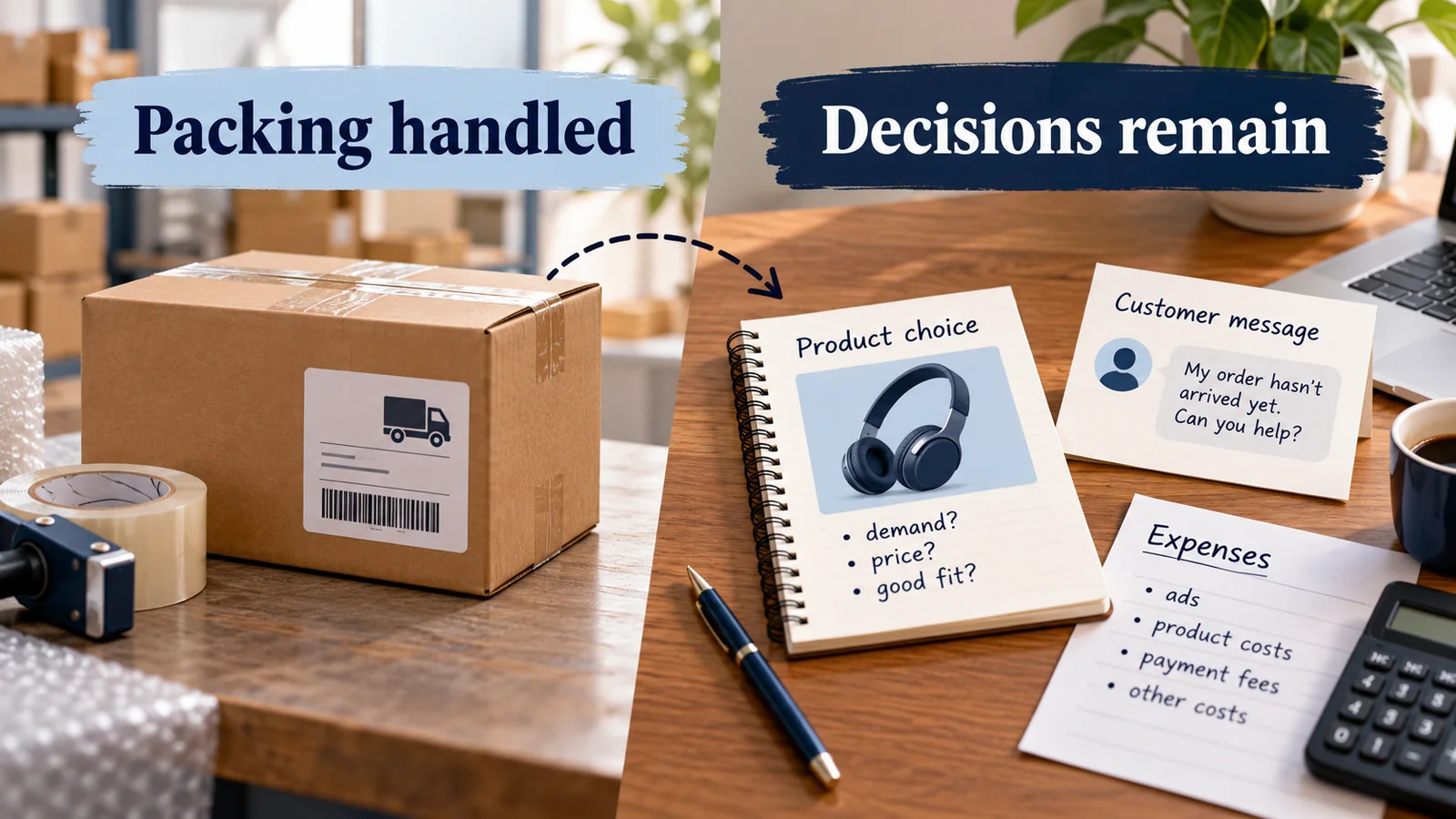
Dropshipping is usually an active retail business, not passive income. A supplier can pack the parcel and software can move routine orders, but someone still has to attract customers, pay for accepted work and resolve the purchases that do not go to plan. You can reduce the manual work without making the responsibility disappear.
If you are considering it alongside a job, that distinction matters. The question is not simply whether an order can arrive while you sleep. It is whether the store has a reliable way to fulfill it, fund it and help the customer when the ordinary process fails.
The examples here concern a conventional store where you sell to your customers and use a supplier for fulfillment. Other managed platforms can assign different roles. The dropshipping definition guide explains the wider models.
01
What the supplier takes off your hands
In the usual arrangement, you do not store the goods or pack each parcel yourself. Shopify’s dropshipping explanation describes suppliers sending products on the store’s behalf. That removes a substantial physical job.
The store still needs an offer that people understand and want. Someone chooses the product, explains its contents, sets a price and brings potential buyers to it. The supplier’s catalog does not decide those things for your particular customer.
| Work | What can become less manual | What still needs an owner |
|---|---|---|
| Listings | Importing product data | Deciding whether the description is accurate and useful |
| Orders | Sending supported requests between systems | Resolving unmatched or rejected work |
| Tracking | Adding the correct carrier reference | Answering a missing, wrong or disputed delivery |
| Customer messages | Drafting known answers | Approving promises, refunds and unusual remedies |
| Marketing | Scheduling approved content | Choosing the offer and judging what the results mean |
This is why “no inventory at home” and “no work” are different propositions. You may avoid a warehouse while remaining responsible for a retail relationship.
It is possible to arrange help for much of that work. What matters is the arrangement behind it: a service with a clear job, suitable access and someone who can handle the situations outside the routine. Buying another tool does not automatically create that arrangement.
02
Follow the order that needs a person
Suppose a customer orders a desk organizer in walnut finish. The supplier then says that finish is unavailable and offers white instead. The customer has paid for walnut; importing the supplier’s substitute automatically would change what they bought.
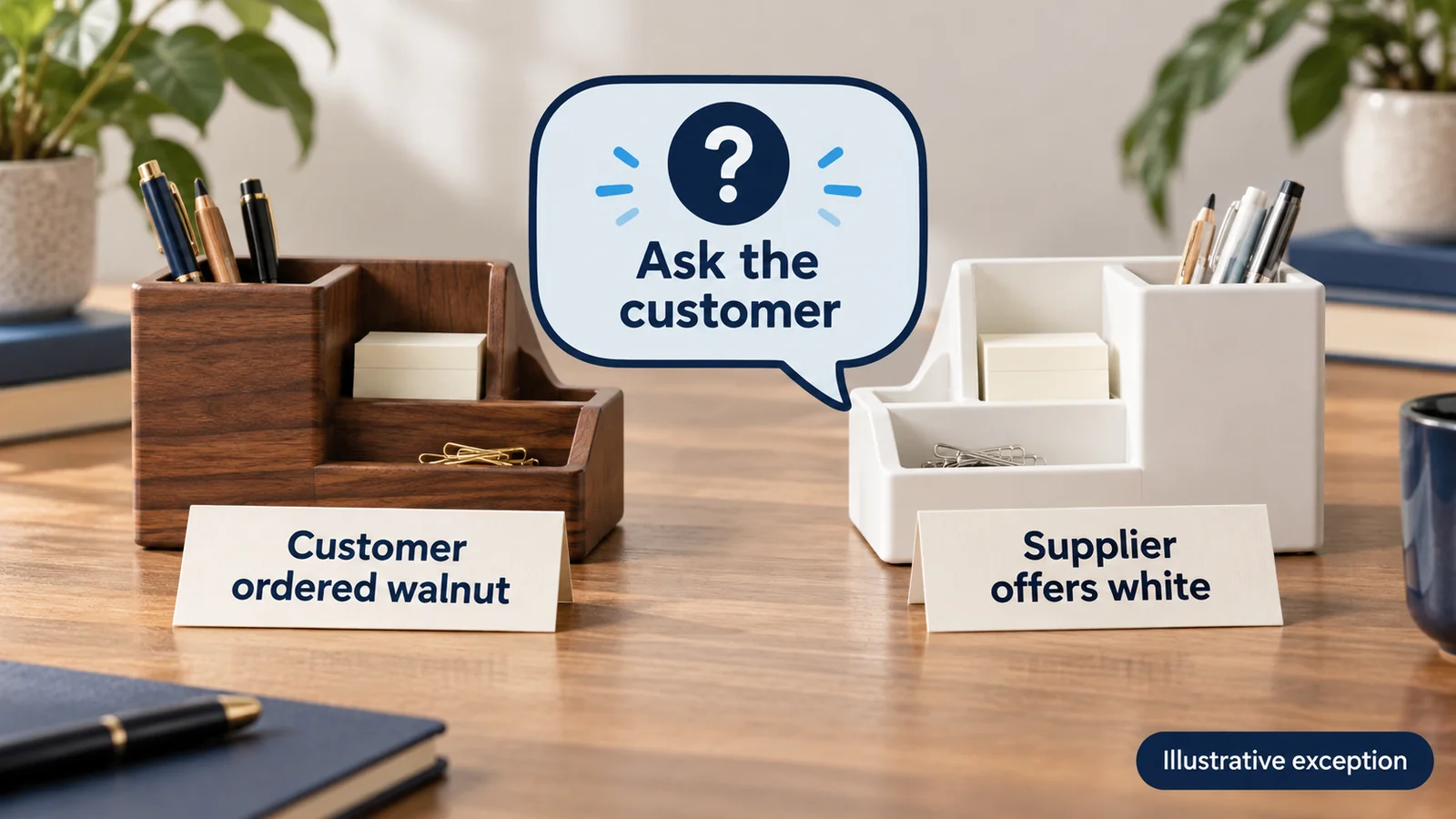
This fictional case has several possible paths. The supplier may be able to supply the original item later. The customer may choose to accept another finish. An appropriate cancellation or refund may be needed. Someone must establish the facts, contact the customer and carry out the chosen response.
Software can flag the stock problem and prepare a message. It cannot make an unsupported delivery promise true or determine that this customer will like the other finish.
A routine needs an exception route
The operating idea is called exception management: a clear process handles ordinary cases, while uncertain cases go to someone who can decide. In plain terms, the order needs somewhere to go when it cannot continue as expected.
Record the original item, customer request, supplier response and next action together. In the example, the action might be “ask the customer whether they prefer the documented later date or the available alternative.” It should not simply be “follow up.”
If the customer chooses a refund, check both the customer payment and any supplier work already accepted. Do not assume that canceling one record has automatically stopped every other part of the order.
Shopify’s app-fulfillment guidance distinguishes requests, acceptance and later fulfillment actions. The exact process depends on the connected service. That is another reason to understand the actual arrangement before calling it automatic.
03
Choose what software and a helper can handle
Start with a repeated task whose inputs and expected result are clear. You might need an alert when an order is blocked, the correct tracking reference attached to an order or a prepared answer to a common product question.
Shopify Flow uses events, conditions and actions to automate supported work. A rule can be valuable when the event and action match the store’s systems. It does not establish that every supplier, payment step and external app will connect in the way you need.
Before adding automation, describe the task in ordinary language:
When a supported order requires review, put it in the team’s visible queue. Include the order reference and the reason. A named person decides whether it can proceed and records the result.
That example describes an operating requirement, not a claim that a particular app provides a ready-made button for it. Choose the actual tool or process that can carry it out, then test both the ordinary and blocked cases.
For specific platform choices, use the automation software guide. Here, the decision is whether the work can be made sufficiently repeatable—not which app has the largest feature list.
Give a helper a defined job
A customer-support assistant can prepare replies and investigate known order issues. They need instructions about what they can promise, spend or approve. Use named access and relevant permissions rather than handing over the owner’s personal login. Shopify’s store permissions explain its available controls.
Define the handover in terms of decisions. “Answer all emails” is broad. “Answer the documented product questions; investigate delivery messages; escalate compensation and changed-product offers to this approver” is easier to perform and supervise.
If you are hiring for the first time, the virtual assistant guide explains how to start with a real queue and paid trial. Do not assume that hiring a person removes the need to supply accurate information or approve difficult decisions.
04
Count the time and money left after delegation
Less owner work is a useful result, but it has a price. Separate the amount left by orders from the money paid for tools and help, then look at the hours you still spend.
Consider this illustrative USD month, not a typical earnings claim:
| Item | Example |
|---|---|
| Orders | 200 |
| Orders following the ordinary process | 160 |
| Orders needing a person’s review | 40 |
| Contribution after the counted order-level costs | $1,200 |
| Tools counted in this example | −$100 |
| Paid help counted in this example | −$300 |
| Remaining before owner pay, tax and any other uncounted costs | $800 |
The 40 review cases are an assumption for the example. They do not establish a normal 20% exception rate. Review work can also vary greatly: a simple question and a complicated dispute are not equivalent tasks.
If the owner spends 40 hours that month, the $800 remainder is $20 per owner hour before the remaining obligations. It is not an employee wage or a guaranteed business profit.
Now suppose another $200 of help genuinely removes ten owner hours. The remainder becomes $600 and owner time becomes 30 hours. The same calculation gives $20 per owner hour, while total money left is lower. The owner may value the ten hours highly, but the service has not created free income.
Measure the result you actually want
If your aim is more time with family, fewer interruptions may matter more than maximizing the monthly remainder. If your aim is replacing a salary, the amount available after every business obligation matters more than a sales screenshot.
Use your own actual costs and time records once trading begins. The income guide follows the difference between revenue, business earnings and money available to the owner. Neither an app subscription nor a large order count answers that question on its own.
05
Build a shop that can run without constant interruption
Start by making the ordinary work reliable. Accurate variants, realistic delivery information and a workable supplier arrangement reduce avoidable questions. Outsourcing confusion usually gives the confusion to another person rather than removing it.
Then give unresolved work a visible home. A shared queue should show the order, issue, responsible person and next update. If the supplier changes an item, the support team needs to know before replying from an old product description.

Have someone who can act when you are unavailable. That person needs appropriate limits and a way to contact the next decision-maker. A helper who can only forward every question back to you has not created much freedom from interruptions.
Rehearse a short absence
Before relying on the business to run while you are away, arrange a limited handover and review what happens. Can the team identify a blocked order? Can they find the correct product information? Can they reach the person who approves a remedy?
This is a proposed operating check, not a test we performed on a store. Review the actual unresolved cases afterward and fix the missing information or authority. Do not use a quiet day as proof that no oversight is needed.
Keep the customer-facing responsibilities intact. Shopify’s dropshipping compliance guidance explains retailer obligations, including product and shipping matters. Delegating a task does not by itself change those obligations.
If physical fulfillment is the part you want help with, ask AIDrop Agent about the identified products, packing, order pattern and destinations. A scoped sourcing and fulfillment arrangement can remove specific work. It should be evaluated on that work, rather than presented as a promise of passive profit.
06
Choose this model for the kind of work you want
Dropshipping may suit you if you want to operate a retail offer without personally storing and packing the stock. It is less suitable if your main requirement is never making customer or supplier decisions.
Before paying for a “hands-off” service, ask what happens in the walnut-finish example. Who contacts the customer? Who approves the changed item or refund? Who pays the supplier, and what happens if the order cannot continue? A specific answer is more useful than a general automation percentage.
Also ask what you keep if the service ends: product records, store access, customer information and unresolved-order history. Read the applicable ownership and exit terms before treating a managed storefront as an independent business asset.
You do not need to decide that dropshipping is good or bad in the abstract. Decide whether its actual work, costs and degree of control fit what you want. If the model still interests you, begin with a limited offer and a budget you understand, rather than buying the largest automation package first.
07
Passive income questions
Can I run a dropshipping store while working full time?
Possibly, if the required work, coverage and supplier arrangement fit your schedule. Plan who handles urgent customer and order issues while you are unavailable. There is no dependable universal number of hours for every store.
Is any part of the income passive?
Orders may arrive without your immediate involvement, and established routines can reduce manual effort. But customer acquisition, financing, supervision and exceptions still need to be handled. Describe the reduced workload accurately rather than assuming the entire business is passive.
Can a fully automated store guarantee profit?
No automation feature can guarantee demand or make an uneconomic offer profitable. Assess the actual service, costs, evidence and commercial terms. Treat an earnings guarantee as a claim to investigate, not a reason to skip that work.
Does hiring a VA make the business passive?
It can delegate defined tasks. The store still needs accurate information, decision authority and someone responsible for the outcome. The amount of owner work depends on that arrangement, not simply the presence of an assistant.
Is a managed store the same as owning an independent shop?
Not necessarily. Check control over pricing, payments, assets and leaving the service. Different arrangements can assign different rights and responsibilities even when both use the word store.
What should I test first?
Test a small, clearly described offer through its actual customer and fulfillment path. Include a plausible exception and a named response. You need to know what happens when an order cannot follow the normal route, not only that a product can be imported.
What Is Dropshipping? How to Build and Run the Business
Learn how dropshipping works, earns money and handles risk, from product research and supplier checks to shipping,
How to Start a Dropshipping Business: From Offer to First Delivery
Start a dropshipping business with a clear offer, verified supplier, workable pricing, tested checkout, and a plan
Dropshipping for Beginners: Learn the Model and Test Your First Order
Learn dropshipping basics, choose a focused offer, budget for supplier payments and rehearse checkout, shipping and support
