
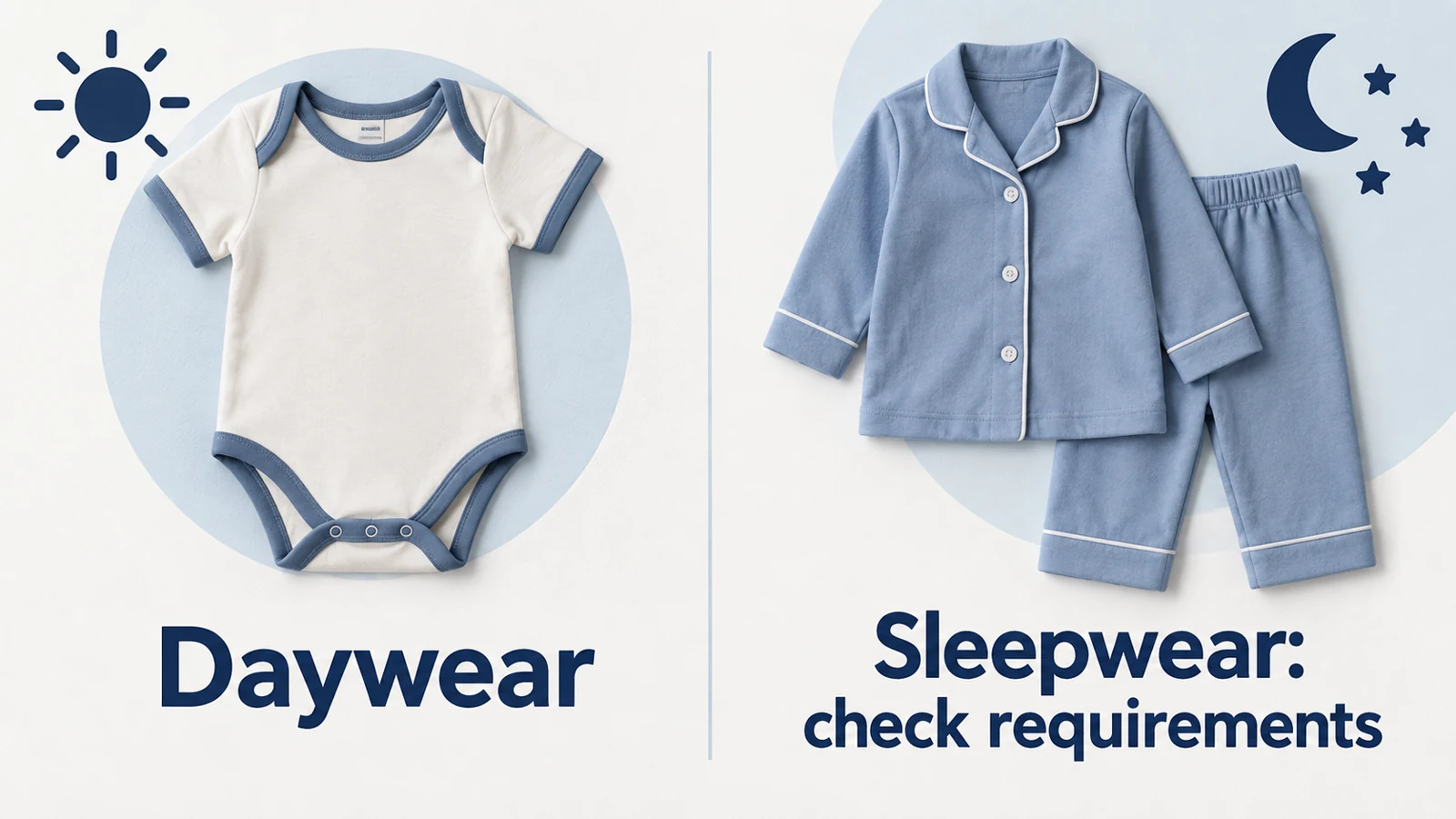
Baby clothes dropshipping lets you sell clothing that a supplier sends to each customer. You can sell existing designs or add your artwork to a print-on-demand garment. In either case, start with an item you can describe properly: what it is for, how it fits, what it is made from and what arrives in the parcel.
For a first range, one well-explained daytime bodysuit is more useful than twenty listings called “soft baby outfit.” Parents need a size they can choose, a closure they can use and care instructions they can follow. Those details also give you something concrete to compare with the supplier’s sample.
This guide follows that choice through sourcing, sizing, product records, a sample and pricing. US requirements are identified where they apply. For other product families, start with the broader baby-products guide.
01
Start with one garment and one intended use
Picture the first listing: a short-sleeve bodysuit for daytime wear, with a neckline that opens for dressing and snaps at the legs. The useful questions are immediately clearer than they are for a general “babywear” collection.
- Can a parent get it on and off easily?
- Which size chart describes this garment?
- What changes when they choose another color?
- Is the pictured item one piece or part of a set?
Decide the intended use before choosing photographs and sales copy. A daytime bodysuit and pajamas can fall under different requirements. Calling an item “loungewear” does not settle its classification if its design and marketing point to sleeping.
For US sales, the CPSC’s children’s-sleepwear guidance describes specific conditions for infant-garment exceptions and tight-fitting sleepwear. A “9 months” label alone does not establish an exception. Have the responsible manufacturer or importer identify the rules for the actual item and intended use.
This choice gives the sourcing request a useful starting point: one defined daytime garment, sold to a specified destination. It does not make ordinary daywear exempt from product requirements.
02
Choose a sourcing route and a named product
Ready-made clothing works when you want the supplier’s existing designs. Print on demand works when the design is yours and the provider decorates a chosen blank after purchase. The second route adds decisions about print placement, artwork and the finished garment; it does not remove the first route’s sizing and fulfillment questions.
| Route | Your main product decision | What to obtain before listing |
|---|---|---|
| Ready-made | The exact style, color and size assortment | Individual-order fulfillment, current size availability, labels and destination quote |
| Print on demand | The blank plus the decoration | The selected provider, garment specification, artwork requirements and finished-item price |
A public example you can investigate is Printful’s Baby Short Sleeve One Piece, Bella + Canvas 100B. Its page, checked October 16, 2026, lists 3–6m, 6–12m and 12–18m sizes, an envelope neckline and a three-snap leg closure. The decoration choices include front/back DTG printing and center-chest embroidery.
The color matters as well as the product name. The page lists solid colors as cotton, most heathers as a cotton/polyester blend and Athletic Heather as a different blend. Use the composition for the selected color. A range-wide “100% cotton” claim could misdescribe another variant.
Start with one selected color, size and decoration. Save the blank name, chosen options, artwork version, current size guide and destination quote. If the sample differs, this record helps establish whether the wrong size, blank or print file was used.
Printify’s baby-clothing catalog offers another POD route where the individual print provider also needs selecting. For a wider ready-made search, use the clothing-supplier comparison. Neither catalog listing is a sample inspection or product approval.
03
Help a parent choose the size
“12M” is a convenient label, not a complete fit explanation. Two suppliers can use the same age band for different dimensions. A stretchy bodysuit also fits differently from a woven top.
Find out whether the chart gives body measurements or finished-garment measurements. For a garment chart, obtain the measuring positions, whether the fabric is relaxed and the supplier’s tolerance. Put that explanation beside the chart rather than expecting the buyer to infer it.
Here is a fictional record for teaching the measurement method. These are not dimensions of the Bella + Canvas 100B or a recommended baby size.
| Fictional garment BOD-12 / label 12M | Recorded measurement |
|---|---|
| Flat chest width | 24 cm at the stated measuring position |
| Shoulder-to-crotch length | 38 cm with the closure in the recorded position |
| Stretch and permitted variation | Obtain these from the actual supplier; no value is assumed here |
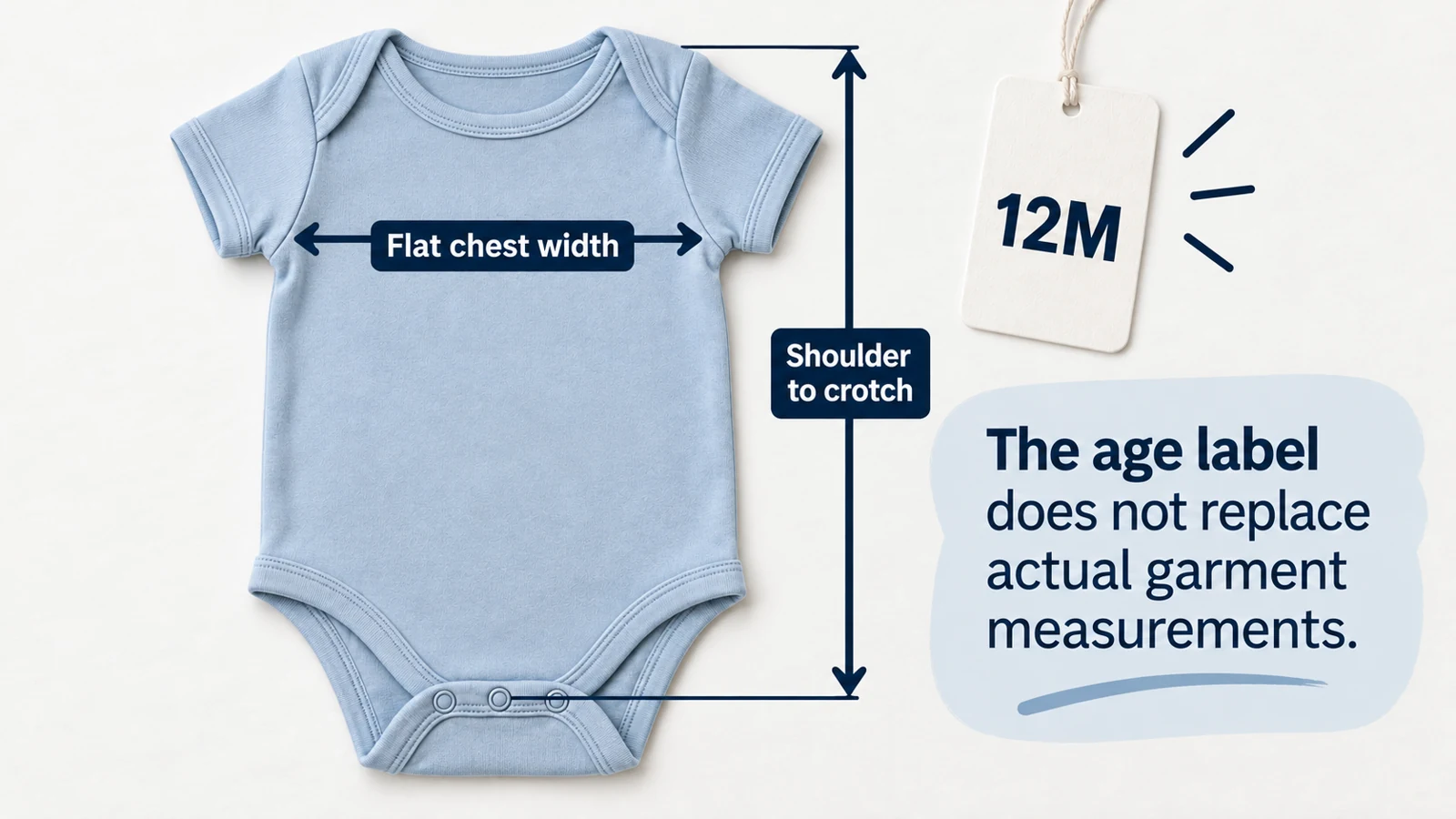
A 24 cm flat width is not a 24 cm body circumference. Doubling it still does not tell you the intended fit on a child: stretch, construction and ease matter. Give parents the supplier’s usable chart and method rather than making up a conversion.
If you add another supplier’s bodysuit, attach its own chart to that product. If a sample disagrees with the chart, resolve the measurement method and item version before publishing a store-wide “size up” rule. That rule can create a second fit problem for buyers whose original size was correct.
04
Keep the labels and product documents with that garment
The record should describe the finished item you sell. Keep its style, color, size, materials, decoration version and attached labels together. A report for another blank or an undecorated version needs an explanation of whether it covers your finished garment.
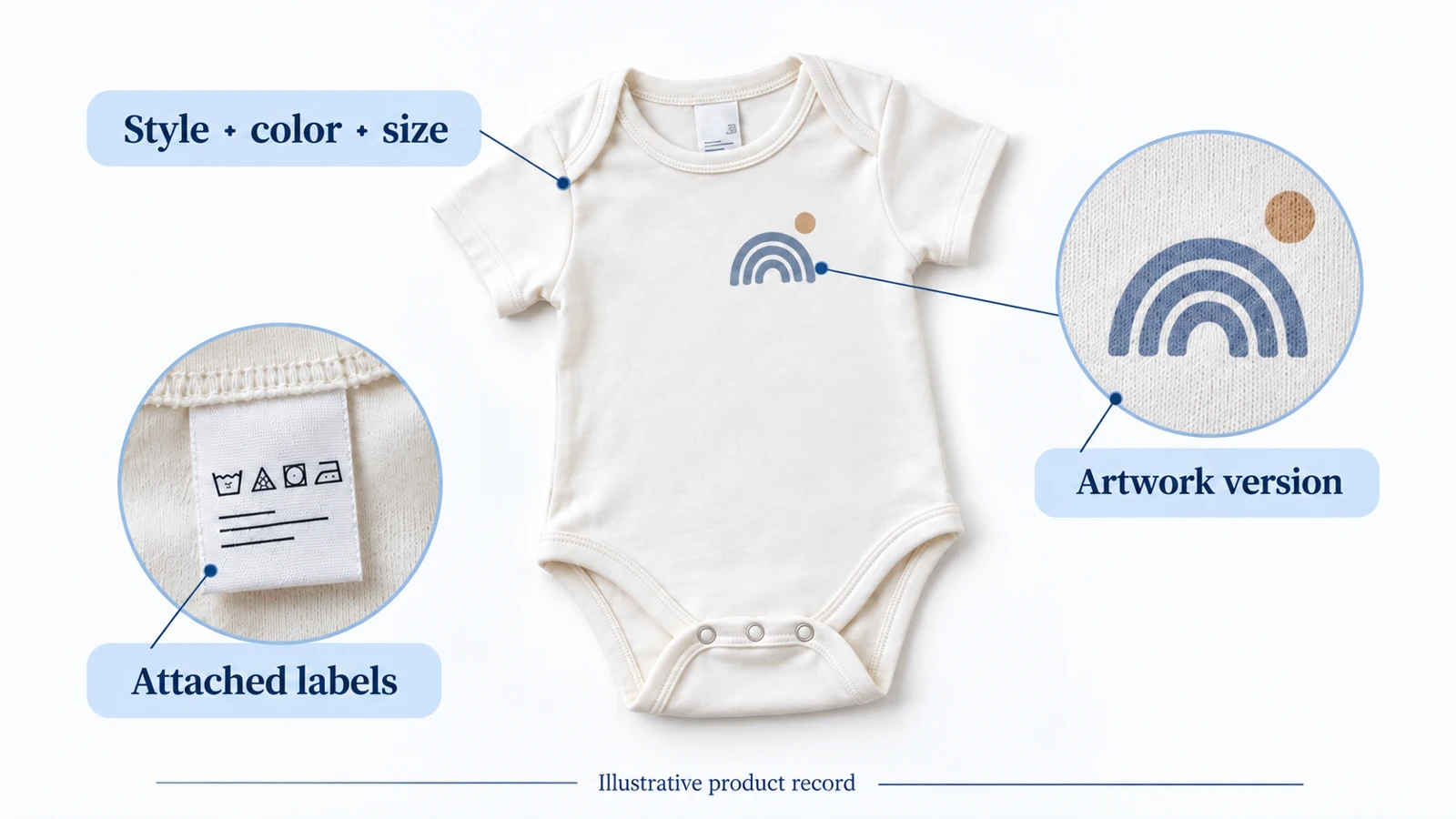
For US children’s products, CPSC explains that the responsible domestic manufacturer or importer issues a Children’s Product Certificate where required, based on applicable testing or supported exceptions. Ask who holds that role for your route and which finished product the certificate identifies.
The CPSC page also flags July 8, 2026 eFiling requirements for most regulated imports. The actual importer and entry partner need to establish how the current requirements apply to the shipment. The business sending a parcel is not automatically the party that has settled every importer obligation.
For labels, the FTC’s textile guidance covers fiber content, country of origin and responsible-business identification. Care labeling is a separate requirement. Compare these details with the selected garment and the labels that actually arrive.
If a supplier offers a replacement blank, ask what changes in measurements, material, labeling, decoration and document coverage. Hold the affected listing until those changes are understood. This is more useful than placing an unsupported “CPSC certified” badge on every product.
05
Use the sample to improve the offer
Order the selected garment through the proposed fulfillment route. Open it as a parent would: does the parcel contain the right item, can the closure be used easily, are the labels readable and does the decoration match the approved file?
Then compare the dimensions using the supplier’s method. For a set, examine each piece and its size label. Photograph actual findings for the supplier; use permitted photographs of the delivered version on the product page.
Suppose the fictional sample above measures 38 cm before a documented wash and 36.5 cm afterward. The observed reduction is 1.5 ÷ 38 × 100, or about 3.95%. Follow the actual care instructions and record the conditions. That calculation describes one observation; it is not a regulatory test, a production tolerance or a universal shrinkage claim.
| What you find | How it changes the listing or purchase |
|---|---|
| Dimensions differ from the chart | Resolve the method, version and tolerance before advising buyers |
| Print covers a useful label | Change the placement or labeling arrangement before release |
| Top and trousers have different size labels | Correct each component’s pick code and packing instruction |
| Material or trim differs from the agreed item | Identify the substitute and review the product information and records |
Save the approved reference using the sample-approval guide. A sample helps improve the offer and resolve discrepancies. It does not prove every later unit is identical.
06
Price the set and the order that needs a replacement
Quote what the buyer actually receives. A photograph of a top and trousers may represent two separate products. Your purchase needs both pieces, their sizes, decoration, packing and shipping to the actual destination.
For a hypothetical two-piece set, use one calculation all the way through:
| Order calculation | Illustrative amount |
|---|---|
| Customer revenue | $38.00 |
| Two garments together | −$18.00 |
| Packing | −$0.70 |
| Shipping | −$7.00 |
| Payment fee, assumed 3% + $0.30 | −$1.44 |
| Left before advertising, remedies and overhead | $10.86 |
Now suppose one piece arrives in the wrong size and an agreed replacement costs $9 plus $5 to send. The affected order’s remainder becomes −$3.14 before the other excluded costs. No return-rate assumption or extra reserve is counted in this example.
Before offering the set, ask how that problem would be handled: what identifies the wrong piece, whether return authorization is required, where a return can go and who funds the remedy. A buyer choosing an unsuitable size is a different case from the supplier sending a size you did not order.
These are teaching figures, not supplier prices or a direction to choose replacement over another required remedy. Your obligations to the customer remain separate from the supplier’s business terms. A customized item still needs a response when it is incorrect or defective.
07
Build a product page parents can use
Place the garment’s important answers near the size and color selection. A parent should not need three other pages to understand what they are buying.
- Fit: the actual chart, measuring method and relevant sample findings.
- Material and care: details for the selected color and finished garment.
- Use and contents: closure, included pieces and decoration choices.
- Delivery and help: preparation, destination scope and the route to resolve an incorrect order.
Use a close photograph to show the neckline or snap closure and another to show the actual decoration. An illustration can explain measurements; it cannot stand in for a product photograph or a sample you have not inspected.
Avoid unsupported organic, hypoallergenic, flame-resistant or certification claims. Preserve the product and order references so that a later supplier change or product issue can be traced to the affected version.
If you need China-side garment sourcing or packing help, send AIDrop Agent the exact style, size range and destination. Include the closure, decoration and set contents you want quoted. That gives the inquiry a usable specification; certification and importer duties still belong with the responsible parties.
08
Baby clothes dropshipping questions
Does a POD supplier handle every product obligation?
Establish the manufacturer, decorator, importer and seller roles for the actual product and destination. Ask which finished-item documents and labels are available. The platform’s reputation does not identify those roles for your particular shipment.
Can I use one size chart for all baby clothes?
Only where it really describes those garments and their measuring method. Keep different styles and suppliers separate. Matching age labels do not establish matching dimensions.
Are infant clothes automatically exempt from sleepwear rules?
No. Classification and any exception have specific conditions. The responsible party needs to examine the actual garment and intended use; an age label by itself is insufficient.
Is washing a sample enough to establish safety?
No. It helps you observe the garment under its care instructions. It does not replace required testing or establish how every production unit will behave.
Can the supplier substitute a similar-looking blank?
Review the new identity, fit, labels, material, decoration and document coverage before retaining the original promise. A similar photograph does not make it the approved garment.

Clothing Dropshipping: Sizes, Variants, Samples and Returns
Verify apparel sizes, variants, samples, labels and returns before launch. Build a clothing dropshipping offer around accurate
Clothing Dropshipping Suppliers: 5 Options for Different Stores
Compare Trendsi, Printful, Printify, Apliiq and BrandsGateway by clothing model, fit information, stock, shipping and return costs.
Shoe Dropshipping: Sizing Evidence, Variants and Return Exposure
A shoe listing needs model-specific fit evidence, exact size-color stock and a workable exchange route. Compare one
